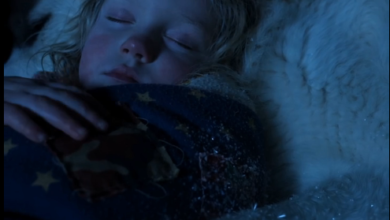
Part 2: The Mother Mocked by Neighbors for Wearing a Waitress Uniform — Until Her Night Shifts Left Them Speechless
Sarah Whitaker had lived on Cedar Lane for eleven months, long enough for everyone to form an opinion and short enough for no one to question it.
She rented the smallest house on the block, a pale yellow bungalow with chipped porch paint and one stubborn rosebush near the steps. The mailbox leaned slightly. The lawn was cut, but never perfectly edged. Her car was a twelve-year-old gray Ford with one missing hubcap and a back window covered by clear tape.
To most of Cedar Lane, Sarah was the woman who left at strange hours.
She backed out of her driveway at 4:40 every afternoon in her red Millie’s Diner uniform. Some nights, she returned at midnight. Other nights, the Ford rolled back in after three in the morning, headlights off before the wheels stopped.
People noticed.
Cedar Lane noticed everything.
They noticed that Lily packed her own school lunches. They noticed Sarah’s porch light burned all night. They noticed delivery notices taped to the door. They noticed Sarah rarely joined meetings unless someone cornered her at the mailbox.
By the time of the summer social, the story had already written itself.
“She works too much to parent,” one neighbor said.
“She could at least change before coming here,” another whispered.
Margaret Collins never said the cruelest things first. She let others say them, then lifted one eyebrow in agreement.
That evening, when Sarah arrived in uniform, Margaret felt almost relieved. The neighborhood had been right.
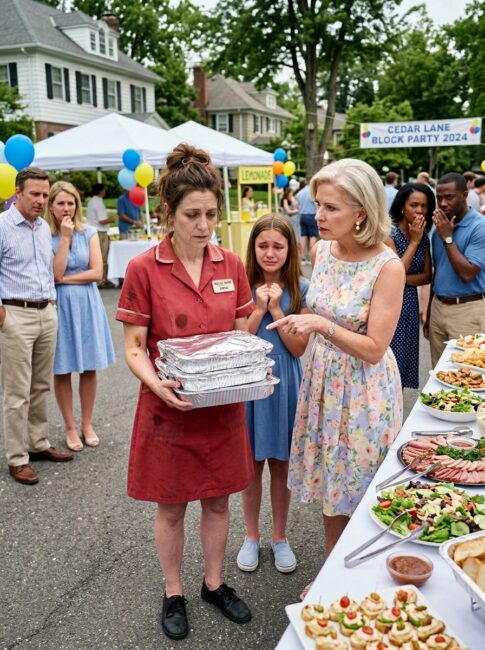
Sarah looked like someone who did not belong beneath white tents and linen tablecloths.
But small things did not match the story.
When Lily reached for a cupcake, Sarah gently touched her wrist and shook her head. Not harshly. Carefully. Lily put it back, then chose a carrot stick instead.
When a little boy dropped his plate near the drink station, Sarah knelt before anyone else moved. She picked up the broken plastic fork, wiped lemonade from the grass with napkins, and told the boy it was okay.
When the caterer’s assistant struggled carrying a crate, Sarah stepped forward automatically.
“Careful,” she said. “Your left hand is slipping.”
The assistant blinked, surprised by the accuracy.
“Thanks.”
Margaret watched from near the flowers.
Something about Sarah’s hands bothered her. They were not careless hands. They moved quickly, but gently. They folded napkins the way nurses fold blankets around sleeping patients. They steadied cups before children spilled them. They touched Lily’s shoulder twice, not to control her, but to check that she was still there.
Then came the trays.
It happened near the end of the party, after the speeches about community pride. Three pans of food sat untouched at the catering table: roasted chicken, green beans, and buttered rolls. The caterer said they would be thrown out if nobody wanted them.
Sarah heard that.
Her head turned too fast.
Lily noticed and whispered, “Mom, don’t.”
Sarah’s face tightened.
That was the first crack.
Why would a child beg her mother not to take free food?
Sarah looked toward the street, then at her watch. It was 8:17 p.m. She should have been tired after a diner shift, but the look in her eyes was not hunger.
It was urgency.
She found foil near the catering boxes and began wrapping portions. Not sloppily. Not greedily. She separated chicken from rolls, counted containers, and placed napkins between each tray as if she knew exactly where they were going.
Margaret crossed the lawn.
“Sarah,” she said, loud enough for the closest neighbors. “I hope you asked before packing up half the dinner.”
Sarah stopped.
Her cheeks colored.
The caterer started to speak, but Margaret’s voice had already gathered an audience.
“I know times are hard,” Margaret continued, “but there are ways to handle that with dignity.”
Lily flinched.
Sarah’s hands tightened around the aluminum edge.
For one second, it looked like she might explain.
Instead, she lowered her eyes.
“I’m sorry,” she said.
The apology made everyone more certain she was guilty.
She lifted the trays and walked away.
Lily followed, swallowing tears.
At the sidewalk, Mr. Daniel Hayes, an older Black American neighbor who lived across from Sarah, stepped out from behind a tree.
He had been quiet most of the party. A retired bus driver, seventy-one years old, he often sat on his porch at dawn with black coffee and a wool cap, even in summer.
He looked at Sarah’s trays.
“Need help carrying those?” he asked.
Sarah shook her head quickly.
“No, Mr. Hayes. Please don’t get involved.”
That was the second crack.
Please don’t get involved.
Not please don’t tell.
Not please believe me.
Mr. Hayes glanced toward the lawn, where Margaret stood with folded arms.
Then he said something low enough that only Lily heard.
“You going to St. Luke’s tonight?”
Lily’s eyes filled.
Sarah’s face changed.
Not fear.
Pain.
“Daniel,” she whispered.
He nodded once and stepped back.
Margaret did not hear the words. She saw only an old neighbor looking sorry for a waitress caught stealing party food.
At 10:42 that night, Margaret was cleaning serving spoons in her kitchen when her phone rang.
It was St. Luke’s Memorial Hospital.
Her father, Harold Bennett, had fallen again.
Margaret arrived just before midnight, still wearing pearls from the party and carrying the smell of white wine and roses. The emergency waiting room was too bright. A vending machine hummed near the wall. Somewhere, a child cried behind a curtain.
Her father was eighty-two, stubborn, proud, and slipping deeper into dementia every month. Some evenings he forgot Margaret was his daughter. Some nights he thought she was her mother.
The nurse led her toward a hallway.
“He’s asking for someone,” the nurse said.
Margaret sighed.
“He always asks for my mother. She’s been gone twelve years.”
“No,” the nurse said. “He’s asking for Sarah.”
Margaret stopped walking.
“Sarah who?”
The nurse looked down at her clipboard.
“Sarah Whitaker.”
For a moment, Margaret could not make the name fit inside the hospital.
Then she turned the corner.
And there, sitting beside her father’s bed in the same red waitress uniform, was the woman Cedar Lane had shamed two hours earlier.
On the tray table near Harold’s bed sat a covered plate of chicken, green beans, and one buttered roll.
Margaret did not step into the room at first.
She stood half-hidden by the curtain, watching a version of Sarah Whitaker that Cedar Lane had never bothered to see.
Sarah sat in a hard plastic chair beside Harold Bennett’s bed. Her uniform was wrinkled, and one sleeve still carried the coffee stain. Her hair had fallen loose around her face. She looked exhausted enough to disappear into the pale hospital light.
But her voice was steady.
“Mr. Bennett,” she said softly, cutting the chicken into tiny pieces, “you told me last week your wife made green beans with too much pepper.”
Harold smiled faintly.
“Eleanor did that.”
“I know,” Sarah said. “You said you complained every time, then ate two servings.”
Harold laughed.
It was small, but Margaret had not heard that laugh in months.
The nurse beside Margaret whispered, “She’s one of our overnight companions.”
Margaret turned.
“What does that mean?”
The nurse glanced into the room.
“Not official staff. Volunteers, mostly. Some families can’t afford private care. Some patients get frightened at night. Sarah comes after her diner shift when we call.”
Margaret felt the first piece of shame settle in her chest.
“But why my father?” she asked.
The nurse hesitated.
“Because he calms down for her.”
Inside the room, Harold reached for the cup of water. His hand shook badly. Sarah caught the cup before it spilled and guided it to his mouth.
She did it without embarrassment.
Without impatience.
Without making him feel like a burden.
Margaret remembered the way she had said, There are ways to handle that with dignity.
The words returned to her like something rotten.
The nurse continued quietly.
“The food helps. He refuses hospital meals some nights. Sarah brings familiar food when she can. She says eating is easier when it smells like a home.”
Margaret gripped her purse.
“The trays tonight…”
The nurse nodded.
“She called ahead. Said she might have leftovers from a neighborhood event if the caterer was throwing them out.”
Margaret closed her eyes.
The first twist had become clear, but the deeper one waited.
“She does this for several patients,” the nurse said. “Not just your father.”
Margaret opened her eyes.
“What?”
The nurse looked down the hallway.
“There’s a widower in 312 who only eats rolls with warm milk. A stroke patient in 305 whose daughter works nights. A little girl upstairs in pediatric oncology whose mother can’t leave her bedside. Sarah brings food when she can. Sits when she can.”
Margaret could not speak.
From inside the room, Harold said, “Eleanor, don’t forget the porch light.”
Sarah did not correct him.
“I won’t,” she said. “I’ll leave it on.”
Margaret’s throat tightened.
She had paid for roses that afternoon. Sarah had carried dinner through a neighborhood’s judgment because an old man might eat if someone remembered green beans.
Then Lily appeared at the end of the hallway.
She was still in her blue dress, now with a sweater over her shoulders. In her hands, she held Sarah’s old canvas bag.
“Mom,” Lily whispered.
Sarah turned, startled.
“You should be sleeping.”
“The bus was late,” Lily said.
Margaret watched the girl walk in and take three small envelopes from the bag. Each envelope had a room number written on it.
Sarah’s face tightened.
“Lily.”
“I wrote the notes like you said,” Lily replied. “Mrs. Alvarez’s says no onions. Mr. Grant’s says extra roll.”
Margaret leaned against the wall.
This was not a single good deed.
This was a system.
A quiet, hidden system built by a waitress and her daughter between school, buses, diner shifts, and hospital corridors.
The next twist came when Dr. Mitchell, a tired white American physician in his fifties, stopped beside Margaret.
“You’re Mr. Bennett’s daughter?” he asked.
“Yes,” Margaret said.
He looked into the room.
“Sarah saved him last month.”
Margaret turned sharply.
“Nobody told me that.”
“She didn’t want to make you feel guilty,” he said. “Your father wandered toward the service elevator at 2:00 a.m. He thought he was late for work. Sarah found him before he reached the stairwell.”
Margaret’s knees weakened.
“She never mentioned it.”
Dr. Mitchell shook his head.
“She asked us not to. Said families already carry enough.”
Margaret looked at Sarah again.
A woman Cedar Lane had mocked for leaving at night had been spending those nights keeping other people’s loved ones from being alone, afraid, or hungry.
And still, there was one last truth.
At 1:30 a.m., Harold finally slept.
Sarah stepped into the hallway and saw Margaret.
For a moment, neither woman moved.
Sarah’s face showed no triumph. No anger prepared for release. Only tiredness, and a guarded patience that somehow hurt more than accusation.
Margaret tried to speak.
“I didn’t know.”
Sarah gave a small nod.
Most people used those words as a shield.
She did not accept or reject them.
Margaret looked toward Harold’s room.
“How long have you been coming here?”
“Since January.”
“January?” Margaret whispered.
That was six months.
Six months of nights Margaret had spent assuming Sarah was irresponsible, while Sarah sat beside her father when dementia made him frightened.
“Why didn’t you say something?” Margaret asked.
Sarah looked down at her black shoes.
“Because Mr. Bennett asked me not to tell.”
Margaret frowned.
“My father?”
“He has proud days,” Sarah said. “On one of them, he said he didn’t want Cedar Lane knowing he needed a waitress to sit with him.”
The sentence hit Margaret with unbearable gentleness.
Sarah continued.
“And I wasn’t doing it for Cedar Lane.”
Lily stood beside her mother, holding the empty canvas bag.
Margaret looked at the girl.
“You come too?”
“Only when there’s no school the next morning,” Lily said. “And only in the waiting room.”
Sarah’s eyes warned her to stop, but Lily had carried the silence too long.
“My mom uses her tips for bus cards, snacks, and sometimes medicine copays when families are short,” Lily said. “She says people eat better when they’re not scared.”
Margaret’s lips parted.
Sarah closed her eyes.
“Lily.”
“No,” Lily said, and her voice broke. “They laughed at you tonight.”
The hallway went still.
Lily looked at Margaret with tears shining but not falling.
“They laugh because she smells like coffee and fries. But she goes to work, then comes here, then goes home and makes sure I have clean clothes for school. She doesn’t even buy new shoes because Mr. Grant needed compression socks and Mrs. Alvarez needed a ride voucher.”
Margaret covered her mouth.
The pearls at her throat suddenly felt ridiculous.
Sarah placed a hand on Lily’s shoulder.
“That’s enough.”
But the room had already changed.
Not loudly.
Not dramatically.
Just completely.
At 2:05 a.m., Margaret walked to the vending machine and stood there without buying anything. She saw her reflection in the glass: neat hair, expensive dress, perfect earrings, and a face that had spent years mistaking comfort for character.
When she returned, Sarah was preparing to leave.
“Please let me drive you home,” Margaret said.
Sarah hesitated.
The offer was small, almost useless beside what had happened.
But it was a beginning.
Sarah looked at Lily, then at the dark windows beyond the hallway.
“All right,” she said.
In the hospital parking lot, Margaret saw Sarah’s taped car window and missing hubcap under the orange streetlamp. She had seen that car every morning and never once wondered how much strength it took to keep it running.
She drove them back to Cedar Lane in silence.
As they passed the Collins lawn, the white tents still stood in the dark like a party no longer proud of itself.
Sarah gathered her bag and opened the car door.
Margaret finally said what she should have said hours earlier.
“I’m sorry.”
Sarah paused.
The porch light from her little yellow house fell across her uniform, softening the red fabric.
“I know,” she said.
Then she added, “Next time, ask before everyone listens.”
Margaret nodded.
It was not forgiveness.
It was better.
It was honest.
By morning, Cedar Lane knew something had happened.
Not all of it. Not yet.
They saw Margaret Collins walking from house to house before breakfast, still wearing the same cream dress from the night before, but without the pearls. She spoke first to the caterer’s wife, then to Daniel Hayes, then to the mothers who had laughed beneath the white tent.
At 10:00 a.m., an email went out to the neighborhood.
It did not make Sarah a charity case.
It did not turn her into a public project.
Margaret wrote only what belonged to her.
Last night, I accused a neighbor unfairly in front of others. I was wrong. The food Sarah carried was going to patients at St. Luke’s who needed it. I am sorry for my words, and I am sorry for the silence that followed them.
No one replied for thirty minutes.
Then Daniel Hayes wrote back.
Some of us knew she was good. The rest of you are catching up.
That sentence traveled faster than any rumor Cedar Lane had ever enjoyed.
By afternoon, a paper bag appeared on Sarah’s porch.
Inside were new black work shoes in her size.
No note.
Sarah looked at them for a long time, then set them inside without smiling. Lily asked if she would wear them.
“Maybe,” Sarah said.
The next night, another bag appeared. Bus cards. A package of pens for Lily. A sealed envelope for St. Luke’s companion fund.
Sarah did not like it at first.
Kindness from ashamed people can feel heavy.
But on Thursday, when Mr. Grant’s daughter needed gas money to get to the hospital, Sarah used one of the cards.
On Friday, Mrs. Alvarez got her no-onion soup without Sarah missing rent.
On Saturday, Harold Bennett ate green beans again, too soft and not peppered enough, while Margaret sat on the other side of the bed and listened to her father call Sarah “the diner angel.”
Sarah laughed at that.
“Don’t let Cedar Lane hear you,” she told him.
Harold looked at Margaret, then at Sarah.
“Cedar Lane talks too much.”
For the first time in weeks, Margaret laughed with her father instead of apologizing to him.
Summer moved on.
The white tents came down. The grass recovered. The story did not disappear, but it softened into new habits.
When Sarah came home after midnight, more porch lights were on.
Not staring lights.
Welcoming lights.
Daniel Hayes began leaving coffee in a thermos by his front steps on Tuesdays. Margaret started driving to St. Luke’s once a week, not to supervise Sarah, but to sit with her father long enough for Sarah to visit another room.
Lily joined the school art club after three neighbors quietly covered the supply fee through the office. Nobody announced it. Nobody put their names on anything.
One cool September morning, Sarah stepped onto her porch wearing the new black shoes.
They still looked stiff.
They still did not erase the long nights, the sore feet, or the months of being judged by a uniform.
But Lily saw her mother look down at them and smile, just a little.
Across the street, Margaret was helping her father into the car for a doctor’s appointment. Harold lifted one shaking hand.
“Morning, Sarah,” he called.
Sarah raised her hand back.
“Morning, Mr. Bennett.”
He squinted at her shoes.
“Those good for walking?”
Sarah looked at Cedar Lane, at the houses that had once watched her like a mistake, and at the porch lights still glowing after sunrise.
“They’ll do,” she said.
Then she picked up her diner bag, kissed Lily on the forehead, and walked toward another long day without asking anyone to understand it.
Follow this page for more heartfelt stories about the quiet sacrifices people carry behind ordinary doors.