Part 2: The Old Teacher Asked to Say a Few Words Before Retiring — His Final Story Made Every Student Stand and Applaud
The gym did not sound like a gym anymore.
No sneakers squeaked. No student laughed too loudly. No chair scraped without making someone flinch.
Mr. Whitaker held the yellow envelope in both hands. His fingers were thin now, the knuckles swollen from age, but the way he touched the paper was careful, almost tender.
Ethan Miller remained half-standing in the senior section.
He was eighteen, broad-shouldered, and wearing his letterman jacket over a white shirt. Until that moment, he had been slouched between two teammates, trying to look bored enough to survive a retirement assembly.
Now his face had gone pale.
Principal Reynolds stepped closer to the podium.
“Mr. Whitaker,” she said, quietly but firmly, “this may not be the right setting.”
He glanced at her.
There was no anger in his eyes.
Only a tired patience, the kind students mistook for indifference because they had never seen what it cost.
“It is the only setting left,” he said.
A murmur passed over the bleachers.
Mr. Whitaker opened the envelope and removed a folded paper.
It was not a letter.
It was a graded essay.
The red ink was visible even from the first rows.
Some students exchanged looks.
That was exactly what they expected from him. A final lecture. A final humiliation. One last chance for the old man to prove he cared more about commas than people.
Ethan sat back down slowly, his jaw tight.
Mr. Whitaker held up the essay.
“This paper was written in March,” he said. “It was supposed to be about The Great Gatsby, but the first sentence had nothing to do with the assignment.”
A few students laughed nervously.
Mr. Whitaker looked at the page.
“The first sentence read, ‘Some houses look normal from the street because the broken things are kept inside.’”
The laughter stopped.
Ethan looked down.
Mr. Whitaker did not look at him yet.
“I marked the sentence with a red circle,” he said. “In the margin, I wrote, ‘Explain this.’”
A teacher in the front row lowered her eyes.
Mr. Whitaker turned the page.
“The second paragraph was about a green light at the end of a dock. But every few lines, Ethan wrote about a porch light that stayed on all night because his mother was afraid to sleep in the dark.”
The gym shifted.
Students who had mocked Ethan for sleeping through class sat suddenly still.
Mr. Whitaker continued, “He turned in six pages. Only two were about the book.”
He paused.
“So I failed him.”
There it was.
The old story, confirmed by the man himself.
Ethan’s shoulders hardened.
One of his teammates whispered, “Man, don’t listen.”
But Mr. Whitaker reached into the envelope again.
This time, he pulled out a small blue sticky note.
“This was attached to the back page,” he said.
He read it quietly.
“Mr. W, please don’t call home. I’ll fix it.”
Ethan’s eyes snapped up.
Mr. Whitaker folded the note again.
“I did not call home.”
Some parents looked relieved.
Others looked confused.
The principal stared at the floor.
“I did something worse,” Mr. Whitaker said.
The gym held its breath.
“I walked to my car after school. I sat behind the wheel for twenty minutes. Then I drove to Ethan’s house.”
Ethan stood fully now.
“What?” he said.
His voice echoed against the rafters.
Mr. Whitaker finally looked at him.
“I never knocked,” he said.
The anger in Ethan’s face faltered.
“I parked across the street. I saw the porch light. I saw your mother’s car in the driveway. I saw you come outside carrying a trash bag and a backpack.”
Ethan’s hands curled at his sides.
Mr. Whitaker’s voice grew softer.
“And I saw your little sister standing behind the screen door, holding a stuffed rabbit by one ear.”
A girl in the sophomore section covered her mouth.
Ethan looked as if the floor had moved under him.
Mr. Whitaker placed the essay on the podium and reached into his briefcase again.
This time, he took out a small object wrapped in tissue.
When he unfolded it, the students in the first row leaned forward.
It was a plastic toy rabbit, missing one eye.
Ethan whispered something no one heard.
Mr. Whitaker heard it.
He nodded once.
“Yes,” he said. “I found it beside the curb the next morning.”
The gym was completely silent now.
Not because the mystery had been solved.
Because it had become larger.
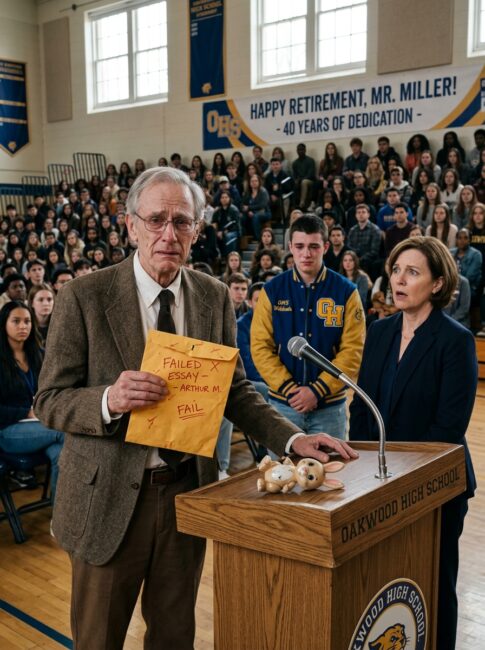
Mr. Whitaker set the broken toy rabbit beside the microphone.
It looked painfully small against the polished wooden podium.
“I kept this for eight months,” he said. “Not because it belonged to me, but because I was waiting for the day I could return it without making a boy feel exposed.”
Ethan stared at the toy.
His sister, Mia, was eleven now. The whole school had heard pieces of his life, but pieces are dangerous things. They let people feel informed without making them compassionate.
Everyone knew Ethan had a temper.
They knew he skipped morning classes. They knew he fell asleep in English. They knew he had shouted at Mr. Whitaker in the cafeteria after the failing grade.
Most had not known why.
Mr. Whitaker turned slightly, addressing the school but not performing for it.
“That night, I saw enough to know something was wrong,” he said. “But seeing enough is not the same as understanding enough.”
His voice tightened.
“I was a teacher. I was also a proud man. I believed students should tell the truth, but I had forgotten how hard truth can be when you are trying to keep a family standing.”
Ethan looked away.
Mr. Whitaker continued, “The next morning, I asked the guidance counselor to check on him. I did not mention the essay. I did not mention the house. I only said I was concerned.”
Principal Reynolds shifted in her chair.
Mr. Whitaker looked toward her.
“And then I did something that made many of you hate me.”
The students leaned in.
“I refused to change Ethan’s grade.”
A low reaction moved through the gym.
Ethan’s scholarship offer had depended on academic eligibility. When the F appeared, rumors spread faster than truth ever could.
Some said Ethan had been lazy.
Others said Whitaker wanted to punish athletes.
Ethan had confronted him in the cafeteria, face red, hands shaking.
“Change it,” he had demanded in front of half the school.
Mr. Whitaker had looked at him and said, “No.”
Everyone remembered that part.
No one knew what happened next.
“What Ethan did not know,” Mr. Whitaker said, “was that I had already called the college recruiter.”
Ethan turned sharply.
Mr. Whitaker held up a hand, not to stop him, but to steady himself.
“I told Coach Harris that Ethan had not failed because he was careless. I told him there were circumstances the school could not discuss publicly. I asked for time.”
Coach Harris, sitting near the back wall, lowered his head.
“He gave us two weeks,” Mr. Whitaker said.
Ethan’s lips parted.
“But you told me—”
“I told you the grade would stand,” Mr. Whitaker said. “Because it had to.”
He picked up the essay.
“This was not an essay about Gatsby. It was a boy trying to confess without betraying the people he loved. If I gave it a passing grade and sent him away, everyone would have applauded me for kindness.”
He paused.
“But kindness that avoids the wound is not always mercy.”
No one moved.
Mr. Whitaker opened the essay to the last page.
“I wrote one more note after the red marks,” he said. “Ethan never saw it.”
He read aloud.
“Rewrite this as the truth, and I will count it as extra credit. Do not make it perfect. Make it honest.”
Ethan’s face crumpled.
“I never got that,” he said.
“I know,” Mr. Whitaker replied.
That was the twist that took the room by the throat.
The note had been written. The chance had been offered. But Ethan had never received it.
Mr. Whitaker reached into the envelope again and pulled out a returned mail slip.
“The letter came back unopened,” he said. “The house was empty.”
Ethan closed his eyes.
The memory was there now, pulling him backward.
That week, his mother had taken Mia and left in the middle of the night. They stayed with an aunt two towns over. His phone died. His backpack was left behind. His English folder disappeared with everything else that could not fit in a car.
Mr. Whitaker looked at him with something close to grief.
“When you came back, you were angry,” he said. “And you had every right to be.”
Ethan’s throat worked.
“I thought you were trying to ruin me.”
“I know.”
“Why didn’t you tell me?”
Mr. Whitaker’s answer came slowly.
“Because your mother asked me not to.”
Ethan stared at him.
A gasp moved through the parents.
Mr. Whitaker folded the returned mail slip.
“She came to school two days later. She looked exhausted. She said you had spent years trying to protect her and Mia. She asked me not to make you feel like the whole town knew your pain.”
Ethan covered his mouth with one hand.
“She said you needed your dignity more than you needed an explanation.”
Mr. Whitaker’s eyes shone behind his glasses.
“So I became the villain in the story.”
The gym seemed to tilt.
All year, students had treated him as the cruel old teacher who failed a desperate senior. Ethan had glared at him in hallways. Parents had complained online. Someone had taped a note to his classroom door that said, “Retire already.”
Mr. Whitaker had taken it down before first period.
He had said nothing.
Principal Reynolds wiped her eyes.
Mr. Whitaker continued, “I worked with the counselor, Coach Harris, and Ms. Lane in the district office. Ethan completed three substitute assignments privately. Not easier assignments. Different ones.”
He smiled faintly.
“The final one was the best writing he has ever done.”
Ethan looked up, stunned.
“You read it?”
“I read it five times.”
Mr. Whitaker reached into his briefcase and took out a second envelope.
This one was clean and white.
“I sent the final grade change to the college two months ago,” he said. “Your scholarship was never gone.”
Ethan sat down as if his knees had failed.
His teammates stared at him.
Mr. Whitaker looked across the bleachers.
“I did not tell this story today to make myself noble. I made mistakes. I used red ink when I should have used a softer voice. I confused discipline with distance too often.”
He looked at Ethan.
“But sometimes a teacher must hold a line long enough for a student to reach the other side.”
Ethan was crying now, quietly, angrily, like a young man who did not know where to put relief.
Mr. Whitaker picked up the broken toy rabbit.
“Mia asked me to keep this,” he said. “Your mother brought it in after you moved. She said Mia wanted it returned when your house felt safe again.”
Ethan stood.
This time, he did not look furious.
He looked younger.
Mr. Whitaker stepped away from the podium, walked to the edge of the gym floor, and held out the toy.
Ethan came down from the bleachers.
The entire school watched the boy who had once called him heartless take the broken rabbit in both hands.
Ethan whispered, “She still asks about it.”
Mr. Whitaker nodded.
“Then take it home.”
For a moment, they simply stood there.
The old teacher in his worn brown shoes.
The senior in his letterman jacket.
Between them, a toy rabbit that had somehow carried more truth than any official speech could hold.
Then Ethan did something nobody expected.
He hugged him.
Mr. Whitaker froze.
His arms stayed at his sides for half a second, as if kindness had arrived in a language he had not practiced enough.
Then he lifted one hand and placed it carefully on Ethan’s back.
That was when the first student stood.
Not Ethan’s teammate.
Not a teacher.
A freshman girl near the top of the bleachers stood with tears on her face and began clapping.
Then another student rose.
Then another.
The sound grew, uneven at first, then full enough to shake the banner on the wall.
Teachers stood too.
Parents stood.
Even Principal Reynolds stood with both hands pressed together, crying openly beneath the basketball hoop.
Mr. Whitaker looked around the gym as if he did not know what to do with so much forgiveness.
Ethan stepped back and wiped his face.
“You still gave me too many commas,” he said.
A soft laugh moved through the gym.
Mr. Whitaker smiled.
“You still needed them.”
After the assembly, students did not rush for the doors the way they usually did.
They lingered.
Some walked past Mr. Whitaker and thanked him without making eye contact. Some gave awkward hugs. Others handed him folded notes they had written during the assembly on the backs of programs.
One boy apologized for scratching “Grammarian Goblin” into the underside of a desk.
Mr. Whitaker said he had known about it for three years.
The boy looked horrified.
Mr. Whitaker almost smiled.
Near the gym doors, Ethan stood with his mother and Mia.
His mother looked smaller than the story surrounding her. She wore a gray cardigan and held her purse against her stomach, watching her son hold the broken rabbit like something sacred.
Mia took it from him carefully.
“He kept the ear,” she whispered.
Mr. Whitaker lowered himself to her height as best he could.
“I tried not to lose it,” he said.
Mia studied him.
“Were you mean to Ethan?”
The adults around her went still.
Mr. Whitaker took a long breath.
“Sometimes,” he said. “But I was also trying to help him.”
Mia considered that, then nodded with the seriousness only children can manage.
“Next time, say the helping part louder.”
Ethan laughed through a tear.
Mr. Whitaker looked at the little girl for a long moment.
“I wish I had.”
Later, when the gym emptied, Principal Reynolds found him alone in Room 106.
The classroom looked exactly as it had for decades. Stacks of novels on the windowsill. A cracked mug full of red pens. A bulletin board covered with quotes from students who once thought they hated writing.
His briefcase sat open on the desk.
“You could have told me more,” she said.
He looked around the room.
“I could have told many people more.”
“Why didn’t you?”
Mr. Whitaker picked up the torn retirement speech from where he had carried it back without noticing.
“Because some truths are not mine first,” he said.
The principal nodded.
Outside the window, Ethan and Mia crossed the parking lot with their mother. Mia held the rabbit against her chest.
Mr. Whitaker watched until they reached their car.
Then he began placing things into a cardboard box.
The mug.
The framed class photo from 1998.
A stack of letters from former students.
At the bottom drawer, he found a red pen and held it longer than expected.
For most of his career, that pen had been his symbol of standards. To many students, it had also been a symbol of fear.
He uncapped it, looked at the sharp red point, and then set it gently inside the desk drawer.
He did not take it with him.
On the chalkboard, the day’s message remained from his final morning class.
“Revision is not punishment. It is the belief that something can still become better.”
He had written it before the assembly, not knowing how much he would need it himself.
Mr. Whitaker picked up a piece of chalk.
Under the sentence, he added five words.
“So can the teacher.”
Then he turned off the classroom lights.
At the door, he paused and looked back at the empty desks, each one holding the ghost of a student who had once been loud, lonely, angry, brilliant, tired, or afraid.
He closed the door softly.
In the hallway, applause was long gone.
But on his desk, beside the torn speech he never read, a freshman girl had left a folded program.
Inside, in careful handwriting, she had written, “Thank you for seeing the parts we didn’t know how to say.”
Mr. Whitaker read it once in the quiet hallway.
Then he folded it carefully and placed it in his briefcase.
If this story stayed with you, follow this page for more heartfelt stories about the quiet kindness people often misunderstand.