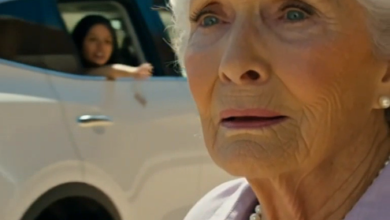
Part 2: The Old Woman Who Knelt Before a Young Girl in the Supermarket — Minutes Later, No One Could Hold Back Tears
Lena Carter had not planned to work that Friday.
She had asked for the day off two weeks earlier, writing the request on a sticky note because the employee app kept freezing on her cracked phone.
Family matter, she wrote.
Her manager, Mr. Dobbins, read it, sighed, and told her everyone had family matters.
So Lena came in.
At 7:10 that morning, before the store opened, she had stood in the break room with her backpack still on and called the nursing home twice. No one answered the first time. The second time, a nurse told her that her grandmother had eaten half a banana and asked for music.
That sounded like a good day.
Lena held on to that.
Her grandmother, Ruth Carter, had raised her from the age of six after Lena’s mother disappeared into a life of missed calls, unpaid bills, and promises that always arrived late. Ruth had been a school custodian for thirty-four years. She believed in clean corners, folded receipts, and feeding anyone who came through the door.
Now Ruth lived at Brookside Care.
Her memory came and went like porch light in bad weather.
Some days she knew Lena.
Some days she called her “baby” and then asked when her own husband would be home.
Lena worked at Miller’s Market to cover what Medicaid did not, which sounded impossible until it became her normal. She picked up shifts, skipped lunches, and wore the same sneakers until the soles peeled at the heel.
That was the first piece nobody saw.
The second was the small birthday cake with blue frosting.
Mrs. Evelyn Moore had placed it on the belt carefully, as though it were glass. The cake was only six inches wide, the cheapest one in the bakery case, with crooked frosting flowers and the words Happy Birthday printed in shaky white letters.
When Lena scanned it, she noticed the date sticker.
Marked down.
Half price.
Evelyn watched the register screen like a student waiting for a grade.
The total came to $38.17.
Evelyn opened her purse.
She counted bills.
Then coins.
Then smaller coins.
Her mouth tightened.
The woman behind her in line shifted loudly.
Lena looked at the items again.
Bread. Milk. Apples. Oatmeal. Soup. The little cake.
“Do you have a loyalty card?” Lena asked gently.
Evelyn shook her head.
Lena tapped something into the register.
Mr. Dobbins would not like it.
The price dropped by four dollars.
Evelyn still did not have enough.
Her hands moved toward the cake.
“I do not need this,” she said.
But her voice broke on the word need.
Lena looked at the cake.
Then at the old woman.
Then at the name printed on the pharmacy slip tucked inside Evelyn’s open purse.
Moore, Evelyn A.
Something passed through Lena’s face, quick and strange.
Not recognition exactly.
More like a memory trying to knock from the other side of a wall.
“Is it your birthday?” Lena asked.
Evelyn shook her head again.
“My son’s,” she said. “He is sixty today.”
The woman behind her sighed.
Lena kept her eyes on the register.
“Is he coming over?”
Evelyn looked down.
“He died when he was eight.”
The line went still for half a breath, then returned to impatience because the world is cruelest when it is in a hurry.
Evelyn reached for the cake again.
“I just put it by his picture every year.”
Lena’s lips parted.
The name Moore had found something now.
Not in her memory.
In Ruth’s stories.
A house fire. A winter night. A boy named Tommy. A woman screaming in a driveway. A young custodian who ran into smoke before the firefighters arrived.
Ruth rarely told the story fully.
When Lena was little and begged for “the brave story,” Ruth only said, “A mother lost more than any person should. Do not turn her pain into a bedtime adventure.”
But Lena remembered one detail.
The woman’s name.
Mrs. Moore.
Lena looked back at Evelyn.
“Was his name Tommy?”
Evelyn’s eyes lifted slowly.
Behind Lena, the bagger stopped moving.
Evelyn clutched the brown paper envelope against her chest.
“How do you know that?”
Lena swallowed.
“My grandmother is Ruth Carter.”
The old woman stared at her.
A faint tremor began in her chin.
Then she said the sentence that made Lena step back.
“I hated her for forty years.”
Lena’s hands went cold.
The line heard that.
The manager heard that.
The woman with the full cart leaned in, suddenly interested in something larger than being delayed.
Evelyn’s eyes filled, but her voice did not rise.
“I thought she saved the wrong child.”
Lena did not understand.
She only knew that her grandmother’s name had been pulled into a public place like something accused.
Mr. Dobbins came closer.
“Lena, do we have a problem?”
Before Lena could answer, Evelyn tried to move around the cart.
Her cane slipped.
Lena reached for her, but Evelyn waved her away and lowered herself, slowly, painfully, onto both knees.
That was when everyone judged the girl.
They thought Lena had insulted her.
They thought youth had broken age.
They thought the cashier had made a poor old woman beg.
But Evelyn was not begging for groceries.
She was kneeling before the granddaughter of a woman she had spent most of her life misunderstanding.
And the photograph in the envelope was about to turn that supermarket aisle into a place of confession.
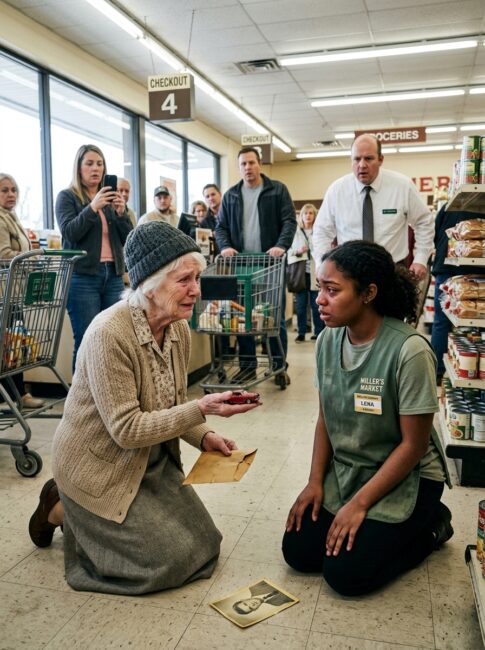
“Please get up,” Lena whispered.
Evelyn shook her head.
“No,” she said. “Not until I say it right.”
The store around them faded into a strange quiet. A register beeped once at lane two and then stopped. Somewhere near produce, a child asked his mother why the old lady was on the floor.
Nobody answered.
Evelyn’s hands trembled as she opened the brown envelope. A yellowed photograph slid onto the tile between her knees and Lena’s worn sneakers.
It showed two children on a porch.
A little white boy with a missing front tooth.
A little Black girl holding a stuffed rabbit.
Behind them stood a younger Ruth Carter in a custodian’s uniform, one hand resting on each child’s shoulder.
Lena stared at the photo.
She knew her grandmother’s face instantly, though Ruth was young there, strong-backed and smiling in a way Lena had never seen in person.
“Who is the girl?” Lena asked.
Evelyn pressed her fingers to her mouth.
“Your mother.”
The words moved through Lena so hard she almost grabbed the counter.
Her mother had never kept many photographs. In the few Lena had seen, she was older, thinner, always turned slightly away from the camera as if ready to leave.
In this picture, she was six.
Innocent.
Alive in a way Lena had never been allowed to imagine.
Evelyn touched the edge of the photo.
“Her name was Marisol then.”
Lena frowned.
“My mother’s name was Mara.”
“Ruth changed it after the fire,” Evelyn said. “She thought a new name might help a child sleep.”
Mr. Dobbins looked down, his stern face loosening.
Evelyn continued, and every person in line leaned closer without meaning to.
Forty years earlier, before Miller’s Market was remodeled, before the strip mall had a pharmacy, before Lena was born, Ruth Carter worked nights cleaning classrooms at Lincoln Elementary.
She also cleaned houses on weekends.
One of those houses belonged to Evelyn and Harold Moore.
Evelyn had an eight-year-old son, Tommy. Her neighbor’s little girl, Marisol, was often there because her mother worked double shifts at the textile plant.
The two children were inseparable.
Tommy liked baseball cards. Marisol liked rabbits. They built blanket forts and argued over cereal.
On the night of the fire, Evelyn had gone to the pharmacy. Harold was asleep in the den. Ruth was cleaning the kitchen after a dinner party because the Moores paid extra when guests left late.
The fire started in the garage.
By the time Ruth smelled smoke, the hallway was already filling.
She ran upstairs.
The first door she reached was the guest room, where Marisol had fallen asleep under a yellow blanket. Ruth carried her out through smoke so thick she could not see the stairs. She placed the child in the front yard and tried to go back.
A neighbor stopped her.
Firefighters arrived.
Tommy did not make it.
Evelyn returned to sirens, smoke, and the sight of Ruth Carter coughing blood into a towel while Marisol screamed for the boy who had shared his toy cars.
Grief does not always look for truth.
Sometimes it looks for a face.
Evelyn found Ruth’s.
“You took the wrong child,” she had screamed in the driveway.
The words became town gossip.
A cleaning woman saved the neighbor girl but not the son.
People whispered about it in grocery aisles and church basements. Some said Ruth had reached the easier room. Some said she favored the girl because they were both Black. Some said terrible things with calm faces because they had no idea what smoke costs a body.
Ruth never defended herself publicly.
That was the first hidden sacrifice.
The second came later.
Ruth visited the hospital where Marisol recovered from smoke inhalation. The girl’s mother had collapsed under bills and guilt. Evelyn and Harold were buried inside grief. No one wanted to speak to Ruth, except the child who woke crying for her.
So Ruth stayed.
She lost cleaning jobs because people were uncomfortable hiring a woman attached to tragedy. She moved to a cheaper apartment. She took the night custodian position that would shape the rest of her life.
And when Marisol’s mother disappeared two years later, Ruth took the child in.
Lena heard this and felt her own history rearranging.
“My grandmother raised my mother?”
Evelyn nodded.
“And your mother had you when she was very young. Ruth raised you too.”
Lena knew that part.
But she had never known Ruth had first chosen a stranger’s child from smoke, then chosen her again from abandonment.
Evelyn lifted another paper from the envelope.
A copy of an old fire report.
Her voice shook.
“I found this last month when I moved to assisted living. My husband kept it in a box I never opened.”
The report had diagrams.
Times.
Statements.
The rooms.
Evelyn pointed with one bent finger.
“Tommy’s door was blocked by the fire before Ruth reached the stairs. The guest room was not easier. It was the only door still open.”
Lena covered her mouth.
Evelyn’s tears fell freely now.
“She did not choose wrong,” the old woman said. “There was no choice left.”
The man who had shouted at Lena lowered his eyes.
The woman behind Evelyn began crying into her sleeve.
Evelyn looked up at Lena from the floor.
“I let people blame her. I let her name carry my pain. She lost work. She lost friends. She still sent flowers every year on Tommy’s birthday, and I threw them away.”
Lena’s throat burned.
Her grandmother had kept a small reminder on the calendar every February.
T.M.
Lena once asked what it meant.
Ruth said, “Someone who should be remembered.”
Evelyn reached into her coat pocket and pulled out a small red toy car, chipped along the roof.
“Tommy had this in his hand the day before the fire,” she said. “Ruth found it in the yard afterward. She mailed it to me. I returned it without opening the package.”
She placed it in Lena’s palm.
“I do not deserve to ask this, but is Ruth still alive?”
Lena nodded, crying now.
“At Brookside Care.”
Evelyn closed her eyes.
“Can I see her?”
For a moment, Lena was only a granddaughter, protective and wounded. She wanted to say no. She wanted to save Ruth from a woman who had sharpened grief into blame for forty years.
Then her phone buzzed on the counter.
Brookside Care.
Her heart lurched.
She answered with trembling fingers.
A nurse said, “Lena, your grandmother is asking for you. She keeps saying Tommy’s birthday is today.”
The supermarket remained silent around her.
Lena looked at Evelyn kneeling on the tile, the toy car in her palm, the photograph between them, the birthday cake sweating under fluorescent lights.
Then Lena understood the final twist.
Evelyn had not come to the store by accident.
She had come for a cake.
But somehow, on Tommy’s birthday, she had ended up in the checkout line of the one girl connected to both children Ruth had tried to save.
Lena bent down, not caring who watched.
She took Evelyn’s hands and helped her stand.
“My shift ends now,” Lena said.
Mr. Dobbins started to speak, then stopped.
He looked at the cake, the photograph, and the girl he had almost written up for leaving early.
“I’ll cover it,” he said quietly.
Then he took money from his own wallet and paid for Evelyn’s groceries.
Nobody objected.
Nobody hurried her.
The bagger placed the birthday cake carefully into a paper bag, as if it had become something sacred.
Brookside Care smelled faintly of lavender cleaner and soup when Lena arrived with Evelyn beside her.
The birthday cake sat between them on the back seat of Lena’s old car. The red toy car rested in Evelyn’s lap. Neither woman spoke much during the drive.
Some silences accuse.
This one prepared them.
Ruth Carter was sitting near the common room window when they entered. She was eighty-one, small now, with silver hair braided down one shoulder and a blanket over her knees.
Her eyes were cloudy with age, but they moved toward Lena first.
“There’s my baby,” she said.
Lena knelt beside her.
“I brought someone.”
Ruth looked past her.
Evelyn Moore stood in the doorway, one hand gripping her cane, the other clutching the toy car.
For a second, time seemed to fold.
The nursing home disappeared.
The supermarket disappeared.
The years disappeared.
Only two old women remained, standing on opposite sides of a fire that had burned for four decades.
Ruth’s eyes sharpened.
“Evelyn,” she whispered.
Evelyn stepped forward, then stopped.
“I read the report,” she said.
Ruth closed her eyes.
“I am sorry about Tommy.”
The words came quickly, as if Ruth had been carrying them at the front of her mouth for half her life.
Evelyn shook her head.
“No. I came to say I am sorry.”
Ruth opened her eyes.
Evelyn lowered herself into the chair beside her, this time not kneeling, because Ruth reached out before she could.
The toy car passed from one wrinkled hand to another.
Ruth stared at it.
“He loved that thing,” she said.
Evelyn’s face broke.
“Yes.”
Lena stood behind them, crying quietly.
No one made a speech. No one solved forty years in one conversation. They only sat together by the window while afternoon light moved across the floor.
A nurse brought paper plates.
Lena opened the little blue-frosted cake.
The lettering had smudged slightly during the drive, but the word Birthday was still visible.
Ruth looked at it and began to hum.
Evelyn recognized the tune.
It was the song Tommy used to sing when he wanted more frosting.
Her hand covered Ruth’s.
Together, slowly, they sang the first line.
Not well.
Not steadily.
But together.
Later, when Evelyn was leaving, she turned to Lena near the parking lot.
“I thought I came to ask forgiveness from your grandmother,” she said.
Lena held the brown envelope against her chest.
“You did.”
Evelyn looked through the window, where Ruth sat with the toy car on her lap.
“Then why do I feel like she gave me something instead?”
Lena did not answer.
She had no answer that would fit inside language.
That night, after closing, Mr. Dobbins taped a small photograph near checkout lane four.
It was a copy Lena had made at the nursing home office: Ruth, Tommy, and Marisol on the porch, all three smiling into a summer day before smoke, blame, and time changed their names.
Under it, he placed a handwritten note.
Be patient. Everyone is carrying a story you cannot see.
Lena noticed the note the next morning.
She almost took it down because it sounded too neat for what had happened.
Then an elderly man came through her line with trembling hands and counted change three times. The woman behind him started to sigh, but saw the photograph and stopped.
Lena waited.
The man finally paid.
Before leaving, he touched the photo lightly.
“Pretty children,” he said.
Lena smiled.
“Yes,” she answered. “They were loved.”
Weeks later, Lena brought Evelyn to Brookside every Friday.
Sometimes Ruth remembered Tommy.
Sometimes she remembered only the song.
Sometimes she called Evelyn by the wrong name and asked whether the children were playing upstairs.
Evelyn always answered gently.
“They are safe now.”
One afternoon, Ruth fell asleep holding the red toy car. Evelyn sat beside her, watching the small rise and fall of her breath.
Lena stood in the doorway and understood something she would never say out loud.
The old woman who had knelt on a supermarket floor had not lowered herself to shame a young cashier.
She had lowered herself because grief had kept her standing too proudly for too long.
And finally, after forty years, she was tired enough to bow before the truth.
Follow this page for more heartfelt stories about hidden kindness, quiet forgiveness, and the moments that change how we see strangers.