Part 2: The Plainly Dressed Young Woman Was Refused Service at a Luxury Boutique — Minutes Later, the Manager Turned Pale
“Elena?”
The elderly woman’s voice carried across the boutique.
For a moment, Clara did not move.
Helen Ellison stood near the elevator in a cream wool coat, one gloved hand resting against the handle of a polished cane. At seventy-eight, she still possessed the quiet posture of someone accustomed to rooms changing when she entered them.
Her silver hair had been swept neatly away from her face.
Her eyes, however, were fixed on Clara’s handbag.
Clara turned toward her.
“I am Clara,” she said gently. “Elena was my mother.”
Helen closed her eyes.
When she opened them again, the firmness in her expression had softened into something more fragile.
“Of course,” she whispered. “You have her eyes.”
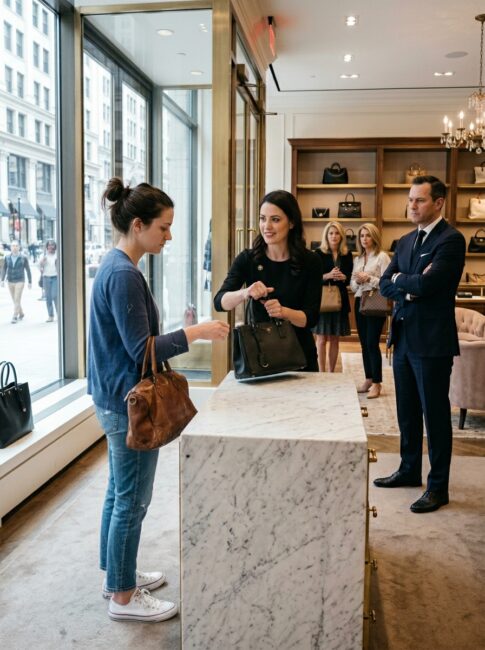
Julian remained beside the marble counter.
His face had already begun to pale.
Helen walked toward Clara slowly, ignoring the customers who had fallen silent around them. Madison stepped aside without being asked.
“You came,” Helen said.
Clara nodded.
“I almost did not.”
Helen looked down at the old handbag.
The leather had darkened with age. One corner had been repaired with a row of tiny stitches so precise they were almost invisible.
Helen removed one glove and brushed her fingertips across them.
“She still carried this?”
“Until the end,” Clara said.
Julian glanced toward Madison, then back toward Helen.
“I am sorry,” he said carefully. “Do you know this customer?”
Helen did not answer immediately.
Instead, she opened the clasp of the handbag with a familiarity that made Julian step closer.
Inside was a faded red lining.
Near the inner pocket, almost hidden beneath the seam, a single line of green thread had been stitched by hand.
Helen touched it once.
“This was the first one,” she said.
Madison looked confused.
“The first what?”
Helen turned the handbag toward her.
“The first Ellison & Rowe bag ever made.”
The room became still.
On the far wall, framed photographs traced the history of the brand through four decades. There were images of Helen beside magazine editors, fashion buyers, and actresses carrying the company’s most recognizable designs.
There was no photograph of Elena Bennett.
Clara had noticed that within seconds of entering the store.
She had also noticed something else.
Near the fitting area, an older Black woman in a navy coat had been waiting quietly while two associates assisted customers who arrived after her.
Clara glanced toward her.
“Excuse me,” Clara said. “Were you waiting for help?”
The woman looked surprised.
“I only wanted to see a scarf for my sister,” she said. “There is no hurry.”
Madison looked embarrassed.
“I can assist you now.”
The woman smiled politely but shook her head.
“It is all right. I was about to leave.”
Clara reached toward the nearby display and lifted the scarf carefully.
The edge had curled slightly where the silk had been folded.
She adjusted it with practiced hands.
Helen watched her.
“You know how to handle the fabric,” she said.
“My mother taught me.”
Clara returned the scarf to the older woman and helped her inspect the stitching.
Julian stared at the scene, uncertain whether to speak.
Helen turned toward him.
“Mr. Mercer, please close the front door for fifteen minutes.”
Julian blinked.
“We have customers.”
“Yes,” Helen said. “That is why I would like the door closed, not locked.”
Her voice remained calm.
Still, Julian moved immediately.
As the door settled into place, Helen looked toward the wall of photographs.
Then she said something that none of the employees had heard in their training.
“Ellison & Rowe did not begin with my name,” she said. “It began with Elena Bennett’s hands.”
Helen asked everyone to remain where they were.
She did not make an announcement.
She did not raise her voice.
Instead, she pulled out a chair near the consultation table and invited Clara to sit beside her.
Clara remained standing.
“I did not come to embarrass anyone,” she said.
Julian looked down.
“That is not what happened,” he replied, although he sounded as though he no longer believed his own words.
Helen rested both hands on her cane.
“Then let us say what happened.”
Forty-two years earlier, Helen had been a young buyer at a department store. She understood customers, trends, and presentation. She could persuade a hesitant store director to place an order before he realized he had agreed.
Elena Bennett understood leather.
She was the daughter of a Romanian immigrant who repaired shoes in a narrow storefront near Albany Park. Elena learned to stitch before she was tall enough to reach her father’s cutting table without a wooden crate beneath her feet.
When Helen first met her, Elena was working in the back room of a small luggage shop.
She had designed a handbag with clean lines, hidden compartments, and a reinforced strap that sat comfortably against a woman’s shoulder.
Helen believed women would buy it.
Elena did not.
She had heard too many people describe her work as practical rather than beautiful.
Helen convinced her to make twelve bags.
They sold within three days.
The thirteenth bag was the brown one resting on the counter.
“It was Elena’s sample,” Helen said. “She carried it to every meeting because she wanted to know how the leather changed with time.”
Clara touched the repaired corner.
“She fixed that seam when I was a child,” she said. “I thought every mother kept needles beside the kitchen sink.”
Helen smiled faintly.
For five years, Helen and Elena built the company together. Helen handled stores, orders, and investors. Elena trained the first artisans and developed the red lining that later became the brand’s signature.
The green thread was different.
Elena stitched it inside prototypes only.
It was her quiet mark.
Then Clara’s father became ill.
Elena stepped away from the business to care for him and raise her daughter. She sold most of her shares because the family needed stability more than promises.
Helen tried to persuade her to remain publicly connected to the brand.
Elena refused.
“She did not want people praising her for leaving,” Helen said. “She wanted to be present where she was needed.”
After Clara’s father died, Elena took sewing work from home. She repaired winter coats, shortened school uniforms, and altered prom dresses for families who could not afford boutiques.
She continued advising Helen privately.
Some of Ellison & Rowe’s most successful designs began as sketches folded inside ordinary envelopes and mailed from Elena’s kitchen table.
Her name remained absent from the wall.
That had been her choice at first.
Later, Helen admitted, it became a convenient silence.
Julian looked toward the framed photographs.
“You never added her,” he said.
Helen’s expression tightened.
“No.”
The answer carried no excuse.
Clara opened the handbag and removed a small cream envelope.
“My mother asked me to bring this here after she passed,” she said.
Helen’s fingers trembled slightly before she accepted it.
The letter inside was written in Elena’s careful handwriting.
Helen read silently for several moments.
Then she offered the page to Clara.
Clara shook her head.
“I know what it says.”
Helen looked toward the employees.
“Elena left her remaining shares to Clara,” she said. “Along with the right to approve the company’s new flagship expansion.”
Julian’s shoulders stiffened.
The boutique had planned a major renovation. Every employee knew the expansion would shape the company’s future.
Yet Clara did not look triumphant.
She looked tired.
She had spent the previous six weeks caring for her mother through the final stage of cancer. The blue cardigan had belonged to Elena. Clara wore it because the hospital room had always been cold.
She had come to the boutique directly after meeting with the attorney handling her mother’s estate.
She had not dressed simply to test anyone.
She had not expected special treatment.
She had only wanted to stand inside the store her mother helped build and ask Helen whether the forgotten photographs could finally be changed.
The older customer near the scarf display lowered her eyes.
Madison pressed her lips together.
Julian spoke quietly.
“I judged you before you finished your first sentence.”
Clara looked at him.
“Yes.”
“I am sorry.”
Clara nodded, but she did not rush to rescue him from the discomfort.
Julian turned toward the older customer.
“And I am sorry we kept you waiting.”
The woman studied him for a moment.
“My sister likes blue,” she said. “Nothing too bright.”
Julian understood.
He walked toward the scarf display himself.
Helen unfolded Elena’s letter again.
Near the bottom, beneath several personal lines, Elena had written one final request.
She wanted the company to establish a paid apprenticeship for young artisans who could not afford design school.
Not a scholarship named after her.
Not a memorial campaign.
A workroom.
A place where people with capable hands could be seen before anyone inspected their clothes, their accent, or the neighborhood printed on their application.
Clara looked around the boutique.
“My mother did not want her name on a perfume bottle,” she said. “She wanted a cutting table.”
Helen smiled through tears.
“You sound exactly like her.”
Clara glanced toward Julian, who was now helping the older woman compare two blue scarves with patient attention.
Then she looked at the empty space between the polished displays.
“A cutting table would fit there,” she said.
The renovation plans changed.
The marble remained. The lighting remained. Ellison & Rowe continued selling handbags that cost more than many families spent on rent.
But the front section of the flagship store no longer looked quite the same.
A long wooden worktable stood near the window where pedestrians could see it from the sidewalk.
The surface carried small marks from scissors, rulers, and careful hands.
Behind the table, apprentices worked beside experienced artisans several days each week. Customers could watch leather being measured, cut, stitched, repaired, and treated with the attention that mass production could never imitate.
The first apprentice was a single mother named Jasmine Carter.
She had learned to sew from her grandmother and spent seven years repairing handbags from a booth inside a suburban flea market.
Her application included no prestigious school.
It included photographs of her work.
Clara selected her after noticing the lining inside a repaired wallet. Jasmine had chosen a thread color nobody would ever see unless the wallet tore again.
Elena would have understood that choice.
Julian remained the flagship manager.
For several days after Clara’s visit, he seemed to expect another decision.
He expected to lose his job.
Clara did not pretend his behavior was harmless. She asked him to retrain every member of the retail team, including himself. She also asked Helen to review the sales incentives that rewarded employees for making quick assumptions about who might spend money.
Julian agreed.
His manner changed slowly, without performance.
He began greeting customers before looking at their shoes.
He noticed who had been waiting.
He stopped treating kindness as a luxury reserved for people who appeared able to buy it.
One Thursday afternoon, the older woman in the navy coat returned.
Her name was Diane.
She carried a small paper bag and asked for Julian.
When he approached, she removed the blue scarf he had helped her choose.
“My sister loved it,” Diane said.
Julian smiled.
“I am glad.”
Diane handed him the paper bag.
Inside was a slice of homemade pound cake wrapped carefully in wax paper.
“For your coffee break,” she said.
Julian looked genuinely surprised.
Then he thanked her and placed the bag beneath the counter as though it contained something delicate.
Clara visited the boutique less often than Helen expected.
She had no interest in occupying an office simply because her mother’s shares allowed it.
Instead, she worked with the apprenticeship team and spent weekends sorting through Elena’s old sketches.
Some were unfinished.
Some were drawn on the backs of grocery lists.
One had a coffee ring across the corner and a note written beside the handle.
Make this softer. Women carry enough already.
Clara framed that sketch for the workroom.
The brown handbag remained nearby, inside a simple glass case.
There was no dramatic spotlight.
The card beneath it contained only a few lines.
The first Ellison & Rowe sample, hand-stitched by Elena Bennett. Carried for forty-two years. Repaired whenever necessary.
Clara had insisted on the final sentence.
One evening, after the store closed, she stood alone beside the case wearing the same blue cardigan.
The loose thread still hung from the sleeve.
Jasmine offered to repair it.
Clara smiled and shook her head.
“Not yet,” she said.
She placed her fingertips against the glass near the green thread hidden inside the handbag.
Then she switched off the workroom light and walked toward the door.
Behind her, the old bag rested quietly beneath the window, no longer forgotten and never pretending to be new.
Follow our page for more heartfelt stories about the people we often fail to notice until we finally look closer.