Part 2: The Principal Read a Letter at Graduation — and the Writer’s Identity Left the Entire School Silent
The first sentence was not a thank-you.
It was not the kind of polished farewell students wrote for graduation booklets, all bright futures and lifelong memories. Daniel’s handwriting, projected onto the large screen behind the stage, looked uneven. Some letters leaned too far. Others were pressed hard enough to nearly tear the paper.
“If this letter is read aloud,” Principal Whitaker began, “it means I did not get the chance to say this myself.”
A small sound came from the senior section. Someone whispered, “Oh my God.”
Whitaker paused, and for the first time all morning, his face looked less like a principal’s face and more like a man trying to stand in a storm without letting anyone see his knees shake.
Daniel’s mother did not sit down.
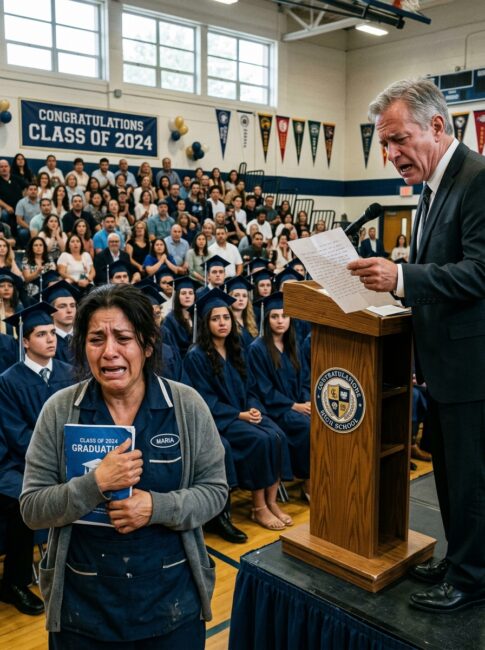
She remained by the double doors at the back of the gym, still wearing black slip-resistant shoes from the diner where she worked breakfast shifts. Her gray cardigan was buttoned wrong. One sleeve was pushed higher than the other, as if she had dressed in a hurry or simply stopped caring whether the world saw her properly.
Onstage, the school board members shifted in their seats.
Whitaker kept reading.
“I know people think I stole from the guidance office. I know some of them think my mother helped me. I know because people stopped lowering their voices when I walked by.”
A few parents glanced around, uncomfortable now that the gossip had returned wearing Daniel’s handwriting.
In the third row, Madison Bell tightened her fingers around the edge of her gown.
Madison had been voted most likely to succeed. Her father owned Bell Construction, one of the biggest donors to Willow Creek High. Her mother chaired the graduation committee. Her scholarship announcement had been printed in the local paper beside a photo of her holding a bouquet of roses.
She was also the student who had cried in the hallway the day the scholarship envelopes went missing.
Daniel had been seen leaving the guidance office minutes before.
That was all it had taken.
Whitaker read the next line more slowly.
“I did take the envelopes.”
A wave passed through the gym. Not loud. Not dramatic. Just enough movement for the room to feel like something alive pulling away from him.
Elena’s mouth opened, but no sound came out.
She looked at the screen, then at Whitaker, then back at the screen, as if the words might rearrange themselves if she stared hard enough.
Daniel had denied it to her. He had sat at their kitchen table under the yellow light with his hands folded, swearing he had not stolen anything.
“Mama,” he had said, “please believe me.”
She had.
Now, in front of the entire town, his own letter seemed to prove she had been foolish.
But Whitaker did not stop.
“I took them because they were already opened.”
That sentence landed differently.
The gym shifted again, this time toward confusion.
Whitaker looked up. His eyes moved, not to Elena, but to the first row where Superintendent Cole sat beside two board members. Cole’s jaw had tightened so hard a vein showed in his neck.
Daniel’s letter continued.
“I found them in the trash can beside Mrs. Lane’s desk. Some were torn. Some had coffee on them. One had Madison Bell’s name crossed out and rewritten on another envelope.”
The guidance counselor, Mrs. Lane, had been smiling thirty seconds earlier.
Now her smile had vanished completely.
She stood near the wall in a pale blue dress, one hand at her throat. A teacher beside her turned and stared, slowly, as if realizing she had been standing next to a locked door that was beginning to open.
Madison Bell’s father rose halfway from his seat.
“What is this?” he said, too loudly.
No one answered.
Principal Whitaker read on.
“I put the envelopes in my backpack because I thought someone had made a mistake. I thought if I brought them to Principal Whitaker, he would fix it. But I got scared when Mr. Bell saw me in the hallway.”
At the mention of his name, Mr. Bell’s face went red.
“He told me,” the letter said, “that kids like me don’t get to ruin things for girls like Madison.”
A quiet, horrified breath went through the audience.
Madison turned toward her father.
“Dad?” she whispered.
But Whitaker’s voice did not stop.
“I wanted to tell the truth that day. I wanted to say I found the envelopes already opened. But then I saw my mother’s name written on a paper inside Mrs. Lane’s office. It was not a scholarship paper. It was a cleaning contract. It said her job at the district building could be terminated immediately.”
Elena lowered herself into the nearest chair as if her legs had finally remembered gravity.
Her fingers gripped the program until it bent.
No one in the gym looked at Daniel the same way anymore, even though Daniel was not there to be seen.
Principal Whitaker stopped reading and took off his glasses.
For a moment, the ceremony disappeared. No one cared about diplomas, honor cords, or the choir waiting beside the bleachers. The entire gym had become one letter, one stain, one boy’s handwriting growing larger than the adults who had failed him.
Whitaker inhaled, then continued.
“I knew they would not believe me if I spoke up,” Daniel had written. “I knew they would say I wanted attention or money or revenge. But if I stayed quiet, maybe my mother could keep her job.”
Elena covered her mouth.
In the back row, a cafeteria worker began crying silently.
Daniel had known the economy of shame better than most adults. He understood that some families could survive a lie better than they could survive unemployment. He understood that in a town like Willow Creek, reputation did not weigh the same in every household.
For Madison Bell, a rumor was a storm that passed.
For Elena Reyes, it could be eviction.
The letter continued.
“So I let them think I stole the envelopes. I let them search my locker. I let them call me into the office while everyone watched. I signed the paper saying I would not attend senior events because Mrs. Lane said it would make everything easier.”
Mrs. Lane sat down without looking for a chair first. She nearly missed it.
Another twist moved through the room, sharper than the first.
Daniel had not been officially expelled. The school had told people he chose to stay home. Teachers had been told he was dealing with personal issues. Students had been told nothing at all, which meant they had filled the silence with whatever cruelty came easiest.
Whitaker’s voice cracked on the next paragraph.
“I kept the envelopes because I thought they were proof. I hid them behind the loose panel in my bedroom closet. If anyone finds this letter, please give them to Principal Whitaker. He is not perfect, but he looked at me like a person the day everyone else looked at me like a crime.”
All eyes moved to Whitaker.
The principal bowed his head.
He had found the letter the week before graduation, Elena had told him, when she finally packed Daniel’s room. She had brought it to his office in a brown grocery bag, along with six envelopes, three torn forms, and a school district memo with initials at the bottom.
Whitaker had spent the last seven days digging.
He found more than anyone expected.
The scholarships had not been stolen.
They had been redirected.
Three merit awards meant for lower-income students had been quietly reassigned after private calls from donors. Two recommendation letters had been removed from files. One financial aid appeal had been buried because approving it would have meant denying another student whose family name appeared on the new athletic building.
Daniel had discovered the beginning of it by accident.
He had stayed after school to ask about a community college application fee. Mrs. Lane was not at her desk. The office door was open. The trash can was full.
And there, under a coffee cup and a torn manila folder, Daniel found his own scholarship envelope, opened, marked “hold,” and clipped to a note that read, “Do not process until Bell decision is final.”
He also found Madison’s paperwork.
But Madison’s name was not there because she had done anything wrong. Her family had.
That was the fourth twist, and it hurt differently.
Madison stood from her chair. Her cap slipped sideways, but she did not fix it.
“Did you know?” she asked her father.
Mr. Bell looked at the principal, then at the board, then at his daughter.
“Madison, sit down,” he said.
She did not.
“Did you know Daniel lost his scholarship because of us?”
Her voice was trembling, but it carried.
Mr. Bell’s silence answered before his mouth could.
A sound broke from Elena then, not quite a sob, not quite a gasp. It was the sound of a mother hearing that her son had not lied, and realizing he had carried truth alone until it crushed him.
But the letter was not finished.
Whitaker read the final page.
“I am not writing this to hurt Madison. She was never cruel to me. In second grade, she gave me half her sandwich when I forgot lunch. I remember because it was turkey with too much mustard, and she said rich people mustard was always trying too hard.”
A strange, broken laugh moved through the gym.
Madison pressed both hands to her mouth.
“She probably does not remember,” Daniel wrote. “But I do. People remember small kindnesses when they do not get many.”
That line changed the temperature of the room.
The students who had laughed at Daniel’s shoes stared at the floor.
The parents who had repeated rumors over grocery carts looked suddenly older.
The teachers who had watched him drift down the hallway with his hood up remembered the times they had decided not to ask, because asking would take time, and time was always short.
Daniel had not written like an angry boy.
That was the most devastating part.
He had written like someone trying to protect everyone except himself.
“I am sorry I did not come back,” the letter said. “I tried. I stood outside the gym on awards night, but I heard people clapping for the students whose names were still on the list, and I could not make myself open the door.”
Whitaker wiped his cheek with his thumb.
“I do not blame the whole school. I know not everyone knew. But I want someone to know this: my mother did not raise a thief.”
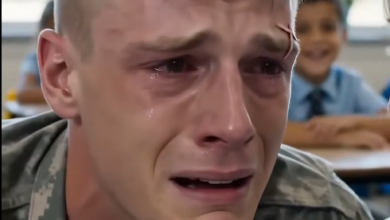
Elena bent forward as if those words had struck her in the chest.
For months, she had carried the looks. The diner customers who stopped chatting when she refilled coffee. The neighbor who asked whether Daniel had “fallen in with bad kids.” The woman at church who touched her arm and said, “Sometimes mothers don’t know everything.”
Elena had known.
She had known her son’s walk, his quiet, the way he apologized when a chair squeaked. She had known he would go hungry before taking what was not his.
But knowing does not protect a mother from a town that has already decided.
Whitaker folded the letter halfway, then opened it again, because there was one more paragraph.
“Principal Whitaker, if you read this one day, please do not read it unless my mother is there. I do not want her to hear the truth from whispers. I want her to hear it in the same room where they judged her.”
The room broke.
Not loudly. Not with one dramatic cry.
It broke in pieces.
A student lowered his head into his hands. A teacher walked out through the side door, unable to stand still. Madison stepped into the aisle, crying now, her honor cords swinging against her gown.
Then she walked to the back of the gym.
No one stopped her.
She knelt in front of Elena Reyes.
“I’m sorry,” Madison said. “I didn’t know.”
Elena looked down at the girl whose family name had helped take what Daniel earned. For a moment, the room seemed to hold its breath, waiting for anger, waiting for a scene, waiting for something that could be understood.
Instead, Elena reached out and straightened Madison’s crooked graduation cap.
“I know, sweetheart,” she said, and her voice was barely more than air. “You were a child too.”
That was when even the superintendent looked away.
The ceremony did not continue for almost twenty minutes.
No one announced a break. No one played music. The seniors simply sat there, holding their programs, their futures suddenly feeling less like trophies and more like fragile things that could be handed to one person and taken from another.
Principal Whitaker returned to the microphone with Daniel’s letter folded carefully in his hand.
“There is another name to read today,” he said.
A custodian opened a side door.
A young assistant principal walked in carrying a diploma cover and a navy graduation gown on a hanger. The gown had been pressed. A white carnation was pinned near the collar.
Elena watched as they placed it on the empty chair at the end of the front row.
The chair had a small card taped to it.
Daniel Reyes.
No one clapped at first.
Then one senior stood.
It was not Madison. It was a boy from the football team who had once shoved Daniel’s backpack off a cafeteria bench and laughed when his notebooks spilled.
He stood with tears running down his face.
Then another student stood.
Then another.
Soon the entire senior class was on its feet, not cheering, not celebrating, just standing because sitting felt impossible.
Whitaker announced, in a low voice, that the district had opened an investigation. Mrs. Lane had been placed on leave that morning. Superintendent Cole had resigned an hour before the ceremony, though no one in the audience had known it yet.
Mr. Bell left through the side exit before his daughter received her diploma.
Madison did not follow him.
When her name was called, she walked across the stage with red eyes and shaking hands. She accepted her diploma, then turned toward Daniel’s empty chair instead of the cameras.
She touched the white carnation once.
“I remember the sandwich,” she whispered.
Not everyone heard it.
Elena did.
After the ceremony, families poured into the parking lot under a pale June sky. There were flowers, photographs, grandparents searching for shade, little siblings tugging at gowns. Life, stubborn and ordinary, tried to resume.
But near the flagpole, a small crowd gathered around Elena.
No one knew what to say.
Apologies came awkwardly. Some were too late. Some were too small. Some were wrapped in excuses and died before they reached her ears.
Elena accepted none of them dramatically.
She only nodded, because grief had taught her that people often needed forgiveness before they had earned it.
Principal Whitaker approached last.
He handed her Daniel’s diploma.
The cover was dark blue with a gold seal, the same as every other student’s. Inside, Daniel’s full name had been printed in careful script.
Elena ran her thumb over the letters.
For a moment, she was not in a parking lot surrounded by people who had misjudged her son. She was back in their kitchen, watching Daniel hunch over homework while steam rose from a pot of rice on the stove.
“He wanted to be a teacher,” she said.
Whitaker nodded.
“I know,” he replied. “He wrote that on his college form.”
Elena looked toward the empty gym doors.
A breeze lifted the edge of Daniel’s gown where it hung over her arm. The white carnation brushed her wrist like a small hand.
Later that afternoon, someone taped a copy of Daniel’s letter to the glass case outside the main office. By evening, students had left notes beneath it. Some were apologies. Some were memories. One simply said, “I should have sat with you.”
The next fall, Willow Creek High created a scholarship in Daniel’s name.
But Elena never came to the ceremony where they announced it.
She came the day after, early in the morning, when the halls were empty and the floors smelled of wax. She stood before the glass case, holding a fresh white carnation, and placed it beneath her son’s letter.
Then she touched two fingers to his name.
The building was quiet around her.
No applause. No speeches. No cameras.
Just a mother, a letter, and the truth arriving late, but finally arriving.
And if this story stayed with you, follow this page for more stories about the quiet moments that change how we see each other.