The Single Mother Was Looked Down On at a Community Meeting — Then Her Son’s Words Made Everyone Look at Themselves
For several seconds, the only sound in the clubhouse was the rain.
Noah stood beside his mother with his shoulders slightly hunched, as though he wished he could take the words back.
Elena touched his arm.
“You do not have to explain anything,” she whispered.
Paula looked down at the check again.
It had never been deposited.
The handwritten note beneath it contained only three sentences.
Please return this money to the emergency fund. We will manage. Please stop publishing the names of families who receive help. Some people are already carrying enough.
Paula cleared her throat.
“The report was required for transparency.”
Elena nodded.
“I understand.”
Her voice was calm, which made the exchange more uncomfortable.
She was not demanding an apology. She was not asking anyone to remove the late fee from her account. She was not trying to persuade the room that she deserved special treatment.
She simply reached for the check.
A retired teacher named Margaret Doyle raised her hand from the second row.
“Elena,” she said, “why did you request the money if you did not need it?”
Elena hesitated.
“I did not request it.”
Paula looked up sharply.
“That cannot be correct.”
Elena pulled a chair closer for Noah and set his backpack beneath it.
“Someone left the envelope under our door.”
The man in the front row turned toward Paula.
“Then why is her name listed as a recipient?”
Paula flipped through the report.
“The payment authorization was approved by the emergency committee.”
There were three members on that committee.
Paula was one of them.
The second was Eric Coleman, a local insurance agent who had not yet arrived.
The third was Reverend James Holloway, who lived near the neighborhood entrance and rarely missed a meeting.
James sat quietly near the back wall.
He was seventy-one, with a weathered face and silver hair. He had spent most of the evening studying his hands.
Paula looked toward him.
“Did you authorize this?”
James lifted his eyes.
“Yes.”
“You cannot issue checks without an application.”
“I know.”
“Then why did you?”
James looked at Elena.
“Because she would never apply.”
Elena closed her eyes briefly.
A murmur passed through the room.
Paula frowned.
“Apply for what?”
James answered slowly.
“Help.”
That explanation did not satisfy everyone.
A woman near the coffee table leaned forward.
“Elena is behind on two months of association dues. That is already in the report. Are we pretending that is not relevant?”
Noah looked down at his sneakers.
Elena kept one hand on the back of his chair.
“It is relevant,” she said. “I will pay the balance.”
“When?” the woman asked.
Margaret turned toward her.
“That is enough.”
“No,” Elena said gently. “She is allowed to ask.”
Then something unexpected happened.
An elderly Black American man named Charles Bennett stood from the final row and walked slowly toward Elena.
He used a cane in his left hand.
In his right hand, he carried a folded grocery receipt.
“Elena,” he said, “did you put groceries on my porch again?”
Elena gave him a tired smile.
“You told me your daughter was visiting.”
“That does not answer my question.”
“It was only soup, bread, and a few things for breakfast.”
Charles held up the receipt.
“You paid for my medication too.”
Several heads turned toward Elena.
She shook her head.
“The pharmacy had a problem with the billing system.”
“So you paid until they fixed it.”
“They reimbursed me.”
“They reimbursed you three weeks later.”
Elena glanced at Noah.
“We should not discuss this here.”
Charles studied the room.
“I think perhaps we should.”
Before anyone could respond, a young mother entered through the side door with a toddler sleeping against her shoulder.
Her name was Bethany Shaw.
She lived in Building C and worked mornings at a daycare center.
“I am sorry I am late,” Bethany said.
Then she saw Elena near the podium.
“Did they tell you about the rent voucher?”
Elena’s face tightened.
“No.”
Bethany stopped.
The room became still again.
“What rent voucher?” Paula asked.
Bethany looked confused.
“The one Elena gave us after my husband’s hours were cut.”
Elena stepped toward her.
“Bethany, it is fine.”
“No, it is not.”
Bethany’s eyes filled.
“She left an envelope beneath our door with enough money to keep our apartment through March. She did not sign it, but my daughter saw her walking away.”
Paula turned toward Elena.
“How much money have you been giving people?”
Elena looked toward the rain-darkened windows.
“It was not much.”
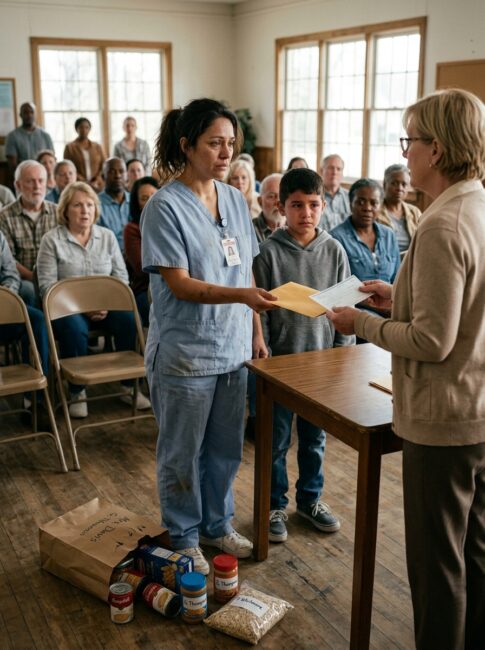
Noah lifted the grocery bag onto the table.
The bottom had begun to soften from the damp pavement outside.
Inside were canned vegetables, pasta, oatmeal, and two jars of peanut butter.
Each item had a small handwritten label taped to it.
Building A — Mrs. Doyle
Building C — Shaw family
Building D — Mr. Bennett
Paula stared at the bag.
Elena reached for it quickly.
“These are only groceries.”
But Noah did not let go.
“Mom,” he said quietly, “they should know.”
Elena looked at her son.
For the first time that evening, she seemed afraid.
Six months earlier, an early winter storm knocked out power across Maplewood Commons.
The outage lasted almost three days.
The neighborhood had generators for the clubhouse and emergency lighting along the main walkway, but several residents still struggled.
Charles Bennett’s apartment became dangerously cold.
Margaret Doyle could not lift the garage door manually because of arthritis in both hands.
Bethany Shaw’s toddler developed a fever while the roads remained covered with ice.
Elena had just finished a twelve-hour shift at St. Catherine’s Hospital when she returned home and saw the first darkened windows.
She changed her shoes, found a flashlight, and knocked on the door of every elderly resident she knew.
Then she knocked on doors she did not know.
She brought extra blankets from her apartment.
She carried hot water in insulated pitchers from the clubhouse kitchen.
She wrote apartment numbers on the back of an old grocery receipt and called the hospital cafeteria manager, asking whether unsold soup could be donated.
The manager agreed.
Elena loaded two large containers into the back seat of her aging sedan and drove home through streets edged with ice.
Noah helped carry paper cups from building to building.
The following morning, Elena found Charles sitting in his coat beneath two blankets.
His medication had run out.
The pharmacy was open, but the computer system could not process his insurance.
Charles told her he would wait.
Elena paid for the prescription with the money she had saved for her electricity bill.
She did not tell him.
A week later, when the power returned and the snow began to melt, Elena found Bethany crying beside the community mailbox.
Her husband’s delivery job had reduced his hours after the storm.
Their rent was short.
Bethany was embarrassed.
She said she would borrow money from her sister.
Elena did not ask more questions.
That evening, she opened a metal cookie tin above her refrigerator.
Inside were small envelopes marked with Noah’s handwriting.
Car repair.
School shoes.
Emergency.
Summer trip.
Noah had never taken a real vacation.
For three years, Elena promised him they would spend one weekend near Lake Michigan when she saved enough.
They had placed loose bills into the summer envelope whenever possible.
Elena counted the money twice.
Then she removed most of it and placed it inside a plain white envelope for Bethany.
Noah watched from the kitchen doorway.
“Is that our trip money?” he asked.
Elena looked at him.
“Some of it.”
“Are we still going?”
“Not this summer.”
Noah nodded.
He was disappointed, but he did not complain.
The next day, Elena slipped the envelope beneath Bethany’s door.
She planned to remain anonymous.
Then Bethany’s six-year-old daughter saw her leaving.
That was how the quiet pattern began.
After the storm, residents began leaving groceries, blankets, and gift cards at Elena’s apartment.
Some signed their names.
Others did not.
Elena organized the donations because nobody else seemed to know where they were needed.
She kept a notebook inside the same metal cookie tin.
It did not record how much people owed.
It listed practical things.
Mrs. Doyle needs help carrying laundry on Thursdays.
Mr. Bennett has a pharmacy pickup on the 14th.
Shaw family needs diapers until new work schedule begins.
Building B, Apartment 9 needs a ride to physical therapy.
Noah added small stars beside completed tasks.
Elena never announced any of it.
She did not want people to feel observed during their hardest months.
She understood how quickly assistance could become a label.
Seven years earlier, Elena had become a single mother when Noah’s father left without warning.
She was twenty-nine, with a four-year-old child and a stack of bills she could not pay on time.
One afternoon, she stood in line at a grocery store with milk, bread, eggs, and a box of cereal.
Her card was declined.
The cashier tried again.
The line behind her grew longer.
A woman sighed loudly.
Someone muttered that people should not fill their carts if they could not afford groceries.
Elena removed the cereal first.
Then the eggs.
Before she could decide whether to return the milk, the elderly cashier reached into her apron and paid the remaining balance.
Elena never forgot the woman’s name.
Marjorie.
She never forgot what Marjorie said either.
“Take the groceries home. Your child is watching how the world treats you.”
Years later, Elena still carried those words.
That was why she asked the board to remove names from the emergency-fund report.
She knew the fund mattered.
She also knew what it felt like to sit inside a crowded room while strangers turned temporary hardship into a permanent description of your character.
Reverend James finally stood and walked toward the podium.
He carried a worn folder beneath one arm.
“I issued the $740 check,” he said. “Elena did not request it.”
Paula folded her arms.
“Why that amount?”
James opened the folder.
“Because that is the amount she spent helping residents during the last six months.”
Elena shook her head.
“You were not supposed to calculate it.”
“I did not calculate all of it.”
He placed several photocopied receipts on the table.
“Some families kept records because they wanted to repay you.”
Paula picked up the first receipt.
There were groceries, prescription costs, utility assistance, and a replacement space heater for Margaret Doyle.
The total exceeded the value of the check.
James looked toward Elena.
“You paid other people’s bills while falling behind on your own dues.”
“I made choices.”
“You skipped your own electric payment.”
“I caught up.”
“After taking extra shifts.”
Elena glanced toward Noah.
“This is not why we came.”
Paula looked at the original report again.
Her voice was quieter.
“Why did you ask us to remove your name instead of explaining the mistake?”
Elena answered carefully.
“Because my name is not the only problem.”
She pointed toward the list.
“Every person printed on that page has to walk past their neighbors tomorrow morning. Some of them already feel ashamed for needing help.”
The man in the front row shifted in his seat.
“But the association needs accountability.”
“Yes,” Elena said. “Accountability for the money. Not a public inventory of people’s hardest months.”
Nobody responded.
Then Noah stood.
His voice trembled at first.
“My mom told me not to say this.”
Elena touched his shoulder.
“Noah.”
He looked at her.
“I think they need to hear it.”
The room waited.
Noah faced the rows of adults.
“When my mom buys groceries for someone, she makes me turn the labels toward the wall before we leave the bag,” he said.
A few residents looked toward the paper grocery bag on the table.
“I asked her why.”
He swallowed.
“She said people should not have to look at the price tag while they are eating dinner.”
Elena lowered her eyes.
Noah continued.
“So maybe the problem is not that people needed help. Maybe the problem is that you printed their names because you wanted to know who to look down on.”
Nobody moved.
The rain continued tapping against the windows.
Paula slowly removed her glasses.
The man in the front row unfolded his arms.
On the table, the emergency-fund report lay open beneath the fluorescent lights.
One by one, several residents turned the printed pages face down.
The board did not vote immediately.
For the first time that evening, nobody seemed eager to raise a hand.
Paula stood behind the podium and looked at the report for a long moment.
Then she picked up the stack of printed pages and placed them inside a folder.
“We will publish totals,” she said. “Not names.”
James nodded.
Margaret Doyle reached across the aisle and touched Elena’s sleeve.
“I owe you for at least three loads of laundry,” she whispered.
Elena smiled.
“You owe me nothing.”
Margaret lifted one eyebrow.
“That was not a request.”
A few residents laughed quietly.
The tension in the room softened, although it did not disappear completely.
Some discomfort should remain.
After the meeting, people gathered near the grocery bag on the table.
Charles added a folded twenty-dollar bill.
Bethany placed a pharmacy gift card beside it.
The man from the front row stood alone for several minutes before approaching Elena.
His name was Brian Keller.
He lived in Building B with his wife and teenage daughter.
“My company reduced staff last year,” he said. “I did not tell anyone here.”
Elena listened.
“We almost missed two mortgage payments.”
Brian looked toward the overturned report.
“I think I was angry because I was afraid people would see me the way I saw that list.”
Elena did not answer immediately.
Then she handed him one of the empty grocery bags from the stack beneath the table.
“Help us carry these on Saturday,” she said.
Brian accepted the bag.
“What time?”
“Nine.”
Paula remained near the podium after most residents left.
She approached Elena slowly.
“I am sorry,” she said.
Elena adjusted Noah’s backpack strap.
“For what part?”
Paula looked down.
“For making a spreadsheet feel more important than the people on it.”
Elena nodded once.
Then she lifted the grocery bag and headed toward the door.
Outside, the rain had weakened to a mist.
Noah walked beside her beneath a small umbrella that barely covered both of them.
Halfway across the parking lot, Elena stopped.
“What you said in there was brave,” she told him.
Noah looked worried.
“Are you mad?”
“A little.”
He smiled faintly.
“Because you told me not to say anything?”
“Because you are eleven and already better at meetings than most adults.”
Noah laughed.
Then he reached into his backpack and removed a folded envelope.
Elena recognized it immediately.
The front was labeled in his handwriting.
Summer trip.
She stopped walking.
“I found it in the cookie tin,” Noah said.
Inside were three crumpled dollar bills and several coins.
“You started saving again?”
Noah shrugged.
“I put my snack money in there.”
Elena looked at the envelope.
“We do not have to go anywhere.”
“I know.”
“Then why are you saving?”
Noah tucked the envelope beneath her arm.
“Because it is nice to have something to look forward to.”
The following Saturday, Elena arrived at the clubhouse expecting four volunteers.
Seventeen people were waiting.
Paula wore jeans and carried a clipboard.
Brian stacked grocery bags near the door.
Margaret sat at a folding table writing small notes for each delivery.
Charles insisted on organizing the canned soup, although he rearranged the same shelf three times.
Nobody wrote the recipients’ names on a public list.
Each bag carried only an apartment number and a small card.
Noah had suggested the message.
Someone in your neighborhood remembered you this week.
Elena read the first card and placed it gently inside a bag.
Then she turned the grocery labels toward the wall.
For more stories about the quiet moments that change how we see one another, follow this page and stay with us for the next story.