Part 2: The Stepfather Was Told “Not to Speak” at the Wedding — Then the Bride’s Words Left Everyone in Tears
Samuel did not go far.
He stopped outside on the stone terrace, where the evening air smelled like salt, roses, and rain that had not fallen yet. Through the glass doors, he could see the ballroom glowing gold behind him. He could see Grace standing beside her new husband, Daniel, while Alan Pierce held the microphone like a man who had been waiting years for an audience.
Samuel took the index cards from his pocket.
His hands were rough and scarred from thirty years as a mechanic. One knuckle had never healed straight after a winter accident on Route 9, when he had worked through a snowstorm because Grace needed a science fair project finished by morning.
On the first card, in careful block letters, he had written: “Grace was never mine by blood. She was mine by breakfast.”
He almost smiled at that line.
Then he folded the cards again.
Inside, Alan began talking.
Samuel could not hear every word, only the tone. Warm. Smooth. Confident. The kind of voice people trusted before they learned what it had failed to carry.
Diane found Samuel beside the railing.
She was still beautiful at fifty-six, though the day had worn through her foundation and left worry around her eyes. She held the skirt of her navy dress in one hand, as if she had rushed.
“Sam,” she whispered.
He did not look angry.
That was the first thing that did not fit the story people inside were already telling.
He looked tired.
“I’m sorry,” Diane said.
Samuel glanced through the window at Grace.
“She asked?” he said.
Diane swallowed.
“The planner said the order changed. Alan wanted to speak first. Grace didn’t want a scene.”
Samuel nodded, the same way he had nodded when Grace was ten and slammed a door in his face after yelling, “You are not my dad.”
He had not yelled back then either.
“Today is hers,” he said.
Diane’s eyes filled.
“You wrote something, didn’t you?”
He looked down at the cards.
“Just a few words.”
Diane reached for them, but he stepped back gently.
“No,” he said. “Not tonight.”
Inside the ballroom, laughter rose. Not cruel laughter, but the polished kind guests give a speaker they do not know well.
Samuel’s jaw tightened.
Diane heard Alan say something about “finding his way back.”
She looked away.
There had been many versions of Alan Pierce over the years. The young husband with a guitar and charming apologies. The father who promised weekend visits and forgot half of them. The man who sent birthday cards with no return address, always late, always signed “Dad,” as if the word itself could do the work.
Grace had kept those cards in a shoebox.
Samuel knew because he had bought the shoebox.
He had also been the one who reminded Diane not to throw them away.
“She deserves something from him,” Samuel had said back then. “Even if it is small.”
That was the second thing no one inside knew.
Samuel had not pushed Alan out of Grace’s life.
He had left the porch light on for him more times than Diane wanted to remember.
At the head table, Grace’s smile trembled.
Alan lifted his glass and spoke with emotion now. Guests leaned in. Some dabbed their eyes.
Daniel, the groom, looked toward the terrace.
He had noticed Samuel outside.
Grace noticed too.
Her eyes followed the outline of the man beyond the glass, the man standing alone in the cooling dusk with his hands folded around something he would not let anyone see.
The wedding photographer moved closer to Alan.
Flash.
Flash.
Flash.
Samuel lowered his head.
A small blue ribbon was pinned inside his jacket pocket. It was frayed, almost gray now, the kind of ribbon tied around a child’s hospital bracelet years ago.
Grace had been twelve when her appendix burst.
Alan had not answered the phone.
Samuel had driven eighty-seven miles in a borrowed truck with no heat, one hand on the wheel and the other holding a plastic bowl in case Grace got sick again. At the hospital, when the nurse asked for the father’s name, Samuel had paused.
Then he said, “Call me whatever you need to call me. Just help her.”
Grace had never known that part.
The nurse had tied a blue visitor ribbon around his wrist and said, “Dad can wait here.”
He had kept the ribbon.
Now it sat in his pocket on the night he had been asked not to speak.
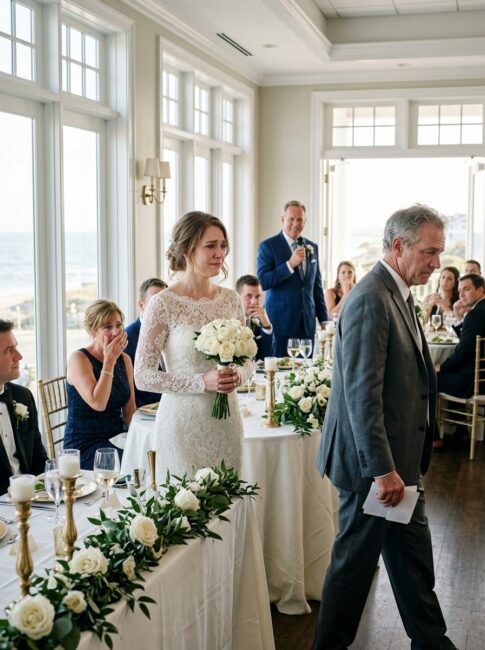
Alan’s speech lasted seven minutes.
It felt longer to the people who knew the spaces between his sentences.
He spoke about Grace as a baby, her dark curls, her stubborn little chin, the way she used to fall asleep with one sock missing. He spoke beautifully because memory, when carefully chosen, can sound like devotion.
Then he said, “I am grateful Grace never stopped believing her father would come home.”
At that, Diane sat down.
Samuel closed his eyes outside.
Grace’s bouquet lowered an inch.
Daniel leaned toward his bride and whispered, “Are you okay?”
Grace did not answer.
She was watching Samuel through the glass.
For weeks, she had felt trapped between two men and two versions of love. Alan had called in March, weeping, saying he had made mistakes and wanted one public moment to repair what he could. He said he was sick, though he did not say how sick. He said he could not bear being treated like a guest at his only daughter’s wedding.
Diane had told Grace the choice was hers.
Samuel had said nothing.
That silence had hurt Grace more than she admitted.
She had wanted him to fight a little. She had wanted him to say, “I earned that place.” She had wanted the man who taught her to ride a bike, changed her flat tires, and mailed her rent money in college to finally claim what everyone else kept refusing to give him.
But Samuel never claimed people.
He stayed.
That was how he loved.
Earlier that morning, before the ceremony, Grace had found an envelope tucked inside her bridal suite door. It had no name on the front, only her childhood nickname.
Gracie.
Inside was a receipt from the venue, marked paid in full, and a note from the manager thanking Samuel Whitaker for settling the final balance months earlier.
Grace had stared at it for a long time.
She had thought Alan paid.
He had told her he wanted to “make up for lost years” by covering the reception. She had cried when he said it. She had hugged him. She had told Samuel at dinner, and Samuel had smiled.
“That is good,” he had said.
Only that.
Now she understood.
Alan had offered a gift he never gave.
Samuel had paid for the room where he had just been asked to sit quietly.
But the receipt was not the only paper in the envelope.
There was a folded letter from the bridal shop.
Thank you for completing the payment on Miss Miller’s gown.
Grace had pressed the page to her chest.
She remembered standing in that shop six months earlier, trying not to cry when the dress she loved cost more than she could justify. She remembered telling the clerk she needed time. She remembered the clerk calling two days later, saying an anonymous family discount had been applied.
Samuel had been quiet that whole week.
He had also sold the old red truck he rebuilt by hand after Diane’s first husband left.
The truck had sat in the driveway for twenty years. Grace used to climb into it with a juice box and pretend they were driving to the moon. Samuel always said he would restore it fully one day, when money stopped needing him first.
Money never stopped needing him.
The third twist had come an hour before the wedding, when Daniel’s grandmother handed Grace a handkerchief for “something old.”
It was not lace.
It was one of Samuel’s work shirts, cut and hemmed into a small square by Diane. In the corner, stitched in blue thread, were the words Samuel used to say outside Grace’s bedroom after nightmares.
Still here.
Grace had almost ruined her makeup then.
But she had not confronted him.
Not yet.
Because Alan had arrived at the church with trembling hands and wet eyes, and the whole room had rearranged itself around his return.
Now, in the ballroom, Alan lowered the microphone.
Guests applauded.
Some stood.
Samuel heard the applause from the terrace and took one step farther into the dark.
Then Grace moved.
She did not ask the planner. She did not look at her mother. She simply lifted the hem of her gown, walked past Alan, and went to the microphone.
The room softened, expecting a thank-you.
Grace looked at the guests.
Then she looked at the glass doors.
“My father just gave a speech,” she said.
Alan smiled.
Samuel froze outside.
Grace continued, “And now I need to say something about the man who was asked not to.”
The ballroom went still.
Alan’s smile faded.
Diane covered her mouth.
Samuel reached for the door handle, not to enter, but to leave before she made herself uncomfortable for his sake.
Daniel moved first.
He walked to the terrace doors and opened them.
The room turned.
Samuel stood in the doorway under the lantern light, one hand still in his pocket, shoulders tense like a man prepared to apologize for being noticed.
Grace’s voice shook.
“Sam, please don’t go.”
No one called him Sam in that room except family.
That one word changed the air.
Grace looked at the guests again.
“When I was seven, I told him he was not my dad. He said, ‘I know, kiddo. But your bike still needs training wheels.’ Then he spent two hours in the driveway teaching me not to be afraid.”
A few people laughed softly through tears.
“When I was twelve, I woke up from surgery and found him asleep in a plastic chair, still wearing his oil-stained work boots. I thought he had just gotten there. I found out today he had been there all night.”
Samuel looked down.
“When I was seventeen, I screamed that he had no right to tell me who to date. He waited on the porch until midnight anyway, because I said I was getting a ride home from someone who had been drinking. I never thanked him for that.”
Diane was crying openly now.
Grace held up the handkerchief made from his work shirt.
“When I found this today, I remembered every night he stood outside my door and said, ‘Still here.’ He never said it loudly. He never made me say it back. He just stayed long enough for me to believe it.”
Alan turned his face away.
But Grace was not attacking him.
That was what made it unbearable.
She was only telling the truth.
“I also learned today that the wedding he was asked not to speak at was the wedding he quietly paid for,” Grace said. “He sold his truck. He paid for my dress. He let someone else take credit because he thought peace would make me happier than gratitude.”
A sound passed through the room.
Not a gasp.
Something deeper.
Samuel shook his head once, almost pleading with her not to continue.
Grace’s eyes found him.
“You always thought love meant not asking for a place,” she said. “But today I am asking you to take one.”
She turned toward Alan.
“Dad, I know you came back trying. I am not taking that away from you.”
Alan nodded, tears standing in his eyes.
Then Grace looked at Samuel.
“But when people ask who raised me, who waited, who paid attention, who came when the phone rang, who stayed when I made it hard to stay, there is only one honest answer.”
She stepped down from the small platform and walked to the doorway.
Her gown brushed the floor. Her veil caught the lantern light. Every guest watched her cross the room toward the man they had misunderstood minutes earlier.
Samuel’s face had gone pale.
Grace stood before him and held out the microphone.
“Please say something,” she whispered.
He looked at the room.
Then at the cards in his pocket.
Then at Grace.
Finally, he shook his head.
“I already got to,” he said.
Grace blinked.
Samuel touched the handkerchief in her hand.
“I got to say it every day you made it home.”
That was when the room began to cry.
There was no dramatic speech after that.
Samuel did not unfold the cards. He did not explain himself. He did not list the sacrifices he had hidden in bank statements, overtime shifts, canceled vacations, and shoes he wore two years too long.
He simply stepped inside the ballroom because Grace was still holding his sleeve.
For a moment, Alan stood alone near the head table.
Then he walked toward Samuel.
The room tightened again, uncertain what kind of collision was coming.
Alan stopped an arm’s length away.
“I should have thanked you,” he said.
Samuel studied him.
“For what?”
Alan’s mouth trembled.
“For being there when I wasn’t.”
Samuel did not answer quickly.
He looked at Grace, then at Diane, then at the guests who had turned one man’s quiet walk outside into a verdict.
Finally, he said, “She was easy to love.”
Grace laughed through tears.
“No, I wasn’t.”
Samuel’s smile appeared, small and tired.
“No,” he said. “You weren’t.”
The room laughed then, and the laughter let everyone breathe again.
A few minutes later, the band began the father-daughter dance. The singer looked unsure. The planner looked terrified. The schedule had already fallen apart in the way weddings do when real life walks in and refuses to follow a printed card.
Grace stood in the center of the floor.
Alan waited on one side.
Samuel waited on the other, hands folded, prepared to step back if asked.
Grace looked at both men.
Then she reached for Alan first.
They danced for half a song.
It was quiet, careful, and full of years neither of them could fix in three minutes. When the chorus came, Grace squeezed his hand, then stepped away.
She walked to Samuel.
He looked startled.
“I don’t know the steps,” he whispered.
“You taught me how to walk,” she said. “We can figure out the rest.”
Samuel placed one hand lightly at her back, careful not to wrinkle the dress he had paid for and pretended not to.
They moved slowly.
Not gracefully.
Samuel looked down at his shoes. Grace cried into his shoulder. Diane stood beside Daniel’s grandmother, holding the handkerchief over her mouth.
Near the cake table, Alan watched with a sadness that did not ask to be forgiven quickly.
When the dance ended, Samuel reached into his pocket and took out the three index cards. He handed them to Grace.
“For later,” he said.
She opened the first card just enough to see the line.
Grace was never mine by blood. She was mine by breakfast.
Her face crumpled.
She folded the cards carefully and tucked them into the bodice of her gown, close to her heart.
Years later, Grace would keep those cards in a small wooden box with her wedding veil, the handkerchief made from his work shirt, and one photograph from that night.
It was not the formal portrait.
It was a blurry picture someone took from the back of the room.
In it, Samuel stood in the terrace doorway, half in shadow, half in golden light, looking like a man who had spent a lifetime outside the frame and had finally been called by name.
Grace framed that photograph after Samuel passed away many years later.
Under it, she wrote the only caption that ever felt true.
Still here.
And if this story stayed with you, follow this page for more heartfelt stories about the quiet love people almost overlook.