Part 2: The Student Asked for 30 More Seconds in His Graduation Speech — His Final Words Made a Teacher Break Down
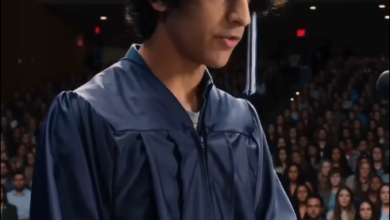
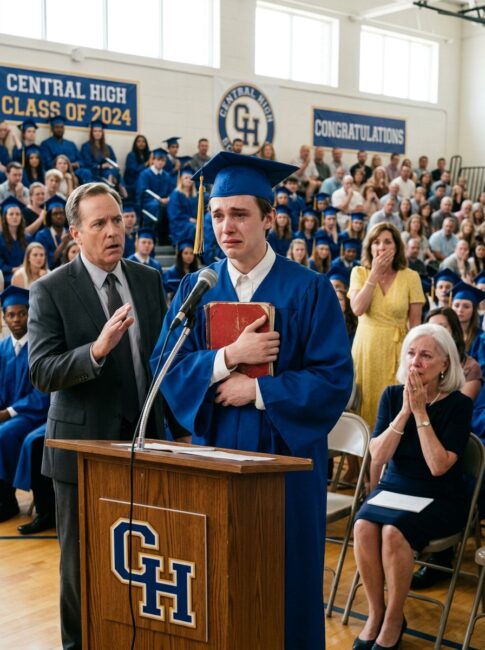
The principal, Dr. Raymond Ellis, stood beside Caleb with one hand half-raised, caught between authority and uncertainty.
Graduation ceremonies were built on order.
Names were called. Hands were shaken. Families clapped. Speeches were approved weeks ahead of time, printed and reviewed so no one wandered into trouble.
Caleb Morgan had already wandered close.
Mrs. Carter did not move from her chair. She stared at the notebook in Caleb’s hand as if it were something alive.
The notebook was red once, though time had rubbed most of the color away. Its corners were soft. A strip of tape held the spine together. From the bleachers, it looked like trash pulled from the bottom of a backpack.
But Mrs. Carter knew it.
Her fingers tightened around the program until it bent.
Caleb noticed.
That was the first small thing that unsettled people. A teacher should not look afraid of a student’s notebook.
Dr. Ellis leaned toward the microphone and whispered, “Caleb, this is not the time.”
Caleb nodded, but did not let go.
“I only need thirty seconds,” he said.
His voice was not angry. That made the room listen harder.
Behind him, the graduating class shifted in rows of blue gowns. Some students smirked, expecting drama. Others looked bored, the way seventeen-year-olds sometimes look when they do not yet know life is happening.
Caleb opened the notebook carefully.
A folded paper slipped out and nearly fell. He caught it with both hands, fast, almost protective.
A girl in the front row whispered, “Is that a letter?”
Caleb glanced at her, then lowered his eyes.
The gym lights hummed above him. Sunlight came through the high windows in pale rectangles, landing across the polished floor and the shoes of teachers who had suddenly stopped whispering.
Caleb began again.
“Four years ago,” he said, “most of you knew me as the kid who didn’t care.”
A few people looked down.
He continued, “That was fair.”
Mrs. Carter closed her eyes.
Caleb saw it and paused.
“That was what I wanted you to think.”
The words did not land loudly, but they changed something. In the bleachers, Caleb’s aunt Linda leaned forward. She had raised him since he was twelve and wore a yellow dress she had ironed twice that morning.
She did not know what was coming either.
Caleb turned one page.
“This notebook belonged to somebody who never got to sit here today,” he said.
A quiet ripple moved through the gym.
Dr. Ellis glanced toward Mrs. Carter.
Her eyes were still closed, but a tear had escaped down one cheek.
That was the second small thing. No one had accused her of anything, yet she was already crying.
Caleb’s thumb brushed the cracked spine.
“He wrote poems in it,” Caleb said. “Bad ones at first. Then better ones. Then one that won a county contest, though he never told anyone.”
A group of students exchanged confused looks.
Caleb had never been known for poetry. He had been known for missing assignments, wearing the same gray hoodie, and disappearing after lunch on Fridays.
“Who wrote it?” someone whispered from the bleachers.
Caleb heard the question but did not answer.
Instead, he looked at Mrs. Carter again.
“She told me once that words can keep a person breathing when nobody else can hear them,” he said.
Mrs. Carter covered her mouth.
Now the room fully changed.
People were no longer waiting for misbehavior. They were waiting for a wound to show itself.
Caleb unfolded the paper that had fallen from the notebook.
“My speech today was supposed to end with a thank-you to my aunt,” he said. “And I do thank her. More than I can say.”
Aunt Linda wiped her eyes, smiling through confusion.
“But there is one sentence I removed because I was afraid.”
Dr. Ellis softened. “Caleb…”
Caleb shook his head.
Not disrespectfully.
Just firmly.
“I was afraid everyone would think I was trying to make graduation sad,” he said. “But the truth is, this day was sad before I got up here. Some people are missing from it.”
A teacher in the third row lowered her head.
Mrs. Carter finally opened her eyes.
Caleb lifted the red notebook slightly.
“This belonged to my brother, Jonah.”
The name moved through the gym like a door opening in an old house.
Some students remembered him.
Some parents did too.
Jonah Morgan had been three years older than Caleb. Quiet. Gentle. Often tired. He had left Lincoln Ridge High before graduation, and most people assumed he had dropped out because he was lazy or troubled.
Caleb looked out at the room.
“You all thought he quit,” he said.
Then he turned toward Mrs. Carter.
“But she knew he was being erased before the rest of us did.”
No one clapped.
No one coughed.
Even the younger siblings in the bleachers seemed to feel the shape of the silence.
Caleb held the notebook like it weighed more than paper.
“My brother Jonah used to walk me to school,” he said. “Even when he was sick. Even when his hands shook so badly he had to hide them in his sleeves.”
Aunt Linda pressed both hands to her lips.
That was the third twist. Caleb’s family had not known the shaking started that early.
Caleb turned another page.
“Jonah had leukemia,” he said. “But before the diagnosis, before the hospital words, people just called him unreliable.”
Several teachers looked at the floor.
“He fell asleep in class. He missed homework. He stopped playing baseball. Some kids said he was on something. Some adults believed them.”
Mrs. Carter’s shoulders trembled.
Caleb did not look angry. That made it harder to bear.
“Mrs. Carter didn’t.”
He turned to her.
“She noticed the bruises on his arms before anyone else. She noticed he was writing with his left hand because his right hand hurt. She noticed he kept giving away his lunch money.”
Aunt Linda blinked. “Giving it away?”
Caleb’s voice caught.
“To me,” he said.
The gym seemed to shrink.
“I thought he was just being nice. He told me he wasn’t hungry. I didn’t know he was saving his money so I could eat when things were bad at home.”
Now the picture everyone had carried of Caleb began to crack.
He had not been the careless boy people thought.
He had been the younger brother of a dying teenager, trying to act hard because grief had no hallway pass.
Caleb looked back at the notebook.
“When Mrs. Carter found out Jonah was sick, she started visiting him after school. Not as his assigned teacher. Not because anyone asked her to. She brought books, soup, and those awful peppermint candies from her desk.”
A weak laugh moved through the teachers’ section.
Mrs. Carter cried harder at that.
Caleb smiled briefly, then the smile faded.
“But that’s not why I asked for thirty seconds.”
He took a slow breath.
“The week Jonah died, I came to school anyway.”
Aunt Linda looked up sharply. She remembered that week only in fragments. Hospital chairs. Phone calls. The sound of machines. Caleb sitting in corners with his fists clenched.
“I didn’t come because I was brave,” Caleb said. “I came because the house smelled like flowers and casseroles, and I hated everyone for speaking softly.”
His classmates watched him with new eyes.
“That day, I walked into Mrs. Carter’s room during lunch. She wasn’t there. Her desk was covered with essays. I saw Jonah’s notebook on top.”
Mrs. Carter looked down.
“I thought she had taken it from him,” Caleb said. “I thought she was going to read his private words to the class as some kind of lesson.”
Several people shifted uncomfortably.
“So I got mad. I flipped her desk into the hallway.”
The old story returned, but changed.
People had laughed about it for years. The angry sophomore. The ruined gradebook. The teacher who refused to press charges.
“I called her a thief,” Caleb said. “I told her she had no right touching my brother’s stuff.”
He swallowed.
“And she let me.”
Mrs. Carter shook her head slightly, as if begging him to stop protecting her.
Caleb did not stop.
“She didn’t tell the principal what really happened. She didn’t tell my aunt. She didn’t tell the class that I was grieving and half out of my mind.”
Dr. Ellis stared at Mrs. Carter, stunned.
Caleb looked at him. “You suspended me for three days.”
The principal’s face tightened with old regret.
“And she brought me homework every afternoon,” Caleb said. “She left it on the porch because I wouldn’t open the door.”
Aunt Linda began to cry.
“I thought she was punishing me,” Caleb said. “But every packet had a note inside. Not about behavior. Not about respect. Just one line.”
He unfolded the paper in his hand.
“This was the first one.”
His voice dropped.
“Caleb, you do not have to become the worst moment of your life.”
The gym went utterly still.
Mrs. Carter covered her face with both hands.
Caleb folded the note back with care.
“She wrote one every week after that. For two years.”
That was the fourth twist. The boy everyone thought had been dragged to graduation had been quietly carried there, week by week, by a teacher who never told anyone.
“She stayed after school when I stopped turning in essays. She made me write letters to Jonah because I couldn’t say his name out loud. She called colleges with me, even after I told her I wasn’t college material.”
He smiled sadly.
“She also made me rewrite one essay nine times, so she wasn’t exactly a saint.”
Soft laughter broke through the tears.
Mrs. Carter lowered her hands.
Caleb looked at her then, fully.
“But there’s one thing nobody knows.”
The room leaned into the next breath.
“Mrs. Carter was supposed to retire last year.”
A few teachers turned to her.
“She had the papers signed. I saw them in her drawer when I was helping stack books. She told me she was tired, and I believed her.”
Mrs. Carter whispered, “Caleb, please.”
He shook his head gently.
“You stayed because I asked if you would be here when I graduated.”
Her face collapsed.
The room understood the fifth twist.
This teacher had not stayed for a pension bonus, a contract, or because she could not let go of her classroom. She had stayed because one grieving boy needed to see one familiar face on the hardest good day of his life.
Caleb turned toward the audience.
“People called me difficult. Some were right. I was angry. I was rude. I pushed away anyone who came close.”
He looked at Mrs. Carter again.
“But she never made my pain a headline. She never used my story to prove she was kind. She just kept showing up with books, notes, and a red pen.”
Mrs. Carter tried to laugh, but it came out broken.
Caleb’s voice softened.
“I thought today was about walking across a stage. But for me, it’s about walking past the version of myself everyone expected me to become.”
He held up Jonah’s notebook one last time.
“My brother wrote something in here before he died. I found it last night.”
Aunt Linda gripped the chair in front of her.
Caleb read slowly.
“If Caleb ever graduates, tell him I knew he would. Tell Mrs. Carter she was right about him.”
Mrs. Carter bent forward as if those words had reached across years and touched her shoulder.
Caleb looked at her with tears on his face.
“So these are my thirty seconds,” he said. “Not to embarrass her. Not to make this room feel guilty. Just to put her name where she kept putting mine.”
He turned to the principal.
“On the list of people who believed I was still worth saving.”
For a few seconds after Caleb finished, the gym did not respond.
Not because people were unmoved.
Because some moments are too human for applause to enter right away.
Mrs. Carter sat with her head bowed, both hands over her face, her white hair trembling at her shoulders. The program in her lap had fallen to the floor, forgotten.
Dr. Ellis stepped toward the microphone, then stopped.
There was nothing official enough to say.
Aunt Linda stood first.
She did not clap loudly. She only pressed one hand to her heart and lifted the other toward Caleb, as if reaching for the little boy she had raised through grocery bills, hospital grief, and closed bedroom doors.
Then one student stood.
Then another.
Soon the entire senior class rose in their blue gowns, the sound of folding chairs scraping across the gym floor filling the silence Caleb had opened.
The parents followed.
The teachers followed last.
Mrs. Carter did not stand until Caleb stepped away from the microphone and walked toward her.
He was supposed to return to his seat. Dr. Ellis was supposed to keep the ceremony moving. Names were still waiting. Diplomas were still stacked on the table.
But nobody stopped him.
Caleb walked down the steps, holding Jonah’s red notebook against his chest.
When he reached the second row, Mrs. Carter tried to stand, but her knees seemed unsure of her. Caleb helped her up with one hand.
For a moment, they simply faced each other.
The boy who had once thrown her desk into a hallway.
The teacher who had never told the world why.
Then Caleb handed her the notebook.
She shook her head. “No, sweetheart. That’s yours.”
He smiled through tears. “Jonah wanted you to read the last page.”
Her hand trembled as she opened it.
The handwriting inside was uneven, but still careful.
Mrs. Carter read silently. Her lips moved over the words. When she reached the end, she pressed the notebook to her chest and began to cry in a way that made every mother in the room understand something without being told.
Caleb leaned close and said the last sentence he had saved.
“He said you made him feel like he was graduating too.”
Mrs. Carter pulled him into her arms.
Not like a teacher congratulating a student.
Like someone holding a promise that had finally come home.
The applause came then, but it was different from the cheering earlier. It was softer, fuller, almost careful. People clapped as though they were afraid to break what had just been repaired.
Later, Caleb’s name was called.
He crossed the stage slowly, accepted his diploma, and shook Dr. Ellis’s hand.
The principal held on an extra second.
“I’m sorry,” Dr. Ellis said quietly.
Caleb nodded.
Not everything needed an answer.
At the end of the ceremony, while families took pictures under the basketball banners, Caleb found Mrs. Carter near the side doors. She was holding Jonah’s notebook in one hand and her retirement folder in the other.
“You’re really retiring now?” Caleb asked.
She looked at him with tired, shining eyes.
“I think I finished the year I was supposed to finish.”
He looked down, smiling.
Outside, the late afternoon sun spread across the parking lot. Parents called names. Balloons bounced in the wind. Someone laughed too loudly near the gym doors, and life began moving again in its ordinary, imperfect way.
Mrs. Carter reached into her purse and handed Caleb one last note.
He opened it after she walked away.
It had only one line.
Caleb, you were never the worst moment of your life.
He folded it carefully and placed it inside Jonah’s red notebook, right beside the final page.
Then he walked out into the sunlight, carrying both his diploma and the words that had helped him survive long enough to receive it.
Follow the page for more emotional stories that stay with you long after the last line.