Part 2: The Student Refused to Read Her Prepared Speech — Then Her Truth Left the Entire Auditorium Silent
The microphone made her breath sound louder than it was.
Lily stared at the rows of faces below her. She had known most of them for years, but from the stage they looked like strangers deciding what kind of story she belonged in.
The teachers sat to the left in black robes.
The school board sat behind them.
The honor students lined the first two rows, medals bright against their blue gowns.
Everyone had expected a speech about hard work, school pride, and bright futures. They expected one of those polished addresses that parents record on their phones and forget by dinner.
They did not expect a girl with a perfect GPA to stand under the stage lights looking like she might break.
Principal Howard took another step forward.
“Lily,” he said, lower this time, “this is not appropriate.”
That was the first thing that made people uncomfortable.
Not Lily’s silence.
Not the paper she refused to read.
It was the fear in the principal’s voice.
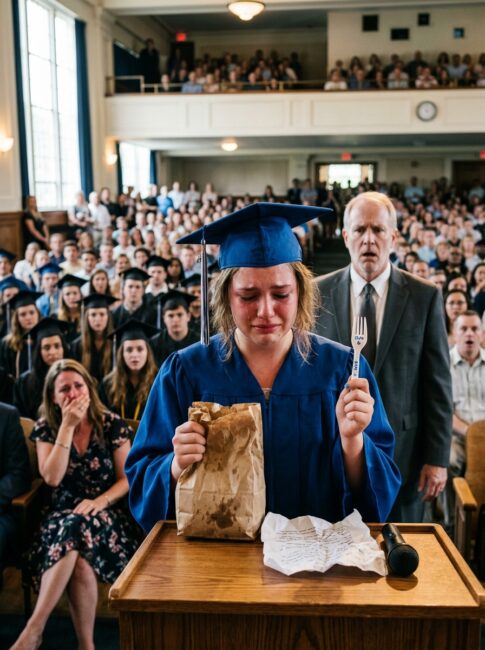
Lily looked down at the brown lunch bag. Her fingers trembled around the taped corner.
“My prepared speech begins with a quote,” she said. “It says success is never accidental.”
A few students exchanged glances.
Lily swallowed.
“I believed that when I wrote it.”
She unfolded the top of the lunch bag and reached inside. For a moment, it seemed like she might pull out a note or a photograph.
Instead, she removed a small plastic fork.
The kind that comes wrapped with a school cafeteria meal.
Someone near the back laughed, too quickly and too loudly.
Lily heard it.
She did not flinch.
“This fork is from October 12,” she said. “I know because I wrote the date on the handle with a blue marker.”
She held it up.
The camera crew from the local community channel zoomed in, confused.
Her mother lowered her head.
Lily continued, “That was the day Mrs. Dalton told me I needed to stop taking extra food from the cafeteria.”
A sound moved through the students.
Mrs. Dalton, the cafeteria manager, sat near the aisle in a flowered blouse. Her face went red.
Lily looked toward her, but not with anger.
“I told her I was sorry,” Lily said. “I said I had skipped breakfast.”
One of the teachers covered her mouth.
Lily put the fork on the podium.
Then she reached back into the bag.
This time she pulled out a folded yellow hall pass.
“This is from November 3,” she said. “I was late to AP Chemistry for the sixth time.”
A murmur rose from the staff section.
Mr. Kendall, the chemistry teacher, looked down at his shoes.
“He told me if I wanted to be treated like a serious student, I needed to start acting like one.”
Lily’s voice stayed even.
That made it worse.
She was not performing. She was placing small pieces on a table and letting everyone notice the shape.
“I said I overslept,” she continued. “That wasn’t true.”
Her mother gripped her purse tighter.
Lily reached into the bag again.
A third item came out.
A library card, cracked at the corner.
“This is from the public library downtown,” Lily said. “Not our school library. The downtown one stays open until nine.”
A grandmother in the third row whispered, “Why does that matter?”
Lily looked at the card for a long moment.
“It mattered because our apartment didn’t always have electricity.”
The room quieted.
Not completely.
There were still chairs creaking, phones lowering, someone coughing into a fist. But beneath those small sounds was a new kind of silence, the kind that begins when people realize they have been watching the wrong story.
Principal Howard stopped walking.
Lily’s English teacher, Ms. Bell, sat very still.
She was the one who had coached Lily’s official speech. She had circled weak verbs in red pen and written “more inspirational here” in the margins.
Now her face looked hollow.
Lily took a breath.
“I didn’t plan to say any of this,” she said. “Even this morning, I was going to read what everyone wanted.”
She looked toward the honor students.
Some stared at her with tears in their eyes.
Others looked afraid, as if Lily’s truth might stain the ceremony they had worked so hard to keep clean.
“My speech says Maple Ridge is a place where every student is seen,” Lily said.
She paused.
Then she shook her head.
“But I was not seen. I was measured.”
A few parents shifted sharply.
That sentence landed harder than accusation because Lily did not raise her voice.
She reached into the brown bag one last time and pulled out a key.
It was attached to a faded purple ribbon.
Her mother stood halfway from her seat.
“Lily,” Denise whispered.
Lily finally looked at her.
Her eyes softened.
“I know, Mom,” she said.
Then she turned back to the auditorium.
“This is the key to Room 214,” Lily said. “And this is where the part of the story begins that almost nobody knows.”
Principal Howard’s face lost all color.
Room 214 was an old classroom near the back stairwell, used mostly for storage after the district cut the home economics program.
Most students walked past it without noticing.
Dusty sewing machines sat beneath plastic sheets. Outdated textbooks leaned in warped stacks. A cracked globe rested on a cabinet, forever tilted toward the wrong ocean.
But to Lily Warren, Room 214 had become something else.
“At first,” she said, “I went there because I needed somewhere warm.”
Nobody spoke.
The air-conditioning hummed above the stage. Outside, traffic moved beyond the school lawn. Inside, every sound seemed too human to hide.
Lily held the key flat in her palm.
“My mom worked nights at Mercy Hospital,” she said. “She cleaned rooms after surgeries and came home smelling like bleach. She never complained. Not once.”
Denise pressed one hand to her mouth.
Lily did not look at her long, because if she did, she might not finish.
“My little brother, Ben, was nine then. He has asthma. When our landlord raised the rent, we moved into a smaller apartment with a heater that sounded like it was choking.”
A few people turned toward Denise.
She shrank under the attention.
Lily’s voice changed when she noticed.
“Please don’t look at my mother like that,” she said.
The room froze.
“She is not the reason I’m telling this.”
That was the first twist nobody expected.
They had been ready for blame. Blame was easier. Blame gave people somewhere to put their guilt.
Lily offered them no such comfort.
“My mom did everything she could,” she said. “She skipped meals so Ben could eat. She wore the same winter coat for seven years. She smiled at every teacher conference because she didn’t want anyone treating me like a sad story.”
Denise began to cry quietly.
Lily’s hands trembled again, but she kept going.
“The reason I had this key is because Mrs. Alvarez gave it to me.”
Every head turned.
At the far end of the teachers’ row sat a small woman in her sixties with silver hair pinned low at her neck. She was not wearing a robe. She was not on the program.
Most parents knew her only as the evening custodian.
Mrs. Rosa Alvarez stood slowly, confused by the attention.
Lily smiled at her through tears.
“She found me in the hallway one night after debate practice,” Lily said. “I was pretending to study, but I was really waiting until the public library opened the next morning.”
A boy in the first row whispered, “She slept here?”
Lily heard him.
“Yes,” she said.
That single word changed the room.
A sob rose somewhere near the back.
Principal Howard closed his eyes.
“I didn’t sleep here every night,” Lily said. “Only when the apartment was too cold for Ben, and I wanted Mom to use the space heater in his room. I told them I was staying with a friend.”
Denise shook her head, crying harder.
“I didn’t know,” she whispered.
“I know,” Lily said gently. “That was the point.”
The auditorium seemed to lean toward her.
“Mrs. Alvarez could have reported me,” Lily continued. “Maybe she should have. Instead, she brought me soup in a thermos and told me the couch in Room 214 was better than a hallway floor.”
Mrs. Alvarez wiped her eyes with the sleeve of her cardigan.
“She said school rules mattered, but children mattered first.”
Nobody clapped.
It would have been too easy.
Lily picked up the plastic fork again.
“This is why I took extra food,” she said. “Not because I was greedy. Because Ben liked the chicken patties, and on Fridays I could wrap one in napkins and put it in my backpack.”
Mrs. Dalton, the cafeteria manager, began to cry.
“I thought you were selling them,” she whispered.
“I know,” Lily said.
There was no bitterness in her answer, and that made Mrs. Dalton bow her head.
Lily picked up the hall pass.
“This is why I was late to chemistry,” she said. “Because I walked Ben to school after Mom’s night shifts ran long. He got scared on the bus after some older boys mocked his inhaler.”
Mr. Kendall’s face crumpled.
“I should have asked,” he said.
Lily looked at him.
“Maybe,” she said. “But I should have told someone too.”
That was the second twist.
She would not make herself a saint either.
The redemption in the room did not come from making everyone else cruel and herself pure. It came from something quieter, something harder to hold.
Everyone had failed in small ways.
Everyone had also been trying to survive their own version of the day.
Lily touched the cracked library card.
“This is why I wrote essays at the downtown library,” she said. “When the lights went out at home, I told teachers my laptop died. When my clothes smelled like mildew, I sat in the back. When kids joked that I was too serious to have fun, I laughed because it was easier than explaining I was tired.”
The student council president began crying into her sleeve.
She had once made a joke about Lily’s thrift-store shoes during lunch. It had been quiet enough to pretend it never happened, but loud enough for Lily to hear.
Lily did not mention her.
That mercy was its own kind of speech.
Then Lily looked toward Principal Howard.
The room turned with her.
“This morning,” she said, “Mr. Howard asked me to keep my speech positive.”
The principal’s jaw tightened.
“He told me donors would be here. The superintendent would be here. He said people want to leave graduation feeling hopeful.”
Parents began murmuring.
Principal Howard stepped to the microphone at the side of the stage.
“That is not what I meant,” he said.
Lily nodded.
“I believe you.”
That answer disarmed him.
“I think you meant well,” she said. “I think you wanted the school to look good. I wanted that too.”
Her gaze moved across the teachers, parents, and students.
“But looking good is not the same as doing good.”
The sentence settled slowly.
Not like thunder.
Like dust after something old has finally been moved.
Lily opened the folded speech she had refused to read.
“This version thanks the scholarship committee,” she said. “It thanks my teachers. It says I’m grateful for every opportunity Maple Ridge gave me.”
She looked up.
“I am grateful.”
Then she tore the first page in half.
A sharp gasp cut through the room.
She tore the second page too.
Not angrily. Carefully.
Like removing a bandage from skin that still hurt.
“But gratitude should not require silence,” she said.
Denise stood fully now, crying openly.
Lily looked at her mother.
“Mom, I didn’t tell you because you already looked so tired. I thought if I could just get to graduation, everything would be worth it.”
Denise shook her head.
“You were a child.”
“I was your child,” Lily said.
That was when Denise left her seat.
No one stopped her.
She walked down the aisle in her worn church shoes, past the school board, past the teachers, past the rows of parents who had once praised her daughter without ever seeing what praise had cost.
At the edge of the stage, Denise looked lost.
Lily stepped away from the podium and knelt in her cap and gown so her mother could reach her.
They embraced there, halfway between the stage and the audience.
The microphone did not catch everything Denise said.
Only one sentence reached the room.
“I’m sorry you thought you had to protect me.”
Lily held her tighter.
Mrs. Alvarez pressed both hands to her heart.
Then Ben appeared from the second row.
Small for twelve, wearing a shirt too formal for his comfort, he moved hesitantly toward the stage. In his hand was an inhaler with a blue cap.
He looked terrified by the crowd.
Lily saw him and opened one arm.
Ben climbed the stage steps and folded into his sister.
The auditorium finally broke.
Not into applause.
Into something more uneven.
A hundred people crying in different ways.
A teacher sobbing without hiding it.
A father wiping his glasses.
A student staring at the floor because she remembered every lunch table she had guarded like a border.
Then Mrs. Dalton stood.
Her voice shook as she called from the aisle, “Lily, I owe you an apology.”
Lily looked at her.
Mrs. Dalton pressed a napkin to her mouth.
“And Ben,” she added.
Mr. Kendall stood next.
“So do I.”
One by one, not dramatically, not perfectly, people began standing. Some were apologizing. Some were simply unable to sit through the truth anymore.
Principal Howard remained near the curtain, looking older than he had ten minutes before.
Finally, he walked to the main microphone.
Lily stepped back, uncertain.
He did not take her place.
He stood beside her.
“I asked Lily to read an approved speech,” he said. “She gave us a necessary one.”
His voice cracked.
Then he turned toward Mrs. Alvarez.
“Rosa,” he said, “after today, Room 214 will not be a storage room.”
Mrs. Alvarez blinked.
The principal looked out at the crowd.
“It will become a student support room. Food, coats, quiet space, emergency supplies. Not someday. This summer.”
The applause came then.
But Lily did not smile right away.
She looked at the brown lunch bag on the podium, at the fork, the hall pass, the library card, and the key.
They were not trophies.
They were evidence of a life people had almost missed.
After the ceremony, families gathered outside beneath the maple trees.
Graduates posed with flowers and balloons. Parents adjusted crooked caps. The brass band played a little too loudly near the front steps, trying to return the day to something normal.
But normal had changed.
People approached Lily carefully.
Some hugged her. Some apologized. Some simply touched her shoulder and walked away because words failed them.
Lily accepted each kindness with a tired grace.
She had not wanted to become a symbol.
She had only wanted the truth to stand in the same room as the celebration.
Near the parking lot, Mrs. Alvarez sat on a bench with Ben beside her. She had given him a wrapped sandwich from her tote bag, and he was eating it slowly while pretending not to be watched.
Denise stood nearby speaking with Mrs. Dalton.
Neither woman looked comfortable, but neither walked away.
That mattered.
Mr. Kendall came over with his hands in his pockets.
“Lily,” he said, “your final lab report is still the best one I’ve read in fifteen years.”
Lily laughed softly.
“That sounds like something a chemistry teacher says when he doesn’t know how to apologize twice.”
He smiled, ashamed and grateful.
“That too.”
He handed her a small box.
Inside was a new scientific calculator.
“You won’t need it forever,” he said. “But maybe for the first semester.”
Lily ran her thumb over the plastic case.
“Thank you,” she said.
Across the lawn, Principal Howard stood with two school board members and the superintendent. They were speaking seriously, not for cameras this time. Every few seconds, one of them glanced toward the old back wing where Room 214 sat behind dark windows.
Lily noticed.
She did not trust promises made in emotional moments.
But she knew promises had to begin somewhere.
Her mother came to her then.
Denise looked smaller in the daylight, like a woman who had been holding herself upright for years and had only just remembered she was allowed to lean.
“I found something in my purse,” Denise said.
She opened her hand.
In her palm was a tiny gold star sticker, bent at one corner.
Lily stared at it.
“When you were little,” Denise said, “you cried because your kindergarten teacher gave everyone a sticker except you. You said she forgot.”
Lily smiled faintly.
“I don’t remember.”
“I do,” Denise said. “I bought a sheet of these from the dollar store. Every Friday, I put one on your homework folder before you woke up.”
Lily looked at her mother.
Denise’s eyes filled again.
“I wanted you to feel seen,” she whispered. “Even when I was too tired to say it right.”
Lily took the sticker carefully.
It was almost nothing.
A small foil star worth less than a penny.
Yet she held it like something precious.
Ben walked over with crumbs on his shirt.
“Are we still going to take pictures?” he asked.
Lily wiped her cheeks.
“Yes,” she said. “But only if you smile like you actually know me.”
Ben rolled his eyes.
“I know you too much.”
For the first time that day, Lily laughed without pain in it.
They stood beneath the maple tree. Denise on one side, Ben on the other, Mrs. Alvarez just behind them because Lily insisted she belonged in the picture too.
As the camera clicked, a breeze lifted the corner of Lily’s graduation gown.
In her hand, hidden from most of the crowd, she still held the key to Room 214.
Later, when people talked about that graduation, some remembered the torn speech. Some remembered the principal’s apology. Some remembered the way the auditorium fell silent when Lily said she had slept at school.
But Lily remembered something else.
She remembered her mother’s hand smoothing the sleeve of her gown after the picture.
She remembered Mrs. Alvarez whispering, “You did not waste the truth.”
And she remembered Ben slipping the plastic cafeteria fork into his pocket, as if it belonged to all of them now.
Years later, when Room 214 became a warm place with shelves of food, clean coats, and a couch no student had to explain needing, the cracked old key was placed in a small frame by the door.
No plaque.
No speech.
Just a key.
And beneath it, a strip of paper in Lily’s handwriting that said, “For anyone who needs somewhere to be seen.”
If this story stayed with you, follow this page for more heartfelt stories about the quiet truths people carry every day.