Part 2: The Student Who Carried an Old Helmet Onto the Award Stage — The Story Behind It Left Everyone Silent
For three seconds, nobody moved.
The gym lights hummed above the stage. A baby fussed somewhere in the bleachers. The blue curtains behind the podium shifted slightly from the air conditioner, but the room itself felt frozen.
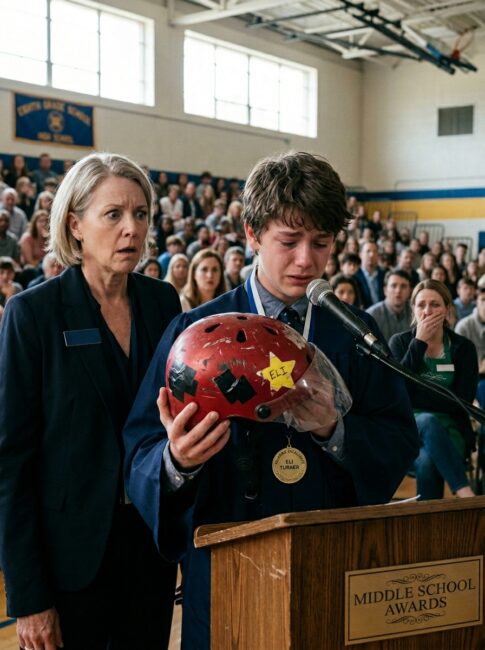
Eli Turner stood with one hand on the old helmet and the other pressed flat against his gown, as if he needed to remind himself to breathe.
Principal Carter looked at the name inside the helmet again.
Then she looked at Eli’s mother.
That was the first small thing everyone noticed.
Not shock.
Recognition.
Eli’s mother, Nora Turner, gripped the back of her folding chair so hard her knuckles turned pale. She was a white woman in her late thirties with brown hair pulled into a tired bun, the kind of face that looked younger in old photos and older under fluorescent lights.
She shook her head once.
Not angrily.
Almost pleading.
“Eli,” she whispered again.
But the microphone caught it this time.
A ripple went through the gym.
Eli’s best friend, Marcus Hill, leaned forward from the third row of students. Marcus was usually the loud one, the boy who could make half a class laugh with one raised eyebrow. Now he stared at the helmet like it had become heavier than metal.
Mrs. DeLuca, Eli’s homeroom teacher, pressed a hand to her mouth.
She had seen that helmet before.
That was the second small thing.
The teachers knew something the students did not.
Principal Carter cleared her throat. “Eli, do you want to say a few words?”
A few parents exchanged uneasy looks.
This was not part of the program. The ceremony still had scholarships, choir awards, and the slideshow. People had dinner reservations. Grandparents had been sitting on hard bleachers for almost an hour.
But nobody complained.
Eli touched the cracked visor with his thumb.
“I know some people think this looks embarrassing,” he said.
His voice was steady enough to surprise even him.
A boy in the back row shifted in his seat.
Eli did not look at him.
“I thought that too at first.”
Nora closed her eyes.
On the stage, the old helmet seemed almost ridiculous beneath the bright banner that read Congratulations, Class of 2026. It looked like something pulled from a garage sale box. The faded red paint had scratches deep enough to show white plastic underneath.
There was a sticker on the left side.
Not a superhero.
Not a sports team.
A small yellow star, half peeled away.
Eli turned the helmet slightly.
Inside, written in black marker, was a name.
Sammy.
Some students squinted.
One girl whispered, “Who’s Sammy?”
Eli heard that too.
His throat moved.
“My little brother,” he said.
The gym softened at the edges.
Most people at Maple Ridge knew Eli Turner as the quiet boy with perfect grades, worn sneakers, and a habit of packing extra pencils for everyone. They knew he walked to school no matter the weather. They knew he never came to dances. They knew his mother missed most parent meetings because she worked closing shifts at Greenway Market.
But many of them did not know he had a brother.
Marcus did.
Mrs. DeLuca did.
Principal Carter did.
And the school nurse, who had quietly stepped into the gym doorway, knew most of all.
Eli looked down at the helmet.
“Sammy is six,” he said. “He likes fire trucks, blueberry waffles, and asking questions during movies.”
A few parents smiled gently.
Then Eli added, “He also thinks this helmet is magic.”
The smile faded from Nora’s face.
Principal Carter’s eyes lowered.
Eli reached into the pocket of his gown and pulled out a folded piece of paper.
The edges were soft from being opened too many times.
“I wasn’t going to bring it,” he said. “Mom told me not to.”
Nora’s face flushed with pain, but she did not sit down.
“She thought people would laugh.”
No one laughed now.
Eli unfolded the paper.
His hands shook.
That was the third small thing.
Eli Turner, the student who never forgot homework, never stumbled during presentations, and once solved a math problem on the board while the fire alarm flashed, could barely hold one piece of notebook paper.
Mrs. DeLuca stood from her chair.
“Take your time, sweetheart,” she said.
The microphone carried it across the gym.
Eli nodded.
Then he looked at the front row of students.
“Some of you asked why I always left right after school,” he said. “Some of you thought I was rude. Some of you thought I didn’t want to hang out.”
Marcus looked down.
Eli continued. “I wanted to.”
The words hung there.
Small.
Heavy.
“I wanted to go to pizza after exams. I wanted to be in the spring play. I wanted to stay for robotics club. I wanted to ride the bus home like everybody else.”
His thumb pressed harder against the paper.
“But I had to get to Oak Street before 3:40.”
Principal Carter closed her eyes for half a second.
The school nurse wiped under one eye.
The audience did not understand yet.
But they understood enough to stop breathing casually.
Eli turned the helmet toward himself, as if the next part belonged first to the object and only second to the room.
“Because if I didn’t,” he said, “Sammy would wait outside the daycare wearing this.”
Nora made a small sound.
Not a sob.
Something smaller and more broken.
Eli looked up.
“And everyone thought I was carrying an old helmet because I was ashamed of what we couldn’t afford.”
He paused.
“But that wasn’t the reason.”
PART 3 – REDEMPTION
Eli had not planned to speak that long.
He had written only five sentences on the paper. Thank you. I am honored. My family helped me. My teachers helped me. This award belongs to someone else too.
But standing there, with the helmet on the podium and the whole gym waiting, the truth began arriving in pieces.
Maybe because he was tired.
Maybe because the year was finally ending.
Maybe because, for the first time, he realized silence had protected him less than he thought.
“My mom works at Greenway Market,” Eli said.
Nora opened her eyes.
“She works there almost every day. Sometimes mornings. Sometimes nights. Sometimes both if someone calls out.”
A few parents glanced at Nora’s uniform.
She stood straighter, though her face remained wet.
“My little brother Sammy goes to daycare after school,” Eli continued. “The daycare closes at six, but the bus from my school drops me off near Oak Street before four. So I walk there first.”
He looked down at the helmet again.
“Sammy has asthma. He gets scared when he feels like he can’t breathe. Last winter, the daycare had a fire drill, and he panicked.”
The nurse bowed her head.
“He ran outside without his coat,” Eli said. “He kept crying because he thought the fire truck was coming for him. So the next day, I told him the helmet was special. I told him if he wore it, nothing bad could get inside his head.”
A few people smiled sadly.
“It was dumb,” Eli said. “But he believed me.”
Nora whispered, “It wasn’t dumb.”
The microphone barely caught it, but everyone heard.
The first twist had been that the helmet belonged to his brother.
The second came when Eli looked toward the student section.
“Some of you saw me carrying it in my backpack,” he said. “And some of you laughed.”
A boy named Trevor Wells sank lower in his chair.
Trevor was not a cruel kid in the dramatic way movies make bullies look. He was popular, loud, and careless. The kind of boy who thought embarrassment was funny when it belonged to someone else.
In November, he had grabbed the helmet from Eli’s backpack after gym class.
He held it over his head and said, “Turner still needs training wheels.”
Students laughed.
Eli did not chase him.
He only stood there with his jaw tight, waiting until Trevor got bored and tossed it back.
What nobody knew was that Sammy refused to leave daycare that afternoon without the helmet.
He sat on the sidewalk, crying so hard he started wheezing.
Eli arrived fifteen minutes late because he had searched every locker row, terrified Trevor had hidden it.
That day, Nora had left work early, lost four hours of pay, and cried in the car where Sammy could not see.
Eli did not say all of that.
Not at first.
He only said, “One day, somebody took it. And my brother had an asthma attack because I didn’t bring it on time.”
Trevor’s face changed.
So did his mother’s.
She had been filming the ceremony on her phone. Slowly, she lowered it.
Eli continued, “He was okay. But after that, I stopped bringing my backpack into the locker room.”
Marcus lifted his head.
That explained something.
All winter, Eli had carried his books in his arms. People had called him weird for that too.
The third twist came from Mrs. DeLuca.
She stepped closer to the microphone, but did not take it from him.
“Eli,” she said gently, “may I say something?”
He nodded.
Mrs. DeLuca turned to the audience.
“In March, Eli missed the first round of the county science fair.”
A murmur moved across the gym.
Everyone remembered that. Eli’s project had been expected to win. He had built a low-cost home air-quality monitor from donated parts and old phone chargers.
Some said he got nervous.
Some said he overslept.
Some said the perfect student finally cracked.
Mrs. DeLuca looked at him with an expression filled with apology.
“I thought he had given up,” she said. “I was disappointed. I told him he had wasted an opportunity.”
Eli looked at his shoes.
“But that morning,” she continued, “his brother had a breathing episode on the way to daycare. Eli stayed with him until his mother could leave work. He arrived at the science fair late, carrying this helmet and a plastic inhaler bag.”
Nora covered her mouth.
Mrs. DeLuca’s voice trembled.
“He still presented in the hallway after the judges left. He showed me how his monitor could warn families when air quality dropped. He said it was for old apartments, places where people couldn’t afford expensive filters.”
The gym was silent.
“Later,” she said, “I found out he had been testing it beside Sammy’s bed.”
Eli stared at the paper in his hands.
He had not expected Mrs. DeLuca to say that.
He had not expected anyone to remember.
Principal Carter stepped beside him now.
“Eli didn’t win the county science fair,” she said. “Because he was late.”
A quiet ache moved through the room.
“But the district reviewed his project last month,” she continued. “They are funding a summer pilot program for three low-income apartment buildings.”
Eli looked at her, startled.
Nora looked at her too.
Principal Carter smiled through tears. “We were going to announce it after the scholarships.”
The fourth twist hit the room like light through a door.
The boy people had laughed at for carrying a child’s helmet had built something that might help children breathe easier.
Eli’s face crumpled for one second before he forced it still.
Then he turned back to the audience.
“My brother thinks I’m brave,” he said. “But he’s the brave one. He wears this even when kids stare. He walks into daycare after being scared. He lets nurses listen to his chest. He sleeps with a flashlight when the hallway is dark.”
Nora sat slowly, as if her legs could no longer hold her.
Eli picked up the gold medal from the tray.
Principal Carter did not stop him.
He held it for a moment, then placed it around the helmet.
A soft sound moved through the audience.
Not applause.
Not yet.
Something between a breath and a broken prayer.
“This award says citizenship,” Eli said. “I thought that meant doing big things people notice.”
He swallowed hard.
“But most days, it meant getting to Oak Street before my brother got scared.”
The main twist arrived quietly then.
Eli had not brought the helmet to embarrass anyone.
He had not brought it to accuse the school.
He had brought it because the person who made the award possible was not allowed in the ceremony.
Sammy was home sick.
A fever had kept him in bed, wrapped in a dinosaur blanket, waiting for Eli to return with “the shiny thing.”
“He wanted to come,” Eli said. “He said he’d clap softly so he wouldn’t cough.”
A few people laughed through tears.
“So I brought this instead.”
Trevor Wells stood up.
Everyone turned.
His mother reached for his arm, but he stepped into the aisle.
He looked smaller than he usually did.
“I took it,” he said.
The gym went completely still.
Eli looked at him.
Trevor’s voice shook. “In November. I took the helmet. I thought it was funny.”
His mother’s face folded in shame.
“I didn’t know about your brother,” Trevor said.
Eli held the helmet tighter.
Trevor swallowed. “I should have given it back right away. I’m sorry.”
There were no dramatic speeches.
No instant forgiveness wrapped neatly for the crowd.
Eli only nodded once.
It was enough for the moment.
Then Marcus stood too.
“I laughed,” he said, looking at Eli. “Not that day. But other times. I didn’t ask why you left after school.”
Another student stood.
Then another.
The gym became a strange place, full of children standing inside small regrets.
Eli did not ask them to.
He did not look victorious.
He looked exhausted.
Principal Carter reached for the microphone.
But before she could speak, Nora walked to the stage.
Her grocery-store shoes squeaked faintly on the gym floor. She climbed the side steps slowly, embarrassed by the attention and unable to stay away from her son.
Eli turned toward her.
“I’m sorry,” he whispered.
“For what?” Nora asked.
“For saying it.”
She touched his cheek.
“You carried too much of it quietly.”
Then she turned to the helmet.
The yellow star sticker curled at one edge.
Nora pressed it down with her thumb, the way mothers fix small things even when large things are falling apart.
The audience finally understood why Eli had not taken the medal at first.
Some children carry backpacks.
Some carry secrets.
Some carry old helmets because a little boy believes plastic and tape can keep fear away.
And some carry all of it without asking anyone to notice.
PART 4 – ENDING
The applause did not begin loudly.
It started with Mrs. DeLuca.
Then the school nurse.
Then a grandmother in the second bleacher row who had been crying into a tissue.
Within seconds, the whole gym was standing.
Eli looked overwhelmed by it. He held the helmet with both hands, the medal resting against its cracked red side. Nora stood beside him, one arm around his shoulders, blinking fast under the bright stage lights.
Principal Carter stepped back.
For once, she let the program fall behind schedule.
No one minded.
That evening, Eli came home with the helmet tucked carefully under one arm.
Their apartment smelled like chicken soup, laundry soap, and the faint dust of the window fan. Sammy was on the couch in dinosaur pajamas, cheeks flushed from fever, hair sticking to his forehead.
He sat up when Eli came in.
“Did you win the shiny thing?” Sammy asked.
Eli knelt beside the couch and placed the helmet in his lap.
The gold medal slid down the side and caught the lamplight.
Sammy’s eyes widened.
“You put it on my helmet?”
Eli smiled. “It fit better there.”
Sammy touched the medal with one finger.
“Does that mean the helmet is famous now?”
“Maybe a little.”
Sammy considered this seriously. Then he looked at Eli.
“Were people nice?”
Eli thought of the laughter that had stopped. He thought of Trevor standing in the aisle. He thought of Marcus staring at the floor, and Mrs. DeLuca saying the words he had never known he needed to hear.
“Eventually,” he said.
Sammy nodded, satisfied by an answer only a child would accept.
Nora stood in the kitchen doorway, watching her two boys. Her work uniform was still on. Her name tag was crooked. Her eyes looked tired, but different now, as if some hidden weight in the room had shifted.
Later that night, after Sammy fell asleep, Eli found the helmet beside his brother’s pillow.
The medal was still around it.
The cracked visor pointed toward the door like it was standing guard.
Eli reached down to move it to the dresser, but Sammy stirred and mumbled without opening his eyes.
“Leave it there.”
So Eli did.
The next fall, Maple Ridge started a new tradition.
At the promotion ceremony, the citizenship award was no longer just a certificate and a medal. Each student had to name one person who helped them become worthy of it, especially someone who might never stand onstage.
Some named grandparents.
Some named bus drivers.
Some named cafeteria workers, older siblings, neighbors, and mothers who packed lunches after midnight.
And on the wall outside the main office, inside a small glass case, sat a photo from Eli’s ceremony.
Not the official one.
In the picture, Eli stood beside his mother, holding the old red helmet with the gold medal around it. His face was shy. Nora’s hand was pressed to the peeling yellow star.
Below the photo was a handwritten note from Sammy, taped slightly crooked.
My brother says brave things can look old.
Years later, Eli would remember the stage lights less than the quiet after the laughter stopped.
He would remember how heavy the helmet felt in his hands.
He would remember his mother pressing the sticker flat.
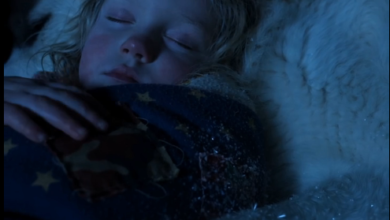
And he would remember Sammy asleep with one hand resting on the cracked red shell, trusting it to keep watch through the dark.
Follow this page for more heartfelt stories about the quiet courage people carry when no one understands them.