Part 2: The Student Who Quietly Swapped His Speech at the Last Minute — And Left the Whole Auditorium Silent
At first, the audience thought it was a prank.
A few students laughed nervously near the back rows. One father lifted his phone higher, waiting for the joke to land. Principal Hensley stayed near the curtain, her fingers locked around the folder Ethan had abandoned.
Ethan did not smile.
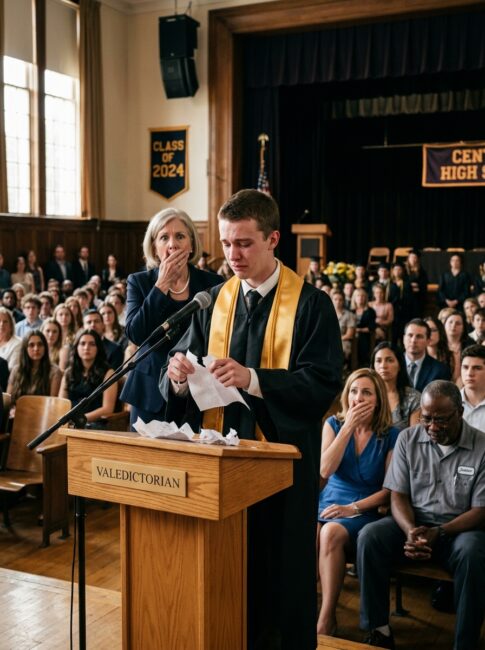
He looked smaller behind the podium than he had during rehearsals. His graduation gown hung loose on his shoulders, and the gold valedictorian stole seemed too bright against his pale face.
“I was supposed to stand here today,” he began, “and thank my teachers, my classmates, and my family.”
A relieved murmur moved through the auditorium. That sounded normal enough.
Then Ethan looked down at the folded paper, but he did not read from it.
“I was also supposed to thank a scholarship committee for choosing me.”
The room stilled again.
In the third row, Mrs. Carlisle, the guidance counselor, shifted in her seat. She had a program folded sharply in her lap. Her eyes moved toward Principal Hensley, then away.
Ethan continued.
“Two weeks ago, I was told I had won the Harrington Future Leaders Scholarship. Full tuition. Four years.”
Now the applause came quickly, almost desperately. Wilson High had never produced many full-ride recipients. The Harrington scholarship was the kind of news a town put on banners and Facebook posts.
Ethan waited until the applause died.
“I didn’t earn it alone.”
That sentence did not sound strange by itself. Graduation speeches were full of humility. Mothers dabbed their eyes. Teachers nodded.
But Ethan’s hands were trembling.
He pressed them flat against the podium so hard his knuckles whitened.
“My grades are mine,” he said. “My essays are mine. But the reason I made it to school every day, the reason I had food some nights, the reason I had a quiet place to study when our lights were cut off…”
He stopped.
In the front row, his mother lowered her face.
For most of Wilson High, Ethan Miller’s family was a simple story. His mother, Denise, worked at a pharmacy. His father had left when Ethan was nine. Ethan was bright, polite, and poor in the kind of way people mentioned only when praising his resilience.
They knew he wore the same black shoes every formal event.
They knew he never came to school trips that cost more than twenty dollars.
They knew he never complained.
But nobody knew why the janitor sitting near his mother looked as if he had already been wounded before Ethan spoke.
Ethan turned a page.
“This morning, before the ceremony, I found out something I was not supposed to know.”
A ripple moved across the audience.
Mrs. Carlisle’s face tightened.
Ethan looked toward the left side of the auditorium, where the teachers sat together in navy folding chairs.
“Last year, when my lunch account was empty, someone filled it.”
Several students glanced at one another.
“When my AP exam fees weren’t paid, someone paid them.”
His voice grew quieter.
“When I got into Ridgewell University and almost declined because I couldn’t afford the deposit, someone left the exact amount in an envelope inside my locker.”
A few people turned toward Ethan’s mother. Denise Miller shook her head slightly, as if begging him not to continue.
Ethan swallowed.
“For a long time, I thought it was my mom.”
His mother began to cry silently.
“She let me think that.”
The janitor beside her, Mr. Samuel Brooks, kept his hands folded around his cap. He was sixty-four years old, with a narrow face and a gray beard trimmed close. Most students called him Mr. Sam. Most adults barely called him anything.
He was the man who unlocked classrooms before sunrise. The man who mopped cafeteria spills after pep rallies. The man who scraped gum from under desks without looking offended by the work.
He had been at Wilson High longer than half the teachers.
And yet, when donors toured the building, he disappeared into supply closets.
Ethan’s eyes found him.
Mr. Sam looked down.
That was the first moment the auditorium changed.
Not loudly. Not dramatically.
Something small passed through the room, like everyone had heard a sound from another floor.
Ethan lifted a worn envelope from inside his gown.
The paper was creased, old, and handled many times. On the front, written in blue ink, was one sentence.
“For the boy who studies after everyone goes home.”
A woman near the aisle whispered, “Oh my Lord.”
Ethan held it up, but he still did not explain everything.
“Yesterday, I saw this envelope in the lost-and-found box in the main office,” he said. “Mrs. Carlisle had pulled it from an old scholarship file by mistake.”
The guidance counselor closed her eyes.
“I recognized the handwriting.”
He paused.
“Because I had seen it on every note taped to the library door when it stayed open late.”
At the back of the auditorium, a former student covered his mouth.
Ethan looked toward Mr. Sam again.
“He wrote those notes.”
Mr. Sam shook his head once, almost invisibly.
Ethan’s voice cracked.
“And that was only the first thing I found.”
The story did not come out cleanly. It came out in pieces, the way truth often does when it has been hidden by people trying not to embarrass anyone.
Ethan explained that during freshman year, after his mother’s hours were cut at the pharmacy, he started staying after school because home was cold and quiet in a way that frightened him.
The library closed at four.
The buses left at three-thirty.
But the back hallway near the old trophy cases stayed warm because the boiler pipes ran behind the wall.
So Ethan sat there with his textbooks balanced on his knees.
One evening, Mr. Sam found him asleep beside a chemistry book.
“He didn’t ask why I was still there,” Ethan said. “He just turned on the hallway lights and said the cafeteria ladies had made too much soup.”
A few people laughed softly through tears.
But Ethan did not laugh.
“There was never too much soup.”
Mr. Sam stared at the floor.
Ethan told them about winter mornings when his locker held a pair of gloves he had not bought. About the time his backpack strap snapped and a plain black backpack appeared on the bench outside the gym. About the day his mother’s car broke down, and Mr. Sam drove them home in silence, pretending he was already headed that way.
Each detail landed gently, then heavily.
The audience began to understand that they had walked around a quiet miracle for years without seeing it.
Then Ethan said the first twist that made the school board president sit upright.
“Mr. Brooks did not pay for those things from school funds,” he said. “He paid from his own paycheck.”
Principal Hensley’s face folded in pain.
Mr. Sam worked part-time nights at a grocery store after cleaning the school. Everyone knew he left Wilson High around five. Nobody knew he stocked shelves until midnight.
Nobody knew because he never parked his truck near the store entrance.
Nobody knew because he kept his uniform folded under the passenger seat.
Ethan found out only because the scholarship committee had requested a financial hardship verification, and Mrs. Carlisle had accidentally included a donor note from Mr. Brooks in Ethan’s file.
That note had never been meant for Ethan.
It had been meant for the counselor.
“Please don’t tell him,” Ethan read, his voice unsteady. “That boy has enough weight on his back. Let him believe people expect great things from him, not that they pity him.”
The auditorium was silent except for a small sob from somewhere in the balcony.
But Ethan was not finished.
He turned to another page.
“There is something else.”
Principal Hensley closed her eyes as if she already knew.
Ethan looked at the scholarship committee seated near the front. Two men in suits. One woman in pearls. All three had been smiling for photographs twenty minutes earlier.
“I was awarded the Harrington scholarship because my application showed community leadership,” Ethan said. “But the project they credited me for wasn’t mine.”
A low murmur broke loose.
Now the old judgment returned quickly. Some people stiffened. A few students looked embarrassed for him. It sounded like a confession.
Ethan let them think it for a second.
“The project was called Warm Hallways,” he continued. “A winter coat drive for students who needed help.”
Mrs. Carlisle pressed her hand to her mouth.
“My name was on it because I submitted the final report,” Ethan said. “But I didn’t start it.”
He looked at Mr. Sam.
“He did.”
Mr. Sam’s head lifted.
For the first time, everyone saw his face fully. He looked tired, exposed, and almost frightened.
Ethan said that three years earlier, Mr. Sam had begun collecting forgotten jackets from lost-and-found bins across the district. He washed them at a laundromat. He repaired broken zippers with his own hands. He left them in the nurse’s office with no names attached.
When the project grew, Mrs. Carlisle helped quietly. She filed reports under “student volunteer initiative” because outside donors were more likely to support a student-led project than a janitor’s private kindness.
Ethan had written the report. He had organized the spreadsheet. He had presented the numbers.
But the heart of it had never belonged to him.
“And when the Harrington committee asked me about leadership,” Ethan said, “I gave the answer everyone wanted.”
He looked down.
“I said we must learn to notice people who are overlooked.”
The shame in his voice was not theatrical. It was worse than that. It was honest.
“I just didn’t tell them the person I learned that from was standing behind a mop bucket.”
No one moved.
Then came the smallest twist, the one that seemed to hurt Ethan most.
“This morning, I found out Mr. Brooks was retiring next week.”
A gasp crossed the teachers’ section.
“He didn’t want a party. He didn’t want a plaque. He asked Principal Hensley not to announce it.”
Principal Hensley wiped her cheek.
Ethan turned toward her, not accusingly, but with the sorrow of someone who had grown up in one afternoon.
“He asked to leave through the side door after cleaning up this very auditorium.”
Mr. Sam’s shoulders shook once.
Ethan took a breath that seemed to scrape him from the inside.
“I changed my speech because I was afraid if I gave the approved one, everyone would clap for the wrong person.”
He stepped back from the podium, then forward again.
“I am grateful for the scholarship. I am grateful for my teachers. I am grateful for my mother, who went hungry more times than she ever admitted.”
Denise covered her face.
“But I cannot accept a future built on a kindness I failed to name.”
The scholarship committee chair, Mr. Lowell Harrington III, rose slowly from his seat.
People turned toward him with uncertainty. He was a tall man with silver hair and a reputation for controlling rooms with politeness. His family name was on the auditorium wing. His grandfather had founded the scholarship after returning from war.
Ethan looked terrified for the first time.
Mr. Harrington walked to the aisle.
Principal Hensley moved as if to stop him, then did not.
The microphone picked up the faint sound of Ethan breathing.
Mr. Harrington reached the stage steps, climbed them slowly, and stood beside the podium. For one long moment, he looked at Ethan, then at Mr. Sam.
Then he took the microphone.
“My grandfather used to say there are two kinds of leaders,” he said, his voice rougher than expected. “The kind who stand where everyone can see them, and the kind who make sure someone else can stand.”
Mr. Sam lowered his head again.
Mr. Harrington looked at Ethan.
“You did not lose this scholarship today.”
The room seemed to exhale.
“You earned it twice,” he said. “Once by working hard enough to receive it, and again by being brave enough to tell the truth when silence would have benefited you.”
Ethan’s face crumpled.
Then Mr. Harrington turned toward Mr. Sam.
“But we have been naming the wrong award.”
He paused, and the silence became almost painful.
“Beginning next year, the Harrington Future Leaders Scholarship will include a second honor. The Samuel Brooks Quiet Service Award. Full tuition for one Wilson High student each year whose kindness was not performed for applause.”
Mr. Sam stood halfway, then sat back down as if his legs had failed.
The auditorium rose before anyone told it to.
Not in a burst. Not all at once.
One person stood. Then another. Then an entire row. Then parents, teachers, students, donors, cafeteria workers, coaches, secretaries, and graduates in wrinkled gowns.
The applause did not sound like celebration.
It sounded like apology.
Ethan left the podium and walked down from the stage. He did not go to the scholarship committee. He did not go to the cameras. He went straight to Mr. Sam.
The old janitor tried to shake his hand.
Ethan hugged him instead.
At first, Mr. Sam kept one hand around his cap, unsure what to do with so many eyes on him.
Then he placed his other hand on Ethan’s back.
And the boy who had spent four years being quietly saved finally let himself cry in front of everyone.
After the ceremony, the graduates poured into the courtyard where families waited with flowers, balloons, and cameras.
But the usual noise had changed.
People still smiled. Parents still called names. Caps still flew into the bright June sky. Yet something softer moved through the crowd, as if everyone had become careful with one another.
A mother stopped a custodian near the cafeteria doors and thanked her for keeping the building beautiful.
A football player picked up programs scattered under the bleachers without being asked.
Mrs. Carlisle stood beside the trophy case, crying into a tissue, while three former students told her about coats they had received and never knew where they came from.
Ethan’s mother found Mr. Sam near the side entrance.
He was trying to slip away.
Of course he was.
His truck was parked near the dumpsters, where staff vehicles always sat in the heat and shadow. In one hand, he carried a cardboard box with his name written on the side. Inside were two work shirts, a thermos, a screwdriver, a roll of tape, and a framed photo of a graduating class from twelve years earlier.
Denise Miller walked toward him slowly.
For a moment, neither spoke.
Then she said, “You let me take credit.”
Mr. Sam looked embarrassed.
“You needed him to keep believing you could do everything,” he said.
Denise covered her mouth again, but this time she smiled through tears.
“I couldn’t.”
“I know,” he said gently. “That’s why people help.”
Ethan joined them under the narrow strip of shade beside the building. His gown was wrinkled now. His eyes were red. The gold stole hung crooked over one shoulder.
In his hand was the approved speech he had torn up, taped back together badly by someone from the office.
Principal Hensley had given it to him after the ceremony.
“I thought you might want to remember the day you scared ten years off my life,” she had said.
Ethan looked at Mr. Sam’s box.
“Are you really leaving through the side door?”
Mr. Sam smiled faintly.
“That was the plan.”
Ethan glanced back at the courtyard, where families were still gathered beneath banners that read Congratulations, Class of 2026.
“Plans change,” he said.
Mr. Sam shook his head, but there was no strength in the protest.
Together, they walked back toward the front of the school.
No announcement was made. No microphone was turned on. Nobody organized the moment.
But people noticed.
They always notice eventually, even if it takes too long.
The crowd parted quietly as Mr. Sam crossed the courtyard carrying his small cardboard box. Students who had never spoken to him nodded. Teachers touched his shoulder. A cafeteria worker took the box from his hands when she saw it shaking.
Near the flagpole, Mr. Harrington waited with the scholarship committee.
He did not make a speech.
He simply held out his hand.
Mr. Sam looked at it for a moment, then accepted it.
Cameras clicked, but the best picture was one nobody took.
It was Ethan’s mother standing a few steps behind them, one hand pressed over her heart, watching her son watch the man who had helped carry him through childhood without asking to be remembered.
Later that evening, after the chairs were stacked and the auditorium lights were turned off, Ethan returned alone.
He had forgotten his cap.
The building was mostly dark, except for one hallway light near the old trophy cases. The same hallway where he had once studied with cold hands and an empty stomach.
On the bench sat a folded note.
For one wild second, Ethan thought Mr. Sam had left him another envelope.
But when he opened it, the handwriting belonged to Principal Hensley.
It said, “We are leaving this light on.”
Ethan sat down on the bench for a while.
Outside, the last cars pulled away. Somewhere in the building, pipes hummed behind the wall. The hallway was warm.
He looked at the empty space beside him, where a tired janitor had once placed a bowl of soup and pretended it was extra.
Then Ethan folded the note carefully and put it inside his jacket pocket.
The next fall, Wilson High placed a small wooden plaque near the old trophy cases.
It did not use grand words.
It did not mention sacrifice.
It simply read:
For those who make room for others to stand.
And every afternoon, long after the final bell, that hallway light stayed on.
Follow the page for more emotional stories about kindness, truth, and the people we often overlook.