Part 2: The Valedictorian Called Her Janitor Father to the Graduation Stage — And the Story She Told Made the Whole University Rise
At first, the silence felt like embarrassment.
Not reverence. Not curiosity. Embarrassment.
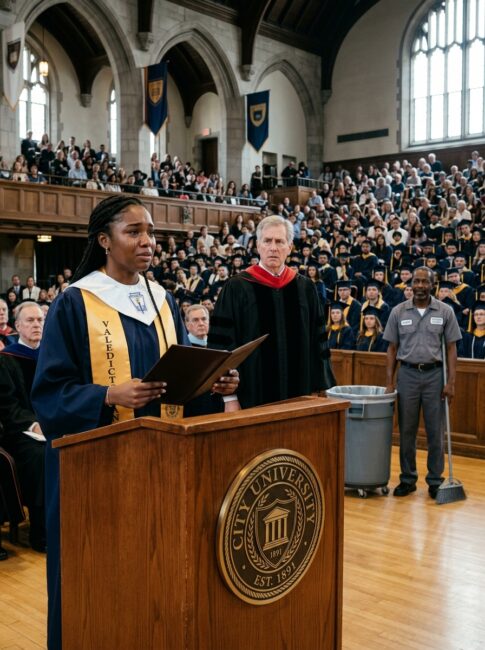
It spread across the auditorium in small, uncomfortable waves. People did not know where to look. The graduates in the front rows turned halfway in their seats, their tassels brushing their cheeks. Parents who had been filming the ceremony lowered their phones just enough to see the janitor at the back door.
His name was Daniel Whitaker, though most students knew him only as Dan from Facilities.
He was fifty-six, Black American, narrow-shouldered, and usually invisible in the way workers become invisible when a room is built to notice someone else. He had cleaned Brookfield’s lecture halls for eleven years. He emptied trash after scholarship dinners. He mopped the science building after rainstorms. He replaced soap in bathrooms where students cried before exams.
That afternoon, he had not planned to sit with the families.
He was working.
He had told Lena there were no extra tickets. She knew that was not true.
Lena watched him standing under the exit sign, one gloved hand still wrapped around the broom handle. He looked smaller than she remembered, pressed between the trash bin and the closed double doors.
“Dad,” she said softly, though the microphone carried it everywhere. “I know you don’t want this.”
The dean leaned closer and whispered, “Miss Whitaker, this is not appropriate.”
The microphone caught enough of it.
A murmur moved through the hall.
Lena turned to him, not angry, not dramatic, just steady.
“With respect, Dr. Bell,” she said, “it was not appropriate that he had to work this ceremony to see me graduate.”
Something shifted.
A woman in the second row covered her mouth.
The university president’s smile disappeared.
Daniel Whitaker lowered his eyes, and Lena saw his right hand tighten around the broom. His knuckles had thick scars she knew by heart, though most people had never noticed them.
She opened the leather folder again.
Inside was the approved speech, printed on heavy cream paper with the university seal at the top. She lifted it, folded it once, and set it aside.
Then she pulled a smaller sheet from the sleeve of her gown.
It was not typed.
It was written by hand.
“My official speech begins with a quote about ambition,” she said. “But my real speech begins with a mop bucket.”
A nervous laugh rose and died quickly.
Lena looked toward the back again.
“When I was ten, my father told me Brookfield University was the most beautiful place he had ever cleaned.”
A few people glanced around, suddenly aware of the polished floors, the chandeliers, the enormous banner that read Excellence Through Service.
“He used to bring me here on Saturdays,” she continued. “Not through the front gate. Through the loading dock.”
Daniel’s face tightened.
That was the first small reveal, and it did not look heroic yet. It looked like a father who had bent a rule and a daughter admitting it publicly.
“My father worked the overnight shift,” Lena said. “When our neighbor could no longer watch me, he brought me with him. I slept in a folding chair outside the supply closet while he cleaned classrooms.”
The hall went quieter.
Not silent, but listening.
Lena turned the handwritten page over, though she already knew every word.
“There was one room he always cleaned last. Room 214 in the biology building.”
A professor seated onstage straightened.
“He would turn on one lamp and let me look at the old anatomy posters. He told me not to touch anything. He told me to be quiet. He told me, ‘This place belongs to people who study hard enough to enter through the front.’”
Daniel’s lips moved, but no sound came out.
Lena smiled faintly.
“I believed him.”
The students near the aisle began to understand something before the adults did. Their faces changed first, softened by recognition. They knew Room 214. They knew the old lab with cracked sinks and skeleton models missing two fingers.
Lena held up a small object from behind the podium.
It was a key.
Rusty, taped across the top, with the number 214 written in fading black marker.
“My father kept this key after the building was renovated,” she said. “He said it was useless. He said it opened nothing.”
She closed her fist around it.
“But every time I wanted to quit, he placed it on the kitchen table.”
Daniel shook his head again, barely.
Lena’s voice dropped.
“And yesterday, I found out why he never came to any parent weekend, why he never sat in any auditorium, why he always asked me to meet him outside.”
The dean’s eyes moved toward the facilities director seated near the side wall.
The facilities director looked down at his program.
Lena did not explain yet.
She let the silence do the work.
Then she said, “My father was afraid someone here would remember how he got me in.”
The phrase hung over the auditorium like an accusation.
How he got me in.
A few people misunderstood it immediately. Lena saw it in their faces. Some leaned back. Some narrowed their eyes. A trustee whispered to another trustee. The words sounded like cheating, like favoritism, like a hidden door through a system that praised merit.
Lena let them sit with that thought for exactly three seconds.
Then she opened the truth slowly.
“When I was seventeen,” she said, “I did not apply to Brookfield.”
Her classmates turned toward her.
“I wanted to. I had the grades. I had the test scores. I had the essay written. But the application fee was more than we had that week.”
She looked down at the podium.
“Our power bill was late. My father had injured his shoulder lifting a floor buffer. He could barely raise his arm, but he still worked both shifts because rent did not care about pain.”
Daniel stood at the back with his broom now resting against the wall. He was not moving. He looked as if each sentence was pulling something from him he had spent years burying.
“I told him I would apply somewhere cheaper,” Lena said. “I said it was practical. I said I did not need a school like this.”
Her voice wavered for the first time.
“He did not argue.”
That was the second twist. Daniel had not given a speech about dreams. He had not forced his ambition onto her. He had simply gone quiet.
“That night, after I fell asleep, he walked two miles to the all-night pharmacy and bought a prepaid card with the money he had saved for his shoulder brace.”
The auditorium breathed in at once.
Lena continued before sympathy could become comfortable.
“He paid the application fee. Then he printed my essay at the public library before sunrise, because our printer had been broken for months.”
She looked toward the faculty section.
“But that was not how he got me in.”
A few heads lifted.
“When Brookfield asked for proof of extracurricular service, I had almost nothing. I had worked after school since freshman year. I watched children at church. I cleaned offices with my father some weekends. None of it sounded impressive on paper.”
She paused.
“My father told me to write the truth.”
Behind her, the dean’s face had gone pale.
“So I wrote that I helped clean classrooms at Brookfield University when I was a child.”
A ripple passed through the hall.
“I wrote about learning discipline from empty lecture halls. I wrote about studying vocabulary words on chalkboards before professors erased them. I wrote about watching my father polish floors beneath portraits of people who never looked like us.”
She turned toward Daniel.
“I wrote about wanting to become a doctor because I spent years watching him hide pain so I would not be afraid.”
Now the silence was not embarrassment anymore.
It was recognition arriving too late.
“That essay got me admitted,” Lena said. “Not because my father pulled a string. Because he carried me close enough to a locked door that I could imagine opening it.”
Daniel covered his mouth with one hand.
Then Lena revealed what even she had not known until the week before graduation.
“When I received my acceptance letter, my father did not celebrate in front of me.”
She smiled through tears.
“He went to the parking garage under the library and cried beside the cleaning cart.”
The facilities director wiped his eyes.
“One of his coworkers saw him. She told me two days ago.”
A gray-haired woman in a facilities uniform, seated near the side aisle, pressed her hand to her chest.
Lena looked at her.
“Thank you, Mrs. Alvarez.”
The woman began to cry quietly.
Lena turned back to the crowd.
“But there is one more part.”
That sentence pulled everyone forward.
“When tuition came due, my financial aid did not cover housing. I was ready to commute almost two hours each way. My father told me he had found a discount through the university.”
She shook her head.
“There was no discount.”
Daniel closed his eyes.
“He gave up his apartment.”
A sound rose from the audience, not applause, not words, just a wounded murmur.
“For six months during my freshman year, my father slept in his truck behind the maintenance building so I could live in a dorm and study safely.”
The university president bent his head.
Lena gripped the podium.
“I found out because campus security wrote him up twice for parking overnight. He begged them not to report it. He told them he was saving money for medical bills.”
She swallowed.
“He was saving money for me.”
The hall was entirely still now.
No one looked at the chandeliers. No one looked at the banners. They looked at the man in gray at the back door, a man who had spent years making rooms ready for other people’s children while his own daughter learned to belong in them.
Lena did not raise her voice.
“My father missed my freshman orientation because he was cleaning the auditorium after it ended. He missed my white coat ceremony because he was stripping wax from the hallway outside. He missed every award dinner because he said tickets were expensive, but really because he had volunteered to work those events.”
She looked at the trustees.
“He wanted to hear my name without making anyone uncomfortable.”
The line landed hardest because it did not accuse anyone directly. It did not need to.
Daniel had not hidden because he was ashamed of his daughter.
He had hidden because the world had taught him that his pride might embarrass her.
Lena stepped away from the podium.
The dean reached out slightly, then stopped.
She carried the microphone down the stage steps. The camera operators followed, unsure whether they were allowed to record this. The whole university watched her cross the long aisle between rows of graduates.
Her gown brushed the floor.
Her gold stole slipped from one shoulder.
At the back of the hall, Daniel whispered, “Baby, don’t.”
The microphone caught that too.
Lena stood before him.
For a second, she looked like a child again, standing beside a supply closet under fluorescent lights.
Then she held out her hand.
“You told me this place belonged to people who studied hard enough to enter through the front,” she said. “You were wrong about one thing.”
Daniel’s face crumpled.
“It belonged to you every night you made it shine.”
The first person to stand was Mrs. Alvarez.
Then a graduate in the third row.
Then a professor from the biology department, the one who had taught Lena anatomy in Room 214 without knowing she had once slept outside it.
Then Lena’s classmates rose, one by one, gowns rustling like a storm through dry leaves.
The trustees stood last.
Not because they were less moved, perhaps, but because they had more to understand.
The applause began gently. It did not crash at first. It grew, filling the hall from the back to the stage, from the students to the parents, from the workers near the doors to the people whose names were on buildings.
Daniel did not move.
He looked at the standing crowd as if he had wandered into someone else’s life.
Lena placed the microphone between them, but did not ask him to speak.
She knew him better than that.
Instead, she took the broom from beside the wall and leaned it carefully against the chair beside him.
Then she took his hand.
The applause became louder.
Daniel stepped forward once, then stopped.
“I’m in uniform,” he whispered.
Lena smiled through tears.
“So am I,” she said.
And with the whole university standing, she led her father up the aisle.
When they reached the stage, Daniel tried to stand at the edge.
It was an old habit. Stay near the wall. Leave room for others. Do not block the important people.
Lena did not let go of his hand.
She brought him to the center, beneath the university seal, where afternoon light spilled through high windows and touched the polished floor he had cleaned before sunrise.
The dean stepped back.
The president removed his glasses and wiped them with a hand that was not entirely steady.
For a long moment, Daniel faced the crowd without speaking. His uniform shirt was faded at the collar. There was a small bleach mark near his pocket. His name tag, scratched and dull, simply read Dan.
Lena adjusted the microphone for him.
He looked at it, then at her.
“I don’t have a speech,” he said.
The hall laughed softly, not at him, but with relief.
Daniel looked across the sea of gowns, parents, professors, and staff. His eyes stopped on Mrs. Alvarez. Then on the biology professor. Then on the students in the front row who had once stepped around his mop bucket without noticing his face.
“I just wanted her to have a chair in a room I used to clean,” he said.
That was all.
It was enough.
The applause returned, but Daniel did not seem to hear it clearly. He was looking at Lena now, as if the rest of the university had dissolved.
“You were never supposed to know all that,” he told her.
Lena nodded.
“I know.”
“I didn’t want you carrying it.”
“I know,” she said again.
He touched the edge of her gold stole with two fingers.
“You look like your mother.”
That was the only time Lena broke fully.
Her mother had died when Lena was twelve, the same year Daniel began taking night shifts at Brookfield. The approved speech had contained a polished sentence about grief shaping ambition. This moment did not need polish.
Daniel pulled his daughter into his arms, and the crowd let them have the quiet inside the noise.
After the ceremony, the university held its reception on the lawn.
There were photographs, handshakes, and speeches that sounded smaller than they had before. Reporters wanted quotes. Trustees wanted to promise changes. The president asked Daniel if he would attend a private dinner the next week.
Daniel said he would think about it.
Then, while no one was watching closely, he picked up a napkin someone had dropped near the lemonade table.
Lena saw him do it.
She almost stopped him.
Instead, she walked over, took another fallen napkin from the grass, and placed it in the trash beside his.
He looked at her, embarrassed.
She smiled.
“Old habits?” she asked.
He shrugged.
“Clean rooms help people breathe.”
Later, when most families had left, Lena and Daniel walked to the biology building. Room 214 was no longer a lab. It had become a seminar room with new chairs, white walls, and a glass panel beside the door.
Daniel stood outside it for a long time.
Lena reached into her pocket and took out the old taped key.
“It really does not open anything anymore,” he said.
“I know.”
She placed it in his palm.
He closed his fingers around it slowly.
“What am I supposed to do with this?”
Lena looked through the glass at the empty room where a little girl had once learned to dream quietly.
“Keep it,” she said. “Some doors open long after the lock is gone.”
Daniel did not answer.
He just tucked the key into his shirt pocket, right behind the scratched name tag.
As they walked out through the front entrance, the sun was lowering across the campus lawn. For once, Daniel did not ask to use the service hallway. He did not hurry. He did not step aside when families passed.
He walked beside his daughter through the main doors.
And before they reached the steps, Lena slipped her hand into his arm the way proud parents usually do.
Follow the page for more heartfelt stories about hidden sacrifices, quiet love, and the people we finally learn to see.