Part 2: The Wife Who Abandoned Her Husband and Two Little Girls Came Back Years Later Demanding $200,000 for Giving Birth
For several seconds, nobody moved.
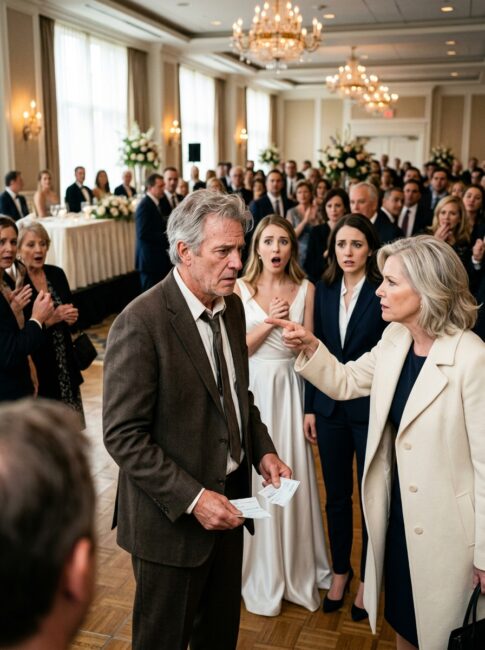
The woman at the door had soft blond hair carefully curled around her face, a leather handbag hanging from one wrist, and the smooth confidence of someone who had rehearsed her entrance in a mirror.
Her name was Linda Bennett.
At least, that was the name Emily and Grace had learned to stop saying before bedtime.
In old family photos, Linda looked younger than memory, always smiling with one hand on Harold’s shoulder and the other around her daughters. But the woman standing in the ballroom did not look like a mother returning home.
She looked like a creditor.
Emily took one step forward, then stopped. Her hands curled at her sides, the way they used to when she was a little girl trying not to cry.
Grace, who could question hostile witnesses without blinking, could not speak at all.
Harold bent slowly and picked up the torn check pieces from the carpet. The movement was stiff, painful, almost humiliating. People watched him like they were watching a poor man embarrass himself at a rich family’s table.
Linda smiled wider.
“Harold,” she said. “You look older.”
He slipped the torn pieces into his jacket pocket.
“You shouldn’t be here,” he said.
That was the first thing that made the room shift.
Not anger.
Not shock.
Fear.
It was small, but it was there.
Harold Bennett, the man who had just humiliated his daughters, looked afraid of the woman he had supposedly lost.
Linda walked past a waiter holding champagne glasses and stopped near the gift table. She picked up a framed photo of Emily and Grace as children, both missing front teeth, both sitting on Harold’s lap in front of a cheap Christmas tree.
“How sweet,” she said. “You kept the old narrative alive.”
Emily’s voice finally came out. “Where have you been?”
Linda’s expression softened in a way that looked practiced. “Surviving.”
Grace’s jaw tightened. “For twenty-four years?”
“For twenty-four years,” Linda said, “I carried the pain of being erased by this family.”
Guests shifted uncomfortably. The story was changing shape in real time, and people loved nothing more than a tragedy with a villain they could recognize.
Linda turned to the room. “Did he tell you I abandoned them?”
Nobody answered.
“Of course he did,” she continued. “That was easier than telling two little girls the truth.”
Harold closed his eyes.
Emily looked at him. “Dad?”
He did not answer.
That silence cut deeper than any denial could have.
Linda stepped closer to her daughters. “I was young. I was overwhelmed. Your father controlled everything. Money. Decisions. Friends. Even what I could say in my own house.”
A low murmur spread through the ballroom.
Harold’s reputation had always been simple. Hardworking. Quiet. Stubborn. Proud. A man who delivered furniture at dawn, fixed machines at night, and never let anyone see him tired.
But simple reputations break quickly when someone offers a darker explanation.
Emily looked at his hands.
They were rough, scarred, and swollen at the knuckles. When she was little, those hands had tied her shoes before school. They had held cold washcloths to Grace’s fevered forehead. They had washed dishes in the sink after coming home from a second job.
Now those same hands were pressed flat against his sides, like he was stopping himself from reaching for something.
Linda took an envelope from her purse.
“I didn’t come to ruin your party,” she said. “I came because I am tired of being treated like I gave nothing.”
Grace gave a small, bitter laugh. “You gave birth. Then you left.”
Linda’s eyes flashed. “Birth is not nothing.”
Nobody argued with that.
Even Harold looked down.
Linda opened the envelope and pulled out several papers. “I have spoken to an attorney. I gave birth to two daughters who are now successful, wealthy women. I lost my body, my youth, my place in this family. I want compensation.”
Emily stared at the papers. “Compensation?”
“Two hundred thousand dollars,” Linda said. “One hundred thousand for each birth.”
The ballroom went silent.
It was such a cold number that nobody knew how to react.
Then Harold laughed once.
It was not humor.
It was the kind of laugh that escapes when a person has held too much inside for too long.
Linda turned on him. “You think that’s funny?”
Harold shook his head. “No.”
“You stole my life,” she said.
He looked up then, and his face changed.
Only for a second.
The tired old man was gone. In his place stood someone who had once swallowed fire and never told anyone it burned.
“I kept them alive,” he said quietly.
Linda lifted her chin. “Because you had to.”
“No,” Harold said. “Because you didn’t.”
The guests looked between them, hungry and uncomfortable.
Emily stepped forward. “Dad, what does she mean by ‘truth’?”
Harold’s mouth opened, then closed.
Grace noticed something then.
A small brown leather wallet in her father’s hand.
He had pulled it from his pocket without realizing it. It was old and cracked, the edges worn nearly white. She recognized it immediately because she had seen it on the kitchen counter every night of her childhood.
Inside that wallet, Harold had kept three things: a picture of his daughters, a grocery store rewards card, and a folded note nobody was allowed to touch.
Grace’s eyes moved to the wallet.
“Dad,” she said softly, “what’s in the note?”
Harold held it tighter.
Linda’s smile vanished.
For the first time since she entered, Linda looked nervous.
That was the second crack in the story.
Emily saw it too.
Her mother, who had walked in like a woman owed applause, was suddenly watching Harold’s wallet like it contained a weapon.
Harold slipped it back into his pocket.
“This is your engagement party,” he said to Emily. “Not a courtroom.”
Grace looked at Linda. “Then why did you bring legal papers?”
Linda folded them quickly. “Because your father never listens unless someone forces him.”
But her hand was shaking now.
Not much.
Just enough.
The guests did not notice.
Grace did.
Emily did.
Harold did not defend himself. He simply moved toward the exit, shoulders bent, his face carrying a shame that did not seem to belong entirely to him.
Emily grabbed his sleeve. “Dad, don’t walk away.”
He stopped.
His eyes went to the floor, then to the guests, then to his daughters.
“I walked away once,” he whispered. “And it cost me twenty-four years of peace.”
Linda whispered sharply, “Harold.”
Grace heard it.
Not a warning.
A threat.
And suddenly, for the first time that afternoon, both daughters wondered whether the man everyone was judging had not been hiding guilt.
Maybe he had been hiding mercy.
The party ended early.
Not officially. No one announced it. The music simply stopped sounding like music, and the waiters moved with the careful quiet of people working around a family wound.
Emily found Harold outside near the loading dock behind the hotel.
It was the kind of place guests were never meant to see: stacked crates, wet pavement, cigarette butts near a drain, and the smell of kitchen grease drifting into the evening air.
Harold was sitting on a concrete step, alone.
For years, Emily had seen him in places like that.
Not ballrooms.
Not offices.
Not country clubs.
Loading docks. Diner kitchens. School hallways after parent-teacher conferences. Hospital waiting rooms where he pretended not to sleep because both daughters were scared.
Grace came out behind Emily, still holding Linda’s envelope.
Their mother had left after saying she would give them “time to think like adults.”
Harold did not look at the envelope.
Emily sat beside him, carefully, like he might break. “Dad, tell us.”
He rubbed his palms together. “There’s nothing good in old dirt.”
Grace stood in front of him. “Then why is she afraid of the note in your wallet?”
Harold looked at her.
That was enough.
Emily whispered, “Please.”
He took out the wallet slowly. His fingers fumbled with the fold, not because he was old, but because memory can make even strong hands clumsy.
The paper was yellowed, soft at the creases.
He handed it to Grace.
She opened it.
At first, her face showed confusion.
Then disbelief.
Then something worse.
Emily leaned in and read over her sister’s shoulder.
Harold,
I can’t do this anymore. Don’t look for me. Don’t make me the villain to the girls, because one day I might come back when they are old enough to understand. Tell them I died if you want. Tell them anything. Just don’t tell them I chose myself.
Linda
Below the signature was a second line, written in darker ink.
If you ever tell them, I’ll tell everyone what you did to me.
Emily looked up slowly. “What did you do?”
Harold gave a tired smile. “I married the wrong woman and thought love could make her stay.”
Grace’s eyes filled. “That’s not an answer.”
“No,” he said. “It’s the only one I’ve got.”
But Grace was a lawyer. She read lies for a living, and what sat in her father’s voice was not deception.
It was protection.
She went through the envelope Linda had brought. There were typed letters, claims, a list of “maternal damages,” and a demand for payment. But tucked between the papers was a photocopy Grace nearly missed.
A birth certificate.
Then another.
Beside both girls’ names, in the section for father, someone had circled Harold Bennett in red ink.
Under the copies, Linda had written: He benefited from my labor. Now they can pay.
Grace’s face hardened. “She’s treating us like invoices.”
Emily sat very still.
Harold reached for the papers. “Give them to me.”
“No,” Grace said.
He looked startled.
Emily turned toward him. “All our lives, you never said one bad word about her.”
Harold stared at the pavement.
“Not once,” Emily continued. “When I asked why she left, you said some people get lost. When Grace cried on Mother’s Day, you said missing someone doesn’t make you weak.”
Grace’s voice trembled. “When kids at school said our mom ran away because we were too much, you told us adults carry storms children don’t cause.”
Harold swallowed.
“I didn’t want you growing up thinking half of you was poison,” he said.
That sentence broke something open.
Emily pressed her hand to her mouth.
Grace looked away because courtrooms had taught her how to stay composed, but daughters are not built like attorneys in front of their fathers.
Harold continued quietly.
“The first year after she left, Emily stopped eating breakfast. You kept putting toast in your backpack for your mother, like she might be hungry wherever she was.”
Emily closed her eyes.
“And Grace,” he said, looking at the younger one, “you slept with your shoes on for three months because you thought if she came back at night, you’d be ready to leave with her.”
Grace let out a sound too small to be called a sob.
“So yes,” Harold said. “I lied. I said she loved you but didn’t know how to stay. I said she might write one day. I said grown-ups make mistakes too big for children to fix.”
Emily whispered, “Why?”
“Because anger is heavy,” he said. “And you were both too little to carry hers.”
A car passed behind the hotel, headlights sliding across Harold’s face. For a moment, both daughters saw every year there.
The winter he fixed broken heaters in apartment buildings after his day shift.
The summer he came home sunburned from roofing jobs and still took them to the public pool because Grace had earned a good report card.
The nights he mopped grocery store floors while Emily did homework in the break room with a vending machine dinner.
The Christmas he gave them bikes and told them the store had a sale, though Emily later found his wedding ring missing.
Grace crouched in front of him. “You sold your ring for those bikes.”
He looked almost embarrassed. “You both needed something that moved forward.”
Emily laughed through tears. “Dad.”
“There were worse trades,” he said.
And there had been.
Harold had cleaned buses at four in the morning, delivered medical supplies before dawn, worked construction until his back gave out, and took weekend shifts at a laundromat where he learned to braid Grace’s hair from a woman named Mrs. Alvarez.
He had done all of it without telling his daughters how close they had come to losing the house.
He had done it while Linda sent nothing.
No birthday cards.
No phone calls.
No child support.
No apology.
But that was not the final twist.
Grace unfolded another paper from Linda’s envelope, a bank statement copied from an old account.
“Dad,” she said slowly, “what is this?”
Harold looked once and turned away.
Emily took it.
The account was from twenty-two years earlier. It showed several withdrawals made days after Linda disappeared.
$4,800.
$2,300.
$1,100.
Then a final withdrawal that emptied everything.
Grace looked at Harold. “She took all the savings?”
He nodded once.
Emily’s voice shook. “And you still let us believe she was just lost?”
Harold’s eyes reddened. “She was your mother.”
“She was the woman who left you with two babies and an empty account,” Grace said.
Harold did not argue.
That was his kind of courage.
Not loud.
Not polished.
Almost foolish to anyone who had never loved children more than being right.
Emily stood and walked a few steps away. She looked through the hotel windows at the ballroom where flowers still sat on the tables and guests whispered around untouched cake.
Then she remembered the check.
“Dad,” she said, turning back, “why did you rip up the money?”
He sighed. “Because I heard what Linda said before she walked in.”
Grace frowned. “What?”
“She called the hotel this morning,” he said. “Asked if the Bennett daughters were wealthy enough to make ‘a family settlement’ worth her trip.”
Emily’s face went pale.
Harold looked at both of them. “I knew she might come. I knew if she saw you give me that check, she would think I had trained you to pay debts that love should never create.”
Grace looked down at the legal papers.
Emily whispered, “You ripped it up to stop her from using it against us.”
He shrugged faintly. “I ripped it up because no child owes a parent for being raised.”
The words stayed in the air.
Simple.
Plain.
Devastating.
Emily sat beside him again, closer this time. “You let the whole room think you were ungrateful.”
Harold smiled without humor. “They’ve thought worse. I survived.”
Grace shook her head. “You shouldn’t have had to.”
“No,” he said. “But most people survive things they shouldn’t have to.”
The back door opened.
Linda stepped out.
Nobody knew how long she had been listening.
Her face was pale beneath her makeup, but her voice remained sharp. “That note proves nothing. I was young.”
Harold stood slowly. “So was I.”
“You had help,” she snapped.
He gave her a look so tired it almost seemed kind. “From whom?”
Linda faltered.
“Emily’s kindergarten teacher gave me extra worksheets because I couldn’t afford summer camp,” Harold said. “Mrs. Alvarez taught me how to braid hair during laundry shifts. The church food pantry gave us canned peaches every Thursday.”
His voice remained low.
“You had choices, Linda. We had strangers.”
Linda’s eyes moved to her daughters. “Are you really going to take his side?”
Grace stepped forward. “This is not a side. This is a receipt.”
She held up the old bank statement.
Linda’s face hardened. “I was entitled to something.”
Emily said quietly, “So were we.”
For the first time, Linda had no answer ready.
Emily walked to Harold and took his hand. Grace joined them on his other side.
It was a small formation, but it looked stronger than any argument.
Linda looked at their joined hands and laughed bitterly. “After all this, he still gets to be the saint.”
Harold shook his head. “No. I get to be tired.”
That line, more than any accusation, ended the performance.
Linda stared at him, and for one brief moment, something like shame passed across her face.
Then it was gone.
She reached for the envelope, but Grace pulled it back.
“These are evidence now,” Grace said.
Linda’s confidence flickered.
Emily, who spent her life healing children other people brought to her too late, looked at the woman who had given birth to her and said, “You can leave without being hated. But you cannot leave with our silence anymore.”
Linda’s mouth tightened.
She walked away without saying goodbye.
Again.
But this time, nobody chased her.
Three weeks later, Emily’s engagement party had become family gossip in half of Columbus.
People who had never worked a double shift suddenly had opinions about Harold Bennett. Some said he should have handled it privately. Others said Linda had a right to be heard. A few apologized for judging him too fast, but apologies often arrive with soft shoes and leave no footprints.
Harold went back to his small yellow house on Maple Street.
The same house where the porch leaned slightly to the left.
The same house where Emily had learned multiplication at the kitchen table while Grace practiced spelling words with refrigerator magnets.
The same house Linda had walked out of before sunrise with one suitcase and every dollar they had saved.
Emily wanted to buy him a new house.
Grace wanted to set up a retirement account so large he would never check grocery prices again.
Harold said no to both.
Not because he was proud in the way people accused him of being.
Because the house had dents that belonged to them.
A pencil mark on the pantry door still measured Emily at age seven.
A tiny purple nail polish stain remained on the bathroom tile from the year Grace wanted “fancy toes” for picture day.
In the garage, two rusty bicycles hung from hooks, one red and one blue. Harold had kept them all those years, though he never admitted why.
One Sunday morning, the daughters came over without warning.
Emily brought coffee.
Grace brought a folder.
Harold narrowed his eyes at it. “If that’s paperwork, I’m going back to bed.”
Grace smiled. “It is paperwork.”
“No.”
“You haven’t heard what it is.”
“I raised an attorney,” he said. “That means paperwork is never harmless.”
Emily laughed, and the sound softened the kitchen.
Grace placed the folder on the table. “We started a scholarship.”
Harold stared at her.
Emily slid a page toward him. “For single parents working multiple jobs while raising children.”
Grace added, “No perfect essays required. No polished sob stories. Just proof they kept showing up.”
Harold looked at the paper but did not touch it.
At the top, printed in clean black letters, were the words:
The Harold Bennett Keep Showing Up Fund
He blinked.
Once.
Twice.
Then he pushed the page back. “Take my name off.”
Grace folded her arms. “No.”
Emily reached across the table. “Dad, please.”
“I don’t want strangers knowing my business.”
“They won’t,” Grace said. “They’ll know your example.”
He looked toward the window above the sink. Outside, the maple tree had begun dropping leaves across the yard he still insisted on raking himself.
For a long moment, he said nothing.
Then he asked, “Will it help somebody keep their lights on?”
Emily nodded.
“Will it help a kid stay in school?”
Grace nodded.
He rubbed his thumb over a scar on his knuckle, the one he got fixing a furnace the winter Emily had pneumonia.
“Then fine,” he said. “But make the name smaller.”
The daughters looked at each other.
That was as close to yes as Harold Bennett ever came.
Months passed.
Linda sent one more letter through an attorney. Grace answered it with twelve pages of documentation, two bank records, the old note, and a sentence so precise it ended the matter without raising its voice.
Linda did not write again.
Emily married in the spring in a small garden behind the hospital chapel. This time, Harold wore a new suit that fit properly, though he complained the collar was trying to choke him.
When the music began, Emily took his arm.
Halfway down the aisle, she stopped.
The guests waited.
Harold leaned toward her. “You forget something?”
Emily looked at him, her eyes shining. “No. I just wanted one second where nobody was taking you from me.”
His face trembled.
Only once.
Then he patted her hand and kept walking.
At the reception, Grace gave a toast.
She did not mention Linda. She did not mention abandonment, bank accounts, or court letters.
She simply raised her glass and said, “Some people teach love by staying so long that staying becomes the whole story.”
Harold looked down at his plate.
Emily reached under the table and squeezed his hand.
Later that night, after the guests had gone and the staff began folding chairs, Harold stepped outside alone.
Grace found him near the garden gate, holding something small.
It was the torn cashier’s check.
He had taped the pieces together.
Not to cash it.
Not to keep score.
Just to remember the day his daughters tried to repay love with money, and he had finally made them understand there are debts no decent parent should collect.
Grace stood beside him. “Why did you keep it?”
Harold looked at the paper, then folded it carefully.
“Because for one minute,” he said, “you girls thought I needed paying back.”
Grace leaned her head on his shoulder.
“What do you need?” she asked.
He looked through the chapel window, where Emily was laughing with her new husband, her face free in a way childhood had not allowed.
Harold’s voice was barely above a whisper.
“I need you both to live without owing your pain to anyone.”
Grace did not answer.
She only took his hand.
The old man and his daughter stood there beneath the garden lights, quiet as the world moved around them. No speeches. No grand forgiveness. No perfect ending wrapped in ribbon.
Just a father with rough hands, two daughters who finally saw the weight he had carried, and a torn check folded into a wallet beside an old photograph.
Follow this page for more emotional stories that stay with you long after the final line.