Part 2: The Woman Who Poured Coffee on the Bride’s Dress — What She Did Next Made the Guests Cry
At first, everyone thought Margaret Ellis had come to destroy the wedding.
That explanation was easy. It fit the stain. It fit the timing. It fit the kind of story people prefer when they are standing in expensive clothes and need someone to blame.
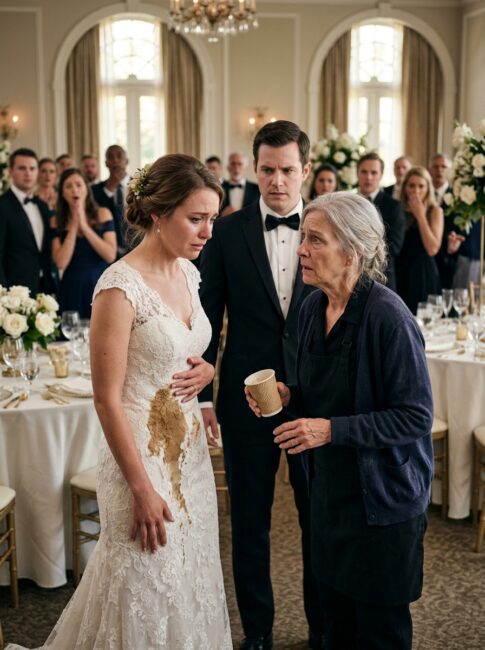
Claire stood in the center of the room, her mouth open, looking down at the brown splash across her gown. The coffee had soaked through the lace at her waist, spreading from one side to the other like a bruise.
Her mother, Judith Whitmore, rushed forward with a linen napkin, but Margaret lifted one hand.
“Don’t rub it,” Margaret said.
The room turned colder.
Judith stared at her. “You do not get to give instructions after what you did.”
Daniel stepped between them, his face red. He had the clean, handsome look of a man who had spent the morning being congratulated. Now his jaw clenched so hard it trembled.
“Get her out,” he said.
The ushers tightened their grip on Margaret’s arms.
She did not resist. That was the first thing that did not fit.
She did not look proud. She did not look angry. She looked terrified.
Her eyes stayed on Claire’s dress, not on the guests, not on Daniel, not on the phones already rising from several tables.
“Please,” Margaret said again, softer this time. “Keep her standing.”
One of the bridesmaids, a young woman named Hannah, was already crying as she dabbed at the stain with shaking fingers. “Claire, I’m so sorry. We can fix it. We can take you upstairs.”
“No,” Margaret said.
Daniel spun toward her. “You are not speaking to my wife again.”
The word wife seemed to break something in Margaret’s face. She lowered her eyes for half a second, then reached into her cardigan pocket with two fingers.
An usher yanked her arm back.
Something small fell to the floor.
It was a silver thimble.
No one noticed except Claire.
The thimble rolled across the wood and stopped beside the hem of her ruined gown. It was dented on one side, old enough to have belonged to another lifetime.
Claire bent down instinctively.
“Don’t,” Margaret whispered.
But Claire had already picked it up.
Her expression changed, just a little.
Not enough for the crowd to understand. Enough for Hannah to pause.
Claire turned the thimble in her fingers. Inside, scratched so faintly that she had to tilt it toward the light, were two initials.
E.E.
Claire looked up.
Margaret’s lips parted, but no words came.
Daniel noticed the pause and softened his voice. “Claire, honey, give it to me.”
He reached for the thimble.
Claire pulled her hand back.
That was the second thing that did not fit.
Judith looked sharply at her daughter. “Claire, we need to get you cleaned up before pictures.”
Pictures.
The word landed strangely.
Claire’s dress was ruined. Guests were whispering. Someone had spilled coffee on a bride at her own reception. But Margaret was not watching the camera. She was watching the left side of Claire’s waist, where the stain had spread darkest.
Then Claire swayed.
Only slightly.
At first, people thought it was humiliation. Any bride might feel faint after something like that.
Hannah reached for her elbow. “Claire?”
“I’m fine,” Claire said, but her voice came out thin.
Margaret took one step forward before the ushers stopped her.
“Ask her about the pins,” she said.
Daniel’s head snapped toward her. “What pins?”
Margaret’s eyes filled. “The ones under the bodice.”
The room shifted.
Claire looked at Hannah.
Hannah looked at the dressmaker, who stood near the back wall, pale and frozen beside the cake table.
The dressmaker’s name was Vivian Cole. She had arrived late, wearing black gloves and a tight smile. She had been fussing with Claire’s waistline all morning, saying the final stitches needed checking.
Claire’s hand moved to her side.
The stain had made the lace cling to the fabric beneath. Through the wetness, under the delicate flowers, something dark and thin showed where nothing should have been visible.
A line.
Then another.
Hannah whispered, “Claire, don’t sit down.”
The guests went silent in layers.
Margaret swallowed. “I saw it when she turned by the coffee station. The seam opened just enough.”
Judith’s voice dropped. “What are you saying?”
Margaret shook her head. “I didn’t have time to explain it and make you believe me.”
Claire looked at Daniel. “Did you know?”
His face changed too quickly.
Not guilt. Not yet.
But fear.
Vivian took one step backward.
A chair scraped near the cake table.
Margaret’s eyes moved from Vivian to Daniel, then back to Claire.
“I poured the coffee where everyone would look,” she said. “Because if I just screamed, you would have called me crazy.”
The first pin came out with a sound so small that only Claire heard it.
Hannah had taken Claire behind a folding screen near the side of the ballroom, not out of embarrassment, but because Margaret kept repeating, “Do not let her bend. Do not let her sit.”
The guests waited in a silence that felt heavier than music.
Judith stood with both hands pressed to her mouth. Daniel stood near the rose wall, staring at the floor. Vivian Cole was gone.
No one had seen her leave.
That became the third thing that did not fit.
A minute later, Hannah stepped out from behind the screen holding a long steel pin between her fingers. It had been hidden beneath the dress’s waist seam, angled inward.
Then she held up another.
Then a third.
The coffee, dark and wet, had flattened the lace enough to reveal where the bodice had been altered. Without the stain, the pins would have stayed hidden until Claire sat down during dinner.
No one said the word danger.
They did not need to.
Claire came out slowly, one hand against her side, her face drained of color. The ruined dress no longer seemed ruined. It looked like evidence.
Margaret stood near the doorway, still held by one usher who no longer seemed sure what his hands were doing.
Claire looked at her.
“Why did you know to look?” she asked.
That question opened the part of the story Daniel’s family had buried for years.
Margaret Ellis had not been invited by the Whitmores. She had been hired that morning to help the catering staff because one server had called in sick. She had arrived through the kitchen door before sunrise, carrying flatware, folding napkins, and avoiding the hallway where Daniel’s relatives gathered.
She had known Daniel since he was six.
Not as an aunt. Not as a family friend. Not officially.
She had been the woman his mother called when life fell apart.
Years earlier, Daniel’s father had left. His mother, Evelyn, had worked nights at the hospital, and Margaret, then a seamstress at a bridal shop, watched Daniel after school without asking for money. She patched his jackets. Packed his lunches. Sat through Little League games in the rain.
When Evelyn became sick, Margaret moved into the guest room for three months and slept in a chair beside her bed.
After the funeral, Daniel’s wealthy relatives arrived with lawyers, sympathy flowers, and opinions. Margaret was asked to leave the house before the reception ended.
No one said she had done anything wrong.
They only said it would be “cleaner” for Daniel.
The boy she had raised did not stop them.
He was sixteen.
Margaret told herself grief makes children quiet.
For years, she sent birthday cards he never answered. She kept one photograph in her sewing box: Daniel at eight years old, missing a front tooth, holding up a paper star she had helped him make.
That morning, when Margaret saw his name on the wedding schedule, she almost walked out of the kitchen.
Then she saw Claire.
Claire was kind to the servers.
That was what made Margaret stay.
The bride thanked the dishwasher for finding her grandmother’s handkerchief. She knelt to help a flower girl tie a shoe. She asked Margaret if she had eaten anything, though she did not know her name.
Margaret had smiled and said, “I’m fine, sweetheart.”
The word slipped out before she could stop it.
Claire had smiled back.
Later, near the coffee station, Margaret saw Vivian Cole tug at the bride’s waist. Vivian’s hand moved too quickly, pushing something under the lace. Claire winced, but Vivian laughed.
“Beauty takes discipline,” Vivian said.
Margaret knew dresses. She knew seams. She knew the difference between a temporary fitting pin and something left where it could hurt a woman who trusted everyone around her.
She also knew no one would believe a hired server over the dressmaker chosen by the Whitmore family.
Especially not Margaret Ellis.
Not the woman people remembered only through rumor.
So she watched.
She saw Vivian whisper to Daniel near the side door. She saw Daniel shake his head. She saw Vivian touch his sleeve like a person with history, not business.
Then Margaret understood one more thing.
This was not only about a dress.
Claire stood in the ballroom, still holding the old thimble.
“Who is E.E.?” she asked.
Margaret looked down.
“Evelyn Ellis,” Daniel said quietly.
Everyone turned.
He had not spoken since the pins were found.
Margaret closed her eyes.
Daniel’s voice cracked. “My mother.”
Judith looked between them. “Your mother’s last name was Whitmore.”
Daniel shook his head. “That was my father’s name. She changed it after she married him. Before that, she was Evelyn Ellis.”
Claire looked at the thimble again.
Margaret said, “Your mother gave it to me when we worked at the bridal shop together. We were nineteen. She told me if she ever had a daughter-in-law, I should sew something blue into the hem.”
Her laugh broke into something smaller. “I never got asked.”
The room held its breath.
Daniel covered his face with one hand.
“I knew Vivian,” he said.
Claire did not move.
“She was someone I dated before you. It ended badly. When my aunt hired her for the gown, I thought it was awkward, but harmless.”
Margaret looked at him then, not with anger, but with the exhaustion of someone who had waited too long for a child to grow brave.
“You saw her near the dress,” Claire said.
Daniel’s silence answered.
A guest near the back whispered, “He knew?”
“No,” Margaret said immediately.
Her voice surprised everyone, including Daniel.
“He knew something was wrong,” she said. “He did not know what. There is a difference, even when it still hurts.”
That sentence made Daniel cry.
Not loudly. Not beautifully.
He simply folded, as if all the years he had spent looking polished had finally become too heavy.
“I was ashamed,” he said. “Of how I let them erase you. Of how easy it was to pretend I came from people who never needed help.”
He looked at Claire, then at Margaret.
“When I saw you in the kitchen this morning, I acted like I didn’t.”
Margaret’s mouth trembled.
Claire looked at her ruined gown, then at the pins on the white napkin in Hannah’s hand.
The dress had been saved by the stain everyone condemned.
The bride had been protected by the woman everyone wanted thrown out.
And the most expensive room in the country club had no place left to hide from a quiet truth.
Claire walked toward Margaret.
Judith reached for her, but Claire kept going.
The usher let Margaret go.
For a moment, the two women stood facing each other, the bride in stained lace and the server in a worn cardigan.
“I thought you hated me,” Claire said.
Margaret shook her head. “I never hated you. I was afraid they would teach you to hate the wrong people.”
Claire’s eyes filled.
Then she did something no one expected.
She took Margaret’s shaking hand and placed the old thimble back in her palm.
“Will you help me fix it?” she asked.
Margaret stared at her.
The question was not about the dress.
Everyone knew it.
They moved the wedding to the garden.
Not because the ballroom was ruined, though the stain on the floor remained until late evening. Not because the photographs would look better outside.
They moved because Claire asked for air.
The sun was beginning to lower behind the sycamore trees, laying warm gold across the lawn. Guests carried chairs themselves. Men in suits lifted flower stands. Bridesmaids removed the heavy train from Claire’s dress, and Margaret sat on a stone bench with a sewing kit borrowed from the country club laundry room.
No one spoke loudly near her.
The same people who had stared at her like a criminal now watched her hands like they were witnessing a prayer.
She cut away the damp lace at Claire’s waist. She removed the last hidden pin. Then, from inside her cardigan, she pulled a small piece of pale blue fabric.
Daniel recognized it first.
His lips parted.
It was from one of his mother’s old scarves.
Margaret had carried it for years in a small envelope, folded beside the photograph of the boy with the paper star.
“I brought it because I thought maybe,” she said.
She did not finish.
Claire lowered her head.
Margaret stitched the blue fabric inside the dress, just beneath the place where the coffee stain had spread. Her fingers were slower than they used to be, but they did not fail.
When she finished, the stain was still visible.
Claire refused to hide it.
During the toast, Daniel stood without a glass. He looked at the guests, then at Margaret, who sat at the end of the front row because Claire had moved her there herself.
“I spent years letting people call kindness charity,” he said. “Today, the woman I ignored saved my wife because she still cared enough to be misunderstood.”
He stopped there.
It was all he could manage.
Claire took his hand, not to rescue him from shame, but to remind him he was still allowed to become better than it.
Later, when the music started again, the photographer asked whether Claire wanted to avoid showing the coffee stain in the portraits.
Claire looked at Margaret.
“No,” she said. “Make sure it shows.”
So in the final wedding photo, Claire stood in the garden with Daniel beside her, her gown marked at the waist by a dark, imperfect bloom. Margaret stood one step away, not hidden in the back, not cropped out, her old thimble shining in her palm.
Weeks later, a small framed copy of that photo appeared on Margaret’s kitchen table.
On the back, Claire had written one sentence.
Thank you for ruining the dress before someone ruined the day.
Margaret read it every morning while her coffee cooled beside her.
Sometimes Daniel came by before work. Sometimes he brought flowers. Sometimes he said nothing at all and simply fixed the loose cabinet door or changed the porch bulb.
One Sunday, Claire arrived with the stained piece of lace preserved in a small shadow box. Inside it, beneath the brown mark, was the blue fabric from Evelyn’s scarf.
Margaret touched the glass and smiled through tears.
Outside, the maple leaves moved in the wind, and for once, no one asked her to explain why she had done what she did.
The stain had already told the story.
Follow the page for more emotional stories about the quiet moments that change how people see each other.