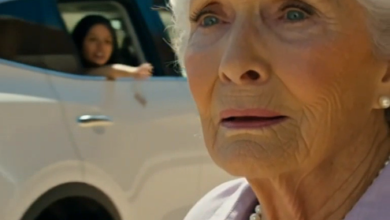
Part 2: The Woman Who Shoved a Little Girl in the Park — Then the Camera Revealed What No One Expected
The little girl’s mother, Natalie Brooks, dropped to her knees and pulled her daughter into her arms.
“Emma, baby, look at me. Are you hurt?”
Emma cried so hard she could not answer. Grass clung to her yellow dress. Blue popsicle stained her fingers. Her white sneaker had come halfway off, and her pink bow was now hanging by one loose strand of hair.
Natalie looked up at Clara.
Her face changed from fear to fury.
“You pushed my daughter.”
Clara’s mouth opened, but nothing came out. Her eyes shifted past Natalie, past Emma, toward the far end of the park where the walking trail curved behind the restroom building.
People moved closer.
A man in a baseball cap stepped between Clara and the child. “Lady, you need to back up.”
Clara backed up, but not because he told her to.
She was still looking beyond them.
Her hands trembled.
That was the first thing Officer Daniel Reyes noticed when he arrived five minutes later.
He was off duty, sitting with his sister and nephew near the duck pond, but someone had shouted for help. When Daniel reached the crowd, he found Clara standing alone beneath an oak tree, surrounded by strangers who hated her.
She looked like someone who had done something unforgivable.
But she also looked like someone listening for a sound no one else could hear.
Natalie was crying now too, anger shaking through her voice. “She attacked my child. We were right there. Emma didn’t do anything.”
“I saw it,” said a man holding a camera phone. “She just came out of nowhere.”
“Record her face,” another woman said. “People need to know.”
Clara flinched at that.
Not at the accusation.
At the phone.
She lifted one hand slightly, as if to shield her face, then let it fall again. There was a thin scar across her wrist, old and pale.
Officer Reyes held up both hands. “Everybody give the child space.”
“She needs to be arrested,” Natalie said.
Daniel looked at Emma. The girl was shaken, but she was sitting upright now, tucked tightly against her mother. Her left elbow was red from the fall. No blood. No obvious broken bone.
He turned to Clara. “Ma’am, I need you to tell me what happened.”
Clara swallowed.
Her voice came out thin. “She was running.”
“That’s why you pushed her?”
Clara looked down.
People muttered.
Daniel tried again. “Did you know this child?”
“No.”
“Did she say something to you?”
“No.”
“Did she touch you?”
Clara closed her eyes for one second. “No.”
The crowd reacted like the answer settled everything.
Natalie stood, still holding Emma against her hip. “You hear that? My daughter did nothing.”
Clara’s lips trembled. She looked at Emma then, not with anger, but with a grief so sudden Daniel almost stepped back.
“I know,” Clara whispered.
It was not an apology.
It was worse.
It sounded like a woman admitting she had hurt someone innocent and could not take it back.
Daniel asked Clara to sit on a bench while park security was called. The crowd stayed close enough to watch, far enough to feel righteous. Phones remained raised.
A park attendant named Marcus arrived, sweating in his green uniform. “We have cameras around the splash pad,” he said quietly to Daniel. “One near the restroom, one over the maintenance gate.”
“Good,” Daniel said. “Pull it.”
Natalie heard him. “Why do we need cameras? Thirty people saw her.”
Marcus hesitated. “It’s procedure.”
While they waited, Clara did something strange.
She took a small folded cloth from her purse. It was not a tissue. It looked like a child’s handkerchief, white cotton with tiny embroidered daisies along the edge.
Her thumb rubbed one corner over and over.
Natalie saw it and misread it.
“You keep souvenirs for this?” she snapped.
Clara looked up, wounded. “No.”
“Then what is it?”
Clara’s fingers closed around the cloth.
She said nothing.
Another small thing happened then.
Emma, still crying softly, looked over her mother’s shoulder toward Clara and stopped.
Not because she forgave her.
Because Clara was not looking at Emma anymore.
She was staring at Emma’s red kite string, still lying in the grass near the splash pad, tugging gently in the breeze.
The kite had fallen into a low shrub beside the walking path.
Clara’s breathing changed.
She stood too fast.
Daniel caught her arm. “Ma’am.”
“The string,” Clara said.
“What about it?”
Clara pointed, but not at the kite.
At the path behind it.
“The man.”
Everyone turned.
There were fathers, mothers, kids on scooters, a teenage couple, and an older man feeding ducks from a paper bag.
No one suspicious.
No one running.
Natalie shook her head. “There is no man.”
Clara’s face collapsed inward, as if she had expected exactly that.
Marcus returned with a tablet. “Officer.”
The crowd leaned in.
Daniel took the tablet and watched the first camera angle.
It showed Emma skipping near the splash pad. It showed Clara walking slowly along the path, her purse across her chest, eyes lowered.
It showed Emma running.
Then Clara lunging.
Then the shove.
Gasps rose again, satisfied and cruel.
But Daniel did not stop the video.
“Play the other angle,” he said.
Marcus tapped the screen.
This camera faced the maintenance gate.
For the first two seconds, nothing seemed important.
Then Clara appeared on the left edge of the screen.
Emma entered from the right, laughing, pulling the kite string.
And behind Emma, near the restroom wall, a man in a dark hoodie stepped through the half-open maintenance gate.
His face was turned away.
In his right hand was something small and silver.
Not a knife.
Not a gun.
A utility blade, open.
The crowd went silent.
Still, the video did not explain everything.
The man had not touched Emma.
He had not reached her yet.
Then Emma’s kite string caught on the open blade.
The red string pulled tight.
Emma kept running.
The blade jerked upward.
And the silver tip came within inches of the child’s throat.
That was when Clara shoved her.
Not away from safety.
Out of the line.
The camera froze on the frame where Emma fell, the blade sliced through empty air, and the man’s hand snapped backward from the force of the kite string breaking.
Nobody spoke.
Clara sat down on the bench as if her bones had given out.
Natalie stared at the tablet.
Then at her daughter’s neck.
There was no cut.
Only a faint red mark where the kite string had brushed her skin.
Daniel looked toward the restroom path, but the man was already gone.
And Clara, the woman everyone had called a monster, lowered her face into her shaking hands.
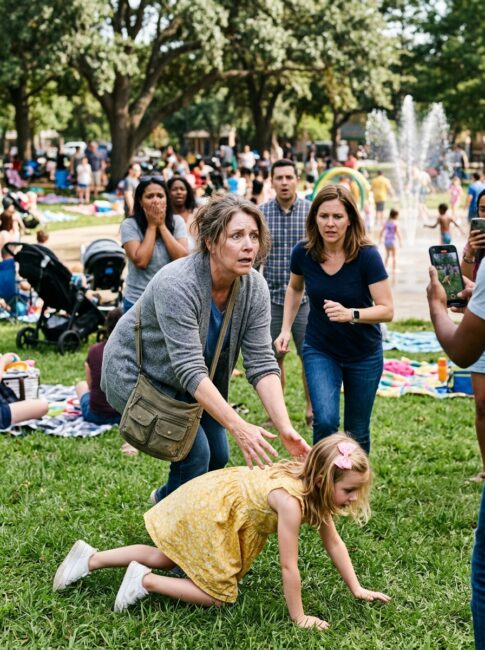
The second camera changed the park.
Not physically.
The same oak trees stood in the same warm sunlight. The same fountain kept splashing. The same balloons tugged at picnic tables. But every person watching the tablet seemed to be standing in a different place than before.
A place where certainty had become uncomfortable.
Natalie held Emma closer.
“She saved her?” Natalie asked, but the words barely came out.
Daniel did not answer quickly. He watched the clip again.
This time slower.
Clara’s head had turned before anyone else’s. Her body had moved before Emma even seemed afraid. She had crossed six feet of grass in less than two seconds. She had not aimed to hurt the child. She had aimed to change her path.
The shove had been ugly.
It had also been precise.
Daniel looked at Clara. “How did you see that?”
Clara did not raise her head.
“I saw the hand.”
“What hand?”
“The way he held it.” Her voice shook. “Low at his side. Hidden. Like he didn’t want anyone to notice.”
Natalie stared. “You knew him?”
Clara looked toward the maintenance gate. “No.”
“Then how?”
Clara’s thumb still pressed the daisy handkerchief. She unfolded it slowly, and for the first time, Daniel saw a name stitched in faded pink thread.
Maddie.
The name landed softly, but it changed Clara’s face.
“My daughter was seven,” Clara said.
The crowd shifted.
“She loved kites,” Clara continued. “Red ones. Always red, because she said they looked brave against the sky.”
No one interrupted.
Even Emma had stopped crying.
Clara looked at the handkerchief in her palm, not at the people around her. “Fourteen years ago, we were at a county fair outside Dayton. I was buying lemonade. She was twelve steps away from me. Twelve.”
Her voice broke on the number.
“A man walked past her with a box cutter from one of the vendor stalls. He wasn’t trying to hurt her. Not at first. He was angry at somebody else. He turned too fast, and her balloon string caught on the blade.”
Natalie covered her mouth.
Clara’s eyes filled, but the tears did not fall. Maybe they had run out years ago.
“I heard her laugh. Then I heard people scream. By the time I turned around, everyone was looking at me like I should have known.”
Daniel lowered his gaze.
The park had judged Clara for acting too violently.
Once, the world had judged her for not acting fast enough.
That was the second twist, and it sank deeper than the first.
Clara had not pushed Emma because she was cruel.
She had pushed Emma because her body remembered what her mind had spent fourteen years trying to survive.
Natalie stepped closer, but guilt slowed her feet. “I didn’t know.”
Clara gave a small nod. “You weren’t supposed to.”
Marcus, the park attendant, zoomed in on the footage. “Officer, look at the maintenance gate.”
Daniel leaned over the tablet.
The gate had a sign that read STAFF ONLY, but the latch was broken. It hung slightly open. In the video, the man did not force it. He simply slipped through.
Marcus went pale. “That gate was supposed to be repaired last month.”
Daniel looked at him. “Who has access?”
“Maintenance, vendors, city contractors.” Marcus swallowed. “But he’s not one of ours.”
Another parent spoke from the crowd, quieter now. “My son was near that restroom ten minutes earlier.”
A woman hugged her toddler.
What had looked like one violent moment was becoming a failure made of small ignored things: a broken latch, a blade carried carelessly, a crowd too busy filming, and one woman old enough in sorrow to notice danger before it had a name.
Then came the third twist.
Emma tugged her mother’s sleeve.
“Mommy,” she whispered, “the lady yelled before she pushed me.”
Natalie looked down. “What?”
Emma sniffled. “She said duck.”
Clara closed her eyes.
Nobody in the crowd had heard it.
Phones had captured the shove.
Not the warning.
Daniel asked gently, “Emma, did you see the man?”
Emma shook her head. “I saw the kite pull. Then I fell.”
Natalie knelt before her daughter. “Did she hurt you?”
Emma looked at Clara.
Children sometimes understand before adults are ready to.
“She scared me,” Emma said. “But I think she was scared too.”
That sentence did what the video could not.
It gave Clara back a piece of her humanity.
Daniel radioed in the description of the man from the footage. Marcus called park management. The birthday party near the fountain quietly packed up, parents suddenly aware of every open gate, every stranger, every blind corner they had dismissed as ordinary.
The man in the baseball cap who had blocked Clara earlier stepped toward her.
“I’m sorry,” he said.
Clara nodded without looking at him.
Another woman lowered her phone. Her face flushed. She deleted something, then slipped the phone into her pocket as if it burned.
Natalie still had not spoken to Clara directly.
She wanted to.
Her mouth opened twice.
But shame can make even kind words heavy.
Finally she crossed the grass and stopped in front of the bench. Emma stayed beside her, one hand gripping her mother’s fingers.
Clara rose at once, as if expecting another accusation.
Natalie shook her head. “Please don’t stand.”
Clara sat back down.
For a moment, the two mothers looked at each other across a space no camera could measure. One had almost lost her child that afternoon. One had lost hers years ago and had been living inside the echo ever since.
“I called you a monster,” Natalie said.
Clara’s eyes flickered. “You were protecting your daughter.”
“I was wrong.”
“You didn’t know.”
“I didn’t wait to know.”
That was the fourth twist, the one nobody posted online because it was not dramatic enough.
A mother apologizing.
A woman accepting that fear had made her unfair.
A crowd learning that being loud first is not the same as being right.
Emma stepped forward then, small and unsure. Natalie tried to stop her, but Clara lifted one hand, not reaching, only allowing the child to choose.
Emma looked at the daisy handkerchief.
“Is Maddie your girl?”
Clara’s face crumpled.
“Yes.”
Emma thought for a moment. Then she held out the broken red kite string, which someone had picked up and given back to her.
“My kite broke,” she said.
Clara stared at the string.
Then, with a tenderness that made Natalie turn away, Clara took it like it was something sacred.
“I’m sorry,” Clara whispered. “I didn’t mean to make you fall.”
Emma nodded. “It’s okay.”
“No,” Clara said softly. “It still hurt.”
Emma considered this with the seriousness only children give to small truths. “But I’m not cut.”
Clara pressed the daisy handkerchief to her mouth.
Daniel looked away, giving her the privacy of a second she had not been given all afternoon.
Later, police found the man in the hoodie two blocks away behind a convenience store. He was a temporary contractor who had been dismissed from another city job that morning. The blade belonged to him. He claimed he had only been cutting zip ties near the maintenance area and panicked when people shouted.
Maybe he had meant harm.
Maybe he had only carried danger carelessly through a park full of children.
Either way, the footage was clear.
If Clara had not moved, Emma’s story would have ended in a way no mother in that park wanted to imagine.
But Clara did not stay for the explanations.
When Daniel turned back from speaking to another officer, she was already walking away along the path, shoulders folded inward, the broken red string tucked beside Maddie’s handkerchief in her purse.
Natalie called after her.
“Clara.”
The woman stopped.
Natalie’s voice trembled. “You saved my daughter.”
Clara turned slightly.
“No,” she said. “I only saw what I missed before.”
Then she kept walking.
And nobody knew what to do with a sentence that heavy.
The video spread anyway.
Not the first clip, though that one had already been uploaded by someone before the truth came out. For twenty-three minutes, Clara Whitmore was a villain on half the neighborhood’s phones.
People wrote things they would later delete.
Cruel things.
Confident things.
Things that sounded righteous when typed quickly and shameful when read slowly.
Then Officer Reyes released a short statement asking residents not to share incomplete footage. Park security provided the second angle to investigators, and by evening, local news had the full story.
The headline changed.
So did the comments.
But Clara did not read them.
She lived in a small white duplex three miles from Willow Creek Park, with basil plants on the windowsill and a wind chime shaped like a little copper moon. Her neighbors knew she worked part-time at the library. They knew she walked every morning. They knew she kept to herself.
They did not know she still visited a small grave in Dayton every second Sunday.
They did not know she carried Maddie’s handkerchief because grief had made her afraid of forgetting the exact shape of her daughter’s name.
Two days after the park incident, Natalie stood on Clara’s porch holding Emma’s hand.
Emma wore jeans now, not the yellow dress. Her elbow had faded from red to pink. In her other hand was a new kite, still wrapped in plastic.
Red.
Clara opened the door and froze.
Natalie spoke first. “We don’t want to bother you.”
“You’re not.”
Emma looked down at her shoes. “Mom said I could bring you something.”
Clara’s eyes went to the kite.
Natalie took a breath. “I know this may be painful.”
“It is,” Clara said.
Natalie nodded. “Then we don’t have to.”
Clara looked at Emma, then at the red kite, then at the porch railing where sunlight fell in long golden bars.
“No,” she said quietly. “Maybe we do.”
They went back to Willow Creek Park the following Saturday.
Not for attention.
Not for a ceremony.
Just Clara, Natalie, Emma, Officer Reyes on his lunch break, and Marcus the park attendant, who had personally repaired the maintenance gate with a new latch and a bright silver lock.
The splash pad was running again. Children laughed. Parents watched a little closer than before.
Emma carried the red kite to the open lawn.
For a while, Clara only stood there with her hands clasped.
Then Emma turned and held out the spool.
“Can you help me?”
Natalie looked at Clara, giving her a choice.
Clara took the spool.
Her hands shook at first. Then the kite lifted, uncertain and low, before catching a clean rush of wind. It rose above the oak trees, red against the pale blue sky.
Clara watched it until tears finally slid down her face.
Emma noticed but did not ask why.
She only stepped beside Clara and leaned her shoulder gently against the woman’s arm.
That was all.
No speech.
No crowd.
No applause.
Just a child standing close to the woman who had frightened her, because somehow she understood that saving someone does not always look gentle from the outside.
Across the park, Marcus locked the maintenance gate and checked it twice.
Officer Reyes folded his sunglasses into his pocket and let the moment stay quiet.
Natalie took one photo, but she did not post it.
Some things deserved to live outside other people’s judgment.
When the kite pulled higher, Clara opened her purse and took out Maddie’s daisy handkerchief. Wrapped inside was the broken red string from Emma’s old kite.
She tied that short piece to the new spool.
A small knot.
Almost invisible.
But Clara touched it like a bridge between two little girls who would never meet, and for the first time in fourteen years, she did not look only at what she had lost.
She looked at what had been spared.
Emma smiled up at her.
“Is it flying good?”
Clara wiped her cheek with the back of her hand.
“Yes,” she said. “It’s flying brave.”
And if stories like this remind you to look twice before judging someone, follow this page for more unforgettable stories from ordinary lives.