Part 2: They Asked the Biker to Leave Church — Then the Priest Said My Mother’s Name
Raymond Holloway did not sit in the front pew.
Father Michael asked him to.
Ray shook his head once and chose the last row beside the door.
The other bikers remained outside.
Through the stained-glass windows, I could see their silhouettes beside their machines. Some leaned against handlebars. Others stood with paper coffee cups between both hands. Nobody smoked near the church entrance. Nobody talked loud enough to carry through the walls.
They were waiting for Ray.
I did not know that yet.
At the time, all I knew was his name.
Raymond Holloway.
The man who had crossed the center line on Route 66 after drinking at a roadside bar nineteen years earlier.
The man whose pickup struck my mother’s car two miles east of Kingman.
The man who lived.
My mother did not.
I had spent years imagining him as a shape without a face. A reckless shadow behind a windshield. A court file my family kept inside a yellow envelope in the hall closet.
Now he sat twenty feet behind me with his boots flat on the tile and his scarred hands resting on his knees.
His hands surprised me.
They were rough and darkened by grease, but his fingernails were trimmed short. Fine pale lines crossed his fingertips. Sandpaper marks.
When the service began, Father Michael did not introduce him again.
He spoke about the new children’s room.
It had been added behind the fellowship hall for children who needed a quieter place during Mass: children overwhelmed by noise, children with sensory challenges, children who communicated differently, children who needed soft lighting and a door that did not slam.
My eight-year-old son, Noah, was one of them.
Noah was autistic. He loved ceiling fans, train schedules, and the sound of rain against the garage door. He hated applause, fluorescent lights, and crowded rooms where strangers touched his shoulders without asking.
For years, I had sat with him in our car during church events when the noise became too much.
The new room had padded benches, weighted blankets, shelves built low enough for small hands, and a wide interior window facing the sanctuary. Every corner had been rounded and sanded smooth.
Someone had done careful work.
Work that took time.
I had assumed a construction company donated the labor.
After the service, Noah slipped away before I could stop him. He pushed through the side door and entered the new room alone.
Ray saw him.
I tensed.
Ray did not follow.
He crouched several feet from the doorway, making himself smaller without blocking the exit.
Noah touched the edge of a wooden shelf.
“Too sharp,” he said.
Ray nodded.
“Yeah.”
He removed a folded square of fine-grit sandpaper from his vest pocket and placed it on the floor.
Not in Noah’s hand.
Not too close.
Just within reach.
Noah picked it up.
Ray said, “Show me.”
That was the first time I saw my son voluntarily walk toward a stranger wearing leather.
It was also the first time I noticed the tiny blue medal again.
The same crooked stitches.
The same shade of blue my mother used for every button she repaired because she said matching thread was boring.
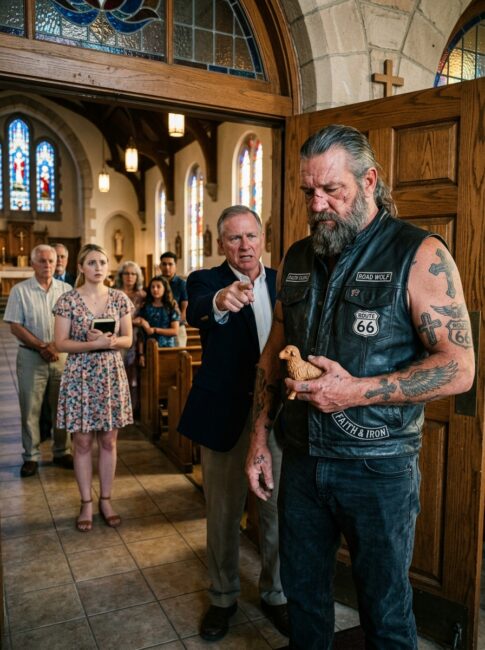
The dedication should have ended with coffee, sheet cake, and polite conversation.
Instead, it almost ended in the parking lot.
Don, the usher who had asked Ray to leave, found out who he was from someone near the fellowship hall. News moved quickly. It always did in a small church.
By the time I stepped outside, Don was standing between Ray and his Harley.
His face had gone red.
“You built that room?” Don asked.
Ray did not answer.
“You think a few shelves fix what you did?”
Ray looked toward the highway.
A semi rolled past on Route 66 with a low hiss of tires.
“No,” Ray said.
That single word took the air out of the confrontation.
Don had expected an argument. So had I.
Ray gave him nothing to push against.
Then one of the bikers moved forward.
He was older, with a white beard, a denim shirt beneath his cut, and a stiff right leg. His road name, stitched above his chest pocket, was Preacher.
He was not a priest.
He looked like a man who had once settled problems with his hands and now worked hard not to.
“Easy,” Preacher said.
Don pointed toward Ray.
“My wife was Elena’s friend.”
“I know,” Ray said.
“She brought food to Sofia for weeks after the funeral.”
“I know.”
“You do not get to walk in here like some kind of hero.”
Ray’s jaw tightened.
“I know.”
Again, that word.
No defense.
No speech.
No demand to be understood.
The bikers behind him shifted. Leather creaked. A boot scraped gravel. The mood changed fast enough that I felt it against my skin.
Father Michael stepped between the men.
“Enough.”
Don looked at him.
“You invited this?”
“Yes.”
“Why?”
Father Michael turned toward Ray.
“Tell her.”
Ray’s hands began to shake.
Barely.
But I saw it.
The wooden lamb was still in his left palm. He had held it through the entire service so tightly that one carved edge had pressed a pale mark into his skin.
Ray looked at me.
His eyes were not dramatic. They were tired.
“I made the room,” he said.
I waited.
“The shelves. The benches. The window frame. The ramp outside.”
“Why?”
His voice came out rough.
“Because your boy needed it.”
My anger rose so quickly that it frightened me.
“You do not know my son.”
“No.”
“You do not know me.”
“No.”
“You did not know my mother.”
At that, Ray stopped.
Father Michael closed his eyes.
Ray opened his vest and reached into the inside pocket beneath the Saint Christopher medal.
He removed a folded piece of paper sealed inside a clear plastic sleeve.
The paper was old. Yellowed. Soft at the creases.
I recognized my mother’s handwriting before he handed it to me.
The note began with my name.
Sofia, if you ever find your way back to St. Michael’s…
My knees nearly gave out.
The room had not been Ray’s idea.
My mother had planned it before she died.
My mother taught special education at a small elementary school near Route 66.
That part of her life had become background noise in my memory. I remembered lesson plans stacked on the kitchen table. Wooden puzzles. Children’s drawings on our refrigerator. The smell of sawdust when she carved small animals for students who needed something solid to hold during difficult moments.
I had forgotten the notebook.
Father Michael had not.
Three weeks before the crash, my mother gave him a folder filled with sketches for a quiet room at St. Michael’s. She had noticed families leaving services early because their children could not manage the noise. She wanted a small place where nobody had to apologize for needing silence.
She had drawn low shelves.
Rounded corners.
A wide sanctuary window.
A ramp with a gentle slope.
After my mother died, the folder disappeared into a filing cabinet. The church had bills. The parish was small. Father Michael could not raise the money.
Years passed.
Then Ray wrote to him from prison.
The first letter contained four sentences.
I am sorry. I know that changes nothing. I will not ask for forgiveness. Tell me what I can do that does not insult her memory.
Father Michael did not answer for six months.
When he finally did, he mailed Ray a photocopy of my mother’s sketches.
No explanation.
Ray had worked in carpentry before alcohol took pieces of his life one by one. In prison, he returned to the shop. He built tables. Repaired chairs. Learned to shape wood without rushing.
When he was released after serving his sentence, he joined a sober riding club called the Mile Markers.
Not saints.
Not outlaws.
Mostly men and women who understood that some roads did not forgive mistakes, but people still had to decide what to do with the miles left afterward.
Ray spent twelve years building the room in pieces.
He took extra jobs. Fixed fences. Repaired porch steps. Built cabinets for cash. The Mile Markers donated labor but refused to let him hide behind them.
Every time Ray tried to abandon the project, Preacher rode to his trailer outside Flagstaff and parked in the driveway until Ray came outside.
Every time Ray said he had no right to enter St. Michael’s, Father Michael sent him another measurement.
Every time Ray drank coffee at a gas station and watched traffic move toward Kingman, he kept the folded plans beneath the blue medal.
The medal had belonged to my mother.
Police found it beneath the passenger seat after the crash.
Father Michael mailed it to Ray in prison with a single line:
Carry the weight honestly.
That morning was the first time Ray had stepped inside the church.
He was not there to be honored.
He had come to return the wooden lamb and leave before anyone knew his name.
I wanted a clean emotion.
Anger would have been easier.
Forgiveness would have made a better church story.
What I felt was neither.
I stood in the parking lot holding my mother’s note while motorcycles ticked softly as their engines cooled.
The paper trembled in my hands.
Her handwriting wandered across the page in blue ink.
She had written the note for me years before the crash because she imagined I might become involved with the church someday. She mentioned the room as though it were a small thing. A project for the future. One more item on a list.
Children should not have to leave because the world is too loud. Give them a window. Give them a softer place to land.
Below the words was a sketch of the carved lamb.
Ray had copied it carefully.
Not perfectly.
One ear was too short.
Noah noticed immediately.
“The left ear is wrong,” he said.
Ray looked at the lamb.
“Yeah.”
Noah took it from his hand and studied it.
“You can fix it.”
Ray swallowed.
“Maybe.”
Noah shook his head.
“Not maybe.”
For the first time that day, Ray almost smiled.
It lasted less than a second.
The smaller twists came out slowly.
The Mile Markers had not ridden to Kingman merely to support Ray. They had come because they did not trust him to finish the last part.
Not the shelves.
Not the ramp.
Walking through the church door.
Preacher told me Ray had parked across the street on three different Sundays during construction and refused to enter. He waited until the building emptied, carried tools through the fellowship hall entrance, and worked alone.
“He figured leaving before people saw him was respect,” Preacher said.
“And you disagreed?”
Preacher looked toward Ray.
“Brotherhood ain’t agreeing. Sometimes it is refusing to let a man keep lying to himself.”
Ray had told them he planned to return the lamb, hand Father Michael the keys, and ride west without attending the dedication.
The Mile Markers said no.
They rode behind him from Flagstaff at dawn.
Not to celebrate him.
To make sure he showed up.
The second twist was the blue medal.
I assumed Father Michael gave it to Ray as a punishment. A physical reminder of the life he had taken.
My uncle corrected me later.
“I sent it because your mother carried it when she was afraid,” he said. “Not because I wanted Ray crushed beneath it.”
Father Michael had visited Ray in prison twice a year.
Some visits lasted five minutes.
Some ended in silence.
He never told Ray he was forgiven.
He never told him redemption was guaranteed.
He gave him measurements. Work. A way to stop making his remorse the center of every room.
The third twist belonged to Noah.
When we returned inside, he sat on the padded bench behind the sanctuary window. For the first time in years, he remained in the building through an entire hymn.
Ray stood outside the room.
He did not enter until Noah tapped the space beside him.
Ray lowered himself slowly onto the floor instead of the bench. Leather creaked against the wall. His knees made a small cracking sound.
Noah handed him the sandpaper.
“Left corner,” he said.
Ray rubbed one thumb along the shelf edge.
“Good catch.”
For ten minutes, the man whose face had haunted my family sanded a piece of wood beside my son.
I did not forgive him that day.
He did not ask me to.
That mattered.
Ray still rides to Kingman on the first Sunday of every month.
He parks behind St. Michael’s near the fellowship hall, away from the main entrance. The Harley engine settles into a low uneven pulse before he shuts it down.
Then comes the silence.
Then the boots on gravel.
Then the squeak of the side door.
He carries a thermos of black coffee and a canvas tool bag with sandpaper, wood glue, spare screws, felt pads, and a small flashlight. He checks the ramp first. Then the shelves. Then the window latch.
Noah usually waits for him in the quiet room.
Their conversations remain short.
“Door sticks.”
“Humidity.”
“Bench squeaks.”
“Loose brace.”
“Train at 2:17.”
“Freight or passenger?”
“Freight.”
Ray never arrives empty-handed. Sometimes he brings a carved animal. A fox. A turtle. A horse with legs slightly too thick. He leaves them on the lower shelf without ceremony.
The children take them when they need something solid to hold.
The lamb stays on the windowsill.
Its left ear is still too short.
Ray offered to repair it once.
Noah said no.
“It is the first one,” he told him.
Ray understood.
The Mile Markers stop by several times a year. They repair things nobody submits on a work order. A loose handrail. A cracked picnic table. A bad hinge on the storage shed.
Their bikes line up beside Route 66, chrome dulled by dust, engines ticking after long rides.
Some parishioners still keep their distance.
Ray never complains.
He does not try to win the room.
He works.
Before leaving, he stands beneath the wooden crucifix for a few seconds. He touches the blue Saint Christopher medal stitched inside his cut.
The thread is still crooked.
I asked him once whether he wanted me to repair it.
He shook his head.
“Your mother sewed like that?”
“Yes.”
“Then it stays.”
Two years after the dedication, St. Michael’s held its Christmas service during a cold desert rain.
The church filled early.
Families shook water from coats. Children tracked wet footprints across the tile. The choir warmed up near the altar. Outside, headlights slid along Route 66 in long pale streaks.
Noah lasted twelve minutes in the sanctuary before the noise became too much.
He went to the quiet room.
I watched through the open door as he sat behind the wide interior window. He held the wooden lamb against his chest.
A few minutes later, the side entrance opened.
Ray stepped inside carrying his tool bag.
His beard had gone almost completely gray. Rain darkened the shoulders of his leather cut. His boots left small wet marks behind him.
He stopped when he saw the crowded church.
For a second, he looked ready to turn around.
Don was handing out programs near the aisle.
The same usher who had asked Ray to leave on his first Sunday.
Their eyes met.
Don hesitated.
Then he held out a program.
“Back row is open,” he said.
Ray looked at the paper.
Then at Don.
“Appreciate it.”
That was all.
Ray entered the quiet room and sat on the floor beside Noah. Neither of them spoke during the first hymn.
When the service ended, he packed his tools and walked back into the rain.
I followed him as far as the steps.
The Harley fired with a rough mechanical cough. The low vibration rolled through the parking lot and faded beneath the sound of tires on wet pavement.
Ray lifted two fingers from the handlebar.
Then he turned west along Route 66.
His taillight became a small red point in the rain.
Noah stood beside me holding the lamb.
This time, nobody asked Ray to leave.
Follow the page for more stories about the people behind the leather.