They Called Him a Beggar — Until the Biker Sat Down and Everyone in the Diner Stopped Talking
“Say one more word to him while I’m chewing, and you’re going to regret what this room learns next,” the biker said, dropping into the seat across from the old man as if the whole diner belonged to him.
The spoon stopped halfway to the waitress’s mouth.
So did almost everyone else.
It was 12:18 p.m. on a raw Tuesday in February, in a narrow little diner off Route 6 in Scranton, Pennsylvania, the kind of place where the coffee was always too hot, the windows were always a little fogged, and every regular believed they had earned the right to decide who belonged there. Outside, sleet tapped the glass in uneven bursts. Inside, the air smelled like bacon grease, wet coats, and tomato soup.
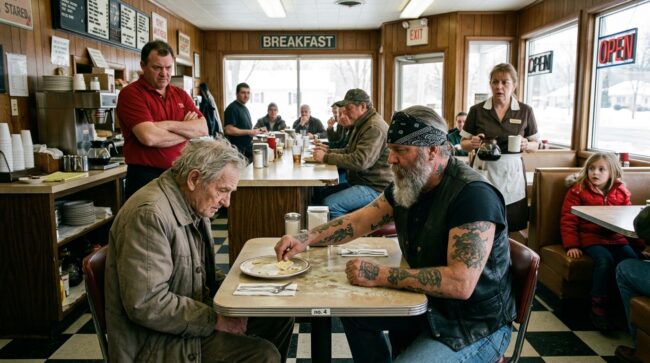
At the back corner booth, near the pie case and the rattling heater, an old man sat with both hands wrapped around a paper cup of water as though even that had to be borrowed carefully.
He looked seventy, maybe older, though poverty ages a face in ways calendars don’t. His coat was too thin for February. One sleeve had a stitched tear near the elbow, repaired by someone patient or desperate. A wool cap rested on the table beside him, damp with sleet. In front of him sat an empty plate with only two saltines left in the wrapper.
He had not ordered a meal.
That was the problem.
At least according to Marty Kessler, who owned the diner and had begun the confrontation five minutes earlier with the confidence of a man who mistook irritation for principle.
“You can’t sit here all afternoon if you’re not buying food,” Marty had said loudly enough for half the room to hear and the other half to guess correctly.
The old man had looked up once. Not defiant. Not pleading. Just tired.
“I asked if there was any work out back,” he’d said. “Trash, dishes, anything.”
“There isn’t.”
“I can sweep.”
“You can leave.”
That should have been enough humiliation for one lunch hour.
It wasn’t.
Because a young mother by the window had pulled her little girl closer. A pair of men in work jackets had started muttering the word panhandler like they’d earned it. Someone near the counter had laughed when the old man reached into his coat pocket and came up with exactly eighty-seven cents in change, lined neatly on the table as if order could make it less pitiful.
“Keep your money,” Marty had snapped. “I’m not running a shelter.”
That was when the bell over the diner door rang.
Everyone looked.
The biker filled the doorway in one still, unwelcome shape—broad shoulders, sleeveless leather vest over a thermal shirt despite the weather, tattooed forearms darkened by sleet, a rough gray beard that made him look older than violence and more patient than trouble. He stood there with rainwater on his boots and helmet in one hand, taking in the room with one long glance that paused only once.
On the old man.
Then on Marty.
No one in the diner knew him. That made it worse.
Because men who look like that don’t usually walk into tension. They bring it with them.
He crossed the room without stopping at the counter, without ordering coffee, without even glancing at the handwritten pie specials taped under the register. His boots sounded heavy on the old tile. Too steady. Too deliberate.
The young girl by the window whispered, “Mommy?”
Her mother said, “Don’t stare.”
But everyone stared.
The biker reached the back booth, slid in across from the old man, and pulled the untouched cracker packet toward himself as if he had been invited. Then he looked over his shoulder at Marty and said the line that emptied the room of all comfortable noise.
“Say one more word to him while I’m chewing.”
No one laughed.
No one even moved.
Because the whole scene now looked wrong in a new direction.
The old man’s eyes lifted to the biker’s face, and for one second something flickered there—not relief, not fear exactly, but recognition shaped like disbelief.
That detail would have meant something if anyone had been calm enough to notice it.
They weren’t.
Marty recovered first, which was unfortunate for everyone.
“You threatening me in my own place?” he said, voice climbing half a notch, the way men’s voices do when bravado is trying to outrun uncertainty.
The biker didn’t answer immediately.
He tore open the cracker sleeve, set one cracker on the old man’s empty plate, kept the other for himself, and took a bite without hurry. The gesture was so strange, so controlled, that it unsettled the room more than shouting would have.
Because now it looked intentional.
Personal.
And no one knew why.
The old man sat very still. His fingers had gone white around the paper cup. He looked like someone bracing for a collision that had not reached him yet.
At the counter, Doris—the day waitress with the smoker’s voice and the softest heart in the building—stood frozen beside the coffee machine. She had tried quietly, twice, to slide the man a bowl of soup on the house. Marty had stopped her both times. Now she looked from the biker to the old man to the front door, already calculating how long police would take if someone called.
A trucker in a camouflage cap muttered, “This is about to go bad.”
A teenager near the pie case angled his phone lower and started recording.
The little girl by the window had turned fully around in her seat now, watching with the shameless focus only children and old people have. She couldn’t have been more than seven. Her red mittens lay on the table beside a grilled cheese sandwich cut into crooked triangles.
“Mommy,” she whispered again, “why’s he sitting with him?”
Her mother had no answer.
Neither did anyone else.
Marty planted both hands on the counter and leaned out. “You two need to leave. Now.”
The biker turned his head slightly, but not enough to give Marty his full attention. “Bring a menu.”
That made several people inhale at once.
Marty laughed, short and ugly. “I’m not serving either of you.”
The biker finally looked at him then.
His face didn’t change. It didn’t need to.
“Didn’t ask for your opinion,” he said. “Asked for a menu.”
Tension rolled outward from that booth, touching every table. The men in work jackets shifted in their seats like they might stand if standing became useful. The trucker took his wallet out, then thought better of involving himself in a scene he didn’t understand. Doris took one step forward, then stopped when Marty lifted a hand to keep her back.
The old man spoke for the first time since the biker sat down.
“You don’t have to do this,” he said quietly.
His voice was surprisingly steady. Thin, but steady.
The biker didn’t look at him. “I know.”
That answer landed strangely.
Not because of the words. Because of the tone.
There was no kindness in it. No performance. No public charity. Just a flat acknowledgment, almost irritated, like whatever this was had already been decided somewhere before the room got to watch it.
That made the misunderstanding spread faster.
“He knows him,” someone whispered.
“No way.”
“This is a setup.”
“Maybe they do this all the time.”
Marty seized on that last part immediately.
“Yeah,” he said louder now, looking to the room for support. “That’s what this is. Guy comes in, makes a scene, scares people, gets a free meal out of guilt.”
The old man flinched.
Only slightly. But the biker saw it.
Everyone did.
And because fear makes fools of crowds, the room interpreted that tiny movement in the worst possible way—not as humiliation, but as proof.
A woman near the register stood and pulled her purse closer. The trucker in the cap muttered, “Call somebody.” The teenager with the phone started recording more openly now, thrilled by the possibility that lunch had turned into the kind of clip people send around with captions and no context.
Doris found her voice.
“Marty, enough.”
“Stay out of it.”
“No.”
He turned on her. “You want to pay for every drifter who wanders in?”
That word did it.
The little girl by the window frowned like she had heard something wrong even if she couldn’t name it. The old man lowered his eyes to the table. And the biker, who had remained still through all of it, placed both hands flat on the booth and rose.
Not fast.
Not violently.
Worse.
Calmly.
Every chair scrape in the room stopped.
He was taller standing than anyone had guessed sitting down, and broader too, his leather vest hanging heavy over a frame that had seen years harder than this room could imagine. The tattoo on his right forearm disappeared under old scar tissue near the wrist. His gaze moved from Marty to the old man and back again like he was measuring distance, risk, and the exact amount of truth the room deserved.
The young mother grabbed her daughter’s shoulder and pulled her back.
The teenager whispered, “Oh, man.”
Marty stepped away from the counter before he seemed to realize he was doing it. “Don’t start with me.”
The biker took one step toward the register.
Only one.
And suddenly even the people who had wanted drama seemed to understand they had asked for more than they meant to.
“Sir,” Doris said quickly, voice shaking now, “please—don’t.”
The biker stopped.
That was the unsettling thing about him. He stopped exactly where she asked, like he respected the plea but not the panic. One more step and he would have been at the counter. As it was, he stood halfway between the back booth and Marty Kessler’s register, broad enough to make the aisle feel narrower than it was.
No one in the diner breathed normally.
Marty tried to recover his ground.
“If you touch anything in this place, I’m calling the police.”
The biker’s eyes went to the old black cash register. Then to the soup warmer. Then to the sign beside the pie case that read NO LOITERING — CUSTOMERS ONLY in curling red letters. When he spoke, his voice was low and level.
“Go ahead.”
He reached into the inside pocket of his vest.
Three things happened at once.
The teenager by the pie case dropped his phone half an inch and said, “Whoa.”
The little girl’s mother pulled her child fully behind her chair.
And Marty took two quick steps back and reached under the counter, where everyone suddenly remembered he kept an old aluminum bat for “security” whenever the late shift got rough.
Doris gasped. “Marty, no!”
The biker noticed the motion under the counter. Of course he did. But he didn’t lunge. Didn’t raise his voice. He only withdrew whatever was in his vest pocket slowly, giving the room just enough time to imagine the worst before proving them wrong.
It wasn’t a weapon.
It was a folded paper.
Yellowed at the edges. Creased so many times it looked as thin as cloth.
For a moment that made no sense at all.
Then the biker set it on the counter.
Not in front of Marty.
Not toward Doris.
He turned, walked back to the booth, and placed the paper beside the old man’s water cup.
The old man stared at it like it had arrived from another decade.
His mouth parted slightly.
The little girl by the window, forgetting fear for curiosity, leaned around her mother and whispered, “Is it a letter?”
Nobody answered her.
The biker remained standing beside the booth now, one hand resting on the tabletop, not touching the paper, not touching the old man, just waiting. Marty, still half-crouched behind the register with one hand near the hidden bat, seemed less certain than before. The room’s certainty had begun to rot from the inside. That was what confusion did when it met restraint.
“What is that?” Marty demanded, though not nearly as loudly as before.
The biker ignored him.
The old man looked up slowly.
“You kept it,” he said.
There it was.
Not a question.
A recognition.
A line that changed the air in the diner so sharply even the people who didn’t understand it felt the shift.
The biker answered with the first sentence he had spoken that sounded remotely personal.
“Took me long enough to find you.”
No one moved.
Not Marty.
Not Doris.
Not the teenager with the phone.
Not even the little girl, whose grilled cheese sat cooling untouched while her round eyes moved from the biker to the old man and back again.
The old man’s hand hovered over the folded paper but did not touch it. His fingers shook.
“You shouldn’t have come here,” he said.
The biker’s jaw tightened once. “And you shouldn’t be asking strangers for crackers.”
That might have been almost funny in another room. In this one, it landed like a warning wrapped around a memory.
Doris took a hesitant step closer. “Do you… know each other?”
Neither man answered.
Marty finally straightened up from behind the counter, though he kept one defensive hand beneath it. “I don’t care what this little drama is. He asked for money in my diner.”
The biker turned his head.
“No,” he said. “He asked for work.”
Marty opened his mouth, but the biker cut across him for the first time, not louder, only sharper.
“And you knew the difference.”
Silence.
Real silence now.
The old man lowered his eyes, ashamed all over again—but for what, no one could tell. The folded paper lay between his trembling hand and the biker’s scarred one like a fuse nobody in the diner understood.
Then the bell over the door rang again.
A uniformed Scranton patrol officer stepped in out of the sleet, shaking water from his cap, already frowning at the tension frozen across the room. He took in the biker first, then Marty’s face, then the old man at the booth, then the phone held half-hidden by the pie case.
And because every bad scene looks obvious before the truth arrives, his hand moved instinctively toward his belt.
“What’s going on here?”
Marty pointed instantly.
“That man came in threatening people.”
The officer turned toward the biker.
The old man finally put his fingertips on the folded paper.
And the expression that crossed his face in that moment made Doris grab the back of a chair to steady herself.
Because whatever was written there—
It had already changed him.
And the biker, still standing over the booth like a man who had come too late and known it for years, said only one thing.
“Ask him his real name.”
The officer looked from one man to the other.
The entire diner leaned in.
And the old man, staring down at the letter with eyes that had gone suddenly bright and haunted at once, opened his mouth to answer.
For a moment, the old man did not answer.
He sat in that back booth with the folded letter under trembling fingers, the paper cup of water sweating onto the table, the sleet ticking softly at the windows while the whole diner seemed to hold itself above a drop.
Officer Sean Mercer took one step closer.
“Sir,” he said, measured now, looking not at the biker but at the man in the booth, “I need your name.”
The old man lifted his head slowly.
It was strange, the way dignity can return in fragments. Not all at once. Not enough to erase the shivering or the stitched sleeve or the eighty-seven cents still lined in a neat row by the plate. But enough to change a jawline. Enough to make a room doubt itself.
“My name,” he said, voice thin but clear, “is Harold Whitaker.”
The biker’s eyes stayed on him.
“Not the one on the shelter card,” he said.
That made Officer Mercer turn sharply. “Shelter card?”
Doris looked confused. Marty looked irritated. The teenager filming lowered his phone a little, because now this was no longer the easy kind of public shame that fit cleanly on a screen.
Harold shut his eyes once.
On the table beside the water cup sat a laminated county shelter card, partly visible beneath his sleeve. Officer Mercer reached carefully and drew it out.
THOMAS REED, it read.
He looked back at the old man. “Is this yours?”
“No,” Harold said.
A stir moved through the diner.
Marty seized on it first. “See? He’s lying. I told you.”
The biker turned his head just enough to make Marty fall silent without being asked.
Officer Mercer’s voice softened almost despite himself. “Why are you using another name?”
Harold looked at the folded paper again.
His hand opened over it, then closed.
“Because mine used to matter to somebody,” he said. “And I got tired of hearing it from the wrong mouths.”
Nothing about that sentence answered anything. It only widened the room.
The little girl by the window leaned farther around her mother and whispered, “Mommy, why’s he sad?”
Her mother didn’t answer. She had gone pale.
The biker finally pulled out the booth bench across from Harold and sat again, not because the room had calmed, but because he seemed to know sitting down would make everyone else less foolish. He rested one forearm on the table and said, “Open it.”
Harold looked at him with something like pain. “You kept that all this time?”
“Yeah.”
“You shouldn’t have.”
“Tough.”
There was no comfort in it. No performance for the room. Just an old argument resuming in front of strangers.
Officer Mercer glanced at the paper. “What is that?”
The biker answered without looking away from Harold.
“A letter his daughter wrote twelve years ago.”
That sentence hit the diner harder than if he had shouted.
Doris covered her mouth. Marty frowned, because facts that humanize the shamed always arrive as an inconvenience to men who prefer certainty. The little girl blinked rapidly, trying to piece together how a beggar became a father in one sentence.
Harold’s fingers tightened on the paper.
“My daughter is dead,” he said.
The biker gave one short nod. “I know.”
That changed the temperature again.
Not calmer. Deeper.
Because now the room understood this was not charity and not some roadside performance between a drifter and a biker with a taste for trouble. This was history. Family, somehow. Loss, definitely.
Officer Mercer holstered the hand he’d half-moved toward his belt. “Sir, are you in danger?”
Harold let out something that might have been a laugh if it hadn’t been so close to breaking.
“No,” he said. “That’s the worst part.”
Then, finally, he unfolded the letter.
His hands shook so badly Doris took an involuntary step forward as if she might help hold the paper flat. He read only the first line before his face changed—not into tears yet, but into the expression of someone hearing a voice arrive intact across impossible distance.
The biker sat perfectly still.
Marty, desperate now for the world to be simple again, said, “This doesn’t change what he was doing in here.”
“No,” the biker said. “It changes what you were doing.”
And no one in the diner, not even Marty, had an answer ready for that.
Harold read the letter all the way through in silence.
No one interrupted him.
Not the officer. Not Doris. Not even the teenager with the phone, who finally lowered it completely and slipped it into his pocket with the awkwardness of someone realizing too late that he had turned the wrong pain into entertainment.
When Harold finished, he folded the letter with absurd care, smoothing each crease as though his daughter might notice from wherever the dead keep score of the living.
Officer Mercer asked quietly, “Who is she?”
Harold stared at the paper in his hands.
“My daughter,” he said. “Evelyn.”
The biker looked out toward the fogged windows as if giving the name room to land.
Doris whispered it once under her breath, maybe without meaning to. Evelyn. A real woman now. Not an abstract daughter. Not a sympathy device. Someone who had written a letter that could stop a diner colder than winter outside.
Officer Mercer pulled a notebook from his pocket, then hesitated and put it away again.
“And you are?” he asked the biker.
The man finally answered. “Wes Callahan.”
The name meant nothing to Marty, nothing to the trucker, nothing to the mother by the window. But it meant something to Harold.
His chin lifted half an inch.
“You got old,” he muttered.
Wes shrugged. “You vanished.”
That wasn’t warmth. It wasn’t anger either. It was the flat tone of men whose loyalty had survived more than their comfort did.
Officer Mercer looked between them. “How do you know each other?”
Wes leaned back slightly, leather creaking.
“Afghanistan,” he said.
The room went still again.
Harold’s eyes stayed on the table.
Doris sat down in the nearest chair without asking anyone’s permission, because whatever lunch service had been happening in this diner was over for the moment.
Wes continued, not dramatically, just enough.
“Her daughter was a medic on our route support unit. Smart. Fast. Better under pressure than most men twice her age.” He glanced once at Harold. “He used to send her letters every month. Real paper. Envelopes with stamps. She’d read them three times and pretend she wasn’t crying.”
Harold’s mouth moved, but no sound came out.
The little girl by the window whispered, “Was she a soldier?”
Her mother nodded once, tears standing in her eyes now.
Wes said, “She didn’t make it home.”
No one asked how.
They didn’t need to.
Loss, when spoken plainly enough, brings its own image.
Harold stared at the crackers on the empty plate as if he could not bear the room seeing his face. “I buried her,” he said. “Then I lost the house eight months later. Then I lost the rest in pieces.”
Wes added, “And he stopped answering everybody.”
Harold shot him a tired look. “Didn’t ask for commentary.”
“You’re getting it.”
A tiny sound—almost laughter—escaped Doris before she could stop it. Not because the situation was funny, but because the rhythm between the two men suddenly made sense. This wasn’t rescue in the usual way. It was unfinished business wearing the wrong clothes for a diner.
Officer Mercer crouched slightly so he was nearer Harold’s level. “Why the other name?”
Harold rubbed one thumb against the edge of the folded letter.
“Because Evelyn was Staff Sergeant Evelyn Whitaker,” he said. “Gold Star funeral. Flags. Uniforms. Handshakes. People saying ‘sir’ to me with their eyes full of pity.” He swallowed. “Then after the mortgage went and the drinking did what it does and my son-in-law took the grandbaby out west, I heard ‘Mr. Whitaker’ from a caseworker who’d Googled her name in front of me. I couldn’t do it anymore.”
That was the reveal the room hadn’t earned but received anyway.
Not just an old man asking for work.
A father who had outlived the daughter whose name still opened doors for everyone except him.
Marty looked suddenly smaller behind the counter.
The teenager near the pie case sat down without realizing he had done it.
Wes reached into his vest again, and every eye followed, though the fear was different now.
This time he placed a small photograph on the table.
Harold saw it and froze.
Officer Mercer leaned in just enough to glimpse three soldiers in desert light, one of them a young woman grinning under a helmet, arm slung over the shoulder of a younger, leaner Wes Callahan.
Evelyn.
Harold made a sound then. Not loud. Worse. The kind of sound a room remembers after it forgets the details.
And still Wes had not explained why he’d chosen today, this diner, this exact humiliation, to come find him.
That answer was still waiting.
Wes let the photograph sit between them for a few seconds before he spoke.
“I’ve been looking for you since September,” he said.
Harold wiped once at his mouth with the back of his hand. “Why now?”
Wes glanced toward the sleet-streaked windows, then to Officer Mercer, then back to Harold.
“Because Lily turns eleven next month.”
Harold went completely still.
Even Doris felt it, though she had no idea who Lily was yet. Some names enter a room like dropped glass. You know they matter before you know why.
Harold’s voice came rougher. “No.”
Wes nodded once. “Yeah.”
The old man’s hand tightened around the folded letter so hard Officer Mercer almost told him to ease up before the paper tore.
“My granddaughter?” Harold said.
Wes didn’t answer right away, and that hesitation told the room more than any speech could have.
Then: “Your son-in-law died in Reno last summer. Accident on a scaffolding crew. Lily’s been in state kinship placement since August while they tried to verify family.”
Doris sat back hard in her chair.
The mother by the window pulled her own little girl closer and kissed the top of her head without thinking.
Harold stared at Wes as if the air had been punched out of him.
“No,” he said again, but there was nothing behind it now except grief trying to refuse a second shape.
Wes pushed a second paper across the table. This one newer. Official. County letterhead. Names. Case number.
“I found out through an outreach contact in Lackawanna. They were still trying to locate ‘Harold Whitaker, possible maternal grandfather, address unknown.’ I started asking around shelters. Soup kitchens. Bus station lists.” He gave Harold a hard look. “Then I walked into this place and found Thomas Reed begging for crackers.”
Harold shut his eyes.
“I wasn’t begging.”
“No,” Wes said. “You were disappearing.”
The distinction mattered. Everyone in the diner felt it.
Officer Mercer took the county paper and scanned it quickly, his professional instinct returning just enough to steady the room.
“This is real,” he said.
Harold looked at him as though the confirmation itself hurt.
“My granddaughter’s alive?”
Wes nodded.
“Small. Mean left hook. Looks like her mother around the eyes.”
That did it.
Harold bent forward with both forearms on the table, one hand over his face, not sobbing exactly because some men no longer know how to do that in public, but shaking in a way the body recognizes even when pride does not.
Wes remained still. Not touching him. Not rescuing him from being seen. Just present.
Then came the final turn.
Harold lowered his hand slowly and looked at the letter again. “She wrote this before her last deployment.”
“Yep.”
“You kept it.”
“Yep.”
Harold nodded once to himself, like a terrible arithmetic had just resolved.
“You promised her.”
Wes’s jaw flexed.
No answer.
The room leaned inward.
Harold looked up. “You promised Evelyn you’d find me if anything happened.”
Wes held his gaze.
“Yeah.”
Officer Mercer’s eyes moved between them. Doris stopped breathing again. Even Marty, who had wanted the entire day reduced to loitering and policy, understood he was standing in the ruins of something much larger.
Harold whispered, “And I let twelve years pass.”
Wes answered with the one line that broke the scene open.
“No. I did.”
It came out flat, disciplined, and heavier than any apology.
He looked at the photograph, not at Harold.
“She made me promise in the aid station after the blast took her hearing on one side for a day. Thought it was funny she could still order us around. Said if she didn’t make it back and you got lost in the grief, I was to find you before Lily ever needed a stranger more than family.” His throat moved once. “I told myself I had time.”
There it was.
The twist inside the twist.
Not merely a biker showing mercy to a shamed old man. Not even a soldier honoring a fallen comrade.
A man who had broken a promise for years, and had just found out time had reached the child attached to that promise.
Harold stared at him through wet, astonished eyes.
And for the first time since entering the diner, Wes looked almost ashamed.
Nobody in the diner said much after that.
Some stories close a room down by force. This one did it by truth.
Doris stood up first. She took Harold’s empty plate without asking, wiped the table clean of the lined-up coins, and came back two minutes later with tomato soup, a grilled cheese, and a slice of apple pie she set down in front of him like a correction too small to matter and somehow necessary anyway.
Marty opened his mouth once, thought better of it, and closed it again.
Then, to everyone’s surprise, he came out from behind the counter carrying a fresh pot of coffee.
He set it down at the booth and said, “On the house.”
It wasn’t enough. He knew it. So did everyone else.
But shame has awkward hands, and that was all his knew how to offer.
Harold looked at him, then at the coffee, and gave the smallest nod. Not forgiveness. Just acknowledgment.
Officer Mercer stepped outside to make a call to the county number on the letterhead. When he came back in, sleet melting from his shoulders, his face had changed.
“They’ll reopen family verification,” he told Harold. “They’ll need ID, a stable address, and a contact point. But yes—there’s still time.”
Still time.
Those two words seemed to pass through Harold and Wes differently.
For Harold, they landed like pain with a pulse inside it.
For Wes, they landed like a sentence.
Harold picked up the spoon with an unsteady hand. Before he took the first bite, he looked across the table.
“You got a place?”
Wes frowned. “What?”
“A place,” Harold repeated. “To sleep. Since you found me in a diner and not at your own kitchen table.”
A few people smiled despite themselves.
Wes said, “Motel off Keyser Avenue.”
Harold looked at the soup. “Waste of money.”
“Not your business.”
“Seems like it is if I’m going to need a ride to county offices.”
That nearly made Doris laugh again.
Wes leaned back, studying him. “You planning to live long enough to be difficult?”
Harold took a bite of soup. Swallowed. “I was difficult before you met me.”
The little girl by the window, who had absorbed more of the day than any adult intended, tugged on her mother’s sleeve and whispered too loudly, “Mommy, is the scary man his friend?”
Her mother opened her mouth, but Wes answered first.
“Something like that.”
The girl considered him. Then she picked up half her grilled cheese, marched it carefully across the diner under her mother’s alarmed gaze, and placed it beside Harold’s plate.
“For later,” she said.
Harold stared at the sandwich as if no ceremonial medal he had seen at military funerals had ever hit him so directly.
“Thank you, sweetheart.”
She nodded, satisfied, and went back to her booth.
No speech followed. No neat bow.
Officer Mercer gave Harold a card with his direct number. Doris wrote down the address of a veterans transitional housing coordinator on a napkin even though Harold wasn’t the veteran, because sometimes help arrives sideways. Marty took down the NO LOITERING sign before anyone asked him to and set it face-down under the register.
Wes stood when Harold finished half the soup.
“Come on,” he said.
Harold looked up. “Where?”
“Barber first,” Wes said. “County tomorrow. Motel tonight. One problem at a time.”
Harold stared at him for a second, then rose carefully, old bones stiff from cold and pride and too many bad benches. He reached for the eighty-seven cents still sitting near the saltines.
Wes covered the coins with one scarred hand.
“Leave it.”
Harold looked at him. “Why?”
Wes glanced at the little girl’s sandwich wrapped by Doris in foil, the county letter in Officer Mercer’s handwriting-clipped folder, the pie case reflecting two men who both looked more worn than dangerous now.
“Because,” he said, “she’s going to need every version of your real name.”
Harold stood very still.
Then he took his wool cap from the table, folded his daughter’s letter into the inside pocket of his thin coat, and walked toward the door with Wes half a step behind him—not leading, not pushing, just there.
When they reached the threshold, Harold paused and looked back once at the diner that had watched him become something other than what it first decided.
Marty lowered his eyes.
Doris lifted one hand.
The little girl waved.
Outside, the sleet had thinned to cold rain. Wes put on his helmet but did not start the bike yet. Instead he took off his own heavier flannel overshirt and handed it to Harold without ceremony.
Harold accepted it with the same silence men use when refusing would cost more than taking.
They walked to the motorcycle together. Not quickly. Not dramatically.
Just two figures moving through the wet Pennsylvania afternoon, carrying between them a dead woman’s promise, a child still living, and a little more time than either man had expected to find.
And inside the diner, long after the engine faded down Route 6, no one said the word beggar again.