Part 2: They Laughed at the Biker Buying Dolls — Until He Said Why
My name is Emily Parker, and I was twenty-six that winter, assistant manager at Bright Box Toys, which sounds more important than it was. Mostly I handled returns, cleaned glitter off shelves, calmed down parents, and pretended not to judge adults who argued with children over ten-dollar plastic dinosaurs.
The store sat between a burger place and a gas station, not far from Interstate 40 and the old Route 66 strip. We got tourists, truckers, grandparents, birthday-party emergencies, and divorced parents trying to buy love in a hurry before weekend visitation started.
You learn to read people in a toy store.
Some parents shop like they know the child. They touch things, remember colors, laugh to themselves. Some shop like they are guessing. They grab the most expensive box and hope the price covers the distance.
Hank Mercer looked like a man guessing with his whole life on the line.
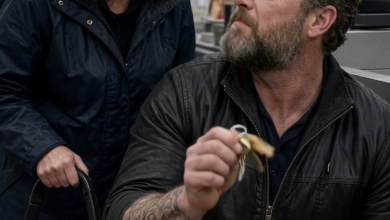
He stood in the doll aisle holding two boxes, one purple dress, one blue dress, while his daughter watched from the phone. His hand was huge around the cardboard, scarred and tattooed, the word GRACE inked across his knuckles. I noticed that because it did not match the rest of him.
Most of his tattoos looked old. Dark eagles. A cracked compass. A date under his left wrist. A small black road sign near his thumb. Across the inside of his leather cut, just visible when he turned, was a tiny stitched patch shaped like a yellow star.
No club colors on the front that I could read from where I stood. Just one back patch: Canyon Dogs MC — Northern Arizona.
I knew that club by sound before I knew it by name. They came through town in small groups sometimes, stopped for coffee at the diner, bought batteries or duct tape or cheap sunglasses, then rolled out again with that low V-twin rumble. They looked rough. They tipped well. They always held doors for old women and scared tourists anyway.
Hank was their sergeant-at-arms, I learned later. That meant something in his world. In mine, it meant parents in aisle seven were trying not to stare.
On the phone, the girl said, “Purple, maybe.”
“Maybe purple,” Hank repeated, as if writing it down inside his skull.
“She comes with a dog,” I said gently, stepping closer.
Hank looked at me like I had appeared from under the floor.
“What?”
“The purple dress doll. She comes with a little dog. The blue one comes with a hairbrush and mirror.”
He looked at the boxes again, lost.
His daughter’s voice came through the phone.
“I like dogs.”
Hank nodded once.
“Purple then.”
He put the blue box back with the carefulness of a man returning a borrowed tool.
The rude father behind him muttered something under his breath and walked off. Hank did not follow. Did not glare. Did not perform toughness for the aisle.
He looked back at the phone.
“What else do you like now?”
That word hit me.
Now.
Not “what do you like?”
What do you like now?
The girl’s face went smaller.
“I don’t know.”
Hank swallowed.
“Me neither.”
The call ended two minutes later because, he told her, “You need sleep before school.” His voice was rough, but he said it like he was repeating a line someone had taught him.
Then he stood there with the doll under one arm, not moving.
I asked, “First birthday?”
He shook his head.
“First week.”
I waited.
He looked toward the front windows, where his Harley sat under a weak parking lot light, rain beading on the tank.
“She just moved in.”
“With you?”
He nodded.
“After nine years.”
He said it flat. No drama. Bikers did that, I would learn. They put pain on the table like a wrench and expected you to know it was heavy.
I did not ask what happened.
He told me anyway, piece by piece, because sometimes strangers in fluorescent light are easier than family.
Her name was Abby. She was eight when she came back to him, but the last time Hank had lived with her, she was barely walking. There had been a divorce. A custody order. A bad stretch with alcohol. Missed calls that turned into blocked numbers. Child support sent through the state. Birthday cards returned. Nine years of him telling himself she was better off without the sound of his boots in the hallway.
Then Abby’s mother got sick. Not dying sick, but sick enough that the people around her finally admitted she needed help. Abby came to stay with Hank “for a while,” which every adult pretended was clear and every child knew was not.
The Canyon Dogs helped before he knew how to ask.
Rico, a Mexican American biker in his forties with a shaved head and a mechanic’s hands, helped him build a bed. Bear, a huge Black American biker in his early fifties, hauled a dresser from a thrift store. A White American woman named Jo, who rode a blue Harley and had raised three boys, inspected the room and told Hank, “No kid wants to feel like a guest in their own house. Put something on the wall.”
So Hank bought a corkboard.
Then stood in front of it for an hour.
Because he did not know what Abby liked now.
That became the quiet wound.
He could rebuild a transmission. Ride through desert rain. Pull a grown man out of a ditch. Stand between two angry brothers until both remembered they were brothers.
But he did not know whether his daughter liked purple.
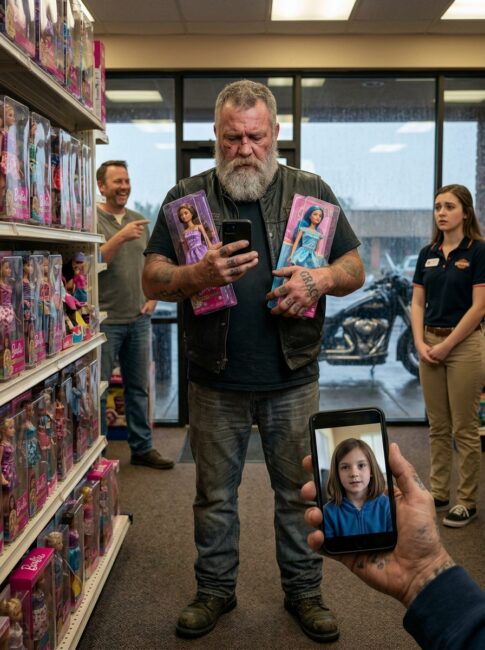
The night in the toy store should have ended with him buying the purple doll and leaving.
That would have been a sweet little story.
It did not end there.
Hank brought the doll to the counter, then stopped beside the craft kits. His eyes moved over beads, markers, bracelets, sticker books, plastic horses, tiny cooking sets, science kits with smiling kids on the boxes, and puzzles with too many pieces.
He looked more afraid there than he had when that man mocked him.
“Do eight-year-olds still color?” he asked.
“Some do.”
“Do they like slime?”
“Some do.”
“Is slime a bad idea?”
“For carpet, yes.”
He nodded like that mattered.
“Got carpet.”
I walked him back through the aisles. Not because I was trying to upsell him. Because I had seen enough parents panic-buy giant toys that would never be opened. Hank was not trying to impress Abby. He was trying to learn her language.
“What does she do when she’s nervous?” I asked.
He rubbed one hand over his beard.
“Reads.”
“What kind?”
“No clue.”
“Animals? Magic? Funny? Mystery?”
He looked ashamed.
“Animals maybe. She had a stuffed fox when she was little. Carried it by one ear.”
That was something.
We picked a book about a girl and a lost dog. A small art set. A night-light that projected stars on the ceiling. A puzzle with wolves on it. Not too childish. Not too grown. A soft blanket with moons.
Then he stopped in front of the dolls again.
“Should I get both dresses?”
“They’re different dolls.”
“Can clothes switch?”
“Not all brands.”
He frowned at that like toy companies had personally betrayed him.
I found a small clothing set that fit the purple doll. Pajamas, raincoat, little boots.
He held it in one hand.
“Raincoat,” he said.
“She likes rain?”
“She hates thunder.”
“Then the raincoat might make it feel safer.”
He put it in the basket.
At the register, the total came high enough that he blinked once. Not because he could not pay. Because money becomes strange when guilt is standing behind it. Too little feels careless. Too much feels like bribery.
He pulled out cash.
The rude father from aisle seven came up behind him with the soccer ball and a board game. His wife, a White American woman with tired eyes, stood beside him. She had heard the earlier comment. I could tell by the way she would not look at her husband.
Hank was placing the items on the counter one by one. Doll. Book. Blanket. Star light. Art set. Doll clothes.
The man snorted.
“Whole nursery now?”
His wife whispered, “Stop.”
Hank did not turn around at first.
His hand rested on the doll box. The tattoos over his fingers flexed once. GRACE. He took a breath through his nose, slow and hard.
Then he turned.
“Brother,” he said, not warmly, not threatening, just tired. “Nine years ago, I knew her favorite song, what cereal made her sick, and how she wanted the hall light left on. Now I’m asking a stranger what size doll pajamas fit because I don’t know what my own kid likes.”
The man’s face changed.
Hank went on.
“You got a child at home who lets you know things? Don’t waste that.”
No one spoke.
The wife looked at Hank like he had reached across the aisle and taken something heavy out of her hands.
The cashier, a college kid named Miles, scanned slower than necessary because his eyes were wet and he was pretending they were not.
Hank paid, thanked me, and carried the bags outside.
I watched through the glass.
Rain had turned the parking lot black and shiny. His Harley waited near the curb. He stood beside it, bags hanging from one hand, helmet in the other, and suddenly all that leather and ink looked less like armor and more like a man who had worn the wrong protection for too long.
Then another sound rolled in.
More Harleys.
Three of them.
The Canyon Dogs pulled up beside him. Rico, Bear, and Jo. Engines cut one by one, leaving only rain ticking on chrome.
Jo looked at the toy bags.
“You ask for help?”
Hank said, “At the store.”
Rico grinned.
“He asked a civilian?”
Bear shook his head.
“Man’s desperate.”
Hank did not smile.
Jo noticed first.
She stepped closer.
“What happened?”
Hank looked through the window at the toy aisle, then down at the purple doll box.
His voice was so low I could not hear it, but I saw the shape of his mouth.
“I missed everything.”
That was the false climax.
I thought the story was about a man being mocked and finding humility.
It was not.
The real wound was waiting at home.
PHẦN 4 — THE TWIST
A week later, Hank came back.
This time, he was not alone.
The same Harley rolled into the parking lot at 5:40 on a Thursday evening, but behind it came an old pickup truck driven by Jo. Hank climbed off the bike and stood beside it for a moment, looking toward the passenger door of the truck like he was waiting for permission to breathe.
Then Abby stepped out.
She was smaller than I expected. Eight years old, White American girl, brown hair cut to her shoulders, blue hoodie, black leggings, and sneakers with one untied lace. She had Hank’s eyes. Same pale gray-blue. Same way of looking at the world like it might move too fast.
She held the purple doll against her chest.
That nearly broke me.
Not because the doll mattered. Because the doll had been opened. Loved a little already. One of its plastic shoes was missing. The doll’s hair was messy. The raincoat from the clothing set was on backward.
Hank noticed the untied shoe at the same time I did. He bent a little, then stopped.
“Can I?” he asked.
Not “hold still.”
Not “your shoe’s untied.”
Can I?
Abby looked down. Then nodded.
The biker who looked like he could kick open a steel door got down on one knee in front of a toy store and tied his daughter’s sneaker with the concentration of a surgeon.
His leather cut creaked. His chain wallet clicked against the pavement. His big tattooed hands fumbled once with the tiny laces.
Abby watched him.
“You’re slow.”
“Been a minute.”
“You forgot how to tie shoes?”
“Forgot how small they are.”
She looked at his hands.
“They’re not that small.”
“No. They ain’t.”
He finished. Double knot.
She tested it with her toe and accepted the work.
Inside the store, I pretended to straighten plush animals while my chest tightened.
Hank brought her to aisle seven. The doll aisle. Same fluorescent lights. Same rows of plastic faces. Same place where he had stood like a lost man a week earlier.
Abby did not run ahead.
She walked close enough that her sleeve brushed his hand, but she did not take it. Hank did not grab for her. He let the almost-touch be enough.
Then she saw me.
“That’s her,” Hank said.
I smiled. “Hi, Abby.”
She looked at me, then at the doll, then at Hank.
“You’re the lady?”
I crouched so I was closer to her height. “I helped a little.”
Abby’s fingers tightened around the doll.
She turned to Hank.
“She helped you pick the raincoat?”
He nodded.
“And the stars?”
“Yep.”
“And the book with the dog?”
“Yep.”
Abby looked back at me.
Then she said the sentence I still hear when I close the store at night.
“She helped my dad find the road back to me.”
Hank went completely still.
The whole aisle seemed to stop breathing.
I did not know what to say. Neither did he.
Then Abby reached for his hand.
Not his sleeve.
Not the edge of his cut.
His hand.
Her little fingers wrapped around the tattooed letters across his knuckles.
GRACE.
That was the twist.
The toy store had not been about dolls.
It had been about directions.
Every little thing Hank bought was a mile marker on a road he thought he had lost forever.
Purple dress.
Star light.
Raincoat.
Book.
Permission.
And Abby knew.
They stayed in the store almost an hour that night.
Not because they bought much. They bought almost nothing, actually. A sticker sheet. A pack of doll socks. A small stuffed fox Abby found at the bottom of a clearance bin.
She held it by one ear.
Hank saw it and had to turn away.
That was one of the seeds coming back.
The fox from when she was little. The one thing he remembered right.
“You like foxes still?” he asked.
Abby shrugged.
“Maybe.”
But she put it in the basket.
That counted.
They walked slowly through the aisles, and I watched without trying to make it obvious. Hank did not know how to fill silence yet. He kept trying to ask questions, then stopping before they became too big.
“You need school stuff?”
“No.”
“You like art?”
“Sometimes.”
“You hate thunder still?”
Abby looked at him sharply.
He looked surprised by his own memory.
“You remember that?”
“Hall light,” he said.
“What?”
“You liked the hall light on. Door open two inches. Not all the way.”
Abby’s face shifted.
A crack in the wall.
“Mom said you forgot everything.”
Hank’s jaw tightened.
He looked down at the basket.
“I forgot how to be there,” he said. “Not you.”
That was the kind of sentence a child can carry. Not perfect. Not pretty. But solid.
Later, while Abby examined puzzles, Hank told me more in broken pieces.
He had been sober six years. Six years and four months, if you asked Jo. He kept the coin in the inside pocket of his cut, behind the yellow star patch. I had seen the patch the first night and thought it was cute, maybe a club joke.
It was not.
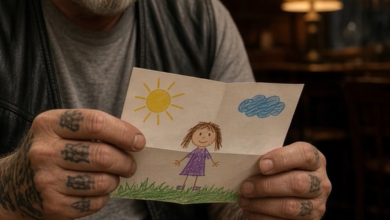
Abby had drawn it for him when she was three, during one of his last supervised visits before the custody battle turned ugly. A yellow star with too many points. She had told him, “So you find my house.”
He had folded the drawing into his wallet until it nearly fell apart. Years later, Jo had stitched a copy into his cut.
That was why the patch was inside, not outside.
Some things are not for the club.
Some things are for the heart.
The Canyon Dogs had not pushed him to fight for custody back then because Hank was a mess. He said that without self-pity. He had been drinking. Angry. Late to work. Late to visits. Late to everything that mattered. Abby’s mother had not invented all the reasons to keep him away.
That was important.
The story did not work if he was innocent.
He was not.
He was a complicated man trying to become safer than his past.
When Abby’s mother called nine years later and said, “I can’t do this alone anymore,” Hank did not celebrate. He sat on the floor of his garage for twenty minutes, phone in hand, listening to the ticking of his cooling Harley.
Then he called Brick.
Not the Brick from another story, but Hank’s club president, a Black American man in his sixties with calm eyes and a preacher’s patience.
Hank said, “I got a chance.”
Brick said, “Then don’t ride over it.”
The club built around him fast.
Jo brought sheets and said his old ones looked like “bachelor evidence.” Rico installed a lock on the bathroom door because little girls deserved privacy. Bear took away the beer fridge without asking permission. Hank came home from work and found an empty space where it had been.
He called Bear.
“You take my fridge?”
“Yep.”
“I was gonna do that.”
“You were gonna think about doing that.”
Hank hung up mad.
Then he texted thank you.
Those were the guardrails.
By the time Abby moved in, the house was clean, the room was ready, and Hank was terrified.
The first night, she barely spoke. She ate half a grilled cheese. Put the purple doll on the pillow. Asked where the bathroom was even though he had shown her twice. At 2:13 a.m., thunder rolled over Flagstaff. Hank woke up to the sound of her door opening.
He stood in the hallway, not too close.
“Door two inches?” he asked.
She nodded.
“Hall light?”
Another nod.
He turned it on.
She looked at him from the bed.
“Are you going to leave?”
He gripped the doorframe so hard his knuckles went pale.
“No.”
“People say that.”
“I know.”
“What if you get mad?”
“I go to the garage.”
“What if I get mad?”
“I stay in the house.”
That was the first promise.
The toy store was the second.
He did not come to buy a doll because he knew fatherhood.
He came because he did not.
And that humility did more than any perfect speech could have done.
After that, Hank and Abby came to Bright Box Toys every other Thursday.
Not always to buy. Sometimes just to look.
The Harley became familiar in our parking lot. That deep V-twin would roll in just before sunset, rattle the front windows, then cut off into a silence that no longer scared anyone on staff. Hank would step inside smelling like leather, cold air, engine heat, and peppermint gum. Abby would come beside him, sometimes holding his hand, sometimes walking ahead like she owned aisle seven.
She started teaching him.
“Dad, that doll is for little kids.”
“Dad, nobody says rad anymore.”
“Dad, you can’t just buy glitter because it’s on sale.”
He listened like she was giving road instructions in bad weather.
One Thursday, she brought in a list written on notebook paper.
Things Dad Doesn’t Know Yet.
Favorite color: teal, not purple, but purple is okay
Favorite animal: fox, then dog, then owl
Thunder: still bad
Pancakes: no blueberries
School pickup: don’t rev engine
Bedtime: knock first
Birthday: March 3, he knows now
Hank read the list at the end of aisle seven.
His face did that thing again. The hard tightening that meant something soft had been hit.
He folded the paper carefully and put it inside his cut behind the yellow star patch.
“Homework,” he said.
Abby nodded.
“Don’t lose it.”
“No, ma’am.”
He did not.
The rude father came back once, months later. Same clean shirt, same son, but quieter. He saw Hank and Abby near the puzzles. I watched him hesitate, then walk over.
Hank saw him coming and straightened.
The man held up both hands.
“I owe you an apology.”
Hank said nothing.
The man looked at Abby, then back at Hank.
“You were right. About not wasting it.”
Hank gave one nod.
That was all.
Biker forgiveness is not always warm. Sometimes it is just not hitting back when someone comes with their hands open.
In the spring, Bright Box Toys hosted a small charity drive for children in emergency foster placement. Jo organized the Canyon Dogs before I even finished making the flyer. Ten Harleys rolled in on a Saturday morning with backpacks strapped to their seats. Dolls, books, blankets, night-lights, crayons, stuffed animals. Not random junk. Thoughtful things.
Abby helped sort them.
She made a special box labeled Thunder Nights.
Inside went soft blankets, star lights, and small stuffed foxes.
Hank watched her tape the label down.
“You did good,” he said.
She glanced at him.
“You helped.”
He shook his head.
“You showed me.”
That became their ritual.
Every March 3, Hank brought Abby to the store. He let her pick one thing for herself and one thing for a kid who had to sleep somewhere new. Then they rode home, not on the Harley when she was still too small, but in Jo’s pickup or Hank’s old truck, with the motorcycle waiting in the garage like a patient animal.
When Abby turned twelve, she finally rode behind him for the first time around the neighborhood, helmet too shiny, boots too new, Hank going so slow a jogger passed them.
She laughed the whole block.
Hank did not.
He kept both hands steady and his heart somewhere in his throat.
I left Bright Box Toys three years after I met Hank Mercer. Went back to school. Became a counselor, of all things. Maybe that toy aisle taught me more than I knew at the time.
On my last evening shift, the Harley rolled in just before closing.
Same sound. Low thunder under fluorescent lights.
Hank walked in older than before, beard whiter, shoulders still wide, leather cut still carrying the yellow star inside. Abby came with him. Twelve years old now, taller, teal hoodie, fox keychain on her backpack, walking with the easy confidence of a girl who had learned where home was.
She carried a small wrapped box.
“For you,” she said.
Inside was a doll-sized road sign.
Hand-painted.
Route Home.
I laughed because I was about to cry, and sometimes those sounds come from the same place.
Hank cleared his throat.
“She made it.”
Abby rolled her eyes.
“He cried.”
“Did not.”
“You stood in the garage for twenty minutes.”
“Dust.”
“There is no dust in the garage. Jo cleaned it.”
Hank looked at me, caught, then shrugged.
“Maybe a little dust.”
Before they left, Abby walked to aisle seven. The doll aisle had changed by then. New brands. New boxes. New colors. But she stood in the same spot where Hank had once held up two dolls and admitted he did not know how to be her father.
She slipped her hand into his.
He looked down.
“You good?” he asked.
She squeezed once.
“Yeah, Dad.”
Outside, the Harley started with that old, heavy rumble. Abby climbed into Jo’s truck because it was raining hard, and Hank rode beside them through the wet parking lot, taillight glowing red against the black road.
Not fast.
Not loud.
Just steady.
Finding home again.
Follow the page for more biker stories where rough men learn the softest roads by heart.