Part 2: They Laughed at the Biker’s Fairy Makeup — Then His Daughter Stood Up
I should probably tell you why I was there.
My name is Jenna Porter. I am thirty-eight, a nurse at Saint Francis Children’s Hospital, and I had just finished a night shift that made my bones feel hollow. I stopped at Riverside Park because I could not go home yet. Nurses know that feeling. Sometimes you leave the hospital, but the hospital does not leave you. The monitors still beep in your head. The antiseptic smell stays in your hair. The faces follow you into your car.
So I bought bad coffee from a food truck and sat on a bench near the river.
That was when Cole and his daughter arrived.
The Harley came first. Deep V-twin rumble rolling along the park road, not showing off, not speeding, just heavy enough to make pigeons lift off the grass. Cole parked near the curb, killed the engine, and for a second the silence after it felt enormous.
Then he helped his daughter off the bike.
She was tiny, white, five years old, with a round face, tired eyes, and a pink knit cap pulled low over her head even though the afternoon was warm. Her name was Mia. I learned that later. At the time, I only noticed how carefully he moved around her, like she was made of glass and fire at the same time.
He carried her purple backpack.
She carried a plastic makeup kit shaped like a butterfly.
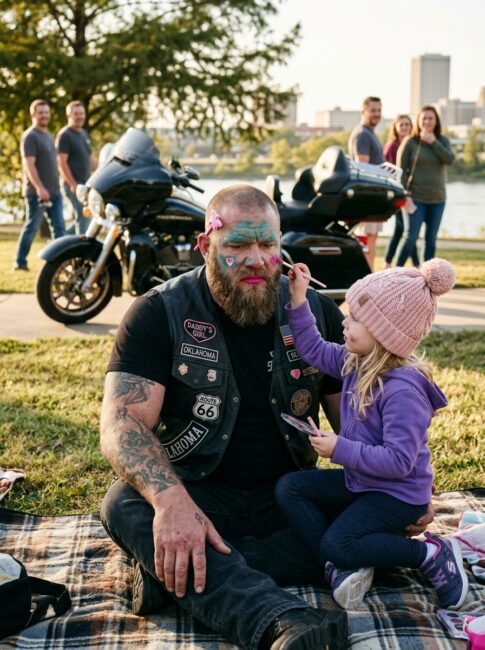
They spread a blanket under an oak tree. Cole lowered himself onto the grass with a grunt, knees cracking loud enough for me to hear from the bench. He took off his sunglasses. Mia opened the makeup kit like a surgeon opening tools.
“You ready?” she asked.
“No,” he said.
She smiled.
He sighed. “Do it.”
That was the first time I laughed. Not mean. Quiet. Surprised. The contrast was too much. This huge biker with scarred knuckles and old road dust in the creases of his skin, sitting cross-legged while a little girl examined him like he was a doll.
But the longer I watched, the less funny it became.
Cole was not performing.
He was not doing that loud dad thing where men make a show of being silly so strangers will praise them. He did not look around to see who noticed. He did not pose. He did not smile for phones. He sat with his hands open on his knees and let Mia decide what he needed.
Blue eyeshadow.
Pink lips.
Green fairy dust.
Heart stickers.
A plastic wand behind one ear.
Every time she finished something, she leaned back and studied him.
Cole waited for judgment like a man waiting on a mechanic’s bill.
“More glitter,” she would say.
“Yes, ma’am.”
Later, I learned Cole Maddox had not always been that patient.
He grew up in Sand Springs, west of Tulsa, in a house with holes in the walls and a father who threw words harder than fists. Cole left school early, worked salvage yards, ran with hard men, drank too much, fought too fast, and spent eight months in county jail at twenty-three for putting a man in the hospital during a bar fight. He did not tell that story like a trophy. He told it like a bill he was still paying.
The motorcycle club came after sobriety, not before. The club was called the Iron Psalm Riders, though most people just called them Iron Psalm. They were not angels. They were mechanics, veterans, linemen, welders, men who knew bad roads and worse choices. But they had rules. No hurting kids. No leaving brothers drunk. No letting grief rot alone.
Cole became a father at forty.
He said Mia was the first thing in his life that made him afraid to die.
Her mother, Rachel, had left when Mia was two. Not in a villain way. More in a broken-human way. Pills, relapse, rehab, relapse again, phone calls that came at the wrong hours. Cole raised Mia with help from his sister, his club, and one elderly neighbor who taught him how to make pancakes that did not taste like roofing shingles.
The club teased him at first.
Not cruelly. Men tease what scares them.
They watched him show up to Saturday rides with juice boxes in his saddlebag. They saw sticker sheets stuck to his helmet. They heard him say things like, “No, brother, I can’t ride Sunday. Princess breakfast.” Diesel, the club president, once found Cole in the clubhouse bathroom trying to remove glitter glue from his beard with dish soap.
“Brother,” Diesel said, “you been attacked?”
Cole looked at him in the mirror.
“Fairy ambush.”
That became a club phrase.
Fairy ambush meant anything soft that beat you without raising a hand.
Mia gave the hardest ones.
But when the diagnosis came, nobody joked.
Leukemia is a word that changes the temperature of a room.
Again, I am not here to turn this into a medical explanation. This is not about charts or protocols. This is about a little girl who loved stickers and hated needles. It is about a father who could rebuild an engine in a roadside ditch but could not explain to his daughter why medicine sometimes had to hurt before it helped.
Mia’s first chemotherapy appointment was scheduled for a Monday morning.
The park happened the Sunday before.
Cole had spent the week trying to prepare her. He used books. Videos. A stuffed rabbit wearing a bandage. He let her give pretend shots to every teddy bear in the house. He drove her past the hospital twice so it would not feel like a monster hiding around a corner.
Nothing worked.
Saturday night, Mia sat on her bed and whispered, “I don’t want to go.”
Cole sat on the floor because he was too big for the little chair by her desk.
“I know, bug.”
“What if I’m scared?”
“Then I’ll be scared with you.”
She looked at him seriously. “You don’t get scared.”
Cole almost lied.
That is what adults do. We lie when children ask clean questions because we want the world to seem less dirty than it is.
But Cole had learned something from recovery, from fatherhood, from every hard mile that did not kill him. Lies make children lonely.
So he said, “I get scared all the time.”
Mia frowned. “Of what?”
He looked at the princess stickers on her dresser. The small shoes by the closet. The butterfly makeup kit from her birthday.
“Of you hurting,” he said.
She thought about that.
Then she picked up the makeup kit.
“If you look silly,” she said, “maybe I won’t be scared.”
Cole looked at the kit.
Then at his own rough hands.
Then at her.
“You want me to look silly at the hospital?”
She shook her head. “Practice first.”
That is how they ended up in the park.
He thought fresh air would help. He thought the river, the trees, the food trucks, the normal noise of life might make the next day feel smaller. He also thought, stupidly, that nobody would care if one man let his child put makeup on him under a tree.
He underestimated people.
People care about everything that makes them uncomfortable.
At first, it was just looks. A couple walking a dog slowed down. A mother pushing a stroller smiled. Two older men at a chess table stopped mid-game. Someone took a picture from far enough away to pretend it was not rude.
Cole ignored it.
Mia worked carefully. Her hands were smaller than the makeup brush wanted them to be. She got blue powder on his eyebrow, green on his nose, pink on his mustache. She pressed heart stickers to his cheeks so hard he winced.
“Too much?” she asked.
“No.”
“Daddy.”
He corrected himself. “A little.”
She patted his face. “Beauty hurts.”
That made him laugh.
A real laugh. Short. Rusty. The kind men like him do not spend often.
Then the teenagers arrived.
They were not evil kids. That matters. They were dumb, young, trying to be funny in front of each other, and protected by that particular teenage belief that nothing you say can leave a scar if you call it a joke.
One wore a red hoodie. One had a skateboard under his arm. One was filming before they reached the oak tree. The tallest one saw Cole and shouted, “Yo, biker Barbie!”
Mia’s brush stopped.
Cole’s hands curled once on his knees.
The boy with the phone laughed. “Bro got cooked by a toddler.”
Another said, “That’s embarrassing.”
Cole looked at them.
Not with rage.
With a warning he kept leashed.
For a moment, every old story people tell about bikers stood up in the grass. Big man. Young mouths. Public disrespect. People nearby tensed, waiting for Cole to become the stereotype they already had loaded.
He did not.
He took a slow breath through his nose.
“Mia,” he said softly, “keep going.”
She didn’t.
Her little face had changed.
She stood up.
The makeup brush was still in her hand. A heart sticker was stuck to one finger.
And then she yelled.
“Don’t laugh at my daddy. He’s doing this so I won’t be scared to go to the hospital.”
The red-hoodie boy’s smile died first.
Then the phone lowered.
Mia’s voice cracked on the next words.
“I have cancer, and tomorrow they put medicine in me, and Daddy said I can make him a fairy if it helps.”
No one moved.
Not the teenagers.
Not the dog walkers.
Not me.
Cole closed his eyes for one second.
The false climax should have been there. The shame. The apology. The teenagers walking away. The father hugging his daughter.
That would have been a fine story.
But grace, when it shows up, usually looks stranger than that.
The first teenager to move was the one with the skateboard.
He was Latino, maybe fifteen, with curly dark hair and a face still soft under the attitude he had borrowed for the afternoon. He looked at Mia. Then at Cole. Then at the phone in his friend’s hand.
“Delete it,” he said.
The boy with the phone blinked. “What?”
“Delete the video.”
The tall kid muttered, “Man—”
The skateboard kid turned on him. “Delete it.”
Something in his voice changed the group. The phone boy tapped the screen. I could not see what he did, but the way his shoulders dropped told me he understood.
Then the skateboard kid walked toward the blanket.
Slowly.
Carefully.
Cole watched him. So did everyone else.
The boy stopped a few feet away.
“I’m sorry,” he said.
Not loud. Not for applause.
To Mia.
She looked at him with wet eyes and suspicion.
He swallowed. “My little brother was in the hospital last year.”
That was twist one.
The kid who had laughed knew the smell of that place.
He just forgot for a minute.
He pointed to the sticker sheet beside Mia’s knee.
“Can I have one?”
Mia wiped her nose with her sleeve. Cole reached for a tissue from the purple backpack, but she ignored him.
“For what?” she asked.
The boy touched his own cheek.
“For here.”
Cole’s eyes narrowed, not angry, just uncertain.
Mia looked at her father.
Cole said nothing.
This was hers.
She picked up a red heart sticker and stepped closer. The teenage boy crouched down so she could reach his face. She pressed the heart onto his cheek.
“There,” she said.
He nodded. “Thank you.”
The other boys stood frozen.
Then the one in the red hoodie took one step forward.
“Can I get one too?”
Mia looked him up and down.
“You laughed.”
He looked at the grass.
“Yeah.”
“You have to say sorry first.”
He did.
She gave him a blue star because, as she explained, “You don’t get a heart yet.”
That was the first time Cole laughed after she yelled.
Just a little.
The park loosened.
The phone boy asked for a sticker. Then the tall kid. Then a father from the playground walked over and said, “My daughter says I need one too.” His little girl put a glitter flower on his forehead. An older Black man from the chess table came next, wearing a cap that said Vietnam Veteran. He removed the cap, bent slightly, and said, “Princess, I served under worse commanders.”
Mia considered him carefully.
“You can have two.”
He saluted.
Within ten minutes, there were six men with stickers on their faces.
Within twenty, nine.
Within thirty, twelve grown men sat or stood near that oak tree with hearts, stars, flowers, and glitter dots on their cheeks.
A jogger.
Two fathers.
The chess player.
The skateboard kid.
His friends.
A park maintenance worker.
A man in a suit who had been eating lunch alone.
And Cole Maddox, still the biggest, still the scariest-looking, now wearing enough makeup to light a birthday party.
That was twist two.
The laughter did not end the moment.
It became the doorway.
I had my phone out by then.
I know that sounds hypocritical after what happened with the teenagers, but I asked Cole first. I walked over, showed him my nurse badge, and said, “Would it help if people saw this the right way?”
Cole looked at Mia.
She was putting a sticker on the maintenance worker’s nose.
“Ask her,” he said.
So I did.
Mia looked at my phone.
“Will people laugh?”
I said, “Maybe. But I think more people will be brave.”
She thought about it.
Then she said, “Only if Daddy looks the most beautiful.”
Cole sighed.
“Lord help me.”
I recorded ten seconds.
Not her diagnosis. Not private details. Just Cole sitting under an oak tree while Mia placed a final heart sticker in the middle of his forehead, and twelve men behind him held still like soldiers receiving medals.
That night, the video spread.
But the real twist came Monday morning.
At the hospital.
I was working the pediatric infusion floor when Cole and Mia arrived.
I did not know they would be on my unit. Tulsa is big enough for coincidence and small enough to make you believe something is arranging chairs behind the curtain.
The elevator doors opened at 8:17 a.m.
Cole stepped out first.
He wore his leather cut over a black T-shirt, jeans, boots, and no sunglasses. His face was scrubbed clean except for one heart sticker on his left cheek.
Mia wore a purple hoodie, pink knit cap, and a backpack full of things people bring when they are trying to make a medical room less medical. Stuffed rabbit. Coloring book. Crackers. The butterfly makeup kit.
Behind them came Diesel, the club president, a Black American man in his fifties with a gray goatee and arms like steel cables. Then Otis, white, sixty-two, missing two fingers from an old shop accident. Then Miguel, Latino, forty, with a rose tattoo on his neck and a lunchbox full of juice boxes. Three bikers. Quiet. Washed. Nervous in the way big men get nervous when they cannot fix the thing in front of them.
All three had heart stickers on their faces.
Cole looked at me.
“You work here?”
“I do.”
He nodded. “Small road.”
Mia hid behind his leg.
The unit smelled like sanitizer, plastic tubing, and the burnt coffee nobody admitted to making. Machines beeped softly. Nurses moved with that careful speed we learn. A child cried somewhere behind a curtain. Mia heard it and gripped Cole’s vest.
His hand covered hers.
“Remember what you said?” he murmured.
She shook her head.
“You said if I looked silly, you might be brave.”
Mia whispered, “I’m not brave.”
Cole crouched down in the hallway, leather creasing, boots squeaking on the polished floor.
“Bug,” he said, “brave ain’t when you’re not scared.”
She looked at him.
“Brave is scared and still walking.”
That could have been a slogan if someone else said it.
From him, it sounded earned.
Then Diesel cleared his throat.
Mia looked at him.
He pointed to the sticker on his cheek. “This itch is serious, ma’am.”
Mia almost smiled.
Otis said, “Mine’s crooked.”
Miguel turned his face. “Mine’s better.”
Mia stepped out from behind Cole and inspected them.
“No,” she said. “Daddy’s still most beautiful.”
Cole looked at the ceiling like he was asking for patience.
That was seed one returning. The makeup was not a joke. It was armor. Not for him. For her.
The heart sticker on Cole’s cheek mattered too. He had tried to wash off everything Sunday night because glitter had gotten in his pillowcase and he said he smelled like a craft store. Mia stopped him before the last sticker.
“Keep one,” she said.
“For what?”
“So I know you’re still fairy Daddy tomorrow.”
So he did.
He rode to the hospital with a heart on his face.
Not hidden.
Not ashamed.
The third twist came when we entered the treatment room.
The skateboard kid was there.
His name was Luis. His little brother, Mateo, was down the hall for follow-up bloodwork, and Luis had asked his mother to come early. He stood beside the nurses’ station with red eyes, a backpack over one shoulder, and a sheet of heart stickers in his hand.
Cole stopped.
Luis stepped forward.
“I brought more,” he said.
Mia stared.
“For who?”
Luis looked around the infusion floor. At the fathers trying to smile. At the grandfathers staring at vending machines. At the teenage boys pretending not to be scared. At the nurses holding too many small histories in our pockets.
“For anybody who needs one.”
Mia took the sticker sheet.
Then she looked at me.
“Can I?”
Hospital rules are not built for magic, but nurses spend our careers bending the harmless edges of rules to let children feel human.
I said, “Clean hands first.”
She washed.
Then Mia became the sticker captain of the pediatric floor.
She gave Diesel a second heart because he complained correctly. She gave Otis a star “for balance.” She gave Miguel a flower because his rose tattoo needed a friend. She gave Luis a purple heart and told him he had earned it now. She gave one to me, right on my badge clip.
By the time her IV was placed, four grown men, two nurses, one teenage boy, and a grandfather were wearing heart stickers.
Mia still cried.
Of course she did.
Courage does not cancel pain.
But when the needle went in, Cole put his cheek beside hers, heart sticker touching her cap, and said, “Look at me, bug.”
She looked.
His face was serious. Ridiculous. Tender. Terrified.
She breathed.
And she got through it.
After that, Sunday at Riverside Park became a ritual.
Not every Sunday. Treatment schedules are hard. Sick days do not respect calendars. Some weeks Mia was too tired. Some weeks Cole was too quiet. Some weeks the weather turned mean and the Oklahoma wind slapped grit against every window.
But when she could, they came.
The Harley would roll into the park road, engine low and steady, then shut off near the oak tree. Cole would carry the purple backpack. Mia would carry the butterfly makeup kit. Sometimes his club came with them. Sometimes Luis and his friends showed up with skateboards and awkward kindness. Sometimes strangers came because they had seen the video and wanted to leave stickers, makeup, cards, stuffed animals, gas cards, hospital parking passes.
Cole hated the attention.
Mia loved commanding it.
She made rules.
No laughing unless the person being painted laughed first.
No filming without asking.
No scary hospital questions.
No glitter near eyeballs because “Nurse Jenna said.”
That last one became official.
The Iron Psalm Riders turned the rule into a patch. Small. Purple. A heart with wings. Under it, three words:
FAIRY AMBUSH CREW.
Cole refused to wear it for one week.
Then Mia asked.
He sewed it inside his cut, near the heart, where only a few people ever saw it.
His brothers did not tease him.
Not after the first time.
At the clubhouse, one prospect made a stupid comment about the patch. Nothing vicious. Just young and careless. “Man, I didn’t join up for fairy stickers.”
The room went silent.
Diesel looked at him.
Cole did not say a word.
Otis slid a sticker sheet across the table.
“Then you ain’t ready to sit with us.”
The prospect left before sunset.
Brotherhood gets tested in strange ways. Sometimes it is not who can fight beside you. Sometimes it is who can sit in public with a butterfly sticker on his nose because a child needs the world to look less cruel.
The park changed too.
People started bringing their own chairs near the oak tree. Not crowding. Just being there. A retired teacher kept wet wipes in her purse. The chess player brought extra stickers. A father whose son was nonverbal sat for thirty minutes while Mia painted one blue stripe across his forehead; his boy touched the stripe and smiled at him for the first time that day.
Cole watched all of it like he did not trust beauty to stay.
Men like him often don’t.
But he kept showing up.
That was his language.
Not speeches. Not long posts. Not interviews.
Just boots in the grass. Leather creaking as he sat down. Scarred hands opening the makeup kit. Harley cooling by the path. A little girl saying, “Hold still, Daddy,” and a giant biker answering, “Yes, ma’am.”
Treatment went the way treatment goes.
Hard. Uneven. Brutal in quiet ways.
There were good scans and bad nights. Laughing mornings and sick afternoons. Days when Mia painted Cole’s whole face. Days when all she could do was put one sticker on his cheek before falling asleep against his vest.
He never took it off until she told him.
Not once.
A year later, I still have the video on my phone.
I do not post it anymore. I do not need to. It already did what it came to do.
But sometimes, after a hard shift, I watch it.
Cole under the oak tree. Blue powder on his eyelids. Pink lipstick crooked across his beard. A heart sticker on each cheek. Mia leaning close with fierce concentration. Twelve grown men behind them trying not to move because a five-year-old has declared them beautiful.
People still ask me what happened to the teenagers.
Luis still comes to the park sometimes. Taller now. Quieter. His skateboard is covered in heart stickers. He volunteers twice a month at the children’s wing, mostly carrying boxes, setting up games, pretending he is not good with kids.
People ask about Cole too.
He is still Cole. Rough. Quiet. Too blunt for polite rooms. He still rides the black Harley down Route 66 when his head gets too loud. He still smells like leather, motor oil, and coffee that has been sitting too long. He still looks like a man strangers might step away from.
But at Riverside Park, children run toward him.
Because they know.
The scariest-looking man under the oak tree is the one who will let you put a glitter heart on his forehead if it helps you breathe.
Last week, I saw him and Mia again.
She was thinner than she should be, stronger than she looked, wearing a yellow hoodie and carrying the same butterfly kit. Cole sat cross-legged in the grass while she carefully placed one pink heart sticker over the scar near his eyebrow.
“Beautiful?” he asked.
Mia stepped back, judged him hard, then nodded.
“Beautiful.”
The Harley waited by the curb, ticking in the sun.
Cole closed his eyes.
And held still.
Follow the page for more biker stories that change the way you see people.