They Thought He Took the Missing Girl — Until the Festival Went Silent
“Don’t let him leave with her!” someone screamed as the biker came out of the corn maze carrying the missing girl against his chest—but why was she clinging to him instead of crying?
The whole fall festival seemed to tilt at once.
One second earlier, Hawthorne Farms had been all hay bales, kettle corn, fiddles on the loudspeaker, and the ordinary Saturday noise of families pretending October in Indiana still felt simple. It was 5:42 p.m. on the last weekend of the harvest festival outside Bloomington, and the first blue edge of evening had begun to settle over the pumpkin patch, the cider stand, the petting zoo, and the sprawling corn maze that had already swallowed too many children in laughter all afternoon.
Then the laughter changed.
A woman near the ticket barn started screaming a little girl’s name.
The volunteers at the maze entrance stopped joking and started counting exits.
A father in a brown flannel jacket vaulted the rope line.
And from the far side of the maze, where the trampled path bent near the old utility shed, a biker stepped out of the stalks with a child in his arms.
He looked wrong for the place even before people noticed the girl.
Too big. Too severe. Mid-fifties maybe, broad in the chest, rough gray beard, tattooed forearms under a sleeveless black leather vest darkened with dust and evening chill. His boots were muddy halfway up the ankle. His face gave away nothing. Not panic. Not apology. Not explanation.
The little girl was small enough to disappear against him.
Pink knit hat. One shoe missing. Thin legs in pumpkin-print leggings. Her arms wrapped around his neck so tightly it looked less like rescue than possession from a distance, which was the worst possible angle for anyone to see first.
The mother saw him and made a sound that did not belong in a festival.
Pure terror.
“That’s her!” she cried. “Oh my God, that’s her!”
The crowd turned as one body.
Strangers who had no business becoming part of it became part of it instantly. That was what crowds did best. They took fear, divided it badly, then handed it back louder.
The father ran first.
“Put her down!”
The biker didn’t.
That made everything worse immediately.
Because a decent man carrying a missing child should have rushed toward the parents. Should have started explaining before anyone asked. Should have looked shaken. Human. Relieved.
This man came out of the maze like he had already decided the fastest route and did not care how it looked.
The little girl turned her face into his shoulder.
That detail passed through the crowd like a spark.
A teenager by the cider wagon was already filming.
Someone shouted, “Call 911!”
Someone else yelled, “Block the road!”
Near the petting zoo fence, an elderly veteran who volunteered security on weekends pushed himself upright from a hay bale with more speed than his knees probably allowed. Two teenage workers in orange festival aprons froze beside the caramel apple table, hands sticky, eyes wide. A little boy dressed as a scarecrow started crying because he thought the screaming meant someone was hurt.
Maybe someone was.
The biker kept walking.
Not fast. Not running. But straight. Deliberate. Toward the central lane between the barn and the maze.
And for one impossible second, every person watching had the same terrible thought:
He wasn’t bringing her back.
He was taking her through.
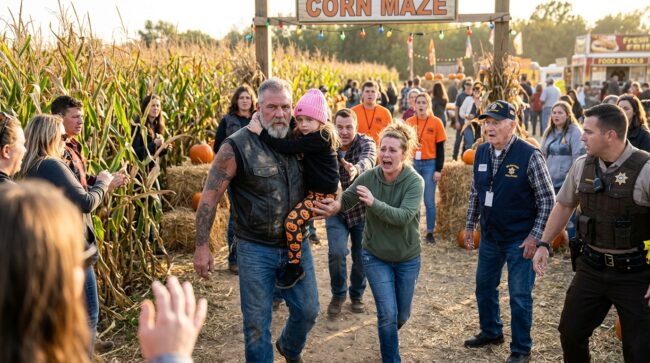
“Sir! Stop right there!”
Deputy Lena Ortiz hadn’t even reached the scene yet, but one of the volunteer security men shouted like his voice could do law enforcement’s work for it.
The biker didn’t stop.
He adjusted the girl once—only once—higher on his shoulder, careful and efficient, like a man used to carrying weight over bad ground. The little girl let out a small, frightened sound and buried her face deeper into the leather at his collar.
That image destroyed whatever benefit of the doubt he might have had.
“She’s scared of you!”
“No,” someone else snapped back. “She’s scared of everything!”
The mother was crying too hard to move in a straight line. The father did not have that problem. He shoved through the crowd, knocking a plastic mug of cider out of somebody’s hand and sending it splashing across the dirt.
“Put my daughter down right now!”
The biker finally stopped.
Only because three people had cut off the main path—one security volunteer, the old veteran, and the father himself, chest heaving, hands open and shaking.
Up close, the man looked even harder to trust. Not wild. Worse. Controlled.
His expression barely moved.
“Back up,” he said.
That was the wrong thing to say.
Or maybe the exact right thing if he wanted the entire festival to turn on him.
The father lunged a half-step. “You don’t tell me to back up!”
The biker shifted his stance instantly, turning his body so the girl was angled away from the man’s reaching arms. Protective, maybe. But it did not look protective to anyone watching. It looked possessive. It looked trained. It looked exactly like the kind of move people later described with trembling hands and missing details.
The crowd surged closer.
Phones lifted higher.
A woman near the pie contest table gasped, “He’s shielding her from them.”
The old veteran—Walt Mercer, who’d spent twenty years reading body language before younger men called it instinct—did not step in yet. He only narrowed his eyes and watched the biker’s hands.
No squeezing.
No panic.
No unnecessary movement.
That should have meant something.
But fear makes people blind in very specific ways.
The mother finally reached the front and nearly collapsed at the sight of her child still in his arms.
“Emma!” she sobbed. “Baby, it’s Mommy!”
The girl did not reach for her.
She turned her face farther in.
And the crowd, already ready to hate this man, took that as proof.
“Oh my God.”
“She doesn’t want to go.”
“What did he do to her?”
The biker’s jaw flexed once. That was the first crack in him.
He looked directly at the mother and said, “Not yet.”
The silence after that was immediate and ugly.
Not yet?
Several people started shouting over one another.
“What the hell does that mean?”
“Get her away from him!”
“Where are the cops?”
The father grabbed for the girl’s ankle.
The biker moved faster than anyone expected.
Not violent. Not a strike. Just a brutal little economy of motion—one forearm turning, one shoulder bracing, one backward step that knocked the father off angle and sent the security volunteer colliding into a hay bale display instead of into the child.
Half the crowd screamed.
The teenager recording said, “Did you see that? He shoved him!”
“He attacked the dad!”
Walt Mercer took one step in now, voice low and sharp. “Everybody hold.”
Nobody listened.
Because the misunderstanding had grown teeth.
The biker scanned the crowd once, then toward the festival lane beyond them—toward the first-aid tent, though no one else seemed to notice that yet. His breathing was steady. The girl’s was not. She clutched his vest so hard her knuckles had gone white.
And still he did not hand her over.
That was the part no one could forgive.
That was the part that made even reasonable people choose the worst version.
A teenage volunteer in an orange apron whispered, “Why won’t he let her go?”
No one answered.
Because every answer they had was bad.
Then the first sheriff’s SUV swung into the gravel lot by the barn, lights flashing blue against pumpkins, wagon wheels, and the handmade HARVEST DAYS sign hanging crooked over the entrance.
The crowd broke open just enough to let Deputy Ortiz through.
She came fast, hand near her belt, gaze taking everything in at once: missing child, hysterical parents, one large biker holding the girl, a father half-stumbling up from the dirt, twenty witnesses already convinced of a story they had built in under a minute.
“Sir,” she shouted, “put the child down now!”
The biker looked at her.
Then at the girl.
Then back at Deputy Ortiz.
And said, in the same calm tone that somehow made everything more terrifying—
“I can’t.”
That word detonated the festival.
You could feel it.
Shock first, then rage, then that sickening collective certainty that the worst thing had finally announced itself out loud.
Deputy Ortiz took two steps closer, voice hardening instantly. “You absolutely can, and you will.”
The biker didn’t move.
Didn’t raise his hands. Didn’t bargain. Didn’t try to explain in the pleading, frantic way innocent people were expected to explain themselves. He only adjusted the girl again, one careful hand between her shoulder blades, and said, “Get your medic. Now.”
The parents didn’t hear that part clearly.
The crowd did, but they misheard it the way frightened people mishear anything that doesn’t fit their panic.
A medic? For what?
The mother made a broken sound and tried to rush forward again. Walt caught her by the forearm before she stumbled under the deputy’s line of sight.
The father pointed at the biker like the gesture itself might drag him down.
“He took her into the maze! I saw him come out with her!”
“No,” the biker said.
Nothing more.
Just one word.
The deputy read that as resistance.
Everyone did.
She drew her taser but kept it low. “Last warning. Put the child on the ground and step away.”
The biker’s expression changed for the first time all evening—not fear, not anger, but impatience. Almost disbelief that the room still had not figured out the one thing he considered obvious.
“She can’t stand,” he said.
The words should have slowed the scene.
Instead they sped it up.
Because the mother screamed, “What did you do to her?”
And suddenly the question belonged to everyone.
The teenager filming moved closer.
A man in a Purdue hoodie muttered, “He drugged her.”
Someone else said, “Check the shed.”
The volunteer who had hit the hay bales came back furious and embarrassed, the most dangerous combination of all. “She belongs with her parents, man.”
The biker shot him a look so flat and cold it shut him up mid-step.
Then, without warning, the biker moved.
He did not run. He pivoted.
Turned away from the crowd.
And started toward the first-aid tent.
Deputy Ortiz reacted instantly. “Stop!”
The father lunged again.
Walt swore under his breath.
Half the crowd followed, because once people smell a chase they confuse it with usefulness.
The biker lengthened his stride through the churned festival dirt, carrying the little girl tight against him, heading straight past the pumpkin-weighing station and the cider press. Deputy Ortiz closed the distance from behind while shouting for the medic team. The father came from the side, slipping in mud and fury. A little boy near the hayride tractor began wailing because the adults had all started running.
At the entrance to the first-aid tent, the biker turned just enough to block the father again.
“Not yet,” he repeated.
The father swung.
It was not a good punch. Too emotional. Too open.
The biker could have dropped him.
Everyone watching saw that immediately.
But he didn’t.
He caught the wrist, twisted just enough to stop the blow, and used his own body to keep the child from getting jolted in the struggle. Deputy Ortiz reached them a second later, grabbing for his shoulder.
“Get down!”
The biker went to one knee instead.
Not surrendering.
Not fighting.
One knee in the dirt, the child still in his arms, lowering her carefully as far as he could without actually setting her down.
That image—big tattooed man kneeling in mud with a missing girl clinging to him while a deputy grabbed for him—would be the one half the festival remembered first.
Then the medic curtain snapped open.
A paramedic in blue gloves looked out, took one glance at the girl, and froze.
Not because of the biker.
Because of what she saw near the child’s leg.
Deputy Ortiz saw the medic’s face change.
So did Walt.
So did the mother, still sobbing, and the father, whose raised fist had gone stupid and useless in the deputy’s grip.
The biker finally said the first complete sentence he had offered since leaving the maze.
“Glass in her foot,” he said. “And she told me not to let anybody touch it.”
The crowd went silent in patches, like shame spreading slower than panic had.
But that wasn’t all.
The paramedic crouched lower, eyes moving from the girl’s sock soaked dark at the heel to the biker’s vest where a pink festival wristband had been looped around one leather button.
A child’s wristband.
Not his.
And the little girl, face wet, voice thin and shaking, opened one eye just enough to look up at the biker and whisper something only the people nearest could hear.
Something that made Deputy Ortiz’s hand loosen on his shoulder at once.
Something that made the mother stop crying mid-breath.
Something that made the father’s expression crack open in confusion before anything else.
The biker looked down at the girl but did not answer her aloud.
He only nodded once.
And the paramedic reached for the child at last.
The little girl did not let go right away.
That was the detail that changed everything.
Not the blood-dark stain at the heel of her sock. Not the shard of dirty glass the paramedic had spotted lodged near the arch of her foot. Not even the pink festival wristband looped through the biker’s vest button like a child’s panicked improvisation.
It was her grip.
Emma held on to him with both arms, face buried against his shoulder, while the paramedic crouched in the mud and Deputy Ortiz slowly removed her hand from the biker’s back as if contact itself had become an accusation she no longer trusted.
“What did she say?” the father demanded, voice cracking on the edge of fury and terror.
No one answered him immediately.
The crowd had gone uncertain now, that dangerous in-between state when people realize they may have chosen the wrong villain but haven’t yet decided what to do with their own momentum. Phones lowered a little. Not all the way. But enough.
The paramedic spoke first.
“She’s injured,” she said sharply. “Everybody back up.”
That order worked better than the deputy’s had.
Maybe because it came attached to something visible at last. Pain is easier for crowds than ambiguity. They understand blood. They understand wounds. What they don’t understand is why the man who looked worst might have been the one protecting a child from their own panic.
The mother dropped to her knees in the churned dirt a few feet away.
“Emma,” she sobbed, “baby, look at me.”
Emma turned her head slightly.
Not toward her mother.
Toward the biker.
Her little hand fisted once in the leather at his shoulder. Then she whispered again, louder this time, the words frayed with crying.
“Don’t let the loud man touch me.”
The father went still.
Not because he understood. Because he didn’t.
Every face around them changed a little.
Deputy Ortiz’s voice lowered. “Sir,” she said to the biker, “I need you to tell me exactly what happened.”
He looked at Emma, not the deputy. “You want me to put you down now?”
Emma nodded once against his neck.
Only then did he shift.
Slowly. Carefully. Like lowering something breakable. He passed her into the paramedic’s arms with such precision that even the deputy, still tense, noticed he never once let the injured foot swing free. Emma whimpered the second the weight changed and reached for his vest again before the medic tucked a blanket around her.
The biker rose, mud on one knee, face still unreadable.
Up close now, Deputy Ortiz could see what the crowd had missed: burrs in his sleeves from the corn rows, dirt smeared across one forearm, a shallow scrape along the back of his hand, and the look of a man who had run into bad ground without stopping to care how it would look later.
The mother crawled closer to Emma, crying softly now instead of screaming, and the father stood just behind them, chest still heaving, shame beginning to work its way in through the cracks fear had opened.
“Talk,” Deputy Ortiz said.
The biker nodded toward the maze. “She wasn’t where the crowd thought. She was behind the utility shed on the east side.”
Walt Mercer, the old veteran, frowned. “There’s no public path back there.”
“Exactly.”
That one word tightened the silence all over again.
The teenager with the phone lowered it completely now.
The paramedic cut away the sock. Emma shrieked once when the fabric pulled near the embedded glass, and the mother buried her face in her own hands. The father took one involuntary step forward. Emma recoiled.
Not from pain.
From him.
That hit harder than anything.
Deputy Ortiz saw it. So did Walt. So did the biker, though his expression barely changed.
“Why wouldn’t she come to the entrance?” the deputy asked.
The biker glanced at the child, then back toward the maze rows. “Because she wasn’t hiding.”
That landed wrong.
The father snapped first. “Then what, she was just wandering around with a piece of glass in her foot?”
“No,” the biker said. “She was under something.”
The words passed through the crowd like cold.
The mother lifted her head.
Deputy Ortiz’s voice hardened again, but differently now. More focused. Less certain of the old story. “Under what?”
The biker looked toward the utility shed.
“Collapsed panel and feed crate,” he said. “Looked like somebody forced through the maintenance side and dropped part of the stack.”
The father stared. “Somebody?”
But the biker didn’t answer that.
Not yet.
Instead he did something smaller.
He reached into the pocket of his vest and pulled out a tiny plastic charm—one of those cheap festival prizes kids win from ring toss or fishing booths. A yellow duck with a cracked loop at the top. Emma saw it in his palm and started crying harder.
“It fell near her,” he said. “She said there was another one.”
The mother frowned through tears. “Another what?”
Emma’s lips trembled. The medic brushed hair from her face.
The girl whispered one word.
“Boy.”
And just like that, the festival’s panic found a new shape.
The crowd broke the wrong way again.
Not as badly as before. Not as loudly. But enough to prove how little people learn from shame in the first ten seconds after it arrives.
“Another child?”
“Oh God.”
“Was someone else in there?”
Deputy Ortiz was already turning toward her radio.
“Dispatch, possible second missing juvenile near east maintenance side of corn maze,” she said, voice clipped and calm now. “Lock down festival exits. I want units at the service road and barn lane.”
That changed the air more than sirens ever could.
Because suddenly the scene was no longer about one biker holding one child too long.
It was about the possibility that he had been the first person to find something everyone else had been looking past.
Walt Mercer moved to the edge of the tent and barked at the volunteers to clear the lane. For the first time that evening, people obeyed him without argument. The teenager who had been filming stepped backward and nearly tripped over a hay bale, face gone pale.
The father was still staring at Emma.
“What boy?” he asked, voice hoarse.
Emma’s eyes fluttered toward the paramedic, then toward the biker, then shut tightly again as if saying the next part hurt more than the foot.
“He was crying,” she whispered.
The mother made a broken sound.
Deputy Ortiz looked at the biker. “You heard another child?”
He shook his head once. “Didn’t when I found her.”
“Then why were you at the east side?”
The question mattered.
Everyone near the tent felt it.
Because until that moment, even with the glass and the crate and the child’s grip, no one knew why this man had been there first.
Why him, out of two hundred festival-goers?
Why that path?
The biker scraped one muddy boot against the dirt before answering. “Saw the crows lift.”
That seemed absurd at first. Several faces showed it.
He didn’t care.
“East edge,” he said. “Three rows past the dead pump line. Birds don’t lift like that unless something changed under them.”
Walt’s brows rose a fraction.
The deputy did not laugh. Neither did the paramedic. Neither did the old farmer who had come up from the pumpkin weigh-in and now stood listening with his cap in both hands. Rural people understood signs in fields better than polished explanations.
The father, city enough to hear only how strange it sounded, said, “You noticed crows?”
The biker looked at him.
“Your girl was missing.”
That shut him up.
The mother pressed both hands over her mouth, because there was no answer to that which did not make the wrong parts of the last ten minutes rise back up in her throat.
Deputy Ortiz nodded once, decision made. “Show me.”
The mother jerked her head up. “No! He’s not going anywhere.”
Emma, under the blanket, whispered without opening her eyes, “He didn’t leave me.”
The sentence was so small it would have been easy to miss.
No one missed it.
Deputy Ortiz crouched beside the child. “Emma, sweetheart, did this man help you?”
A pause.
Then: “He crawled in.”
The mother started crying again. The father looked away.
The biker said nothing.
He did not correct. Did not soften. Did not accept gratitude that had not yet been offered. He only stood there, mud drying at his knee, the pink wristband still hooked to his vest as if she had marked him before anyone else had a chance.
The paramedic glanced up from the foot dressing. “There’s dirt and splinters in the wound. She was pinned longer than a minute or two.”
Deputy Ortiz rose. “Walt, with me. You”—she pointed to the biker—“you come ten feet ahead where I can see your hands.”
The father stepped in front of him instinctively. “I’m going too.”
“No,” the deputy said. “You’re staying with your daughter unless I say otherwise.”
That should have settled it.
It didn’t.
The mother looked from Emma to the biker and asked the question nobody had known how to ask cleanly yet.
“How did she even get to you?”
The biker’s face shifted—not softer, exactly. More tired.
“She followed the music,” he said.
Emma opened her eyes halfway.
“Not the music,” she whispered.
Everyone leaned in.
The girl swallowed hard, one tear sliding sideways into her hair.
“The puppy.”
The crowd went still again.
The father frowned. “What puppy?”
Emma tried to sit up. The medic eased her back.
“Brown puppy,” she said. “By the pumpkins. He had my duck.”
The yellow charm in the biker’s palm suddenly seemed heavier.
Deputy Ortiz’s jaw tightened. “There is no puppy at this festival.”
Walt looked toward the maze with a new kind of anger now.
Not the crowd’s anger. Older. Colder. Directed.
The biker closed his hand around the toy duck.
And that was when people finally began to understand that whatever had happened inside the maze had started long before he ever stepped out carrying the child.
They found the boy seventeen minutes later.
That number would matter later to people who wanted timelines and statements and official order. To the families, it felt like a year lived badly.
Deputy Ortiz, Walt Mercer, two festival staff members, and the biker cut through the maintenance side of the maze while the first-aid team worked on Emma’s foot and the sheriff’s units locked down the grounds. The crowd stayed behind the rope line now, quieter, as though noise had become a thing they no longer trusted themselves with.
The east service lane looked wrong as soon as they reached it.
One crate overturned. One panel broken inward. Straw crushed in two directions. And beyond that, tucked in the blind angle between the utility shed and a stack of feed sacks, a little blond boy in a dinosaur hoodie sat crying with both hands over his ears.
Alive.
Unhurt except for shock and a scraped elbow.
The father of that child collapsed to his knees when deputies brought him out.
By then, the festival had stopped being a festival. The fiddles were off. The cider line was dead. The giant pumpkin contest nobody had been crowding around two hours earlier now sat absurdly bright and irrelevant under the fair lights.
And in the middle of all that, the biker still had not explained the one thing Deputy Ortiz kept circling back to.
Why had Emma trusted him so fast?
Why had she stopped screaming when he found her?
Why had she clung to him as if she knew, at some level below language, that he was the correct person to survive with?
The answer came in pieces.
The first piece was a lanyard.
One of the festival volunteers found it snagged on a splintered board near the shed—a faded elementary-school ID holder attached to a blank silver key tag. Deputy Ortiz handed it to the biker when they returned to the first-aid tent.
He looked at it once and went still.
The mother saw that.
So did Emma, now pale under a thermal blanket, foot bandaged, cheeks streaked with dirt and tears.
“That’s yours?” Deputy Ortiz asked.
He nodded.
“Where’d she get it?”
This time he took a second before answering.
“Charity ride in Terre Haute,” he said. “Three years ago. Children’s ward fundraiser. Kids decorated the riders’ tags with stickers and markers.” He turned the tag over. On the back, in faded purple ink nearly rubbed away, were shaky block letters:
FOR LUCY’S DAD
The mother stared.
The father blinked. “Lucy?”
Emma looked up at the biker with exhausted recognition.
“You’re the hospital man,” she said.
And suddenly several things that had been impossible became merely devastating.
The mother put one hand to her chest. “No. No, that was—”
“You met him before?” Deputy Ortiz asked.
The biker’s face had gone careful in a way it hadn’t all evening. As if a door he kept locked had been kicked open by a child’s memory and he was deciding how much of the room deserved to see inside.
“Her older sister,” he said.
The mother sat down hard on the folding chair behind her.
The father looked like he’d been struck. “Lucy?”
Emma’s lower lip shook. “She said he has the loud bike but quiet hands.”
The mother began crying with a different sound now. Not panic. Grief returning through a side entrance.
Because Lucy had been dead eleven months.
Leukemia. St. Vincent Children’s in Indianapolis. The kind of loss that sits in a family like an invisible chair no one stops walking around. Emma had been five when the hospital rides came through the courtyard. Her sister had made riders names out of craft-table tags while waiting for another round of treatment. The biker—this same one—had crouched by Lucy’s wheelchair so she could hang one on his vest button because her hands were too weak to reach high.
Emma had been there.
Small. Quiet. Watching everything.
And now, in a moment of terror under broken boards and shadowed corn, her mind had reached for the one impossible thing it remembered correctly: a frightening-looking man who once belonged to her sister’s safe world.
The mother covered her face.
The father whispered, “Oh God.”
The deputy looked from Emma to the biker to the faded tag in his hand.
“What happened to the original tag?”
The biker answered without looking up. “Still on my other vest.”
Emma frowned sleepily. “This one fell.”
Which meant he had come into the maze trying to calm her with memory before anyone else even knew why she had stopped fighting him.
That was enough to silence what little judgment remained.
But there was one more turn left.
The mother lowered her hands and looked at the biker through all the wreckage of the evening.
“You remembered Lucy?”
It was such a simple question. That was why it hurt.
He gave the smallest nod. “Yeah.”
Out of everything he could have said, that bare answer did the most damage.
Because families survive grief expecting the world to move on faster than they do. To become embarrassed by names. To forget birthdays. To misplace the child who is gone inside a general softness called tragedy.
This man had remembered specifically.
Not just the ride. Not just the hospital.
Lucy.
And he had recognized Emma, years older, in half-light and panic, in a place where everyone else only saw a missing child.
The formal statements happened under floodlights and generators after sunset.
Deputies took notes. Festival organizers apologized too often and too late. One volunteer admitted seeing a man in a tan jacket near the maintenance lane with a stuffed dog toy earlier in the afternoon. Another remembered a child crying but assumed it came from the hayride line. The sheriff’s office said the right things about ongoing investigation and suspicious activity and parental vigilance.
None of that was the part people carried home.
What they carried was smaller.
More humiliating.
More human.
The father approached the biker last.
That felt right.
His daughter had a juice box in her hand and a clean bandage on her foot. Her mother sat beside her on a folding chair near the first-aid tent, one arm around her shoulders, both of them wrapped in sheriff’s department blankets. Emma kept glancing toward the biker as if making sure he remained real.
The father stopped a few feet away.
He had been loud earlier. Certain. Protective in the way frightened men often become dangerous without meaning to. Now he looked like a man learning how to stand inside the memory of his own mistake.
“I swung at you,” he said.
The biker, who had finally taken off one muddy glove, looked at him once. “Yeah.”
“You should’ve dropped me.”
“No.”
That answer held no virtue. Just fact.
The father swallowed. “I thought—”
“I know what you thought.”
The sentence might have shamed him if it had come with any heat. It didn’t. That was worse. It left nowhere to argue.
The mother rose slowly and crossed the distance with Emma leaning against her side. Up close, Emma looked smaller than she had in the maze, which is what happens when fear drains out of a child and leaves only the child behind.
She reached one hand toward the biker’s vest button where the wristband still hung.
“You kept it,” she said.
He glanced down. “Forgot it was there.”
Emma touched the pink band gently, then looked up at him. “Lucy would’ve laughed.”
The mother’s mouth folded in on itself for a second.
The biker nodded once. “Probably.”
No one said anything after that.
There wasn’t a version of the moment that improved with explanation.
Deputy Ortiz came over with the faded tag in a plastic evidence sleeve, then paused, changed her mind, and handed it to Emma instead.
“This belongs to you,” she said.
Emma turned it over, saw the purple writing, and pressed it against her blanket.
The father drew one long breath. “You saved both kids.”
The biker shrugged slightly. “Found them.”
The deputy gave him a look. “That’s not the same thing.”
Maybe it wasn’t.
Maybe it was the closest language he allowed himself.
Behind them, the festival workers were already starting to take down signs in the dark. APPLE CIDER, FACE PAINTING, MAZE CHAMPION BOARD—all the cheerful cardboard certainty of a normal family day being folded away while something else remained.
Walt Mercer, the old veteran, came over limping, extended one rough hand, and shook the biker’s without ceremony.
“Crow trick,” Walt said. “Good eye.”
The biker gave a brief nod.
“Old habit,” he said.
From anyone else, that might have sounded like boasting. From him, it sounded like history refusing to advertise itself.
When the sheriff’s lights began thinning out and the first-aid tent folded down to half its size, Emma tugged at her mother’s sleeve.
“Can he hear Lucy’s song again?”
The mother blinked. “What?”
Emma pointed to the bike parked beyond the rope line, black and silver under the floodlights.
“He played it that day,” she said. “On the loud bike.”
The biker looked almost embarrassed.
“It’s just the horn melody,” he muttered.
But Emma was already waiting.
So, in the damp Indiana night, surrounded by trampled straw and dismantled festival booths and the residue of a panic the whole place would be remembering badly for weeks, he walked to the motorcycle, settled his helmet on the seat, and tapped out three simple notes on the custom horn switch.
Not a song, really.
Just a tiny musical phrase. Bright. Oddly gentle.
Emma smiled for the first time that evening.
Her mother covered her mouth again.
The father looked down.
No speech followed. No one clapped. Even the deputy stayed quiet.
The biker put his glove back on, swung a leg over the bike, and started the engine. Before he pulled away, Emma called after him.
“Tell Lucy hi.”
The engine idled low.
For the first time that day, his face changed enough for anyone to see it clearly.
Not a smile.
Something quieter.
Then he tipped his head once, rode past the empty hayride station, and disappeared down the gravel lane beyond the pumpkin field.
Emma kept holding the faded tag long after the sound was gone.
And behind her, in a festival that had spent one terrible hour getting everything exactly wrong, the last people still standing finally stopped calling him the man who took her.
They started calling him the man who knew where to look.