Part 2: My Son Asked Why I Had So Many Scars — I Named Every One Except the One That Saved Me
I met Mason before people called him Gravel.
Back then he was just Mason Hayes, a quiet twenty-nine-year-old Army mechanic who came into Ruby’s Diner outside Billings every Thursday after visiting the VA hospital. He always sat in the same booth. Back corner. Face to the door. Black coffee. Two eggs. Toast he never finished.
I was waiting tables, saving tips in a Folgers can, trying to pretend I wasn’t tired. Mason never flirted. Never made small talk just to fill the room. He said please. He said thank you. He stacked his plates when he was done.
That was how I first noticed him.
Not the tattoos.
Not the limp.
The way he made less work for people who were already working hard.
A year later, he bought a beat-up Harley-Davidson Road King from a retired lineman in Laurel. Said he needed something louder than his thoughts. He didn’t say it in a poetic way. Mason never did poetry. He said it while changing the oil, wrench in his hand, cigarette unlit behind his ear.
“I need noise that makes sense,” he told me.
The club came later.
The Iron Psalm Motorcycle Club had a bad reputation if you listened to people who never sat with them. They were loud. Rough. Some had records. Some had divorces that still bled. Some had prison years carved into the way they stood. But they also rode escort for veterans’ funerals. Fixed roofs for widows. Brought groceries to shut-ins during blizzards. They didn’t advertise that part.
Mason fit them because he didn’t need them to be clean men.
He needed them to be honest ones.
They called him Gravel after a wreck on Beartooth Pass. A deer came out of the fog, Mason laid the bike down instead of taking a guardrail, and he slid across the road like a sack of broken tools. Lost skin from his hip to his shoulder. Cracked three ribs. Broke his collarbone.
When Crowbar found him, Mason was bleeding into the road and trying to crawl toward the bike.
“Leave the damn machine,” Crowbar yelled.
Mason looked up, teeth red, and said, “It’s still running.”
That was him.
Stubborn past reason.
The kind of man who would carry everyone else’s pain like a spare tire but hide his own in the trunk.
When Caleb was born, people expected Mason to be scared of holding him. He was. But not because Caleb was small. Because Mason knew what his hands had done. He had turned wrenches on armored trucks in Afghanistan. Dragged burned men out of vehicles. Held pressure on wounds until medics arrived. Punched walls in cheap motel rooms when sleep wouldn’t come. Broken mirrors because he hated the face looking back.
So when the nurse placed Caleb in his arms, Mason didn’t smile at first.
He stared down at that red, angry, squirming little boy like he had been handed a live grenade made of glass.
Then Caleb wrapped five tiny fingers around Mason’s thumb.
Mason made one sound.
Not a sob.
Not exactly.
More like something inside him dropped its weapon.
After that, the club changed around him.
Men who used to show up with beer started showing up with diapers. Saint, who had done seven years in Deer Lodge and scared most adults just by breathing, learned how to warm a bottle. Preacher built Caleb a wooden rocking horse with a hidden compartment under the seat. Crowbar bought a car seat and spent two hours in our driveway reading the instructions, swearing like a sailor in church.
And Mason wore that blue dinosaur patch because Caleb had stabbed his finger three times trying to sew it.
“It’s ugly,” I told him, smiling.
Mason looked down at the crooked little thing.
“Yeah,” he said. “So am I.”
But he kept it.
That patch was the first seed.
The second was the way Mason always touched the center of his chest before long rides. Not dramatic. Not religious. Just two fingers pressed against the scar beneath his shirt, like checking if something was still there.
I thought it was habit.
I was wrong.
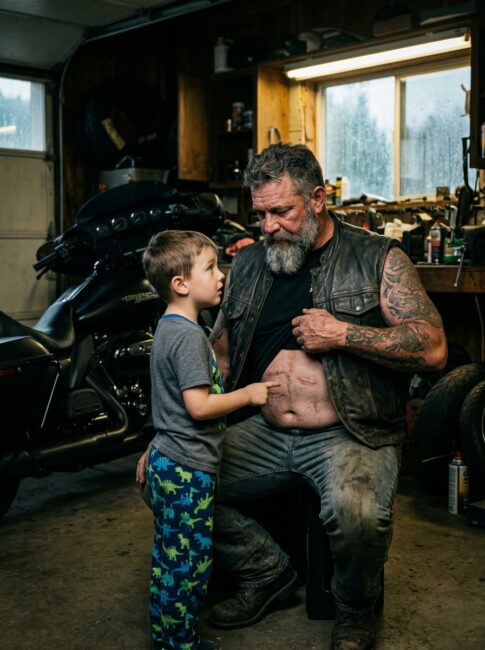
The question came on a Thursday in late October, the first cold rain before snow.
Mason had just come home from a charity ride for a boy in Cody who needed surgery. Three hundred miles of wet road, bad coffee, and gas station sandwiches. His beard was damp. His boots left dark prints on the garage floor. The Harley ticked beside him, cooling slow, giving off that hot metal smell that always made the garage feel like a living thing had just come inside.
Caleb was supposed to be in bed.
Instead he was waiting with a basket of laundry.
That was his new thing. Helping. He liked matching socks because Mason called it “detective work.” He liked folding towels because Mason folded them badly and Caleb got to correct him.
They were sitting on the floor when the question came.
“Dad, why do you have so many scars?”
I was by the doorway with a stack of dish towels in my arms. I remember the exact sound after he asked it.
A drip from Mason’s jacket.
A faraway truck on the highway.
The freezer motor kicking on.
Mason didn’t answer right away. Caleb pointed at the old white line on his father’s shoulder, the one that looked like lightning trapped under skin.
“This one,” Caleb said.
Mason’s voice came out rough. “That one’s from the pass.”
“The motorcycle?”
“Yeah.”
“Did it hurt?”
Mason looked at his son. Really looked.
“Yep.”
“Did you cry?”
“No.”
I saw Caleb’s face change. That little boy look boys get when they think not crying is the same thing as being strong.
Mason caught it too.
He leaned forward, elbows on his knees.
“That don’t mean I was brave,” he said. “It means I was in shock.”
Caleb blinked.
Mason stood, took off his vest, folded it carefully, and laid it over the dryer. The leather made a heavy sound, like a saddle hitting wood. The blue dinosaur patch flashed for a second inside the lining.
Then he pulled off his shirt.
I had seen Mason’s scars a thousand times. In bed. In hospitals. In the bathroom mirror when he thought I was asleep. But seeing Caleb see them was different.
There was the jagged one near his ribs where shrapnel had kissed him in Kandahar.
There was the pale rope of scar across his back from the Beartooth wreck.
There was the round puckered mark near his hip from a piece of hot metal that went through his jacket.
There were little ones everywhere. White cuts. Pink burns. Dark dents. A map of all the places the world had tried to keep him.
Caleb got up slowly.
He touched nothing at first. Just looked.
“What’s that one?” he asked, pointing at the rib scar.
Mason looked down.
“That one’s called Patience.”
“Why?”
“Because I got it waiting for help and not making things worse.”
Caleb nodded like that made perfect sense.
He pointed to the shoulder.
“That one?”
“Courage.”
“Because you crashed?”
“Because I got back on six months later.”
Another scar. Across the knuckles.
“That one’s called Mistake.”
Caleb frowned. “Why?”
Mason flexed his hand. The scar went white.
“Because I hit a man when I should’ve walked away.”
That one landed hard in the garage.
Caleb looked at me. I didn’t move.
Mason kept going.
“This one’s Mercy,” he said, pointing to a small scar near his forearm.
“What happened?”
“Dog bit me.”
Caleb almost smiled. “That’s mercy?”
“Dog was scared. I didn’t bite back.”
For ten minutes, my husband named his wounds.
Not like trophies.
Like warnings.
Discipline. Grief. Temper. Luck. Brother. Home.
He turned every mark into a language an eight-year-old could carry.
I thought that was the moment.
I thought the story would end there, with a scarred biker teaching his boy that pain can become something softer if you name it right.
Then Caleb lifted his small hand and pointed to the long vertical scar down Mason’s chest.
The garage seemed to shrink.
“What’s that one called?”
Mason’s face changed.
Not much.
Just enough for me to feel the old fear wake up.
His hand went to the scar before he could stop it.
Caleb waited.
Mason swallowed once.
“That one,” he said, “is called You.”
Caleb laughed at first.
Kids laugh when they don’t know a room has just split open.
“Me?”
Mason nodded.
Caleb stepped closer. “How can a scar be named me?”
Mason sat down on the wooden step between the garage and the mudroom. He suddenly looked older. Not weak. Mason never looked weak. But tired in a way the road can’t fix.
I set the towels down.
He did not look at me.
“Doctors had to open my chest,” he said. “Fixed my heart.”
Caleb’s eyes widened. “You had a broken heart?”
Mason almost smiled.
“Something like that.”
That was all he planned to say.
I knew it. I knew his tells. The way his left thumb rubbed the scar on his knuckle. The way his shoulders closed in. The way he started searching for an exit even while sitting still.
But Caleb asked the next question.
“Was I born yet?”
Mason went silent.
Not paused.
Silent.
The rain got harder. It hit the garage roof in little hard fists.
Mason looked at me then.
And I knew he was asking permission.
Not to tell the whole thing. Not yet. Maybe not ever.
Because the truth was not pretty.
One week before Caleb was born, Mason collapsed in the parking lot of a gas station outside Livingston. He had been riding home from a club run, stubborn as always, ignoring chest pain for two days because he thought it was heartburn or stress or one more thing he could outwait.
Crowbar found him on his knees beside pump four.
His Harley was still running.
Mason’s helmet had rolled under the ice machine.
When the ambulance came, he fought the oxygen mask. Told Crowbar to call me but not scare me. As if there was a gentle way to tell a woman eight days from her due date that her husband’s heart was tearing itself apart.
By the time I got to Billings Clinic, they had already taken him back.
A surgeon with tired eyes told me they were going to open his chest.
He said words I still hate.
Massive damage.
High risk.
Prepare.
There are sentences that don’t enter your ears. They enter your bones.
The club filled the waiting room. Leather cuts, wet boots, road grime, men too big for plastic chairs. None of them spoke above a whisper. Saint brought me water. Preacher called my mother. Crowbar stood by the vending machines with blood on his jeans and stared at the floor like he could bully God through tile.
Then a nurse came out with paperwork.
Consent forms.
Emergency decisions.
And one quiet question about organ donation if things went wrong.
I signed it.
My hand shook so hard my name looked like a stranger wrote it.
Mason never knew that part.
Not until later.
Not until after Caleb was born.
And Caleb did not know any of it.
He just stood in that garage, eight years old, staring at the scar that had almost been the last mark his father ever got.
Mason rubbed both hands over his face.
Then he said, “You weren’t born yet.”
Caleb’s smile disappeared.
“How close?”
Mason looked at the Harley.
Then at the dinosaur patch inside his vest.
“One week.”
Caleb didn’t understand all of it.
How could he?
Eight-year-olds understand scraped knees, bad dreams, monsters under beds. They don’t understand hospital lights at 3 a.m. or surgeons speaking softly because loud truth feels cruel. They don’t understand a pregnant woman signing papers that might turn her husband into spare parts for strangers.
But children understand almost.
And that word hit him.
Almost.
“You almost didn’t meet me?” he asked.
Mason’s jaw worked.
“No,” he said. “I almost didn’t get to.”
That was Mason. Even then. Careful with blame. Careful with truth.
Caleb looked at the scar again. The long line down the chest. The one I had traced with my fingers after surgery, afraid to press too hard. The one Mason hated for months. He said it made him look opened. Exposed. Like a machine somebody had taken apart and not quite put back right.
After Caleb came home from the hospital, Mason wouldn’t hold him shirtless.
He thought the scar would scare him.
One night, three weeks after the surgery, I woke to an empty bed. I found Mason in the nursery, sitting in the rocker, Caleb asleep against his bare chest. The baby’s cheek rested right on the incision. Mason’s eyes were closed. His hand covered Caleb’s back, wide enough to span almost all of him.
“You okay?” I whispered.
Mason didn’t open his eyes.
“He don’t care,” he said.
“About what?”
“The scar.”
I stood in the doorway and watched my husband breathe like each breath had to pass through permission.
“No,” I said. “He doesn’t.”
That was the night he stopped hiding from his son.
Not from everyone else. Just from Caleb.
The blue dinosaur patch came years later, after Caleb saw a cartoon about a brave little dinosaur who fixed balloons. He found a scrap of blue cloth from my sewing box and asked if he could make Daddy a “secret patch.” Mason sat still for forty minutes while Caleb stitched it crooked into the inside of his cut. The needle went through leather badly. The thread knotted. Caleb pricked himself and cried. Mason kissed the tiny drop of blood off his finger without making it a big thing.
“What’s it for?” I asked.
Caleb said, “So Dad has something soft where nobody can see.”
Mason turned his head away.
Now, in the garage, that patch made sense in a way it never had before.
So did the two fingers Mason pressed to his chest before long rides.
It wasn’t superstition.
It wasn’t fear.
It was attendance.
Like a man checking in with the reason he came back.
Caleb sat beside him on the wooden step. Small shoulder against scarred ribs.
“Did it hurt?” he asked.
Mason nodded.
“Bad?”
“Real bad.”
“Were you scared?”
Mason took a long time with that one.
Then he said, “Worst I ever been.”
Caleb absorbed that. The rain softened. Somewhere down the block a dog barked once and quit.
Then Caleb reached up and placed his palm flat against the chest scar.
Mason went still.
Not frozen like before.
Still like a man listening.
Caleb said, “I’m glad they fixed you.”
Mason closed his eyes.
His hand covered Caleb’s.
He didn’t cry.
Not then.
Bikers don’t cry easy. Not because they’re tougher than other men. Because some of them learned too young that tears attract teeth. So they swallow it. Grind it down. Put it in the tank and ride until the feeling burns cleaner.
But his breath broke once.
Just once.
And every man who has ever survived something he cannot explain would have recognized that sound.
Later that night, after Caleb went to bed, Mason took his vest from the dryer and sat alone in the garage. I watched from the kitchen window.
He opened the inside of the cut and looked at the dinosaur patch.
Then he touched the chest scar.
Then the patch again.
Soft where nobody could see.
Except now I did.
Every year after that, on the Thursday before Caleb’s birthday, Mason took the same ride.
Red Lodge to Livingston.
Highway 212 west until the mountains opened their teeth, then north through Laurel and Columbus, then along I-90 where the wind shoved hard against the bike and the trucks pushed dirty spray across his boots. He never called it an anniversary. Never called it a ritual.
He just said, “I got a stop to make.”
Sometimes the club went with him.
Not the whole club. Just the men who had been there that night. Crowbar. Saint. Preacher. A few others if weather allowed. They’d roll into that gas station outside Livingston and park by pump four. The same pump. Same cracked concrete. Same ice machine humming against the wall.
Mason would kill the engine.
The silence after a Harley shuts down is its own kind of sound. Metal ticking. Leather shifting. Men clearing throats because feelings have entered the room without permission.
Crowbar always stood a few feet away.
He never talked about finding Mason. Not directly. But once, when Caleb was twelve and old enough to ride passenger, Crowbar pointed at the pavement near the pump and said, “Your dad tried to apologize to me from right there.”
“For what?” Caleb asked.
“For bleeding on my boots.”
Caleb laughed.
Crowbar didn’t.
Mason bought black coffee inside and never drank more than half. Then he’d come back out, lean against the bike, and look toward the highway.
One year, Caleb asked to go.
Mason said no.
Caleb asked again the next year.
Mason said no again.
The third year, Caleb didn’t ask. He just came into the garage wearing jeans, boots, and the old bandana Mason had saved from that laundry night.
Mason looked him over.
“You trying to tell me something?”
Caleb handed him the helmet.
“Pump four,” he said.
Mason stared at him for a long second.
Then he took the helmet.
That ride changed something between them.
Not loudly. Nothing in our family ever changed loudly. It changed in the way Caleb stopped asking if scars hurt and started asking what they taught. It changed in the way Mason let him see the hard parts without handing him the weight.
At sixteen, Caleb learned to change oil before he learned to parallel park.
At seventeen, he got his first heartbreak and sat in the garage without speaking. Mason sat beside him for an hour, both of them facing the bike like it was a campfire.
Finally Mason said, “Want me to tell you what that one’s called?”
Caleb wiped his face with his sleeve.
“What?”
“First crack.”
Caleb gave him a look. “That supposed to help?”
“Nope.”
They sat another hour.
It helped anyway.
Last fall, Caleb turned eighteen.
Mason gave him a small leather keychain with a blue dinosaur burned into it. Nothing fancy. No speech. Just tossed it across the kitchen table like it wasn’t the most careful thing he had ever made.
Caleb caught it.
“What’s this?”
Mason shrugged. “For keys.”
“To what?”
Mason nodded toward the garage.
Caleb went still.
The old Road King was waiting under the yellow light, polished, tuned, quiet. Beside it sat a smaller Harley Mason had rebuilt for two years in secret with help from the club. Black tank. Brown leather seat. Not perfect. Better than perfect. Lived-in.
Caleb walked around it once.
Then he looked at his father.
Mason tapped two fingers against the scar beneath his shirt.
Caleb did the same against his own chest, though he had no scar there.
Not yet.
Not that kind.
They rode out just before sunset, father and son, two engines rolling through Red Lodge and onto the highway toward the mountains. The whole club followed a mile behind, giving them room. Leather creaked. Pipes rumbled. Tires hissed over cold pavement.
I stood in the driveway until the taillights became red sparks under the darkening sky.
Mason once told me scars are just places where the body refused to quit.
I think some scars become doors.
And some doors open just in time.
The engines faded past the ridge.
Then there was only rain.
And home.
Follow the page for more true-feeling biker stories about scars, brotherhood, and the people underneath the leather.