Part 2: Two Bikers Guarded a Foster Boy Every Night — Then He Said the Headlights Never Left
The first rider introduced himself as Mack. No last name. Just Mack.
The bald one was Reggie.
That was all I got for the first three nights, because they had not come to make friends with us. They were not rude. They were careful. There is a difference.
They parked in the same place. They never revved the engines after nine. When one of them needed to move, I heard the scrape of a boot, the soft rasp of leather, the click of a thermos lid.
Mostly, I heard nothing.
That nothing mattered.
Before they came, silence in our house was never peaceful. Silence meant waiting. Silence meant listening for the first thud upstairs. Daniel and I would sit at the kitchen table with mugs we kept reheating and forgetting to drink. The refrigerator hummed. Trucks rolled along Route 66 in the distance.
Then Eli would cry out, and both of us would run.
He did not let us hold him when the nightmares came. He curled against the wall and pressed both palms over his ears. If Daniel stepped too close, Eli flinched. If I reached for him too fast, he flinched.
We knew almost nothing about what had happened before he came to us.
We knew enough.
On the fourth night, rain came sideways across Tulsa. Not a polite rain. A hard spring storm that shook the guttering and turned the curb into a brown ribbon of water.
I looked outside at 2:00 a.m. and saw two headlights burning through the downpour.
Mack was gone.
Reggie was gone.
A broad woman with a silver braid sat astride a dark touring Harley beneath a soaked rain jacket. Beside her was a younger man with a red beard and a helmet balanced on his tank.
Their bikes were different, but the arrangement was the same: two beams of light aimed at the house, two bodies staying put.
I went out with towels.
The woman raised one gloved hand.
“We’re good.”
“You’re soaked.”
“So is the road.”
“You can sit on the porch.”
She glanced toward Eli’s window.
“Porch changes the picture,” she said. “He needs the same picture.”
Her road name was June. The red-bearded rider was Cricket.
Soon, Daniel started writing names on the whiteboard by the refrigerator, beneath grocery items and therapy appointments.
Mack and Reggie.
June and Cricket.
Alvarez and Spoon.
Deacon and Moose.
Eight riders.
Two at a time.
I began to notice how precise they were. The bikes arrived before dark, never after. Headlights on. Engines off. Riders in place. When the pair changed near dawn, they did it quietly at the far end of the block so Eli would not wake to the growl of pipes beneath his window.
Some nights they sat for six hours.
Some nights nine.
The yellow star appeared again inside June’s vest when she unzipped her rain shell. I saw another inside Cricket’s cut when he reached for his phone. Different stars. Same cheap thread.
I asked Mack about it one morning while he rubbed warmth back into his hands.
He glanced down and covered the star with the edge of his leather.
“Club business,” he said.
Then he softened, barely.
“Good business.”
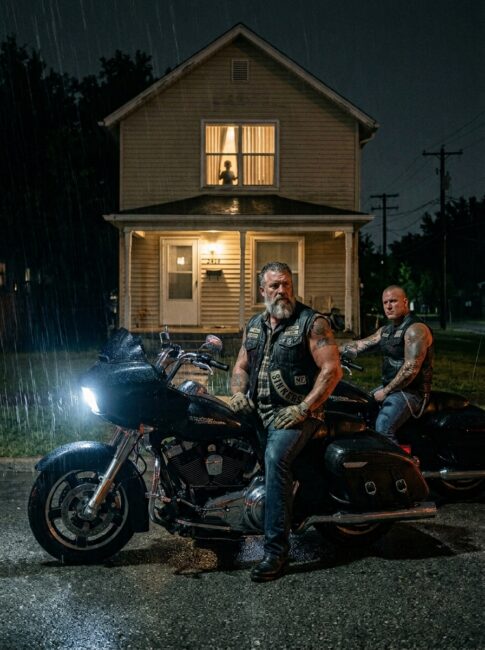
The night we nearly lost the arrangement was the night Eli finally walked outside.
It was late June, four weeks after the riders first came. Tulsa had turned hot and restless. The air smelled like wet asphalt, cut grass, and the faint gasoline bite that clung to the motorcycles after their engines cooled. Cicadas screamed from the trees. Farther down Route 66, tires hissed over pavement.
Eli had gone to bed without asking for the hall light.
That alone felt impossible.
At 12:36 a.m., I woke to the front door alarm chiming.
I found him standing barefoot on the porch in dinosaur pajamas, his hair flattened on one side from sleep. He had one hand around the porch rail. The other was pressed against his chest.
At the curb sat Deacon and Moose.
Deacon was narrow and older, with a white mustache and a faded black cut softened by years of rain. Moose was enormous. Six-foot-four at least, with arms like fence posts and a beard the color of burnt coffee. His left forearm was covered in tattoos, but the hand resting on his handlebar was trembling.
Eli did not look at me.
He looked at the headlights.
“Are you police?” he asked.
Moose shook his head.
“Are you going to take me somewhere?”
“No,” Moose said.
“Are you mad at me?”
That question hit the porch harder than any scream we had heard upstairs.
Moose opened his mouth, closed it, and looked away. Deacon answered.
“No, son.”
Eli gripped the rail tighter.
“Why are you here?”
Deacon’s boots came off the pavement with a slow crunch of gravel. He started toward the yard, then stopped at the property line. He understood before I did that one step too far could change everything.
“So you can sleep,” he said.
“All night?”
“All night.”
“What if it rains?”
Deacon looked at the sky.
“Then it rains.”
“What if you get tired?”
“We got brothers and sisters.”
“What if I have a bad dream?”
This time Moose answered. His voice was rough, but careful.
“Look for the lights.”
Eli’s chin started to shake. He did not cry. He stood there in the porch glow, a small boy trying to decide whether adults could be believed.
Then he asked the question I still hear sometimes when I cannot sleep.
“What if the bad person comes back?”
Moose’s hand tightened on the chrome handlebar. The tremor stopped. Leather creaked when he sat straighter.
“He gets through us first,” Moose said.
It was not loud. It was not theatrical. It was six words spoken by a man who looked like he had spent his life being mistaken for danger.
Eli studied him for a few seconds. Then he nodded once, turned around, and walked back inside.
Daniel carried him upstairs. I stayed on the porch.
Moose was staring at the ground.
“You okay?” I asked.
He rubbed his thumb across the heel of his hand.
“Yeah.”
He was not.
By morning, Eli had slept through the rest of the night.
For nine more nights, the answer held.
On the tenth, a thunderstorm knocked out power across our side of Tulsa.
The street went black.
The house went black.
And at 1:08 a.m., Eli began screaming again.
I ran upstairs expecting to find him against the wall.
Instead, he was standing at the window.
The blinds were open. Rain streaked the glass. Every house on the block had disappeared into darkness.
Except for two white circles at the curb.
The motorcycles were still there.
Their headlights burned against the storm.
The power outage had killed the streetlamps, the porch light, the glow from our hallway, and every familiar shape inside Eli’s room. But outside, two Harley batteries were feeding the only light he could see.
Moose sat on one bike under a poncho.
June sat on the other, rain dripping from the edge of her helmet.
Eli’s breathing slowed while I stood behind him.
He did not ask me to turn on a flashlight.
He did not ask me to stay.
He watched the beams until the panic passed.
The next morning, I came downstairs to find Mack in our driveway with a battery charger, an extension cord, and a plastic grocery sack full of spare bulbs. Reggie stood beside him, reading the side of a headlight box through scratched glasses.
“You planned for this?” I asked.
Mack shrugged.
“Storm season.”
That was when June finally told me the part they had kept from us.
The eight riders had built a schedule the afternoon they heard about Eli. They split the nights around jobs, custody weekends, dialysis appointments, and warehouse shifts. June worked mornings at a school cafeteria. Alvarez drove a tow truck. Cricket had a newborn at home. Spoon was caring for his wife after surgery. Deacon’s knees hurt so badly he sometimes had to stand beside his bike for twenty minutes at a time.
None of them had an empty life.
They made room anyway.
Two riders per night.
Every night.
No exceptions.
They had already voted to keep going until Eli no longer needed to check the window.
“How long?” I asked.
June looked toward the second floor.
“As long as it takes.”
I thought the blackout was the twist.
It was not.
The deeper truth sat inside the vests.
Each crooked yellow star had been cut from the same old piece of fabric. Each one meant that the biker wearing it had taken one of Eli’s nights.
And the first star had belonged to Moose.
A week after the blackout, Moose came alone in the afternoon. Not for a shift.
He parked at the curb, killed the engine, and stood beside the Harley with a brown paper bag in one hand.
Without the darkness, he looked different. Still huge. Still tattooed. Still the kind of man strangers noticed when he walked into a gas station. But daylight showed the tired skin beneath his eyes and the careful way he favored his right knee.
Eli watched from behind the screen door.
Moose did not approach.
He placed the bag on the porch step, then backed away.
Inside was a plastic dinosaur with a missing tail, a flashlight with fresh batteries, and a folded square of yellow fabric. One star had been cut from the corner.
I looked at him.
He looked at the street.
“My boy made those,” he said.
That was the first time I heard about Caleb.
Caleb had entered foster care at seven. Moose was not his biological father. He was a family friend back then, younger and angrier, the sort of man who believed showing up once with gifts counted as showing up.
Caleb moved through three homes in eighteen months. In one of them, he developed nightmares. In another, he stopped speaking at school.
By the time Moose understood how scared the boy had been, Caleb had learned not to expect anybody.
Years later, after Moose got sober and found steadier ground, he became part of Caleb’s life again. Not as a rescuer. Not as a hero. Just as a man who kept arriving.
Caleb gave him the yellow fabric star after a school play. It had been cut from a costume cape his class had made.
“He told me it was for night rides,” Moose said. “Said I needed something bright in there.”
He tapped the inside of his vest.
Caleb died at nineteen when a drunk driver crossed the center line outside Sapulpa.
Moose said nothing for a while after that. A pickup passed. Somewhere down the block, a dog barked twice. His cut shifted in the breeze with that dry leather sound I had come to recognize in the dark.
“When Mack called about your kid,” Moose said, “I had the cape in a drawer.”
Moose cut the fabric into eight uneven pieces. June stitched them into the vests.
He did not ask the club for speeches.
He asked them for nights.
That explained the stars.
It explained why his hand trembled when Eli walked onto the porch.
But there was one more thing I had misunderstood.
I thought the bikers avoided meeting Eli because they feared overwhelming him, or because rough men sometimes do not know what to say around small children.
Mack corrected me when I asked.
“Kid has had adults come close, make promises, then vanish,” he said. “We were not asking him to trust faces. Not yet.”
“So what was he trusting?”
Mack nodded toward the curb.
“A pattern.”
That word stayed with me.
A pattern.
Two motorcycles before dark. Two headlights aimed at the house. Boots on pavement. Quiet voices. The ticking of cooling engines. A silhouette shifting now and then.
Nothing dramatic.
Nothing that demanded gratitude.
Just repetition.
When Eli looked through the blinds at 11:00 p.m., someone was there.
When thunder rattled the glass, someone was there.
When he tested the world again at 4:17 a.m., someone was still there.
The bikers did not ask him to believe every adult was safe. They gave him something smaller and more honest: one piece of the night that behaved the same way every time.
By August, Eli stopped checking the window before bed.
By September, he slept with the blinds closed.
His shoulders changed. That sounds strange, but it is true. When he first arrived, he carried them near his ears as if he expected a blow from weather nobody else could feel. Now they rested lower.
He laughed in the hallway.
He argued about vegetables.
He got mad when Daniel beat him at Go Fish.
Ordinary things.
Beautiful, ordinary things.
The bikers kept coming.
Not because Eli still looked for them.
Because they had promised themselves they would leave slowly.
The motorcycles still arrived before dark, but during the final month, the riders parked half a house farther down the block.
A week later, they moved to the opposite curb.
Then to the corner beneath the sycamore tree.
The headlights were still visible through Eli’s window if he wanted them, but he had to look.
He rarely did.
Mack called it “backing out without disappearing.”
On their final night, all eight riders came.
They rolled in one by one before sunset, engines low, then parked along the curb while the Oklahoma heat lifted from the pavement in slow waves.
Mack. Reggie. June. Cricket. Alvarez. Spoon. Deacon. Moose.
Eight cuts.
Eight yellow stars hidden inside black leather.
Eight people who had donated pieces of sleep nobody could hand back to them.
Daniel brewed coffee and carried it outside in mismatched mugs. I brought sandwiches. Nobody made a speech. June teased Cricket about dropping mustard on his vest. Reggie fixed a loose porch step with screws from his saddlebag. Deacon stretched his knees and pretended not to wince.
Moose sat closest to the window, one hand resting on his Harley tank, the other wrapped around a chipped mug that said WORLD’S OKAYEST DAD.
Eli watched from upstairs for a minute.
Then he came down.
He stopped behind the screen door. The bikers stopped talking.
Moose did not move toward him.
Eli opened the door and walked to the edge of the porch holding the tailless dinosaur Moose had left for him.
“Are you leaving?” he asked.
Mack answered.
“Yeah, buddy.”
“All of you?”
“Yeah.”
Eli looked at the bikes.
“Because I am not scared?”
Mack took a breath.
“Because you know what to do when you are.”
Eli considered that.
Then he held up the dinosaur.
“He is not scared either.”
Moose looked down at his coffee.
At 10:00 p.m., the riders started their engines. Eight V-twins filled the block with a deep, staggered rumble. Porch windows trembled lightly in their frames.
One by one, the headlights swung away from our house.
One by one, red taillights moved toward Route 66 and disappeared.
For the first time in four months, the curb outside Eli’s window was empty.
He slept until morning.
The next day, Eli came into the kitchen wearing one sock and carrying his dinosaur.
Daniel was flipping pancakes. I was standing at the sink, looking out at the bare stretch of curb where the Harleys had been.
Eli climbed onto a chair.
“Where are the motorcycle guys?”
“They went home,” I said.
He was quiet.
I turned around because I thought I had said it wrong. Foster children can hear abandonment inside ordinary sentences. I was learning to handle words with care.
But Eli was not upset.
He looked toward the window.
“I still see the lights,” he said.
I checked the street before I understood. No motorcycles. No headlights. Only morning sun against the pavement and a delivery truck passing on Route 66.
“There are no bikes out there, sweetheart.”
“I know.”
He tapped one finger against his temple.
“I see them in here.”
Daniel stopped moving at the stove.
Eli looked down at the dinosaur in his lap.
“When I get scared, I close my eyes. The lights are still there.”
Four months earlier, eight strangers had parked outside our house because one little boy could not survive another night feeling unguarded.
Then they left exactly the right way.
Not all at once.
Not with promises bigger than they could keep.
They left him the picture.
Some nights, after Eli is asleep, a motorcycle passes somewhere beyond our block. The engine note comes low through the trees, then thins out toward Route 66.
I still look up.
For a second, the window glass catches a pale reflection from the street.
And I see them too.
The lights stayed.
Follow the page for more stories about the people behind the leather.