Part 2: The Biker With a Wrench — And the Manual He Couldn’t Read
I ran the front desk at the Dawson Community Center, which meant I signed kids in, broke up arguments, found lost hoodies, called mothers who were late, and learned which boys joked too loud because they were scared of being quiet.
The Saturday workshop started because the center got a donation from a retired mechanic who left us three half-dead motorcycles, a box of tools, and a note that said, “Maybe this’ll keep a few boys busy.”
Nobody on staff knew what to do with any of it.
Then Wrench showed up.
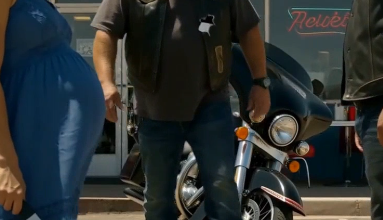
He came in on a Thursday afternoon during a thunderstorm. I remember because the first sound was not the door. It was the Harley outside, a low V-twin rumble shaking rainwater off the windows. Then the engine cut. Then boots hit the sidewalk.
Heavy. Slow. Certain.
When he opened the door, three little girls from dance class stopped tying their shoes.
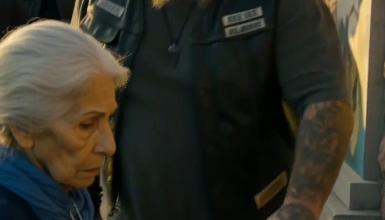
He wore a black leather cut with patches from the Crossbone Saints MC, oil-stained jeans, and boots with silver buckles scarred from years of pavement. His arms looked like old tree roots wrapped in tattoos. A snake on one forearm. A skull on the other. A faded name across his collarbone that I never could read because he always buttoned his shirt high.
“Y’all got bikes nobody can start?” he asked.
I almost asked who sent him.
Instead I said, “They’re in the back.”
He nodded once.
That was Wrench’s way. One nod meant yes. Two words meant a speech.
The Crossbone Saints were a local motorcycle club with a reputation that depended on who was talking. Some people said they were trouble. Some said they delivered groceries to shut-ins every winter. Some said both, and around Tulsa, both could be true.
Wrench never defended the club.
“People talk,” he said once. “Engines don’t. I trust engines.”
The first Saturday, only four kids came.
Isaiah was one of them. He lived with his grandmother, Miss Lottie, two blocks from the center. His father was in McAlester doing time. His mother floated in and out like a bad radio signal. Isaiah had the kind of eyes that dared grown men to disappoint him.
There was also Diego, a Mexican American kid with a stutter who could take apart anything if nobody rushed him. Marcus, a white boy with bruised confidence and a stepfather who called him useless. And T.J., a Cherokee kid who never spoke unless he was correcting somebody.
By the fourth week, there were fifteen kids.
Mostly boys. Two girls too. Keisha and Amber. Wrench treated them exactly the same, which meant he scared them all equally and gave nobody special treatment unless they bled.
He did not teach like a teacher.
He taught like a man trying to save time from killing children.
“Listen before you touch.”
“Don’t force what don’t fit.”
“Clean your mess. A messy bench is a messy head.”
“Ask for help before you break something expensive.”
Every lesson sounded like engines. Every lesson was really about living.
When Marcus threw a socket across the room after failing to loosen a nut, Wrench made everybody stop.
He picked up the socket, put it on the table, and said, “Anger’s a tool. So’s a hammer. You don’t use either on everything.”
Marcus stared at the floor.
Wrench slid him a rag.
“Wipe the bench.”
That was the apology. That was the punishment. That was the mercy.
The brotherhood showed up too. Not every week, but enough.
Tiny, who was not tiny, brought donuts and never let kids see him pay. Preacher, an ex-Marine with a limp, taught them how to patch tires. Jukebox, a white biker with a ponytail and a voice like old smoke, fixed the center’s broken heater without telling anyone.
They called each other brother, but they argued like family.
One Saturday, the club had a ride to Bartlesville for a member’s funeral. Wrench stayed behind for the workshop. I heard Tiny tell him in the parking lot, “That’s one of ours.”
Wrench looked through the window at the kids waiting beside the tool bench.
“So are they.”
Tiny did not answer.
He just took off his sunglasses, rubbed his eyes, and left a box of donuts on Wrench’s Harley seat before riding out.
That was the first time I understood the club had not sent Wrench to the boys.
The boys had become his club too.
Still, there were odd things.
Wrench never filled out the sign-in sheet. He would push it toward me and say, “You got prettier writing.”
He never texted. He sent voice messages.
When instruction manuals came with donated parts, he shoved them under a rag and said, “Manuals make men lazy.”
I believed him.
Everybody did.
Because when Wrench touched an engine, he listened to it like it was speaking English.
We just didn’t know English was the part he had never been able to read.
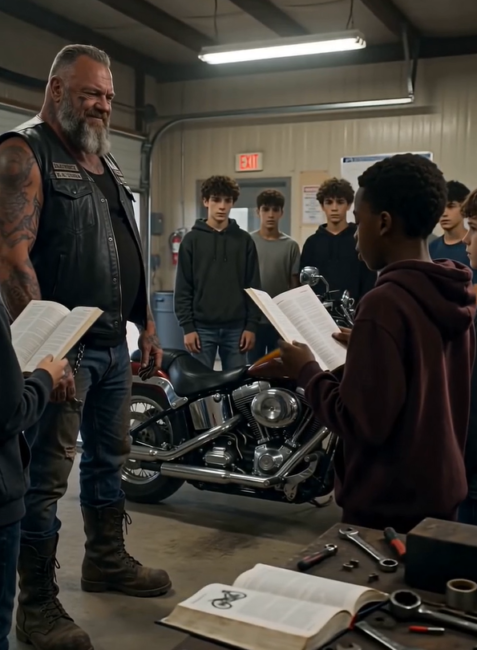
The trouble started with a blue 1987 Harley Softail someone donated in January.
It arrived on a trailer behind a Baptist church van, looking half dead and stubborn about it. Dust on the tank. Dry-rotted hoses. Mice had chewed the seat foam. One mirror was missing. It smelled like old gas, rust, and a garage that had not been opened since someone’s grief moved in.
The donor said it had belonged to her husband.
“He always said he’d fix it,” she told Wrench.
Wrench took off his gloves.
“What was his name?”
“Cal.”
Wrench nodded once.
Then he made the kids stand in a half circle around the bike.
“This ain’t junk,” he said. “This is somebody’s unfinished sentence. Treat it right.”
For six weeks, that Softail became the center of the room.
Every kid wanted a hand on it. Isaiah especially. He had been different since Christmas. Less sharp. Still mouthy, but his mouth had begun to hide questions instead of knives.
Wrench gave him responsibility for the fuel line.
“Why me?” Isaiah asked.
“Because you hurry when you’re scared.”
“I ain’t scared.”
Wrench looked at him.
“Then slow down.”
That was Wrench’s way of saying he saw him.
The false climax came on a Saturday when freezing rain turned the parking lot slick and mean. Only nine kids showed. The center heater coughed. The coffee burned. Outside, the Route 66 traffic hissed over wet asphalt, and Wrench’s Harley sat under the awning with rain clicking off the chrome.
Inside, the kids were trying to get the Softail to turn over for the first time.
Wrench had barely slept. I could tell because his beard was uncombed and his hands shook when he poured coffee. Not much. Just enough for the dark liquid to tap the rim of the cup.
“You good?” I asked.
“Old,” he said.
That was all.
The kids gathered around as Isaiah connected the line. Wrench stood behind him, close enough to stop him but far enough to let him own the work.
“Don’t twist it,” Wrench said.
“I got it.”
“Don’t say got it until it’s got.”
Isaiah rolled his eyes, but he slowed down.
For a moment, everything felt right.
Then Marcus laughed at something. Diego bumped the table. Isaiah flinched and yanked the wrong way.
Gas spilled.
Not much. Enough.
The smell filled the room fast, sharp and dangerous. Keisha stepped back. Amber cursed. Wrench moved quicker than I had ever seen a man his size move.
He slapped the kill switch, grabbed a bag of absorbent pads, and shoved Isaiah back with one forearm.
“Door open. Fans on. Nobody sparks nothing.”
His voice was low, but it cut through panic.
The kids obeyed.
All except Isaiah.
The boy stood frozen, face empty, staring at the fuel dripping onto the concrete.
“I messed it up,” he whispered.
Wrench crouched to wipe the floor.
Isaiah’s voice cracked. “I always mess it up.”
That did something to the room.
Teenage boys can survive yelling. They can survive insults. But a boy saying what he believes about himself out loud? That can break everybody listening.
Wrench stopped wiping.
His shoulders rose once. Fell.
He did not look at Isaiah right away. Maybe because his eyes were wet. Maybe because men like Wrench need an extra second before their face betrays them.
When he stood, his knees popped.
He handed Isaiah the wrench.
“You spilled gas,” he said. “You didn’t burn the place down.”
Isaiah shook his head.
“My dad used to say—”
“I ain’t your dad.”
That came out hard.
Too hard.
Isaiah flinched like he had been hit.
The room froze.
Wrench knew it instantly. His jaw locked. His tattooed hand opened, closed, opened again. The wrench in Isaiah’s hand trembled.
Nobody spoke.
Then Isaiah put the wrench down.
Not angry. Worse.
Careful.
He grabbed his hoodie and walked out into freezing rain.
Wrench took one step after him.
Tiny, who had come in with donuts, blocked the door with his big body.
“Let me.”
Wrench’s face turned dark.
“Move.”
“No, brother.”
That word landed heavy.
Brotherhood is easy when everybody agrees. It becomes real when somebody stops you from making your guilt louder.
Tiny held the door.
“You chase him now, you’re chasing your shame. Not him.”
Wrench stared at him.
For a second, I thought he might swing.
Instead, Wrench’s hand dropped to his side. His fingers were shaking. His mouth moved once, but no sound came out.
Outside, Isaiah ran past the windows, hood up, shoulders hunched against the rain.
The kids looked at Wrench like they had just seen the whole engine fall out of the man.
And we all thought that was the break.
We thought the workshop was over.
We thought one sentence had undone months of Saturdays.
We were wrong.
The real break came when Isaiah returned twenty minutes later to grab his backpack and saw Wrench alone at the bench, holding Cal’s old repair manual upside down.
Isaiah told me later he almost said something.
That would have been the normal thing for a fourteen-year-old to do. A sharp joke. A public wound. Boys who feel embarrassed often pass embarrassment to someone else just to get it out of their hands.
But he did not speak.
He stood in the doorway, wet hair stuck to his forehead, hoodie dripping onto the floor, and watched Wrench stare at a page he could not read.
The manual was open to the fuel system diagram.
Upside down.
Wrench’s thumb moved along the paper like he was trying to feel the words through his skin. His face looked different when nobody was watching. Not fierce. Not hard. Just tired. The kind of tired that starts before sleep and ends somewhere past pride.
He turned a page.
Still upside down.
Then he closed the book and pressed both hands on top of it.
Isaiah understood.
Not all of it, maybe. But enough.
The man who could hear a bad bearing from across the room, who could smell a rich fuel mix before anybody else noticed, who knew every cough and rattle an engine could make, could not read the manual in front of him.
The man who had been teaching them every Saturday carried a secret heavier than the steel wrench in his pocket.
Wrench was illiterate.
Not a little bad at reading.
Not slow.
He could not read.
He could not write his own name without copying shapes he had memorized. He could sign checks with a mark that looked like letters if you did not look twice. He could read numbers on sockets, sometimes, because numbers had shapes that stayed put. But sentences moved on him. Words tangled. Lines crawled.
Thirty years of grease had taught him what classrooms had not.
He learned engines by touch.
By listening.
By smell.
A loose chain had a slap to it. A dry bearing whined like a mosquito. Burnt oil carried a bitter edge. A bolt close to snapping gave a tiny complaint through the handle before it failed. Wrench knew all of that.
But he could not read “Step One.”
Isaiah backed away before Wrench saw him.
The next Saturday, everyone expected Isaiah to stay home.
He came early.
He had a library book under one arm and Cal’s manual under the other.
Wrench was setting tools on the bench, moving like a man ready to be punished.
Isaiah walked in, dropped his backpack, and said too loudly, “I found something we should all hear.”
Wrench looked at him.
The whole room looked at him.
Isaiah opened the manual right-side up.
His hands shook once.
Then he began to read.
“Fuel line inspection should begin with checking cracks, loose clamps, and signs of deterioration…”
His voice was flat at first. Performing. Pretending.
“Since some of us don’t like manuals,” he added, glancing around, “I’m reading it for everybody.”
A couple kids groaned.
Keisha said, “Boy, just read.”
Wrench did not move.
His eyes stayed on Isaiah’s face.
Isaiah kept reading.
Not to expose him.
To cover him.
Not to save the class.
To save the man who had been saving them.
Wrench understood.
I saw it happen.
His jaw tightened. His eyes shone, but nothing fell. Bikers don’t cry easy, not in front of kids, not under fluorescent lights, not with oil pans and socket sets watching. He just reached into his back pocket, pulled out his old steel wrench, and set it gently beside the open manual.
Then he nodded once.
That was thank you.
That was apology.
That was everything.
After that, the workshop changed.
Not loudly.
Nothing important changes loudly.
Isaiah read from the manual every Saturday. He made it sound like a job he had invented for himself, like he was too smart to get his hands dirty, though his hands were always dirty by noon.
“Today,” he would say, “I will bless y’all with the words since you can’t act right.”
The kids laughed.
Wrench grunted.
But every time Isaiah read, Wrench listened with his whole body.
Sometimes he corrected the book.
“Manual says quarter turn. That old hose wants less.”
“How you know?” Amber asked once.
Wrench tapped the metal with two fingers.
“It told me.”
They thought he was joking.
He was not.
Little things began making sense.
Why he avoided sign-in sheets.
Why he shoved forms toward me.
Why he kept manuals under rags.
Why his voicemail greetings were always voice notes sent through Tiny. Why he showed up in person instead of texting. Why he remembered every kid’s voice but sometimes pretended not to recognize names written on paper.
And the biggest seed came back too.
The wrench.
We all thought he carried it because of his nickname. Because it made him look tough. Because bikers like objects that feel like weapons even when they are tools.
The truth was stranger and sadder.
When Wrench was nine, his father worked at a junkyard near Sapulpa. The man drank. He disappeared. He came home with busted lips and stories that did not line up. But once, only once, he put a wrench in Ray’s hand and said, “This here don’t care if you’re dumb. It only cares if you listen.”
That sentence cut deep.
Wrench carried it for forty years.
The insult.
The gift.
Both in the same hand.
School had humiliated him. Teachers called on him to read because they thought pressure made boys stronger. Kids laughed. Wrench learned to fight before he learned fractions. He quit in ninth grade. Worked garages. Swept floors. Held flashlights. Listened when old mechanics talked. He made his hands into books.
He did not become good because life was kind.
He became good because he had no other door.
The Crossbone Saints found him after a bad year he never described in detail. There had been drinking. Debt. A night in county lockup. A brother from the club named Amos who heard him fixing a deputy’s motorcycle by sound through a fence.
Amos gave him a ride home.
Then a job.
Then a patch.
Not all at once.
“Club didn’t make me clean,” Wrench told me once while loading toolboxes into the back of his truck. “Gave me witnesses.”
That was the most he ever said about redemption.
After Isaiah started reading, Wrench did something none of us expected.
He asked for help.
Not in front of the kids.
After class, when the center was quiet and rainwater dripped from the awning outside, he stood at my desk with a folded paper in his hand.
“You know anybody teaches grown folks?” he asked.
I looked at him.
He stared past my shoulder.
“Reading,” he said, like the word had bolts in it.
I gave him the number for an adult literacy program three miles away on Admiral Place.
He took the paper.
Then he handed it back.
“Read it to me.”
So I did.
He memorized the address in one pass.
The next Tuesday, he rode there.
Tiny followed him without being asked.
Wrench knew.
Of course he knew.
At the first lesson, the instructor asked him to write his name.
He sat there for five full minutes.
Then he wrote RAY.
Three letters.
Crooked.
Hard-won.
When he came back that Saturday, he did not tell the kids.
Isaiah noticed anyway.
“You good?” he asked.
Wrench opened his palm.
Inside was a crumpled worksheet with the letter R written over and over.
Isaiah looked at it. Then at him.
No smile. No joke.
He just said, “That one’s clean.”
Wrench folded the paper carefully and put it inside his vest, behind his club patch, close to his chest.
“Yeah,” he said. “Felt like it.”
By spring, the Softail ran.
Not perfectly.
Nothing old does.
But it ran.
The first time the engine caught, the whole room jumped. The sound filled the community center garage, deep and rough and alive. Kids shouted. Amber hugged Keisha. Diego laughed without stuttering. Marcus slapped Isaiah on the back so hard he nearly knocked him into the bench.
Wrench stood behind them all, arms crossed.
His eyes were wet again.
He blamed the exhaust.
Nobody argued.
Then Isaiah held up the manual and said, “Next chapter?”
Wrench looked at the running bike, then at the boy.
“Yeah,” he said. “Read slow.”
The ritual started by accident.
Every Saturday before workshop, Wrench arrived at 7:30 instead of 8:00. He parked his Harley in the same spot by the cracked curb where Route 66 traffic could be heard but not seen. He killed the engine and waited through the ticking heat of metal cooling down.
Then he sat on the back step with coffee in one hand and a children’s reader in the other.
The first book was about a red dog.
He hated that dog.
“Dog’s too happy,” he muttered.
But he read it.
Slowly.
Lips moving. Finger under each word. Boots planted wide like he was bracing against a storm. The same hands that could rebuild a carburetor shook over three-letter words.
Sometimes Isaiah came early and sat beside him.
Not too close.
Boys that age know mercy can embarrass a man if you stand too near it.
Isaiah would eat a honey bun and pretend not to listen.
Wrench would get stuck.
Isaiah would cough the word into his sleeve.
Wrench would grunt.
Then keep going.
By summer, three more kids were coming early.
By fall, the back step became its own class.
No sign. No flyer. No program.
Just a biker reading before he taught engines, and teenagers pretending they were only there because the vending machine had cold Gatorade.
The old steel wrench stayed on the bench during every session.
Not in his hand as much anymore.
On the bench.
Where everyone could use it.
Wrench said tools should not be worshiped. They should be passed around.
One Saturday, Marcus picked it up too fast.
Wrench snapped, “Respect the weight.”
Marcus set it down slower.
Wrench nodded.
That was the lesson.
Respect the weight.
Of tools.
Of words.
Of what people hide because the world laughed too early.
Every year, when the first cold rain came, Wrench rode to the adult literacy center before workshop. He parked outside, drank bad coffee from a paper cup, and read one page of something out loud to whoever was standing nearby.
One year it was a motorcycle manual.
One year it was a birthday card.
One year it was a letter from Isaiah, mailed from Oklahoma State Tech, where he was studying diesel mechanics.
Wrench read that one three times.
He still blamed the exhaust.
The last time I saw the blue Softail, it was rolling slowly down North Peoria with Isaiah riding beside Wrench, not behind him.
Isaiah was nineteen then. Taller. Shoulders filled out. Work shirt with his name stitched on it. He had his own toolbox in the back of his truck and a way of listening to engines that sounded familiar.
Wrench was older.
His beard had gone almost white. His hands were still scarred, still thick, still stained around the nails. But tucked into the inside pocket of his leather cut was a folded adult literacy certificate with his full name on it.
Raymond Maddox.
He could read it himself.
The community center threw him a little party. He hated every second of it. Tiny cried openly and threatened anyone who mentioned it. The kids gave Wrench a new wrench, shiny and polished, with words engraved along the handle.
He stared at it for a long time.
Then Isaiah read the words aloud anyway, because some rituals stay even after the need changes.
“Find the right pressure.”
Wrench closed his hand around it.
Outside, the Harley engines started one by one. Deep. Uneven. Human. The kind of sound that makes windows tremble and little kids look up from their phones.
Wrench swung onto his bike.
Isaiah rolled beside him.
The old blue Softail coughed once, then settled.
Two riders. One road. No speech.
Just chrome, thunder, and a boy reading for the man who taught him how to listen.
The engines faded toward Route 66.
Follow the page for more biker stories about the people behind the leather.