A Biker Wrapped His Jacket Around a Little Girl Locked Outside in Winter—Then the Officer Arresting Him Discovered What She Had Hidden Inside His Pocket
The officer’s hand stopped on my shoulder.
He had heard her.
So had the second officer standing by the walk, although neither of us knew yet whether that would matter.
“She’s confused,” the stepmother said.
Ellie pulled my leather jacket closer around herself. It swallowed her almost to the ankles.
Officer Nathan Cole tightened the cuff on my right wrist.
I kept my hands where he wanted them.
At fifty-eight, six-foot-four, with tattooed knuckles and a beard that made strangers count exits, I knew how a sudden movement from me would look.
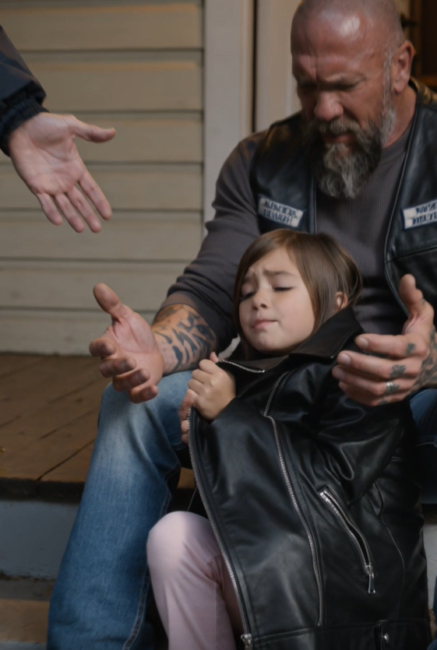
“Call an ambulance for the child,” I said.
“We’ll handle the child.”
“Then handle her.”
That was the sentence he later described as threatening.
Behind the glass, Claire stood close enough to Cole to touch his sleeve. She did it once, lightly, while Ortiz was facing the street. It wasn’t proof of anything by itself. Neighbors knew officers. People reached for familiar faces when frightened.
But Ellie watched the touch and stopped trying to call out.
My name is Ray Maddox. I repair commercial trucks outside the fictional town of Ashford, Ohio. That night, my Harley was in the garage. I was driving home from a late service call in my pickup when I saw bare pink slippers beneath a porch light.
The road was dry.
The porch boards glittered with frost.
I had stopped because the slippers weren’t moving.
Now I was going into a patrol car while the woman who had shut the door stood inside warm yellow light.
The second officer, a young woman named Lena Ortiz, asked Cole whether he wanted medical assistance.
He said no.
She looked at Ellie’s hands.
Then she called anyway.
That small disagreement kept me from believing the whole world had gone crooked.
Claire Sutton said I had tried to force my way inside.
I had knocked.
She said I had grabbed Ellie.
I had wrapped a jacket around her without lifting her from the step.
But I had also put my boot against the door when Claire tried to close it while the child was still outside.
I remembered that clearly.
I had given Cole one piece of truth he could arrange however he wanted.
Ortiz asked a neighbor to stay near Ellie while the medics checked her. Before they moved her, she slipped out of my jacket and handed it toward Ortiz.
“His coat,” she said.
Cole reached for it.
Ortiz already had it.
“I’ll put it with his property.”
He stared at her for half a second too long.
In the car, I watched Ellie through the window. A medic knelt at her height. Claire spoke over him until he raised a hand and kept talking to the child.
I couldn’t hear the words.
I could see which adult answered every question first.
At the county booking desk, a corrections officer emptied my pockets into a tray.
Wallet.
Keys.
My own cracked phone.
Then Ortiz’s property bag arrived with my jacket.
Another phone slid from the inside pocket.
Blue rubber case. Silver tape across one corner.
“Two phones?” the booking officer asked.
“Only one’s mine.”
The other screen woke when it touched the tray.
An incoming message preview appeared beneath a contact saved as Mara.
Give Nathan the phone. Now.
The booking officer looked from the screen to the arresting officer’s name on my paperwork.
Cole was still outside, finishing his report.
“Get your supervisor,” I said.
Would this officer read the message before the wrong man came through the door?
The booking officer’s name was Grant.
He didn’t unlock the phone.
He turned the tray away from the public counter and called his supervisor.
That was the first sensible thing anyone had done with an object all night.
I told him exactly what I knew: Ellie had whispered that it belonged to her father. I hadn’t seen her put it in my pocket. I hadn’t opened it.
Grant wrote that down.
Then he moved me to a room where Cole couldn’t speak to me alone.
At the hospital, Ortiz asked for a child-services worker. I learned that later from her report.
Ellie was cold and frightened. The medical team warmed her and checked her before anyone tried to untangle the family.
Her father’s sister, Mara Sutton, arrived after midnight.
She brought pajamas, a stuffed rabbit, and photographs establishing that she was more than a name on somebody’s contact list.
One photograph showed a kitchen table.
Ellie sat beneath it wearing a paper crown. Her father, Adam, crouched beside her with two mugs of cocoa.
Mara later told me the story behind it.
Adam worked maintenance for a small property company. On Saturdays, he and Ellie built breakfast forts beneath the table. Before crawling in, he knocked twice quickly, then once slowly.
Their private doorbell.
At the family’s old fishing cabin, the sticky door required another little ritual: lift the handle before turning it.
Ellie called it helping the house stand up.
Once inside, Adam made pancakes while a small orange heater whistled beside his workbench. He kept promising to replace it.
Ellie said its whistle meant the cabin was happy.
Those were the happy memories.
They took Mara less than two minutes to tell.
Then she showed Ortiz a recent message from Claire.
Adam was supposedly working on a project overseas.
Mara had asked which country.
Claire answered with an airport photograph and said reception would be bad.
The photograph showed Adam beside a departure sign.
Mara had accepted it.
He traveled sometimes. He hated long telephone calls. Their relationship had been strained since he married Claire.
There were ordinary explanations.
Enough to delay worry.
Not enough now.
Mara hadn’t seen her brother in nearly a month. Their last argument had been about Claire speaking for him on every call. He accused Mara of disliking his wife. Mara stopped calling for a while to prove she could respect his marriage.
Now that little act of pride sat heavily between them.
At the station, the supervisor asked whether I wanted a lawyer.
“Yes.”
Then he asked whether I was willing to give a separate statement about the child.
“With the lawyer.”
I didn’t want anything careless I said to become another tool against her.
Before dawn, Cole requested access to my property to clarify an item in his report.
Grant refused.
The supervisor had already secured the second phone separately.
Cole said it might be stolen.
That was when Grant checked the description Claire had supplied during an earlier call.
Blue case.
Damaged corner.
A personal telephone belonging to Adam Sutton.
Claire had reported it missing two days earlier.
She had also said Adam was already overseas.
If her husband had taken a work trip, why was she searching the house for the phone he supposedly carried?
By morning, the simple story was already failing.
That didn’t mean a clearer one had replaced it.
My lawyer, Ellen Park, arrived carrying a laptop and a paper bag containing a breakfast sandwich.
She put the sandwich in front of me first.
“Start with what you did,” she said.
I described the boot against the door.
She didn’t look pleased.
“Anything else?”
“I told him to handle the child.”
“Did you threaten him?”
“No.”
“Did you resist the cuffs?”
“No.”
She requested preservation of the officers’ recordings and the neighbor’s doorbell footage.
Then she told me something I didn’t expect.
Cole had been at a hospital when Adam supposedly left town.
Not nearby.
Two counties away, accompanying another detainee during treatment. Records and cameras appeared to confirm it.
If Adam disappeared that evening, Cole hadn’t personally taken him from the house.
Claire also had footage.
It showed Ellie opening the front door herself and walking onto the porch carrying the blue phone.
Thirty seconds later, Claire appeared behind her.
No dragging.
No pushing.
Claire said she thought Ellie had gone to the neighbor’s house. She said the latch caught when the wind blew the door closed.
For several minutes, I wondered whether I had seen a frightening ending and invented the beginning.
Then Ellen showed me the rest.
Claire looked through the window twice.
The neighbor’s recording caught knocking from the porch.
Not mine.
Small, uneven knocking.
Claire turned off the hallway light.
“That matters,” Ellen said.
“It happened before I got there?”
“Yes.”
At the hospital, Ellie told a specialist she wasn’t locked outside at first.
She had gone out to hide her father’s phone.
Claire told her she could come back when she stopped lying about where she found it.
A six-year-old didn’t describe that as confinement.
She described it as being in trouble.
That was the difference the short video had hidden.
Ellen reminded me that nobody needed Ellie to describe the law correctly. They needed the adults to explain their choices.
The child could have opened the door herself and still been prevented from coming back inside.
Both statements could be true.
Claire’s video established the first. Her own behavior supplied the second.
The airport photograph also turned out to be genuine.
Old, but genuine.
Mara found it in a family group message from three years earlier.
Now investigators had reason to doubt Claire’s account.
They still didn’t know where Adam was.
His employer said he had requested several days off.
His brother-in-law, Claire’s brother Trevor, had borrowed a white utility van around the same time.
A neighbor remembered that van outside the Sutton house.
For a while, attention moved toward Trevor.
Cole said he barely knew him.
Claire said Trevor had driven Adam to an airport hotel.
Trevor said he had driven him nowhere.
Three adults.
Three accounts.
Ellie was the only one who had consistently said the same thing.
Daddy hadn’t said goodbye.
Ellen called the supervisor before leaving.
She asked him to compare Cole’s hospital shift with the date of the plea on the recovered phone.
Not the date Claire claimed Adam left.
The message had been written more than a day later.
If Cole’s alibi covered the wrong night, who had chosen the date everyone was checking?
State investigators took over the missing-person inquiry that afternoon after the county supervisor referred the conflict.
I didn’t meet them until my release.
What happened with the phone came to me afterward through interviews, court records, and Adam himself.
The device was preserved. Investigators obtained authority to examine it instead of asking a frightened child to unlock it at a counter.
The message addressed to Mara had gone to a number that wasn’t Mara’s.
Someone had changed the contact entry.
Her real number still appeared in older conversations.
The new number belonged to a spare account connected to Claire.
Adam had asked his sister for help.
Claire had received the request.
He had written that Nathan was making him sign documents and wouldn’t let him leave.
There was no address.
No convenient photograph of a street sign.
Just a man’s unfinished attempt to reach somebody he trusted.
Mara cried when investigators explained the altered contact. She had been reading old messages, searching for the question she should have answered differently.
There wasn’t one.
Adam had tried to reach her through a name he recognized, and another adult had quietly moved the person waiting at the other end.
Other records supplied what the message couldn’t.
Claire had been arranging a loan against property Adam owned before their marriage. The proposed paperwork included his signature.
He said later that he hadn’t signed it.
Money from an earlier transaction had already gone toward debts connected to a business Cole operated through a relative.
The affair explained some things.
The money explained why the lies needed to continue.
Adam had discovered both.
He confronted Claire at home.
He still had his personal phone then.
After sending the message, he hid it behind a loose panel beside the kitchen radiator when he heard a vehicle stop outside.
He thought he could retrieve it later.
Ellie watched from the hallway.
She remembered the hiding place.
That was why the phone was still in the house when she found it.
Investigators also checked the photograph Claire had sent Mara. Its age wasn’t the only problem.
Claire’s messages about Adam’s destination changed.
First Europe.
Then a work site with poor reception.
Then a project she couldn’t discuss.
His employer had no overseas contract.
By evening, Trevor agreed to speak with investigators without Claire present.
He had driven the white van.
Adam had been inside.
Trevor said Cole told him Adam was having a breakdown and needed somewhere quiet.
He was ashamed of how readily he’d accepted that explanation.
He also knew where they went.
The family’s fishing cabin stood on private land beyond the edge of the next county.
A team went there while another investigator contacted local emergency services.
Nobody asked me to come.
I waited at Ellen’s office beside a printer that kept flashing because it was out of paper.
At 9:18, her phone rang.
She listened.
Then she put a hand flat on the desk.
“They found him.”
I leaned forward.
“Alive?”
“Alive.”
Only then did she breathe.
Adam had been held in a storage room attached to the cabin. Someone brought food and told him cooperating was the quickest way home.
Ellen listened again.
Her expression changed.
“There’s something else.”
If Adam had been trying to expose them, why had investigators found documents he admitted signing willingly?
I was released the following morning.
The allegation against me hadn’t vanished. Ellen said we would deal with it through the recordings and the formal process.
I signed the release paperwork without arguing with the desk officer.
Outside, Luis Ortega stood beside my pickup.
He worked at my garage and had collected it from the street with permission.
He handed me my keys.
Then he handed me a coat.
My leather jacket was still evidence.
The missing jacket bothered me more than the cuffs had.
Ellie had been inside it.
I wanted it accounted for.
By noon, a clipped porch video appeared online.
It began with my boot against Claire’s door and ended before the medics arrived.
No child knocking.
No phone.
The caption said a convicted biker had tried to enter a family home.
The conviction was mine.
Twenty-four years earlier, I had assaulted a man during an argument outside a bar.
I had served my sentence.
Now people who had trusted me with trucks full of expensive equipment wanted to know whether their children had ever been near my shop.
One customer canceled a repair.
Another sent the post to my business account with three question marks.
Luis offered to answer.
I told him no.
Ellen sent preservation requests.
That sounded small beside the speed of a lie.
It was still the right work.
The neighbor who supplied the complete footage called to apologize for not opening her own door sooner.
She had seen the uniform and assumed the problem was being handled.
I told her the recording mattered.
She said that didn’t answer what she had asked herself.
I understood.
Evidence didn’t always make a person feel useful in time.
Cole had been placed on leave, but he called the garage from a personal number.
I let it go to voicemail.
He said I had misunderstood a family situation.
He said I should consider how easily my old record could affect my future.
He never said a direct threat.
He didn’t need to.
Ellen forwarded the message to investigators.
That afternoon, a complaint accused me of stealing Adam’s phone and using it to invent a connection to Ellie.
For several hours, I thought the complaint had come from Adam.
It hadn’t.
Claire submitted it before being interviewed again.
She was still trying to turn the thing she had lost into something I had taken.
A detective called to confirm my movements.
I answered beside Ellen.
We used my service invoice, a customer’s security camera, and the ordinary location records from my own phone.
Nothing dramatic.
Just a late repair and a man driving home.
Meanwhile, Ellie stayed with Mara under a temporary safety arrangement while the adults handled the case.
I wasn’t allowed to visit simply because she had handed me evidence.
I wasn’t family.
That boundary hurt.
I understood it anyway.
On Friday, the detective called again.
The full recordings contradicted Cole’s account of resistance. The prosecutor declined the case against me.
I sat down so hard the office chair rolled into the wall.
Then he asked whether I would meet Adam.
“He wants to explain something before you hear it elsewhere.”
“About the papers?”
“Yes.”
What had her father agreed to before the night his daughter needed a stranger’s coat?
Adam Sutton met me in a hospital consultation room.
He wore borrowed sweatpants and kept apologizing for taking time away from my business.
Mara stood beside the window.
He didn’t look like a man hiding a clever explanation.
He looked like a man who had finally run out of one.
“I knew Nathan before Claire did,” he said.
Cole had arranged maintenance work for him on rental properties connected to relatives.
At first, it was ordinary work.
Then Cole asked him to sign invoices describing jobs that hadn’t been completed.
Adam did it.
He needed money after his first wife died. Ellie was small. Childcare cost more than he expected. The first dishonest payment solved one month’s problem.
Then there was another month.
He kept telling himself he could stop after catching up.
“How much did you know?” I asked.
“Enough.”
He didn’t dress it up.
He had kept some cash income off his books too. When he discovered Claire and Cole’s relationship, he threatened to report everything.
Cole showed him copies of the false invoices.
The copies had Adam’s signature.
Then came the proposed property loan.
Adam refused.
That was when the situation changed from pressure into confinement.
“I thought if I signed the last papers, they’d let me go home.”
“Did you?”
“Some.”
He looked toward Mara.
“I also told them I wouldn’t report anything.”
Mara folded her arms.
“You didn’t get to promise that for Ellie.”
“I know.”
He had thought about leaving town with his daughter.
Not calling his sister.
Not asking somebody to help him face what he had done.
Leaving.
He had already failed once by making a dangerous man part of their lives. Now he had almost failed again by believing he could privately negotiate his way out.
I recognized that kind of shame.
It made hiding feel like responsibility.
“What happens now?” I asked.
“My lawyer says I tell the truth. All of it.”
“Even when it costs?”
He nodded.
His cooperation didn’t cancel the false invoices. Investigators were reviewing his role separately. He understood that Ellie might someday ask why he hadn’t sought help sooner.
I could not answer that question for him.
Before I left, he asked about the porch.
Not the arrest.
Ellie’s slippers.
“Was she crying?”
“She was trying not to.”
He lowered his head.
Mara put a hand between his shoulders.
Then she told him about the message addressed to her.
He looked up sharply.
“I thought you weren’t answering.”
“I never got it.”
He shut his eyes.
For several seconds, his fingers moved against his knee.
Two quick taps.
One slow.
I remembered the breakfast story.
“She knows that knock,” I said.
He tried to answer.
Couldn’t.
Adam asked whether I hated him.
I told him I wasn’t the person whose answer he needed to organize his life around.
He glanced toward the corridor, where a cart rattled past carrying clean blankets.
Then he nodded.
It was the first time during our conversation that he stopped trying to make his shame somebody else’s assignment.
A week later, Mara brought him to see Ellie under a plan agreed with the people supporting her.
She heard him before she saw him.
Two quick knocks.
One slow.
But why did she ask him to leave the door open before she would come near?
Months later, the courtroom doors stayed open until the clerk called the hearing to order.
Ellie wasn’t there.
Mara had taken her to school.
She had already spoken to trained interviewers. Nobody needed her sitting on a bench while adults argued over what she had survived.
I testified about the porch.
Ortiz described calling the medics after Cole said not to.
Grant described the second phone sliding from my jacket at booking.
Each person knew one piece.
Together, the pieces stopped looking like a misunderstanding.
Ellen sat behind the prosecutor’s table with her notes closed. My part of the case had ended, but she came because I had asked.
Luis waited in the hallway.
He said somebody ought to be there afterward who knew a place to get decent coffee.
I was glad they both came.
The recordings showed my hands staying visible.
They showed Claire calling Cole by his first name before he identified himself.
They showed him directing attention toward me while Ortiz asked about the child.
The financial records supplied a reason for the attempted distraction.
The phone records established who received Adam’s plea.
Trevor described driving the van.
He also described returning later with groceries after being told not to ask questions.
His willingness to help investigators did not make that first decision disappear.
Cole’s attorney said he had believed Adam needed assistance and had tried to manage a complicated domestic dispute.
Cole testified at the hearing concerning the challenged arrest and seizure.
He spoke evenly.
He said he never confined Adam.
He said he hadn’t entered the cabin during the period in question.
He said Trevor had exaggerated his involvement to protect himself.
Then Adam described the storage-room door.
It had no ordinary handle on the inside.
He explained that he could hear the orange heater whistling whenever somebody entered the main cabin.
It stopped when the power was switched off.
That was how he knew a visitor had stayed to talk.
Cole shifted beside his attorney.
The prosecutor asked Adam whether he saw who brought the second meal.
“No.”
“So you can’t identify that person by sight.”
“No.”
Cole leaned forward.
“He couldn’t hear that heater from the storage room.”
The judge told him to wait.
He kept going.
“Not with the connecting door shut.”
The room became very quiet.
It wasn’t a magical confession.
Photographs of the cabin had been disclosed. His attorney could have discussed the building with him.
But Cole had just volunteered certainty about conditions inside a place he claimed not to have entered during Adam’s confinement.
The prosecutor returned to that answer when questioning him.
Cole said he knew the layout from years earlier.
Then the investigator identified a recent change.
Adam had installed the connecting door that fall.
His dated work photographs showed it.
Before then, the rooms had been open to each other.
The whistle and the door were small things.
They fitted the location records, Trevor’s testimony, and a photograph from a nearby road camera showing Cole’s vehicle traveling toward the property.
His explanation narrowed.
Then changed.
He had visited, he said.
Briefly.
To check on Adam.
The prosecutor waited before asking the next question.
“Why didn’t you call for the assistance you say he needed?”
Cole looked toward Claire.
She stared at the table.
I watched his hand close around a paper cup until the rim bent.
If keeping Adam there was help, why had every person involved worked so hard to hide where he was?
There wasn’t one afternoon when everything became right.
The case continued through more hearings, negotiations, and dates I wrote on the back of garage envelopes.
Cole eventually admitted criminal conduct connected to Adam’s confinement and the falsified arrest account. He lost his job.
Claire’s case included her role in the confinement, the financial scheme, and leaving Ellie outside.
The exact accounting took longer than the first newspaper stories.
Adam cooperated.
He also faced consequences for his own false paperwork.
Nobody called that part a misunderstanding.
For a while, he lived with Mara and followed the arrangements established for Ellie’s care.
He attended appointments.
He showed up when promised.
He stopped answering difficult questions with things would be different soon.
One evening, Ellie asked whether her daddy was good or bad.
Mara told me about it afterward.
“He’s responsible for what he does,” she had said. “And the grown-ups are making sure you don’t have to manage him.”
Ellie thought about that.
Then she asked for toast.
Some questions needed toast before another answer.
My jacket came back in a sealed property bag.
The inside pocket had been photographed so many times that I expected it to look different.
It didn’t.
Old lining.
A crooked seam.
A place where I usually kept gas receipts.
I hung it in the garage office and left it there for three days.
Then I wore it to breakfast.
The first visit happened in Mara’s kitchen.
Ellie watched me from the table.
She wore slippers with rubber soles and had a coloring book open beside her cereal.
I stayed near the door until Mara pointed to a chair.
Ellie looked at the jacket.
“Did they give your pocket back?”
“Whole thing.”
She nodded.
Then she went back to coloring.
That was enough.
I never asked her to tell the porch story again.
When she mentioned it, I listened.
When she changed the subject, I followed.
Once she asked whether big people got scared too.
I told her yes.
She considered my beard, my shoulders, and the sandwich in my hand, then asked whether I wanted the last pickle.
Later visits grew ordinary.
She complained about peas.
Adam complained about forms.
Mara complained that both men kept standing in the kitchen where she needed to walk.
One Saturday, Ellie asked to see my motorcycle in the garage.
Her father brought her.
She wore a yellow coat and kept one hand inside his until she saw Luis holding a box of doughnuts.
Then he was temporarily unnecessary.
I showed her the parked Harley.
Engine off.
Keys on the office hook.
She examined the seat, decided it looked uncomfortable, and asked whether the truck had better cup holders.
“Much better,” I said.
She chose the truck.
Before they left, Adam stopped beside my jacket.
His eyes went to the inside pocket.
“I don’t know how to thank you for that.”
I looked toward Ellie, who was telling Luis which doughnut he wasn’t allowed to eat.
“Keep coming back when you say you will.”
He nodded.
At the doorway, Adam knocked on the frame.
Two quick taps.
One slow.
Ellie turned.
This time, she smiled before she saw him.
She came back to me and patted the leather pocket once, checking something only she understood.
Then she looked toward the open garage door.
“Can we leave it open a little longer?”