A Seven-Year-Old Hugged a Biker and Called Him Dad—Then His Mother Recognized the Family Resemblance and Questioned Who Had Come Home Five Years Earlier
Rachel didn’t ask Noah to say it again.
She took one step back.
Not from me.
From the photograph on her phone.
It showed a man holding Noah beside a birthday cake. Short beard. Gray at the temples. My brother’s eyes.
Nathan’s eyes.
Or Miles’s.
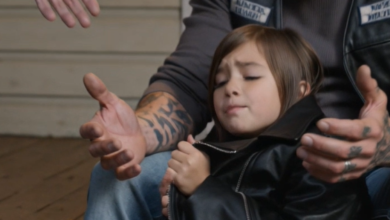
The boy still had both arms around my leg.
I kept my hands open.
“Buddy, I need you to go stand with your mom.”
He looked up.
“Are you mad?”
“No.”
That answer cost less than any explanation I could have attempted.
Rachel drew him close, then looked at my driver’s license again.
Eli Brooks.
Forty-nine.
Not Nathan.
Not Miles.
She had seen my name in an old family album. She had never met me. Her husband said his younger brother wanted nothing to do with them.
That part wasn’t entirely a lie.
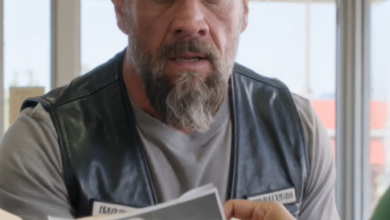
Twelve years earlier, I left Ohio after a fight at our family’s repair shop. I went west, took traveling welding jobs, and let unanswered calls become a reason not to make more.
This month, a contract brought me back near Dayton.
I stopped for groceries.
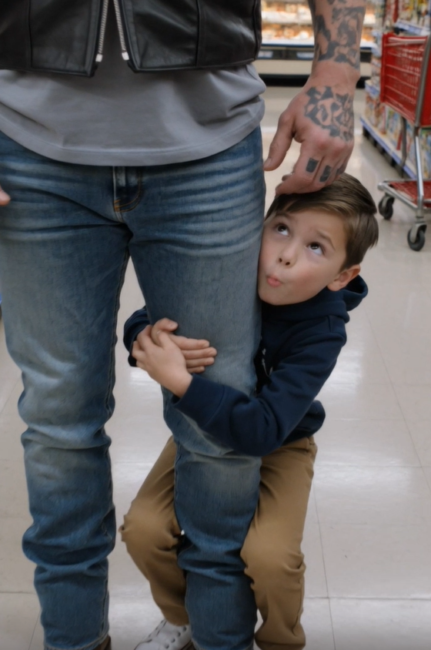
Now a seven-year-old had called me Dad, and his mother was trying to decide which member of my family belonged in a grave.
“The man in your picture,” I said. “How old is he?”
“Fifty-one.”
My older brothers were identical twins.
I was two years younger.
Close enough in the face to be mistaken for either at a distance, especially by a little boy running around a shopping cart.
Not close enough to explain what she asked next.
“If you’re Eli, why did Nathan tell me there was nobody left to call?”
Rachel told Noah the names were something the adults would sort out. He hadn’t done anything wrong.
He looked relieved, then embarrassed about the hug.
I wanted to tell him I had needed one more than he knew.
I didn’t.
A little boy wasn’t there to make my twelve missing years feel better.
A cart wheel squeaked behind us.
Someone reached past my shoulder for cereal.
I wanted to leave the aisle.
Not leave them.
Just get out of a place where breakfast boxes watched us discover something terrible.
A store employee offered the little seating area near customer service.
Rachel agreed.
Noah chose a chair where he could touch her knee.
She bought him apple juice.
I bought nothing.
My basket stayed beside a display of paper towels until someone put it away.
Rachel told me the accident happened five years earlier.
Two brothers in one vehicle.
One died.
The surviving brother identified him.
Our mother confirmed it.
Miles was buried.
Nathan came home.
I studied the photograph again.
A wedding ring.
A small pale mark near the eyebrow.
Both brothers had marks there from different childhood accidents. I couldn’t tell which one the camera had softened.
For a moment, I felt foolish.
I hadn’t spoken to them in years.
Perhaps I was making a stranger’s marriage into a mystery because I resented being absent from it.
Then Rachel asked whether Nathan had always been left-handed.
“Yes.”
“He uses his right now.”
“Injuries can change things.”
She nodded too quickly.
That explanation had been doing work in her house for years.
She showed me a photograph taken before the crash.
Nathan holding Noah as a toddler.
His left wrist carried a long, old surgical scar.
The recent photograph showed a watch covering the same place.
What would we find when the man wearing my brother’s name finally took it off?
Rachel didn’t call her husband from the store.
She called her sister, Hannah, and asked her to collect Noah.
Noah objected until Hannah promised the park.
He looked back at me before leaving.
“Do you have a motorcycle?”
“Yes.”
“Dad says they’re loud.”
“Sometimes.”
He considered that.
Then he went with his aunt.
Rachel watched until Hannah’s car left the parking lot.
Only then did she sit down.
“Tell me something about them nobody puts in an album.”
I thought about our old kitchen.
The memory came with the smell of toast and model glue.
When we were children, Nathan made little wooden boats at our father’s bench. He held the drill in his left hand and took forever getting each hole straight.
Miles hated waiting.
One summer, he carved his own boat and cut three little notches beneath the stern so nobody could claim it.
He used a brass screw that was too long.
The boat leaned.
Nathan helped him balance it, then painted it blue.
Miles complained that everybody remembered the paint and forgot who made the boat.
We sailed it in a drainage ditch after rain.
I fell in retrieving it.
Both brothers laughed until they saw I was crying.
Then both came after me.
For a few minutes, there had been no good brother or difficult brother.
Just three wet boys carrying one blue boat home.
That was the happy memory.
It took less than two minutes to tell.
Rachel opened her handbag.
She didn’t find the boat.
She found a photograph of it.
Noah holding it beside a bathtub.
“His dad gave him this last Christmas.”
I looked at the hull.
A chip near the bow.
The brass screw.
Our father had kept it on a shelf for years.
It hadn’t disappeared.
People could remain in a family longer than the people who remembered making them.
Rachel rubbed the edge of her phone.
“After the accident, everything was different.”
Sleep.
Food.
The way her husband laughed.
He stopped singing a song he used to sing to Noah.
He forgot arguments they had settled.
He remembered details about Miles with startling clarity.
Doctors had told her recovery could affect a person in many ways.
They hadn’t told her a different man had come home.
Nobody had.
Not even the woman who knew both men before either could walk.
“Your mother helped him,” Rachel said.
I wanted to object.
Instead, I remembered the last message my mother sent me years earlier.
Leave Nathan alone. He has enough.
I had obeyed because staying away was easier than being told to leave again.
She said the strange thing wasn’t one forgotten song or a different laugh.
It was how often she had apologized for noticing.
If she asked about the past, he looked wounded.
If she stopped asking, he became kind again.
After a while, peace in the house depended on how little she remembered out loud.
Rachel asked whether I would meet an attorney with her.
“Yes.”
“Not at the house.”
“No.”
She called a family-law office Hannah had used after a separation.
They offered an appointment the next morning.
As we stood, Rachel’s phone rang.
A photograph filled the screen.
The same man.
The same eyes.
She let it ring.
Then a message appeared.
Mom says you met Eli. Bring Noah home.
Who had told our mother before Rachel had told anyone in the family?
The answer was a store photograph.
A shopper had recognized Rachel, seen her crying beside a man who looked remarkably like her husband, and sent the picture to a relative.
Within an hour, it reached my mother.
Nobody needed a tracking device.
Ordinary concern traveled fast enough.
Rachel’s attorney, Dana Price, asked us to stop building conclusions from single details.
A changed writing hand wasn’t an identity.
A watch wasn’t an identity.
A child recognizing a face wasn’t an identity either.
She asked Rachel what she actually needed that morning.
“Somewhere Noah and I can stay while I find out.”
That answer gave us a place to begin.
Hannah had a spare room.
Rachel went there voluntarily.
Dana helped her think through communication, finances, and collecting basic documents without turning the boy into a messenger.
Then the man calling himself Nathan arrived at Dana’s office for an agreed meeting.
I nearly stood when I saw him.
Not because he looked like a stranger.
Because he looked like someone I had been angry with for twelve years.
His beard was shorter than mine.
His shoulders were narrower now.
The family resemblance did the rest.
“Eli,” he said.
Just that.
My name in a familiar voice.
For one second, all my suspicion felt theatrical.
I watched him reach for his wallet.
As children, all three of us had carried things until the corners wore soft.
This wallet looked ordinary.
That was the trouble.
Nothing announced itself as stolen.
A man could put another man’s name in a leather pocket and still look like somebody paying for his groceries.
He showed his identification.
His insurance card.
Photographs of himself at Noah’s school.
Then a parentage report Rachel had obtained months earlier during another argument she hadn’t mentioned yet.
The report was consistent with him being Noah’s biological father.
Rachel stared at it.
Dana didn’t.
“That doesn’t settle which identical twin we’re discussing.”
He smiled without looking at her.
“Listen to yourself.”
He said Nathan had survived.
Miles had died.
Their mother had identified the deceased brother.
He hadn’t invented the account alone.
That was true enough to move the room.
He also had a surgical discharge record from the accident.
His legal name appeared on it.
Again, Nathan.
For a while, every document agreed with the man sitting in front of us.
Then Dana asked when the hospital recorded the name.
After the first family contact.
Not before.
It established what somebody told the hospital.
It didn’t establish who arrived.
The man folded the report.
“Ask Mom.”
We did.
Jeanette Brooks came the following day with a handbag, reading glasses, and a look I remembered from childhood.
The look that meant a conversation had already been decided.
She said her surviving son was Nathan.
She said she had made the identification.
Then Dana placed two old photographs on the table.
Nathan’s wrist.
Miles’s wrist.
My mother turned one facedown.
Not the injured one.
The clean one.
“It was a terrible night,” she said.
Her hands began to shake.
For the first time, the man beside her looked worried.
Had we been questioning the wrong person about who chose the dead man’s name?
Dana referred the suspected identity fraud to investigators.
Rachel supplied what she had.
I gave a statement about the brothers’ childhood and the years I had missed.
Nobody asked me to identify a man by a feeling.
That was a relief.
It was also humiliating.
These were my brothers.
I wanted recognition to be simple.
Investigators requested records connected to the crash and earlier identification records for both men. Rachel authorized access to documents she controlled. Other material required the proper legal process.
There wasn’t one envelope marked TRUTH.
There were offices.
Waiting periods.
Questions repeated by different people.
The parentage report came up again.
It established a family connection.
It couldn’t answer the question Rachel was asking.
The records from before the crash mattered more.
Nathan’s work had required a fingerprint background check.
Miles had separate fingerprint records from an earlier arrest.
Whatever else the brothers shared, those records were distinct.
I learned about the comparisons later through Dana and the proceedings.
The man living as Nathan matched Miles’s earlier record.
Not Nathan’s.
The crash identification also came under review.
The initial name had followed a wallet and statements supplied afterward.
A later comparison of available dental records supported identifying the deceased man as Nathan.
No new photograph could make that less painful.
Dana asked us to keep the identification findings separate from the question of who caused the crash.
Nobody had established that Nathan was deliberately harmed.
Miles’s choices afterward were serious enough without inventing another one.
Rachel nodded.
She wanted her husband back in the record as himself.
She didn’t want another story built because it sounded worse.
Rachel sat in Dana’s office with both feet flat on the floor.
She didn’t cry at first.
She asked whether the men could have swapped records before the crash.
Dana said investigators had compared independently dated material.
Then Rachel asked for water.
I got it.
She held the cup without drinking.
“Five years.”
Nobody finished the sentence for her.
Financial records supplied another part of the story.
Miles had substantial debts before the accident.
Nathan owned part of the family repair business, a house with Rachel, and a life Miles repeatedly described as easy.
After the crash, transactions continued under Nathan’s name.
Business income.
Loans.
Account access.
The official death of Miles closed doors on one set of problems while the survival of Nathan opened another man’s home.
The deception wasn’t just a different name at breakfast.
It lived in signatures, permissions, insurance paperwork, and every decision Rachel believed she was making with her husband.
My mother admitted that the first mistake had not remained a mistake.
She knew which son survived.
She said Miles was frightened.
He had debts.
He thought Rachel would leave him with nothing if she knew Nathan was gone.
“She wouldn’t have owed him anything,” Dana said.
My mother looked at the floor.
“I’d already lost one.”
That was her explanation.
Not a defense.
Then she admitted something else.
She had handled correspondence after the accident because Miles didn’t know which friends and customers would recognize the differences.
Rachel looked at me.
“My husband didn’t change,” she said.
I couldn’t answer.
Her husband had died.
The man she had been struggling to understand had known that every day.
Then investigators asked about a business document Rachel signed six months earlier.
Why had her signature helped Miles keep using the name she now said she had never questioned?
Before Rachel could answer that question publicly, Miles answered a different one for everyone online.
He posted the supermarket photograph.
Under it, he described an estranged brother returning to demand money from a family he had abandoned.
I had asked for nothing.
That didn’t travel as quickly as the picture.
Black vest.
Tattooed hands.
A woman crying beside a child.
People assembled the rest themselves.
My welding contractor called.
He didn’t accuse me.
He said the client had concerns about disruption.
I lost three days of work while he checked what was happening.
Dana told me to keep the messages.
I was beginning to dislike that phrase.
It was always sensible.
It never made a canceled shift pay for itself.
A friend offered to come with two other riders when I collected my groceries from Hannah’s.
I told him to bring coffee instead.
We sat on her back porch without discussing how intimidating we could look.
That helped more.
Miles called my old number.
I hadn’t known he still had it.
He left a message saying Noah had finally been happy before I arrived.
Then he said a child didn’t care whose fingerprints were on a piece of paper.
I listened twice.
The second time, I heard what he hadn’t said.
He didn’t deny the identification.
He argued that it shouldn’t matter.
Hannah stopped showing Rachel every post relatives sent.
She saved the material Dana needed, then put her phone away.
In the evenings, they made dinner while Noah did homework.
Nobody could fix the records over a pot of noodles.
They could still make sure the boy knew what time he would eat.
Rachel received similar messages.
Photographs of school projects.
A birthday video.
Noah asleep against his shoulder.
Real moments.
Sent as if real moments could make the lie that surrounded them disappear.
She stopped answering directly and used the arrangements Dana established.
Noah asked why Dad couldn’t pick him up.
Rachel said the adults were sorting out something important.
He asked whether he had caused it by hugging me.
That question brought her to her knees beside Hannah’s sofa.
“No.”
He asked again.
She answered again.
I stayed away from the room.
Some reassurance belonged to the person he already trusted.
A week later, a complaint reached the contractor accusing me of threatening Miles.
I hadn’t seen him outside the attorney’s office.
Messages and the meeting record helped establish that.
There was no dramatic clearing of my name.
The contractor simply called and asked whether I could return Monday.
I said yes.
By then, investigators had made the identity issue part of a broader case. Miles could no longer solve it by making me look unpleasant.
But he could still hurt Rachel.
He sent her a photograph of the document she signed six months earlier.
Then a message.
Tell them when you started wondering.
She brought it to Dana.
I was there because she asked me to be.
For several minutes, she wouldn’t sit.
Then she closed the office door.
“I need to correct something I told you.”
Had Rachel recognized the lie before her son ever ran into my arms?
She hadn’t known.
That was the first thing Rachel said.
Then she explained what she had known.
Six months earlier, she found a storage envelope containing older financial papers.
Miles’s name appeared on a payment notice.
Not as a deceased brother.
As the person still responsible for a debt.
She asked her husband.
He said he was quietly paying an obligation Miles left behind.
He said the account remained in that name because changing it would create trouble for their mother.
Rachel accepted the explanation.
Not completely.
Enough.
Then a lender questioned a business document.
The signature on it didn’t resemble Nathan’s older signatures.
Rachel signed a statement saying the man handling the business was her husband and that she had no reason to doubt his identity.
That last part wasn’t true.
She had reasons.
A different writing hand.
Forgotten memories.
The debt notice.
A mother-in-law who answered questions too quickly.
She had also been afraid.
The business paid the mortgage.
Noah had just started school.
She told herself she was protecting his stability by refusing to imagine something that sounded impossible.
“I didn’t know he was Miles,” she said. “But I knew I was signing more certainty than I had.”
Dana took notes.
Then she explained that the correction needed to go to the people handling those records.
Rachel agreed.
I looked at the statement.
A family could survive for years on the difference between not knowing and not wanting to find out.
I had done it too.
My mother told me Nathan didn’t want contact.
I had let that become permission to disappear.
I sent one Christmas card after leaving Ohio.
When it came back, I stopped.
Twelve years contained more than one chance to try another address.
I hadn’t taken them.
That didn’t make me responsible for Miles’s deception.
It did mean I couldn’t stand in that office pretending I was the only person who had never looked away.
Dana didn’t tell Rachel that honesty would make every consequence disappear.
She said correcting the statement mattered, and they would handle the consequences that followed.
Rachel signed a fresh account in front of her.
This time, she read every sentence aloud before touching the pen.
Nobody in the room hurried her.
Rachel asked whether Noah would hate her.
“I don’t know,” I said.
She nodded.
It was the answer she trusted.
Then she told me something worse.
Noah missed Miles.
He missed the man who packed lunches, attended school concerts, and sat with him when he had a fever.
For five of his seven years, that was the father he knew.
“I hate what he did,” Rachel whispered. “I can’t make Noah hate every good memory.”
“No.”
“And I can’t call those memories fake.”
“No.”
We sat with that until Dana returned.
There would be decisions about contact.
There would be a professional helping Noah understand what had happened.
Neither decision belonged to me.
Before leaving, Rachel took the blue boat from her bag.
She had brought it from the house with Noah’s clothes.
Three notches beneath the stern.
The long brass screw.
I could almost hear my brothers arguing about who got credit.
Rachel set it on the desk.
“When he asks who made this,” she said, “what do I tell him?”
Could anything Miles had given the boy remain his without becoming another part of the lie?
The boat appeared again months later.
Not as a secret test.
Not in Noah’s hands.
He was at school.
Rachel brought it to a civil hearing connected to the disputed business and property records, along with photographs showing it in the family long before the crash.
It was one small object among many.
The important identification evidence came from independently dated records.
The important financial evidence came from accounts and signatures.
The boat mattered because people kept trying to turn five years of a child’s life into either proof of goodness or proof that nothing good had happened.
Neither was enough.
Before the hearing, Dana asked Rachel whether she wanted somebody else to carry the boat back outside.
Rachel said no.
She put it beside her folder with the care she used when unpacking Noah’s lunch.
For the first time, I understood that returning an object to its own history could feel like protecting a child.
Miles chose to testify.
By then, he wasn’t convincingly denying who he was.
He was explaining why he had stayed.
He said the first confusion happened after the crash.
He said their mother believed Rachel couldn’t cope with losing Nathan.
He said he intended to tell her once things settled.
Then Noah got sick.
Then the business needed him.
Then another birthday arrived.
Every reason ended with later.
Rachel sat beside Dana without moving.
My mother sat farther back.
She had already admitted her part in statements supplied to investigators. Hearing Miles describe it as something she wanted made her lift her head.
“You asked me,” she said.
The judge stopped her.
She pressed a tissue against her mouth.
Miles looked toward her.
Then toward Rachel.
“I took care of you.”
Rachel answered only when it was her turn.
“You let me make decisions without knowing who I was making them with.”
He began listing things.
Mortgage payments.
School pickups.
The repaired kitchen sink.
It sounded like a man reading receipts against a debt nobody had agreed to owe.
Then he saw the boat.
His expression changed.
“You’re bringing that into this too?”
Dana asked what he meant.
“That’s mine.”
Rachel looked down.
“It was in Nathan’s house.”
“No.”
The word came out sharp.
Miles leaned forward.
“I cut those three marks. I put that screw in. Nathan only painted it.”
There they were.
The notches.
The brass screw.
The old argument from a kitchen where three boys had once been ordinary.
He had used Nathan’s name for five years.
For one unguarded sentence, he spoke about Nathan as another man.
No fingerprint examiner needed that sentence.
No account record depended on it.
But Rachel needed to hear him stop asking her to call the two brothers one person.
Miles kept talking.
“He got credit for everything.”
Nobody interrupted.
“The shop. The house. Everybody liked him.”
He looked toward me.
“You left.”
“Yes.”
“He had all of it.”
I watched his fingers curl against the edge of the witness chair.
There was no sudden stranger beneath my brother’s face.
There was my brother.
A man who had taken a child’s wooden boat too seriously long before he took a dead man’s life.
Rachel spoke quietly.
“You could have been Noah’s uncle.”
Miles looked at her.
“You could have told us his father died.”
The room stayed still.
My mother lowered her head.
For the first time, Miles had no list ready.
What had he lost by refusing a place in the family that was actually his?
The criminal case continued after that hearing.
There were more documents, more interviews, and dates Rachel wrote on a calendar she stopped hanging where Noah could see it.
Miles eventually admitted offenses connected to the identity and financial deception.
My mother faced consequences for her own false statements and participation.
The original crash remained an accident.
The years afterward did not.
Rachel worked with counsel to correct records involving the house, business, and her own disputed statement.
Some things could be corrected with a form.
Others required hearings.
None of it returned the years she had spent believing her husband was alive.
Nathan’s death record was corrected.
So was the name on the grave.
Rachel didn’t take Noah there immediately.
First, she showed him photographs.
His real father holding him.
His real father asleep beside an unfinished bottle.
His real father looking tired and young in a kitchen Noah couldn’t remember.
She let him ask the same questions.
Sometimes she answered.
Sometimes she said she didn’t know.
The man Noah had called Dad was now called Miles in adult conversations.
With Noah, the explanations moved more slowly.
He still missed him.
Rachel let him say that without making it an accusation against her.
A counselor helped them build language that didn’t require the boy to erase his own childhood.
I learned not to reach for the word only.
Only your uncle.
Only five years.
Only a mistake.
There was nothing small about any of it.
A revised identification didn’t immediately tell Noah what word to use.
Sometimes he said Dad and meant Miles.
Sometimes he meant the man in a photograph.
Rachel asked gentle questions instead of correcting him in front of visitors.
I learned to wait until I understood which person he was remembering before I answered.
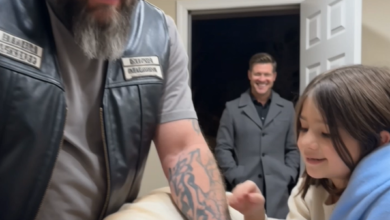
My first ordinary visit happened at Hannah’s kitchen table.
Noah watched me peel an orange.
He asked whether all three brothers looked alike.
“Enough to confuse people.”
“Even grown-ups?”
“Sometimes.”
He thought about that.
Then he asked whether I could tell myself apart.
I laughed.
So did he.
It was the first time either of us had done that in the same room.
Later, Rachel brought out the boat.
We told him who carved it.
Who painted it.
Who had kept it.
Noah ran one finger over the notches.
“So more than one person made it.”
“Yes.”
He nodded as if that answer was difficult but possible.
I began visiting on Sundays.
I didn’t arrive with presents.
I brought groceries when Hannah asked and fixed a hinge that squeaked badly enough to deserve attention.
Rachel found work with a different repair business while the old one was sorted out.
She kept her own accounts.
Her own keys.
Her own copies.
My mother wrote asking to see Noah.
Rachel put the letter away until she was ready to discuss it with the people helping him.
She didn’t ask me to deliver an answer.
That was progress too.
One warm afternoon, Noah and I took the blue boat to a shallow water table in Hannah’s yard.
Its paint had worn thin.
The brass screw was still too long.
He held it above the water.
I kept my hands back.
He looked at the little marks beneath the stern, then at me.
“Does it still float?”