A Biker’s Rescue Dog Saved a Little Girl From a Frozen Lake—Then She Whispered a Name That Led Back to the Mother Her Father Said Was Dead
For a moment, the only sound was the warming unit pushing air beneath Milo’s blanket.
I looked at Lucy’s father.
He looked at his daughter.
Then he gave a small, wounded laugh, the kind that invited everyone nearby to feel embarrassed for him.
“She’s been through something frightening,” he said. “Sometimes she thinks she hears Leah in recordings.”
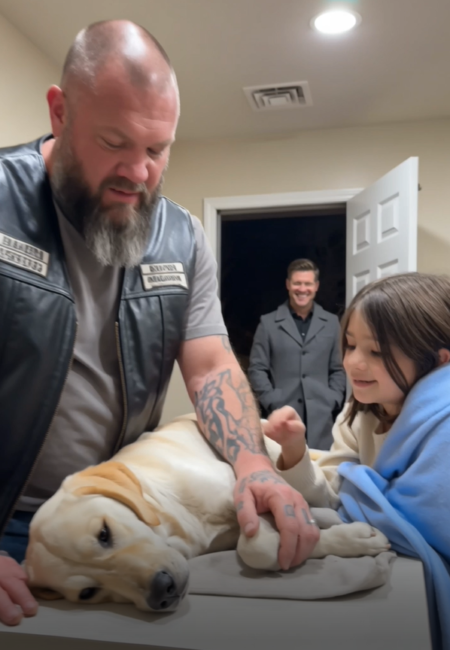
Lucy loosened her grip on my wrist. That bothered me more than if she had held tighter.
She was already preparing to take it back.
Dr. Patel stepped between the treatment table and the doorway. She didn’t accuse anyone. She said her patient needed quiet and asked Daniel Carter to wait in the consultation room.
He thanked her.
He even apologized.
Before leaving, he rested a hand on Lucy’s shoulder. She stared at the floor until it lifted.
Her aunt Caroline stayed beside her.
“I heard her too,” Caroline said.
Daniel stopped.
“On an old video,” she added quickly.
I felt foolish then. I had known these people for twelve minutes. Their child had nearly drowned. Their family had lost a woman. Perhaps I was turning grief into something uglier because the girl had spoken my dog’s secret name.
My own record didn’t help my confidence.
Seventeen years earlier, after my brother died, I had settled an argument outside a bar with my fists. I had served my sentence. I still worked twice as hard to keep people from deciding that one night explained every other day of my life.
Daniel Carter sold insurance. His name appeared on winter-coat drives.
Mine appeared on an old court docket.
Dr. Patel asked Caroline to take Lucy into the staff room for crackers. The girl had eaten almost nothing since breakfast.
Once they were gone, the veterinarian lowered her voice.
“You don’t need to investigate a family,” she told me. “You do need to tell someone what you heard.”
She offered to call the deputy who had helped at the lake.
I agreed.
Milo lifted his head when I touched his neck. Beneath the blue checked fabric, two crooked red stitches held a little sleeve against the lining.
I had noticed them the night I adopted him. I had assumed someone repaired what they couldn’t afford to replace.
Now one stitch had pulled loose.
The sleeve was empty.
Deputy Elena Ruiz arrived carrying a paper cup of coffee she never drank. She listened without interrupting, then asked whether Lucy had spoken freely or answered questions.
“Freely.”
“Good. Don’t ask her to repeat it.”
She took my statement and arranged for another deputy to speak with Caroline away from Daniel. Nobody put handcuffs on him. Nobody announced that a crime had occurred.
That restraint made the room feel stranger.
As Ruiz examined the adoption paperwork I carried in my truck, her finger stopped beneath the intake date.
The dog had entered rescue eleven weeks earlier.
Leah Carter had disappeared ten weeks earlier.
Ruiz looked toward the consultation-room door.
“Mr. Ellis,” she said, “who told you the previous owner was dead?”
“No one.”
I said it too quickly.
The shelter had told me Milo’s owner could no longer keep him. The rest had happened in my head after Lucy spoke.
Ruiz wrote that down.
Then she asked me to describe the adoption exactly, including anything I had dismissed as unimportant. I remembered an employee changing the emergency contact section before handing me the form. I remembered being told the surrender information was private.
I had thought that meant shame.
Now I wasn’t sure.
Later, with Caroline present and a child specialist guiding the conversation, Lucy shared a memory. Caroline repeated it to me that evening while Milo slept.
The happy part took less than two minutes.
Before everything changed, Leah made pancakes on Saturdays while Lucy sat beneath the kitchen table with Milo. They called it the breakfast cave. Leah tapped his chest twice before storms, and he leaned into her knees. His collar was blue checked fabric because Lucy said it looked like a picnic.
When the lining tore, Leah repaired it with red thread. She always used two stitches where one would do.
“Things stay better in pairs,” she told Lucy.
On the last Saturday, Leah stitched a narrow sleeve inside the collar. She folded a little paper into it and said she was keeping something safe until tomorrow.
Lucy asked whether tomorrow meant morning.
“After breakfast,” Leah said.
That was the end of the memory.
No shouting. No slammed door.
Just a child who had spent ten weeks waiting for breakfast.
I sat beside Milo’s kennel and studied those stitches through the glass. The clinic had bagged the collar after Ruiz photographed it, leaving him in a plain temporary one.
Without the blue fabric, he looked oddly undressed.
Caroline rubbed the heel of her hand across her mouth.
“Daniel was different when people were watching,” she said.
“Different how?”
She studied me before answering.
“He could make a question sound like a mistake you’d already made.”
I knew people like that. I also knew that knowing the type didn’t establish anything about this particular man.
“Did Leah ever tell you she was afraid?”
“Yes.”
“Did you tell somebody?”
Caroline stood up.
“I need to check on Lucy.”
She left her handbag on the chair. Her phone buzzed inside it, then buzzed again.
I didn’t touch it.
When she came back, she turned it off without looking at the screen.
Outside, a plow scraped the clinic parking lot. My Harley was home beneath a cover; I had brought Milo to the lake in my old pickup for our morning walk. Now the truck’s wet towels were freezing stiff behind the seat.
I went out for my charger.
A white envelope sat beneath the windshield wiper.
Inside was a photograph of me outside that courthouse seventeen years earlier. Someone had printed it from an archived newspaper page.
On the back, four words:
STAY WITH YOUR DOG.
I took it inside without touching anything else.
Ruiz held the envelope by one corner.
Then Caroline saw the photograph and whispered, “He used that same printer for Leah’s letters.”
Which letters had she been keeping from everyone?
The next morning, Ruiz returned with facts that made Daniel look less suspicious.
At the time Leah’s car had been discovered below the river road, he was speaking at a business dinner in Wausau. There were photographs, payment records, and dozens of witnesses.
He had not been driving behind her.
He had not been at the river.
And Leah had never officially been declared dead.
Her car had been recovered empty. The case remained a missing-person investigation. Daniel had told Lucy that her mother died because, according to him, uncertainty was destroying her.
That explanation made my stomach turn.
It still wasn’t proof that he caused her disappearance.
Ruiz said so plainly.
“We’re checking conduct. We’re not choosing the worst story and making everything fit.”
Then she placed a second photograph on the desk.
It showed Caroline at the animal shelter, handing Milo’s leash to an intake worker.
Caroline had brought him there.
Not Leah.
The shelter had supplied its records through the investigator. The surrender had been authorized by Leah, whose signature appeared on the release. Caroline had transported the dog and delivered the paperwork.
When Ruiz asked Caroline about it, she began crying before answering.
My first thought was ugly and immediate.
The aunt had got rid of the dog. The aunt had corrected Lucy about the phone call. The aunt had mentioned letters nobody else had seen.
Perhaps Daniel wasn’t the person controlling this family.
Perhaps he was married to one missing woman and trusting another.
Caroline denied sending the envelope.
She admitted something else.
“Leah asked me to take Lucy the next morning,” she said. “She was going to meet us somewhere.”
“Where?” Ruiz asked.
“I wasn’t supposed to write it down.”
“Did you go?”
“No.”
Her hands folded around each other so tightly that her knuckles whitened.
Daniel had obtained an emergency custody order after Leah disappeared. He presented a signed statement claiming she intended to leave Lucy permanently. Caroline said she had believed that document.
For a day.
Then for a week.
Then it had become difficult to admit she no longer believed it.
“What changed your mind?” I asked.
She looked at the empty sleeve inside the evidence bag.
“The paper.”
Ruiz leaned forward.
Caroline said Leah had called before surrendering Milo. She had asked Caroline to remove a folded bank transaction slip from his collar and give it to a lawyer whose number was written on the back.
Instead, Caroline photographed it and sent the image to Daniel.
He told her the paper was evidence that Leah had stolen from their daughter.
He said a lawyer would put Leah in jail.
“I thought I was stopping something worse,” Caroline whispered.
My phone rang before anybody answered her.
It was the shelter director returning a message.
She had reviewed the intake notes. There was a detail the original employee hadn’t included on my adoption summary.
Leah had asked one question before signing away her dog.
Could the rescue keep her contact information from her husband?
If Daniel was merely a grieving father, why had Leah needed protection from him before she disappeared?
Milo stayed a second night.
Dr. Patel said his temperature had stabilized, but she wanted to watch his breathing and repeat the examination before sending him home. He had swallowed lake water and exhausted himself getting Lucy toward the broken edge.
The firefighters had finished the rescue.
I kept remembering that distinction.
My dog had gone in without understanding the odds. The men and women who arrived with the right equipment had brought him back.
I could at least wait through another night without demanding certainty from a veterinarian.
By afternoon, Ruiz had brought in Detective Marcus Bell, who handled the financial part of the investigation.
He didn’t show me confidential bank statements.
What I learned afterward came from the hearing and from Leah herself.
The slip Caroline photographed recorded a transfer from an account holding money Lucy had inherited from her maternal grandfather. Leah had questioned the withdrawal. Daniel had told her it was a temporary investment.
There were more withdrawals.
The total was just over eighty-four thousand dollars.
The money had gone toward debts connected to his business, through transactions supported by documents bearing Leah’s supposed consent.
She said the signatures weren’t hers.
Daniel said she was covering her own theft.
For a while, it was one accusation against another.
Then the bank supplied the underlying records. A supposed authorization had been uploaded from Daniel’s office after Leah had already left town. The contact number used to confirm it belonged to a spare business phone.
That phone was on his account.
The paper in Milo’s collar hadn’t been a treasure map or a last message.
It was a bank receipt with a lawyer’s number.
Leah had put it somewhere Daniel routinely ignored: on the dog he complained about feeding.
Caroline had handed its photograph straight to him.
Bell also found that the statement used in the emergency custody filing had originated as a document on Daniel’s office computer. That alone didn’t prove forgery; spouses sometimes typed letters for one another.
But the rescue’s telephone record showed Leah asking how to keep her surrender confidential the same afternoon that document supposedly declared her intention to abandon her child.
One record did not erase the other.
Together, they demanded answers.
Then a legal-aid attorney contacted Bell.
A woman using her services had recognized Milo from a local post about the lake rescue. The post showed me carrying him toward my truck.
The woman said she was Leah Carter.
She was alive.
She was willing to meet investigators at her attorney’s office.
I learned that much while standing beside the clinic’s vending machine, holding a package of crackers I couldn’t open.
My first feeling was relief.
The second was anger.
Lucy had been mourning a mother who could still pick up a telephone.
I hated myself for that thought almost as soon as it came, but it stayed.
Bell must have seen something in my face.
“Let us hear her before we decide what she could have done.”
He put his notebook away.
“There’s another problem,” he said. “Somebody told Mr. Carter we found her.”
Who had warned him before investigators were ready?
By dinner, my face was on half the phones in town.
The post began with an old arrest photograph.
Below it, Daniel described an unstable biker who had become obsessed with his daughter after a rescue. He said I was withholding family property and encouraging a traumatized child to reject her father.
He didn’t name Milo.
He called him the animal.
A customer canceled a transmission job at my garage. Another asked whether I had really put my hands on a little girl.
I sent him the deputy’s number.
Then I sat in my office and stared at the telephone.
For the first time in years, I wanted to solve a problem the way everyone already expected me to solve it.
My friend Boone arrived before I did anything stupid.
He brought coffee and a tow invoice.
“You’re not answering that post,” he said.
“I know.”
“You’re saying it like you don’t know.”
He stayed.
That night, Daniel reported the collar as stolen property. By then, the shelter had confirmed that the collar had been transferred with Milo at adoption, and it was already documented as evidence.
The report went nowhere.
The next move did.
A complaint to the clinic accused me of interfering with Lucy’s treatment and threatened to publish staff members’ names. Dr. Patel moved all family discussions away from the treatment area.
For Lucy, the consequence was another closed door.
I couldn’t visit her. I wasn’t family. Bell reminded me that wanting to protect a child did not give me authority over her.
I knew he was right.
It still felt like leaving her.
The court arranged an urgent hearing after the new information reached the attorneys. Until then, a temporary safety agreement placed Lucy with Caroline under conditions that limited Daniel’s contact.
Caroline’s cooperation mattered.
So did the fact that she had finally surrendered her phone.
Its messages showed Daniel asking about the rescue records shortly after Ruiz interviewed her. Caroline had answered before understanding that she was repeating the same mistake.
That was how he knew investigators were looking for Leah.
She hadn’t meant to warn him.
She had simply never learned how to stop reporting to him.
Late that evening, someone disconnected the battery cable on my pickup outside the garage. Nothing dramatic happened. The truck just wouldn’t start.
Boone noticed the loose connection.
I photographed it and called Ruiz.
There was no camera covering that corner, and I couldn’t name the person responsible. That uncertainty was part of the point.
A deputy drove me to collect Milo the following morning.
He came through the clinic door slowly, wearing a plain harness, and pressed his forehead against my knee.
I knelt.
All that size, all those tattoos, and I couldn’t get the leash clip through its ring because my hands were shaking.
Dr. Patel waited until I managed it.
At home, Milo stopped beside his food bowl.
He touched it once with his nose, then looked toward the hallway.
I remembered Lucy’s breakfast cave.
My phone rang.
Leah’s attorney asked whether I would bring Milo to a meeting later that week.
“Her daughter?” I asked.
“Not yet,” she said. “First, Leah needs to tell you what she left out.”
What could a mother still be hiding after everyone learned she was alive?
Leah Carter looked nothing like the photograph from Daniel’s charity page.
Her hair was shorter. Her coat was too light for the parking lot. She stood beside her attorney with both hands tucked beneath her arms, though the office was warm.
Milo recognized her before I did.
His tail struck my leg.
Then he made a sound I had never heard from him, a thin noise that seemed too small for his chest.
Leah crouched.
She didn’t call him.
She tapped her chest twice.
He crossed the room and leaned against her so heavily that she had to put a hand on the floor.
I turned toward the window.
For a minute, nobody asked her anything.
Then she looked up at me.
“You kept his collar.”
“I thought it mattered to him.”
“It did.”
Her attorney asked whether she wanted a break.
Leah shook her head.
She told me she had not staged her car’s slide off the river road. She had been leaving during freezing rain, panicked, and lost control. After climbing back to the road, she accepted a ride and contacted Caroline.
Then she continued to a safe place.
She had believed Caroline would bring Lucy the next morning.
Instead, Daniel obtained the custody order and presented allegations that Leah had emptied their daughter’s account. An earlier attempt to seek help had ended with him learning where she was staying.
This time, she contacted legal aid from another county.
Her attorney had been working to challenge the order while trying to keep her address private. Delays did not make the silence harmless. Leah knew that.
“I thought if I waited until I had everything, I could come back once,” she said. “I wouldn’t have to leave her again.”
Her fingers worked the edge of a tissue.
“Every day, the next day looked safer.”
I thought about Lucy waiting for breakfast.
“Did you know he told her you were dead?”
“Not until last week.”
She bent forward and pressed the tissue against her mouth.
Then came what she had left out.
She had taken eight thousand dollars from a joint business account before leaving. She used part for a rental deposit and kept the rest available for Lucy.
She had initially told her attorney that Caroline supplied the money.
Daniel’s accusation contained a piece of truth.
That piece had frightened her into hiding the rest.
Her attorney had corrected the account once Leah admitted it. Now Daniel would use the inconsistency against everything she said.
“Why lie to the person helping you?” I asked.
“Because I wanted one room where I wasn’t the woman who took money.”
There was no good answer I could give her.
Milo rested his chin on her shoe.
She looked down at him.
“And I gave him away,” she said. “I told Lucy we never give family away.”
The shelter had been the only place she could arrange quickly that would take him without disclosing her destination. She had signed a permanent surrender because temporary boarding required money and a return date she couldn’t promise.
She had saved him.
She had also lost him.
Both things sat in that room.
Before we left, her attorney showed her the witness list for the hearing.
Caroline’s name was on it.
Leah went completely still.
“What did she tell Daniel about the paper?”
How much of the betrayal would she be able to hear from her own sister?
The hearing took place on a Thursday morning.
No cameras. No cheering crowd.
Just hard benches, winter coats, attorneys arranging papers, and a clerk asking people to silence their phones.
Lucy waited elsewhere with a child advocate. Milo stayed with Boone outside; a courthouse was no place to test a recovering dog’s patience.
I sat behind Leah.
Daniel wore a charcoal suit and the expression of a man inconvenienced by people who didn’t understand how much he had already suffered.
His attorney described a frightened father responding to a missing wife, missing money, and an intrusive stranger.
That stranger was me.
When I testified, the attorney brought up my conviction.
I answered.
He asked whether I had assumed Daniel was dangerous because a child said something confusing.
“I reported what she said.”
“After discussing it with other people.”
“With the veterinarian.”
“Who also had no knowledge of this marriage.”
“Correct.”
He seemed disappointed that I wouldn’t argue.
Then the shelter director explained the surrender and adoption records. Dr. Patel described when the collar had been removed and secured. Bell walked through the bank records without raising his voice.
The numbers did more damage than any speech could have.
Daniel said Leah had authorized the transfers.
Leah denied it.
Caroline testified next.
She admitted forwarding the receipt photograph. She admitted believing Daniel when he said a lawyer would have Leah arrested. Then she admitted helping deliver a statement she had never seen Leah sign.
Daniel watched her without blinking.
When Leah described the collar sleeve, her voice thinned.
“I put a folded paper inside it. Two red stitches.”
Her attorney displayed the photograph Ruiz had taken at the clinic.
Daniel leaned toward his own attorney.
“It was a bank slip,” he said.
The room was quiet enough to hear him.
The judge looked up.
Daniel sat back.
His attorney put a hand on his sleeve, but he kept talking.
“She makes it sound like some goodbye letter. It was a bank slip.”
The judge asked him to wait until he was recalled.
When he returned to the witness chair, Leah’s attorney opened his earlier sworn statement.
He had denied knowing about the dog’s surrender until after the lake rescue. He had also denied seeing anything removed from the collar.
Now he said Caroline had told him.
Caroline’s message record was already in evidence.
The photograph appeared there, followed by Daniel’s reply:
Take the paper out. Cut the red stitches if you have to. Don’t give it to anybody.
The next message instructed Caroline to tell the shelter that Leah would not be returning.
His knowledge was no longer a stray remark.
It fitted his own words.
Then he made it worse.
“I was trying to keep this family together.”
The judge glanced at the abandonment statement.
“By presenting a document saying the child’s mother did not want her?”
Daniel reached for his water.
For the first time that morning, he missed the cup.
The judge didn’t announce a criminal verdict. She changed the temporary parenting arrangements, ordered supervised contact for Daniel, and set further proceedings. The financial evidence and disputed documents remained with investigators.
Outside, Leah sat on a bench.
She didn’t ask whether she had won.
She asked whether Lucy knew she was coming.
The child advocate opened the waiting-room door.
Lucy appeared behind her, holding one mitten in each hand.
She looked at her mother.
Then she asked, “Is this only for today?”
What could Leah promise without giving her daughter another tomorrow that might disappear?
“For today,” Leah said. “And I’m coming back tomorrow.”
Lucy didn’t move.
Leah stayed where she was.
“My lawyer and your advocate know the plan,” she added. “You don’t have to remember it for everybody.”
That brought Lucy across the room.
Not running.
She walked with her mouth held tight, climbed onto the bench, and put her face against her mother’s coat.
Leah wrapped one arm around her.
With the other hand, she held the mitten Lucy had dropped.
I went outside.
Boone stood beside my pickup with Milo, letting him examine a strip of dirty snow. When the courthouse door opened behind me, Milo lifted his head.
Lucy came out holding Leah’s hand.
She saw him and stopped.
“Does he go away again?”
Nobody answered quickly.
I was grateful for that.
Eight weeks of early walks, muddy towels, and sleeping with one ear tuned to his breathing had made him my dog. Eleven weeks of missing him had not made him any less theirs.
We arranged the first visits around his recovery and Lucy’s schedule.
No grand decision in a parking lot.
Leah needed housing she could keep. Lucy needed predictable mornings. Milo needed short walks, rest, and the follow-up Dr. Patel had written on his discharge sheet.
By spring, Leah and Lucy rented half a duplex a few streets from my garage.
Milo spent school hours with me and most nights with them.
The paperwork took longer than the arrangement. When we finally updated it, Leah insisted that my name stay on the emergency contact line.
“First line,” she said.
I didn’t argue.
Caroline helped them move one Saturday.
Leah let her carry boxes.
She did not give her a key.
That came much later.
The money investigation moved slowly too. Daniel’s public generosity did not erase the bank records. Nor did those records make every allegation automatically proven. Months later, he admitted to financial offenses and using a false document in the custody case under an agreement entered in court.
The parenting orders continued.
Lucy’s counselor helped her understand that missing her father did not mean she had to deny what happened.
She still had good memories of him.
Nobody took those away.
I sold the canceled transmission job’s parts to another customer. Some people apologized for believing the post. Some simply began coming back to the garage.
Boone said I ought to charge the latter group extra.
I didn’t.
One rainy Saturday, Leah invited us for breakfast.
Lucy had built a cave beneath the kitchen table with two chairs and an old quilt. Milo lay inside it, his paws stretched toward a plate nobody intended to feed him from.
The blue checked collar hung on a hook near the door.
After investigators released it, Leah repaired the loose lining with two red stitches. She left the little sleeve empty.
Lucy noticed me looking.
“Nothing hidden now,” she said.
Then she took the collar down.
She knelt beside Milo, threaded the buckle carefully, and rested her palm over the repaired place.
Rain tapped the window.
He pressed against her hand.
Lucy looked up at me.
“Will you come next Saturday?”
I set my helmet beneath the empty chair.
“I’ll bring breakfast.”