Part 2: The Long-Haul Trucker Dad Was Mistaken for a Stranger at School Pickup — Then the Principal Shook His Hand in Front of Everyone
Daniel Price had missed enough school events to become a rumor.
At Willow Creek Elementary, parents knew each other by parking spots, bake-sale assignments, and who volunteered for field day. They knew whose mother made gluten-free cupcakes, whose father coached soccer, and whose grandparents came every Friday with juice boxes.
Grace Price’s father was known mostly by absence.
His name appeared on emergency forms, but not in chairs. His signature turned up on permission slips, sometimes crooked and late, but his face did not show up at concerts, conferences, or class breakfasts.
When Grace drew family pictures, she always included him.
A tall man in a blue truck.
A red road.
A little girl waving from a porch.
Some children asked why her dad was always driving away.
Grace answered the same way every time.
“He brings things people need.”
It sounded rehearsed.
Mrs. Palmer, her teacher, first noticed the oddness in October. The class had been asked to bring something that reminded them of home. Grace brought a tiny keychain shaped like a silver semi-truck.
She held it carefully, as if it were made of glass.
“My dad gave this to me at a gas station in Kentucky,” she said.
A boy laughed. “You live at a gas station?”
Grace’s cheeks flushed.
“No. He met us there because his route was close.”
“Why didn’t he just come home?”
Grace looked down at the keychain.
“Because close is not the same as allowed.”
Mrs. Palmer wrote that sentence down later.
She did not know why.
In November, Daniel missed the father-daughter reading breakfast. Grace sat alone at a table with two muffins, one untouched. Mrs. Palmer offered to sit with her, but Grace shook her head.
“He might still come.”
The breakfast ended at 8:30.
At 8:47, the office phone rang.
The secretary came to Mrs. Palmer’s room with an apologetic look.
“It’s Grace’s dad,” she whispered. “He wants to know if she is still at breakfast.”
Mrs. Palmer took the phone.
The line crackled with highway noise.
“Ma’am,” Daniel said, breathless, “I’m outside Amarillo. There was a rollover on I-40. I tried to make it by video. Did she read yet?”
Mrs. Palmer looked at Grace through the classroom window. The little girl was folding the napkin around the second muffin.
“She waited for you,” Mrs. Palmer said before she could soften it.
There was silence.
Then Daniel said, “Can you tell her I’m sorry?”
Mrs. Palmer had heard many absent parents apologize.
Most sounded inconvenienced.
Daniel sounded like a man swallowing glass.
“I’ll tell her,” she said.
“And could you ask if she saved the blueberry one?”
Mrs. Palmer paused.
“She did.”
A small exhale came through the phone.
“That’s my girl.”
That was the first crack in the school’s simple version of him.
The second came in December, when Willow Creek held a coat drive after a cold snap. The donation table filled with bright jackets and labeled bags. One morning, the custodian found six cardboard boxes outside the side entrance before sunrise.
Inside were winter coats, gloves, socks, and small boots.
No note.
Only a freight receipt tucked under the flap.
Mrs. Palmer noticed the company name printed at the top: Price Freight Logistics.
She brought it to Principal Hayes.
“Grace’s father drives for them, doesn’t he?”
Principal Hayes looked at the receipt for a long time.
“He owns one truck,” she said softly. “Not a logistics company.”
The boxes had cost more than Daniel seemed able to spare.
Nobody announced it.
That seemed to be the point.
In January, Grace began carrying a folded map in her backpack. During indoor recess, she spread it across her desk and traced highways with a purple crayon.
“Where is he today?” Mrs. Palmer asked.
Grace pointed to a line crossing Missouri.
“Here, if the snow isn’t bad.”
“You track him?”
Grace nodded. “He sends Mom a dot when he stops.”
Mrs. Palmer looked at the worn edges of the map.
Grace had drawn tiny hearts near certain cities.
“What are these?”
“Places he called me from.”
“And the stars?”
Grace hesitated.
“Places he missed something.”
There were too many stars.
Mrs. Palmer felt the shame of every easy assumption she had made.
Still, Daniel remained a question mark to most of the school. He was a voice on late calls, a name on forms, a shadow in Grace’s drawings. Her mother, Lila, came when she could, but she worked at a dental office and cared for Daniel’s father after his stroke.
No family looked as simple from the inside as it appeared from the pickup line.
Then came the spring carnival.
Grace had been chosen to sing with the second-grade choir. She kept the paper schedule taped above her bed for three weeks.
Daniel promised he would be there.
Not maybe.
Not if dispatch allowed.
He said, “I will be standing in the back, peanut. You find my cap.”
On the morning of the carnival, storms shut down three counties. Daniel’s route changed. A bridge closure added four hours. His phone died somewhere outside Tulsa.
Grace sang anyway.
She looked at the back of the gym through the whole song.
No cap.
Afterward, she folded the program into a small square and put it in her pocket.
At 10:12 that night, Daniel parked his rig outside their apartment complex and sat with the engine off. Lila watched from the window as he lowered his head onto the steering wheel.
He did not come inside for nine minutes.
The next morning, Grace told Mrs. Palmer, “Daddy brought me a moon pie from Oklahoma.”
“Was it good?”
Grace nodded.
Then, quietly, she added, “He cried in the kitchen.”
That was the third crack.
By April, school pickup had become more tense than usual. A custody alert had been issued for another family, so staff checked IDs more carefully. Parents complained about delays. Teachers grew cautious.
On that Friday afternoon, Daniel arrived early for once.
He had driven all night from Nebraska, sleeping only ninety minutes in a rest stop parking lot. He had not shaved. He had changed shirts in the truck cab. His boots were still powdered with road salt.
He stood by the fence because he did not want to crowd the door.
He held a yellow envelope against his chest.
Inside was something he had carried across six states.
When Grace came out and saw him, the world narrowed to one word.
Daddy.
And because the school had seen so little of him, everyone mistook reunion for danger.
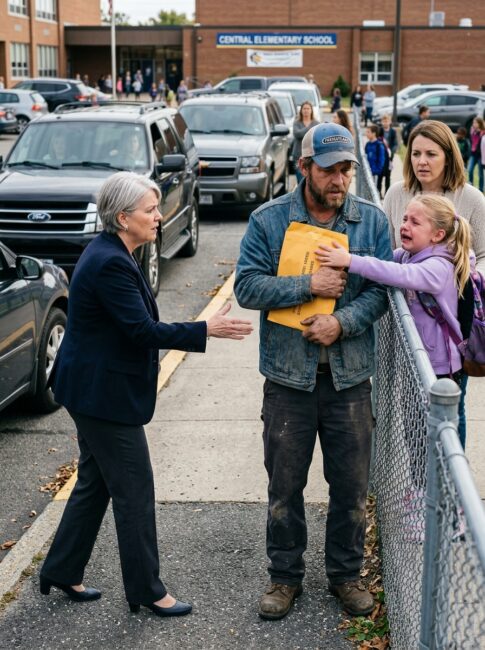
The teacher who stepped between Daniel and Grace was not cruel.
That mattered later.
Ms. Alvarez was young, cautious, and responsible. She had been trained to watch for unfamiliar adults. She had seen a tired man reach for a child who cried hard enough to frighten everyone.
So she did what she had been taught to do.
“Sir, please step back.”
Daniel obeyed immediately.
Grace did not.
“He’s my dad,” she sobbed, trying to squeeze around Ms. Alvarez. “That’s my dad.”
“We just need to confirm,” Ms. Alvarez said gently, though her eyes stayed on Daniel.
Parents gathered without meaning to gather. That was how pickup lines worked. Concern dressed itself as curiosity, and curiosity leaned closer.
Daniel stood with his hands open, palms visible.
“My name is Daniel Price,” he said. “I’m on her pickup list. Her mother knows I’m here.”
A man beside a black SUV muttered, “Then why hasn’t anybody seen him before?”
Daniel heard it.
Grace heard it too.
Her face crumpled.
Daniel looked at her and gave a small shake of his head, the kind parents give when asking a child not to carry something heavy.
“It’s okay, peanut,” he said. “Let them check.”
The assistant principal, Mr. Nolan, called the office. The secretary asked Daniel for identification. He reached slowly for his wallet and handed over his license, then a worn school photo of Grace he had kept behind it.
The photo was from first grade.
Her front teeth were missing.
On the back, in childish letters, she had written: Come home soon.
Ms. Alvarez saw it.
Her expression changed.
Only slightly.
But Daniel noticed.
He was used to reading small signs. Truckers learned to read weather in clouds, anger in headlights, exhaustion in their own hands on the wheel.
Mr. Nolan checked the pickup list.
Daniel Price was approved.
Still, the crowd did not loosen.
Sometimes paperwork can confirm a fact without healing the way people judged it.
Then Principal Marlene Hayes came through the front doors.
She was in her late fifties, with silver hair cut neatly at her chin and the steady walk of someone who did not waste motion. In one hand, she held the yellow envelope Daniel had brought. In the other, she held a folder.
“Mr. Price,” she said.
Daniel straightened.
“Ma’am.”
She looked at Grace first. “Sweetheart, you may hug your father.”
Grace ran so hard she almost knocked Daniel backward.
He caught her and closed his eyes.
For a second, all the watching parents saw was the embrace they should have recognized from the beginning.
A child not afraid of a stranger.
A child relieved beyond words.
Daniel held her carefully, one hand on her backpack, the other on the back of her head.
“I made it,” he whispered.
Grace cried into his jacket. “You smell like truck.”
He laughed, but it broke in the middle.
“I know. I’m sorry.”
“Don’t be sorry.”
Principal Hayes waited.
She understood that some moments should not be interrupted, even by truth.
When Daniel finally set Grace down, he wiped her cheeks with his thumb.
Then Principal Hayes stepped forward and extended her hand.
The handshake was not casual.
It was public.
Deliberate.
A statement made in front of every parent who had doubted him.
“Mr. Price,” she said, loud enough for the pickup line to hear, “on behalf of Willow Creek Elementary, thank you.”
Daniel looked embarrassed at once.
“Principal Hayes, you don’t have to do that.”
“Yes,” she said. “I do.”
The crowd quieted.
Principal Hayes opened the folder.
“Some of you know we had a serious problem last month when our fifth-grade overnight science trip nearly had to be canceled.”
A few parents nodded. Everyone had heard about it. The charter bus company had pulled out three days before the trip because of a scheduling failure. The school could not afford a replacement at the last-minute rate.
Parents had complained.
Teachers had scrambled.
Students had cried.
Then, somehow, the trip happened.
What most people did not know was how.
Principal Hayes looked at Daniel.
“Mr. Price drove his empty rig back from Ohio, made calls from truck stops, and convinced three drivers he knew to help transport equipment and supplies legally and safely. He also paid the difference for a replacement bus deposit before our fundraiser cleared.”
Daniel stared at the pavement.
A mother near the curb whispered, “That was him?”
Principal Hayes continued.
“When the cafeteria freezer failed in February, and we nearly lost two weeks of breakfast items, Mr. Price arranged a refrigerated trailer before sunrise.”
Mrs. Palmer, standing behind Grace, covered her mouth.
“When the coat drive donations came in anonymously,” Principal Hayes said, looking at the crowd now, “six boxes were shipped by Mr. Price after he heard Grace ask why some kids kept their hands in their sleeves at recess.”
Daniel shifted uncomfortably.
“Ma’am,” he said quietly, “I didn’t do it for this.”
“I know,” Principal Hayes replied. “That is why this matters.”
The silence changed shape.
It was no longer suspicion.
It was recognition arriving late.
Grace looked up at her father.
“You sent the coats?”
Daniel scratched his beard, suddenly helpless. “You weren’t supposed to know.”
“Why?”
“Because giving works better when nobody has to say thank you.”
Principal Hayes held up the yellow envelope.
“And today, Mr. Price brought something else.”
Daniel’s face tightened.
“Please,” he said.
She lowered her voice just enough for him. “Are you sure you don’t want people to know?”
He glanced at Grace.
His daughter was gripping his sleeve with both hands.
Then he looked at the parents, at the teachers, at the people who had mistaken him for danger because they had only seen the dirt on his boots.
“I don’t want Grace embarrassed,” he said.
Grace frowned. “Why would I be embarrassed?”
Daniel did not answer.
So Principal Hayes did.
“This envelope contains a check for the school lunch account,” she said.
A few parents exchanged glances.
Daniel’s jaw worked once.
Principal Hayes kept her voice steady.
“It covers the unpaid balances for every child in the school through the end of the year.”
The pickup line went completely still.
Daniel looked at the ground.
Grace stared up at him.
“Daddy?”
He swallowed.
“I heard you ask your mom why a boy in your class got a different tray.”
Grace’s eyes filled again.
“He said he wasn’t hungry.”
“I know.”
“He was lying.”
“I know.”
Daniel knelt in front of her.
His knees cracked from years of climbing in and out of cabs, loading docks, and rest stops where sleep never came deep enough.
“I missed your song,” he said. “I missed the reading breakfast. I missed too much, peanut. But sometimes, when I can’t stand in the room with you, I try to do something that reaches the room anyway.”
Grace threw her arms around his neck.
This time, no one stepped between them.
Mr. Nolan looked away, blinking hard.
Ms. Alvarez whispered, “I’m sorry, Mr. Price.”
Daniel shook his head.
“You were protecting kids,” he said. “Don’t apologize for that.”
Then he looked past her toward the man by the SUV, the one who had asked why nobody had seen him.
Daniel did not shame him.
He simply stood, took Grace’s hand, and said, “Some jobs make fathers look absent from the parking lot.”
That sentence stayed longer than the applause that finally came.
Because applause did come.
Awkward at first.
Then fuller.
But Daniel seemed almost pained by it. He looked like a man who knew praise could not give back missed mornings, lost songs, or a daughter waiting with a muffin no one ate.
Principal Hayes understood.
She put one hand lightly on his shoulder.
“You made it today,” she said.
Daniel looked down at Grace.
She pressed his big hand against her cheek.
“Yeah,” he whispered. “Today I did.”
After that Friday, people at Willow Creek treated Daniel differently.
Not perfectly.
People rarely change as cleanly as they imagine they will.
Some parents overcorrected. They spoke to him too warmly, asked too many questions, and used voices that sounded polished by guilt. A few wanted details about his routes, his income, his marriage, and why he chose a job that kept him away.
Daniel answered what he wanted and let the rest pass by.
He had spent too many years crossing state lines to believe every passing vehicle needed a response.
Grace changed too.
Not all at once.
For weeks, she walked taller in the hallway. She brought her silver truck keychain for show-and-tell again and told the class her dad carried groceries, medicine, furniture, school supplies, and sometimes “things people don’t know they need yet.”
When a boy asked if her dad was famous, Grace smiled.
“No. He’s tired.”
Mrs. Palmer wrote that down too.
In May, the second-grade class hosted a simple family picnic. No stage. No speeches. Just blankets on the grass and sandwiches in paper bags.
Daniel arrived halfway through.
He came in his rig.
The blue truck pulled slowly along the back service road, careful and enormous beside the playground fence. Children ran toward it, shouting as if a parade had arrived.
Daniel stepped down from the cab wearing a clean shirt, though his boots were still dusty. He carried a small cooler in one hand and Grace’s forgotten sunhat in the other.
Grace saw him and ran.
This time, no one stopped her.
He lifted her with one arm, and she laughed against his shoulder.
“You’re late,” she said.
“I know.”
“But you came.”
“I did.”
Principal Hayes watched from beneath the oak tree.
She did not approach right away. She let the moment belong to them.
Later, Daniel sat on a picnic blanket with Grace and Lila. His father, who now used a cane after his stroke, sat in a folding chair nearby, eating potato salad slowly.
For once, Daniel was not on a phone call. Not checking weather. Not watching a clock with dread.
He was just there.
A little boy from Grace’s class walked over with a juice box.
“Mr. Price,” he said, “my mom said you paid for lunches.”
His mother turned red from three blankets away.
Daniel looked at the boy, then at Grace.
“I helped the school fix a problem,” he said.
The boy nodded seriously. “Thanks. The hot lunch is better than the other one.”
Daniel smiled.
“That’s good to know.”
The boy ran off.
Grace leaned against her father’s side.
“Daddy?”
“Yeah?”
“When you drive away, do you think about school?”
Daniel looked across the playground, where children chased bubbles through the afternoon light.
“All the time.”
“What part?”
He considered lying in the gentle way parents lie when the truth is too heavy.
Then he chose the smaller truth.
“The pickup line,” he said. “I think about you looking for me.”
Grace picked at the edge of the blanket.
“I do look.”
“I know.”
“But now I know you might be helping somewhere else.”
Daniel’s throat tightened.
He put his arm around her.
In June, on the last day of school, Grace found a postcard in her cubby. It showed a sunrise over a highway in Wyoming. On the back, Daniel had written in blocky letters:
I’m far today, but I’m still your dad from here. Look for me Friday. Love, Daddy.
Grace read it three times.
Then she tucked it inside her backpack beside the silver truck keychain.
At pickup that afternoon, Principal Hayes stood near the curb greeting families. When Daniel’s rig appeared at the far end of the street, Grace spotted it before anyone else.
She jumped once, then tried to act calm.
The truck stopped.
Daniel climbed down, tired and smiling, with road dust on his sleeves and love written all over his face in ways no pickup list could measure.
Grace walked to him slowly this time, as if she wanted the whole school to see.
When she reached him, she took his hand and turned toward the crowd.
“This is my dad,” she said.
Daniel looked embarrassed.
Principal Hayes smiled.
And for once, nobody needed an explanation.
They only watched as a little girl placed her small hand inside a rough one, and the man who had once looked like a stranger walked her home.
If this story stayed with you, follow the page for more heartfelt stories about the quiet people we almost misunderstand.