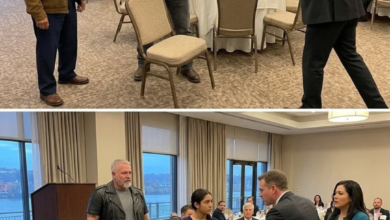
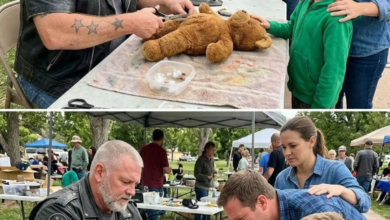
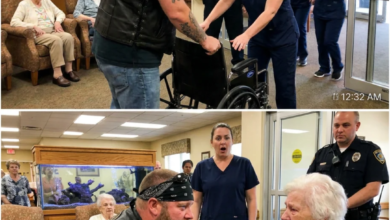
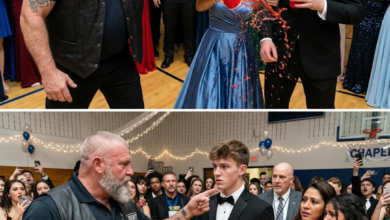
A Biker Screamed At Eight Kids Skating On A Frozen Pond And A Furious Dad Grabbed His Collar—Then He Picked Up A Rock And Threw It, And Every Parent Went Silent.
Part 2
The black hole in the ice was still bubbling.
Ryan couldn’t take his eyes off it. A slow ring of dark water spread outward from the break, soaking into the white. Twenty feet beyond it, Noah’s puck sat right where it had stopped.
“I was going to get the puck,” Noah said in a very small voice. “It was right there.”
Ryan pulled his son against him so hard Noah’s hat came off.
The biker stood at the edge of the bank with his gloved hands hanging at his sides. Up close, Ryan could smell cold leather and engine grease and the faint sweetness of motor oil. The man’s breath fogged in the air between them.
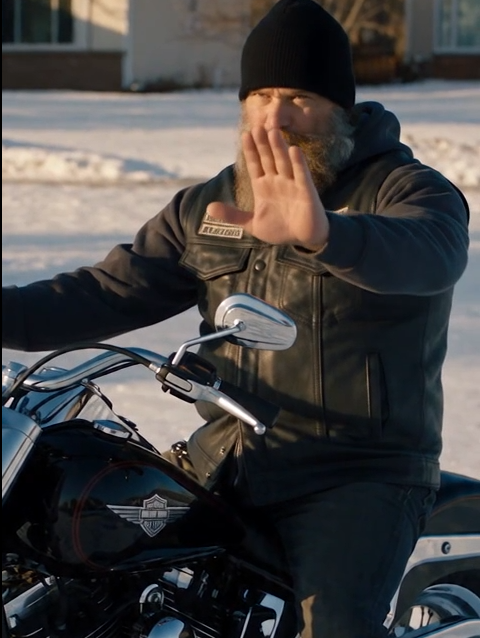
“How,” Ryan said. His voice didn’t sound like his own. “How did you know?”
The biker nodded at the big concrete pipe jutting from the bank behind him.
“Storm drain. Comes up under the middle.” He spoke slowly, like every word cost money. “All the water off your streets runs through there. It’s moving water, a little warmer than the pond. Keeps the ice thin right over the outlet, two inches, maybe less. Shore ice can be a foot thick. From the top, it looks the same.”
“The guy who drilled it this morning—”
“Drilled by the dock. Over there, sure. Thick as a table.” He looked at the middle of the pond. “Not out there.”
Ryan felt sick.
The Mercers had moved to Brookfield from Phoenix in August. Ryan was a civil engineer. He’d taken a job with the county roads department because Megan wanted the kids to grow up with seasons. They’d bought the third house sold in Larkin Pond Estates, a new subdivision of forty-two homes built around the pond. The brochure had a photo of kids skating on it in the sunset. Your own private winter wonderland.
None of the parents on that bank were from Minnesota. They were from Texas, Georgia, and California. Ryan realized with a cold jolt that not one of them had ever looked at a frozen pond and wondered where it was weakest.
Craig Whitmore stepped forward, phone still in hand, his voice smooth again.
“Okay, everybody, let’s take a breath. Every pond has a soft spot or two. That’s nature. Nobody was in danger. This man could’ve walked over and said something politely instead of terrorizing a bunch of children.”
A few parents nodded uncertainly.
The biker didn’t look at Craig. He looked at Ryan.
“There used to be a sign,” he said.
Craig gave a thin smile. “Must have blown down in one of the storms.”
The biker walked twenty yards along the bank, toward the drain pipe, and stopped beside a low snowbank. He kicked the snow aside with his boot.
Underneath was a thick wooden post, or what was left of one. It had been cut off clean, two inches above the frozen ground. The stump was perfectly flat and smooth, with the circular grooves of a saw blade still visible in the wood.
He looked up at Craig Whitmore for the first time.
“Wind doesn’t use a saw,” he said.
Part 3
The sheriff’s deputy arrived fifteen minutes later. She was a broad-shouldered woman in her forties named Dana Lindgren, and she climbed out of her cruiser with a sigh before she was halfway down the bank.
“Dutch,” she said. “You’re out here again?”
The biker nodded. “Dana.”
Craig Whitmore hurried over. “Deputy, thank you for coming. This individual ran onto the ice screaming at small children, threw rocks onto the pond, and has been loitering around this neighborhood every evening for a week. Parents are frightened.”
Deputy Lindgren looked at the hole in the center of the ice. She looked at the sawed-off post. She looked at the drain pipe. Then she looked at Craig for a long, flat moment.
“Mr. Whitmore, how long have you lived in Brookfield?”
“I relocated here with the development company last spring.”
“Uh-huh.” She turned back toward the pond. “I grew up four miles from here. My mother wouldn’t let us within a hundred yards of this pond in winter. Everybody’s mother was like that.” She paused. “This pond took a kid once.”
The bank went quiet. Ryan felt Noah’s hand tighten in his.
“How do you know?” Ryan asked the biker. “For sure, I mean. How are you so sure about that spot?”
The biker, Dutch, was quiet for so long Ryan thought he wasn’t going to answer. A pickup truck rolled by up on the road. Somewhere a dog barked.
Then he pulled off one glove and looked down at his hand.
“Thirty years ago this month, my little brother was skating out here. Petey. He was nine.” He swallowed. “Puck got away from him. Slid out toward the middle. He went after it.”
Nobody moved.
“I was twelve. I was standing right where you’re standing.” He nodded at Ryan’s boots. “I yelled at him to come back. He laughed. Said he’d be quick. Then the ice just opened. No crack, no warning. One second he was there, and the next second he wasn’t.”
A mother behind Ryan made a sound and put a hand over her mouth.
“I couldn’t get to him. Ice wouldn’t hold me. I ran for the Haugen farmhouse to call for help. By the time the firemen got here, it was twenty-two minutes.” Dutch’s jaw worked. “The first thing they brought up was his mitten. Blue.”
He pulled his glove back on.
“After that, my dad cut a post and built a sign. Put it right there. Stayed there twenty-nine years. And every winter since, I come out here when it freezes. Sit up in the lot after work and watch. Make sure nobody goes out where Petey went.”
Ryan looked down at his son.
Noah was nine.
Deputy Lindgren cleared her throat. “There’s no report to write here, Mr. Whitmore. The man didn’t touch anybody. If anything, I’d say he did your homeowners’ association a favor.”
Craig’s face had gone stiff and pink in the cold. “That’s a very moving story. It doesn’t change the fact that this man frightened forty families today. And it doesn’t change the fact that the development company’s engineers certified this pond as perfectly safe for recreational use.”
He turned and walked back up toward the model homes, already typing on his phone.
That night, at 9:47 p.m., every household in Larkin Pond Estates received the same email.
Part 4
Dear Residents,
This afternoon, an unstable individual with no connection to our community ran onto Larkin Pond screaming at children and hurling large rocks onto the ice where they were skating. Several children were traumatized. The individual has been observed loitering near our homes on multiple evenings.
Please be assured that Larkin Pond was professionally evaluated by our developer’s engineering team and is safe for recreational use. The single soft area near the drainage outlet will be addressed in spring.
Our Winter Carnival on the Ice will proceed as planned this Saturday, with skating, hot chocolate, and model home tours. We look forward to seeing your families there!
If you see this individual near our community, please call the sheriff’s department immediately.
— Craig Whitmore, HOA President
Attached was a photo of Dutch, clearly taken from a car window: a huge bearded man in leather sitting on a motorcycle in the dark at the edge of the parking lot.
By the next morning, the neighborhood Facebook group had two hundred comments. Somebody posted a list of reasons why bikers shouldn’t be allowed to park in the community lot. Somebody else suggested the man had thrown the rock at the kids. Three families said they’d seen him watching the playground.
Megan read it at the kitchen table with her coffee going cold.
“Ryan, maybe we don’t know the whole story,” she said carefully. “He showed up out of nowhere. He’s sitting in a parking lot at night watching kids. The developer had engineers. They’re not just going to let people skate on a dangerous pond.”
“I saw the ice break, Meg.”
“Near the drain. Craig said that’s the one spot.”
“Noah was skating toward the one spot.”
Megan didn’t have an answer for that. But she didn’t look convinced either.
That afternoon Ryan got Dutch’s address from Deputy Lindgren and drove out to a cinder-block garage on County Road 12, a few miles outside town. A county snowplow was parked in the yard with its blade raised, next to an old black motorcycle under a tarp.
Dutch Van Horn was a county equipment mechanic. He’d been one for nineteen years, ever since the Army. He opened the door wiping his hands on a rag and didn’t seem surprised.
Inside, the garage smelled of diesel and hot metal. On the workbench, under a coffee can of bolts, was a manila folder.
Dutch slid it across.
It held three printed emails to the Brookfield Parks and Recreation Department. The first was from October: The thin-ice warning sign at Larkin Pond is missing. The post has been cut. Please replace before freeze-up. The second was from November and the third from December, each one shorter and blunter than the last.
There were no replies.
“Called too,” Dutch said. “Four times. They said they’d look into it.”
Ryan read the October email again. “You reported this before the pond even froze.”
“Sign went missing in early November. Before that it stood twenty-nine years.” Dutch set the rag down. “My dad carved that sign himself, the winter after Petey. Red letters. Took him a week. He didn’t talk to anybody the whole time.”
Ryan looked at the folder, then at the photo from the HOA email on his phone.
“Who’d want a sign like that gone?” he asked.
Dutch looked out the garage window toward town, where the roofs of Larkin Pond Estates caught the low sun.
“Somebody,” he said, “who’s trying to sell houses.”
Part 5
Ryan was halfway home when his phone rang from a number he didn’t know.
“Mr. Mercer? This is Edna Haugen. I live in the old white farmhouse on the east side of the pond. The one with the red barn.” The voice was elderly, sharp, and very Minnesotan. “Deputy Lindgren gave me your number. I’d like you to come by. And bring that Van Horn boy with you.”
The Haugen farmhouse had been on the east shore of Larkin Pond for a hundred and ten years, long before anyone dreamed of subdivisions. Edna was eighty-one, tiny, with a white braid and a cardigan buttoned to her chin. She sat them at her kitchen table with coffee and a plate of lefse before she’d say a word.
Then she looked at Dutch.
“You’ve gotten big, Joseph.”
Dutch’s mouth twitched. “Yes, ma’am.”
“You were a skinny little thing the day you came pounding on my door.” She turned to Ryan. “He was twelve. He couldn’t even talk. He just pointed at the pond. I’m the one who called the fire department.”
Ryan looked at Dutch. Dutch looked at his coffee.
Edna reached for a tablet on the counter, the kind with big buttons. “My grandson set me up with this. Says I should take pictures of the birds.” She tapped at it with one finger. “I take pictures of a great many things.”
She turned the screen around.
The photo was dated November sixth. It showed the east bank by the drain pipe, taken from her upstairs window with a decent zoom. A landscaping truck was backed up to the shore. A man in work gloves held a reciprocating saw against the wooden post. Standing beside him, pointing, was a silver-haired man in a camel wool coat.
Craig Whitmore.
She swiped. The next photo showed the old wooden sign lying face-up in the truck bed. The paint was faded, but the red letters were still legible: DANGER — THIN ICE — STAY NEAR SHORE.
Dutch went very still. His big hand opened and closed on the table.
“Why didn’t you show anybody?” Ryan asked gently.
“Who would I show? Nobody listens to an old woman about a sign.” Edna’s eyes went hard. “But then yesterday I heard that man on the bank telling everybody it blew down. And I thought about Joseph, standing in my kitchen thirty years ago with his face blue from cold.”
She swiped once more.
“There’s something else. That’s why I called you.”
The last photo showed the same scene from a slightly different angle. Off to the side of the truck, half-turned away from the camera, stood a second man in a city-issued parka with a clipboard. He was watching the sign being cut down.
Ryan leaned closer. He knew that man. He had sat across from him in a county planning meeting just two weeks ago.
“That’s Lyle Brandt,” Ryan said slowly. “He’s the director of Parks and Recreation.”
Part 6
That night Ryan didn’t sleep. He sat at the kitchen table with his laptop and did what he’d been trained to do. He pulled the records.
The stormwater management plan for Larkin Pond Estates was public, filed with the county eighteen months earlier. It ran a hundred and forty pages. Most people would never have read it.
Ryan read all of it.
By two in the morning, he understood exactly what had happened.
The old drain pipe under the pond had been there since the 1960s, carrying runoff from a few farm fields. When the developer built forty-two houses and three new streets, it didn’t build a new drainage system. To save money, it tied every street drain in the subdivision into that one old pipe. The volume of water flowing under the center of the pond had nearly quadrupled.
The ice over the outlet wasn’t just thin. It was thinner than it had ever been, even in 1996.
On page 97 was a memo from the developer’s own consulting engineer, dated two summers ago. Ryan read it three times.
Increased winter flow at the central outfall will result in persistently compromised ice over a radius of approximately 40 feet. We strongly recommend permanent signage, a buoy-line barrier, and a prohibition on recreational ice use in the pond’s center.
Someone had handwritten a note in the margin of the scanned page.
Not for sales materials. — CW
Ryan sat back in his chair. Upstairs, he could hear Noah turning over in bed.
In the morning he called Dutch and Edna and read the memo to both of them. Then he made a fourth call, to Deputy Lindgren.
She was quiet for a long moment.
“How many lots are still unsold in that subdivision?” she asked.
Ryan checked the developer’s website. “Fourteen.”
“And the Winter Carnival on the Ice is Saturday.”
“With model home tours.”
“So he pulls the sign before the freeze,” Lindgren said slowly, “so the pond looks like the brochure. He leans on Brandt to sit on the complaints. He promises the soft spot gets fixed in spring, after the big sales weekend. And meanwhile, there’s no barrier and no sign, and kids from forty-two families are skating on it every day.” She let out a breath. “And the only man who’s been out there every night making sure none of them went near the middle, he’s calling a predator.”
“The carnival’s Saturday,” Ryan said. “They’re expecting sixty kids on that ice.”
There was a long silence on the line.
Then Dutch’s voice came, low and steady. He’d been listening on speaker the whole time.
“Then we’ll be there Saturday,” he said. “All of us.”
Part 7
Saturday came up cold, clear, and painfully bright.
By ten in the morning, Larkin Pond was decorated like a holiday card. There were strings of lights along the dock, a hot cocoa tent, a DJ playing music, and a big inflatable snowman. Model homes had their doors open and balloons tied to the mailboxes. More than sixty kids were lacing up their skates on the benches along the shore. Craig Whitmore stood beside the cocoa tent with a wireless microphone, greeting families in his camel coat.
Then the engines came.
It wasn’t a roar. Thirty-one motorcycles came rolling slowly down the road, two by two, cutting their engines one by one as they pulled into the lot. Riders climbed off in black leather over thermal hoodies, beards white with frost. Every jacket carried the same patch on the back: a wolf standing on a mountain.
They didn’t come toward the families. They walked to the shoreline, unrolled a long orange rope strung with buoys, and spread out along the bank. Then they stood there in a silent line, facing the middle of the pond.
Craig lifted the microphone. “Folks, this is a private community event. I’m going to have to ask these individuals to leave immediately, or I’ll—”
“You’ll call me,” said Deputy Lindgren, walking up behind him. “I’m already here.”
Behind her came Mayor Anne Halvorsen, who had grown up in Brookfield, and Edna Haugen on her grandson’s arm. Behind them came a man in a dark overcoat whom Craig obviously recognized. Craig’s face lost its color. It was Gregory Lund, the regional vice president of the development company, who had flown in for the weekend sales event.
Ryan stepped forward with a folder.
He didn’t make a speech. He handed the mayor the engineer’s memo from page 97, with the handwritten note in the margin: Not for sales materials — CW. He handed Gregory Lund Dutch’s three emails to the parks department. Edna held up her tablet so everyone could see Craig Whitmore pointing at a post while a man cut it down.
“That’s taken out of context,” Craig said quickly. “That sign was old, rotten. We were replacing it with—”
“With nothing,” Edna said. “For three months.”
Then someone in the crowd said, “Isn’t that Lyle Brandt?”
The parks director had been standing near the cocoa tent with his family. He looked as if he wanted the ice to swallow him. The mayor turned and stared at him.
“Lyle,” she said quietly. “Is that you in that photograph?”
Brandt’s shoulders sagged.
“He asked me to hold off on signage until after the sales weekend,” he said. “Said it would hurt the closings. Said nobody had gone through the ice in thirty years.” He looked at the pond. “I thought it would be fine.”
The crowd went silent. Parents were pulling their kids off the benches.
Craig tried one last time. “There’s no evidence anybody was ever in real danger out there. One rock. One soft spot—”
Dutch walked out onto the ice.
He carried a hand auger on his shoulder and wore a rope tied around his waist. Two club brothers held the other end, braced on the bank. He went twenty feet out from shore and drilled. He held up a tape measure for everyone to see.
“Nine inches.”
He walked farther out, slowly, while the rope played out behind him, and stopped well short of the center. He leaned forward and drilled a final hole thirty feet from the drain outlet. He held up the tape again.
The ice was an inch and a half thick.
Gregory Lund didn’t wait for anyone else. He turned to Craig Whitmore in front of sixty families. “You’re done. Effective now. Hand me that microphone.”
Mayor Halvorsen announced that the ice portion of the carnival was canceled and that Lyle Brandt was suspended pending review. She said the city would install permanent signage and a buoy barrier by Monday morning, at the developer’s expense.
Dutch walked carefully back to shore. As he stepped off the ice, Edna’s grandson came down from the parking lot carrying something heavy wrapped in a moving blanket.
“I pulled it out of the developer’s dumpster in November, Mr. Van Horn,” the teenager said, a little embarrassed. “Grandma said to keep it.”
He pulled the blanket back.
The paint was faded and the wood was split at one corner, but the red letters were still there.
DANGER — THIN ICE — STAY NEAR SHORE.
Part 8
They put the old sign back up on Monday morning, on a new cedar post, exactly where Dutch’s father had planted it twenty-nine years earlier.
Dutch set the post himself. Ryan held the level. Edna watched from her upstairs window with coffee and her tablet, taking pictures.
Behind the old sign, the city installed two new permanent ones in reflective steel. A bright orange buoy line now floats in a forty-foot circle around the drain outlet every winter, anchored before the pond freezes. The developer was fined by the county and ordered to build a separate drainage system for the subdivision. Construction started in the spring.
Craig Whitmore moved back to Illinois before the snow melted. Lyle Brandt resigned in March. The HOA sent a new email to all forty-two households, this one signed by the full board, apologizing to Joseph Van Horn by name. They asked him to accept an honorary membership in a neighborhood he didn’t live in. Dutch said no to the membership but thank you for the letter. He kept the letter.
In April, the mayor asked him to serve as Brookfield’s first volunteer winter ice safety monitor. He would check ice thickness on every public pond in town each week from December to March and post the readings at the shore.
Dutch said yes before she finished the sentence.
The first winter, the city added a small plaque beneath the old wooden sign at Larkin Pond.
PETEY’S WATCH
In memory of Peter Van Horn, age 9.
Skate near shore. Somebody loves you.
On the first Saturday of that winter, after Dutch posted the readings, eleven inches near the dock, Noah Mercer came down the bank in his red pom-pom hat carrying two pairs of skates.
One pair was his. The other was enormous, size fourteen.
“My dad found them at a garage sale,” Noah said, holding them up. “You said you never skate anymore. So I thought maybe you could skate with me. Just by the dock. Where it’s thick.”
Dutch looked down at the skates for a long time.
He hadn’t stood on ice in skates since he was twelve years old.
He sat down on the bench by the shore and unlaced his boots. His big hands fumbled with the laces. Noah helped him without being asked, tugging each one tight the way his dad had taught him.
When Dutch stood up, his ankles wobbled badly. Noah reached up and took his hand.
“I got you,” the boy said. “Don’t worry. I’m pretty good now.”
They went around the dock area slowly, a giant in a leather jacket and a nine-year-old in a red hat. Neither of them went anywhere near the orange buoys. Ryan and Megan watched from the bank, and Megan cried quietly into her scarf. Up in the white farmhouse, Edna Haugen took about forty pictures.
When they came off the ice, Dutch tugged off his glove to unlace his skates. That was when Noah saw the tattoo on the inside of his wrist that he’d never noticed before.
It was a small mitten, faded blue.
“Is that—” Noah stopped.
“It was his,” Dutch said quietly. “The only thing they brought up first. I got it the day I turned eighteen. So I’d never forget why I watch.”
Noah thought about that seriously for a moment. Then he reached into his jacket pocket and pulled out a brand-new pair of mittens, hand-knit in thick wool, bright blue.
“My mom made these for you,” he said. “So you have new ones. You can still keep the old one, though.”
Dutch Van Horn didn’t say anything for a long time. Then he put on the blue mittens, one and then the other. He wears them every winter now when he goes out to measure the ice.
“A dad grabbed me by the collar because I chased his kid off that pond,” Dutch says, when people ask him about the plaque. “Thirty years ago, my little brother went through the thin ice in that exact spot. I was twelve, standing on the bank, and I couldn’t do a thing. This time I could.”
Some people saw a big tattooed biker screaming at children and decided he was the danger. They never asked why he knew exactly where to throw that rock.
The man in the camel coat had engineers and brochures and a microphone. The man in the leather jacket had thirty years of standing guard at the edge of a pond nobody else was watching.
If this story meant something to you, follow our page for more true-hearted stories. And this winter, before your kids step onto the ice, ask somebody who grew up there.