The Boy Sleeping Outside Walmart Thought the Biker Meant Trouble — Until One Knock Changed the Night

“Open the door, kid, or I’m breaking the window before the cold finishes what your father started,” the biker said, knocking once on the fogged glass of the parked car at 2:03 a.m.

The sound was soft.

That was what made it worse.

Not a pounding, not the wild slap of a drunk or a thief checking for easy money in a dead parking lot. Just one hard, measured knock on the passenger-side window of a faded blue Ford Taurus sitting alone under a Walmart lamp that buzzed faintly above the snow.

The boy inside woke all at once.

Not the confused waking of someone in a bedroom. The sharp, animal kind. The kind that comes from sleeping badly in clothes you don’t take off because you might have to run in them.

His name was Eli Ramsey, and he was thirteen years old.

He had gone to sleep with his backpack under his knees, a thin hoodie zipped all the way to his chin, and two hand warmers stuffed into his coat pockets like tiny lies. The heater in the car hadn’t worked right in months. The engine had died around 11:40 p.m. after his father swore at it twice, punched the steering wheel once, and disappeared across the road toward the all-night liquor store, saying he’d “be back in ten.”

That had been over two hours ago.

The inside of the Taurus smelled like old fries, damp clothes, cold vinyl, and the sour trace of adult failure a kid can recognize long before he has words for it. A blanket covered the back seat in a heap. Two plastic grocery bags held everything Eli owned that mattered enough to keep close. His school binder was under the driver’s seat. His dead phone sat in his lap like a bad joke.

And outside the passenger window stood exactly the kind of man his father had always warned him about.

Big. Broad. Gray beard rough against the February wind. Tattooed forearms beneath a sleeveless black leather vest layered over a dark thermal shirt. His motorcycle idled two rows over like some black animal waiting to see how this would go. His face wasn’t angry.

It was worse.

It looked certain.

Eli pushed himself upright too fast and hit his elbow on the door.

The biker leaned slightly closer, peering through the fogged glass, not like a predator and not like a friend. Like somebody checking whether the body inside was still making decisions.

“I’m not telling you twice,” he said.

That line went through Eli like cold water.

Because there are men who threaten you loudly, stupidly, giving you time to sort them into a known kind of danger.

And there are men like this one—quiet, controlled, too still.

The parking lot behind him was mostly empty. A shopping cart rolled across the far lane and bumped a curb with a hollow clack. Snow from an earlier squall had crusted over in gray ridges around the light poles. Near the grocery-side entrance, two overnight stockers in blue vests were on smoke break, turning at the sound of the biker’s voice.

One of them pointed.

The other took out his phone.

Inside the car, Eli’s breath came fast enough to cloud the window again.

He should have locked the doors.

He had locked the doors.

Hadn’t he?

The biker lifted one hand, gloved, and tapped the glass again—once, exactly where Eli’s face hovered behind it.

Then he said the part that truly made the night split open.

“You’re not alone in here.”

Eli’s head whipped toward the back seat.

Nothing moved.

But that was not the point anymore.

The point was this man had already seen more than he was supposed to.

And in the dead middle of a Walmart parking lot, under bad lights and worse luck, Eli had no idea whether the stranger outside his window was there to help him, rob him, drag him out, or tell him something even colder than the air already had.
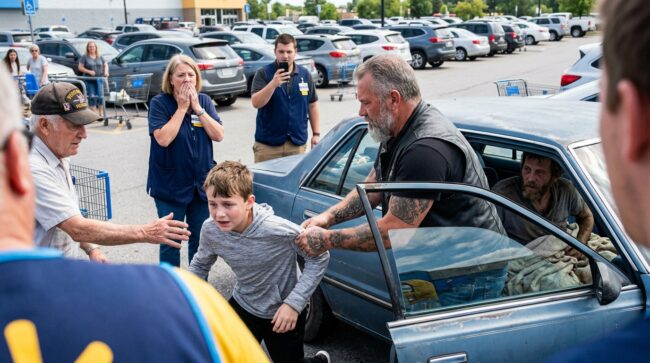
By 2:05 a.m., the parking lot had already begun doing what public places always do when fear gets a face.

It gathered witnesses first.

Then opinions.

One of the Walmart stockers—young, jittery, winter cap pulled low—started walking over from the entrance with his phone raised chest-high, half-recording and half-preparing to call somebody. The older stocker hung back by the bollards, shouting, “Hey, man! Back off the car!”

The biker didn’t turn.

That made the scene feel more dangerous immediately.

Because anyone with good intentions should have turned. Should have explained. Should have raised both hands and said something easy for strangers to classify.

This man kept his eyes on Eli and said, “Check the back seat.”

Eli didn’t move.

He was trying to think and freezing too fast to do it well.

In the driver’s seat, his father’s coat still lay thrown over the console, one sleeve hanging into the footwell. On the floor by Eli’s sneakers sat the cup from the gas station soda his father had bought him six hours earlier when they’d still been pretending this was temporary. One more town. One more motel. One more cousin who might answer. One more promise.

The biker tapped the glass a third time.

Harder.

Not enough to crack it. Enough to make Eli jump.

“Kid.”

The older stocker was closer now, and with him came a woman in a Walmart vest who looked about sixty, with a name badge that read LUCINDA and the face of someone who had seen every kind of night-shift bad decision. Her eyes went straight to the car, then the biker, then the boy inside.

“What’s going on?” she called.

The biker answered without looking at her. “Boy needs out.”

That landed badly.

Lucinda stopped dead. The younger stocker muttered, “Hell no,” under his breath and lifted the phone fully now. Somewhere behind them, automatic doors sighed open and shut as late customers drifted in and out with cat litter, frozen pizzas, and no idea they were walking into the beginning of a scene.

Eli found the lock and pushed it down harder, just to hear the click.

The biker noticed.

Of course he noticed.

His voice stayed low. “Good. Keep it locked.”

That made no sense.

Lucinda frowned. “Sir, step away from the vehicle.”

“Not yet.”

Wrong answer.

The young stocker said, louder now, “I’m calling security.”

“Call whoever you want,” the biker said.

That calm again.

That terrible calm.

Because now he looked like a man who had already measured how much authority mattered here and wasn’t impressed.

Eli’s heart was beating so hard it hurt his throat.

He looked over his shoulder at the back seat again.

Blanket. Grocery bags. Nothing else.

Unless—

There.

For one second he thought he saw the corner of something dark shifted deeper near the far door, down in the footwell behind the passenger seat, where the blanket had slumped oddly. He told himself it was the grocery bag. The shadow. The lack of sleep. Anything but what the biker clearly thought it was.

Outside, the biker took one step back from the window.

That should have relieved everyone.

It didn’t.

Because now he turned slightly, just enough to scan the lot, the row of carts, the dark gap between the car and the cart return, like he was checking for someone else. Not police. Not Walmart staff.

Someone specific.

Lucinda saw it too.

“Who are you looking for?”

The biker said nothing.

The stocker with the phone moved closer, emboldened by the presence of an older woman and fluorescent retail lighting, two things people often confuse with safety.

“Sir, you need to leave the minor alone.”

At that, the biker finally turned his head.

Not his whole body. Just enough to make the younger man stop walking.

“No,” he said. “You need to get him away from the passenger side.”

Now even Lucinda looked unsure.

“Why?”

The biker’s eyes cut back to Eli through the fogged glass.

“Because if I’m right,” he said, “you’ve got about thirty seconds before he wakes up.”

The younger stocker actually laughed once, sharp and frightened. “What the hell does that mean?”

Eli felt the car become smaller around him.

Not physically.

In the way enclosed spaces shrink when someone outside describes a danger you have been trying not to name.

Then the biker moved fast for the first time.

Not toward Eli.

Toward the passenger door handle.

Lucinda shouted.

The stocker lunged.

And the whole parking lot seemed to tense at once.

“Hey!”

The younger stocker reached the biker a half-second too late and caught only leather and cold air.

The biker had already grabbed the passenger handle and yanked once—not enough to force it, just enough to check whether the lock actually held. It did. That should have ended it.

Instead, it made him curse under his breath and look straight at Eli with sudden, unmistakable urgency.

“Slide over,” he said.

Eli didn’t.

Couldn’t.

Because now every person watching had the same interpretation: large biker, locked car, terrified child, middle of the night. The picture assembled itself too quickly to resist.

Lucinda stepped in front of the stocker and shouted, “Sir, get your hands off that door!”

The biker ignored her.

Bad move.

Or necessary one.

In the moment, no one could tell.

The younger stocker grabbed at his shoulder. The biker twisted free with one clean turn of the torso that wasn’t a strike and wasn’t gentle either. The stocker stumbled sideways into the cart rail and swore loudly enough to bring a yellow-vested security guard jogging from the grocery entrance.

Now there were four people watching.

Then six.

A woman loading diapers into a minivan stopped with her trunk open. An elderly man in a veteran cap coming out with a case of water set it down by the bollard and stared. Two teenage boys with energy drinks and bagged chips slowed their walk, delighted in the way only boys are when adults are about to lose control in public.

Inside the Taurus, Eli finally did move.

Not because he trusted the biker.

Because something shifted again behind him.

A sound.

Small. Wet. Human.

From the rear passenger footwell.

He turned too fast and banged his shoulder on the seat.

The blanket in back had definitely moved.

Eli’s mouth went dry.

Outside, the biker saw it in his face.

“There,” he said.

Security arrived at a run. Mid-thirties, paunch under a black jacket, radio already in hand, reading the scene exactly the wrong way.

“What’s going on?”

Lucinda pointed immediately. “He’s trying to get into the kid’s car.”

The biker straightened, half-turned, and said, “There’s another man in the back.”

No one believed him.

That was the problem.

Because the sentence sounded insane enough to be a tactic.

Security looked at the car, then Eli, then the biker. “Step back from the vehicle.”

“Open the driver’s door,” the biker said to Eli.

Eli’s hand found the lock without conscious thought.

Security barked, “Kid, don’t!”

That confusion cost them another three seconds.

Inside the back seat area, the blanket rose—not much, but enough now for everyone closest to see that something beneath it had shape.

The woman with the diapers screamed first.

The older man in the veteran cap dropped his case of water.

The teenage boys stopped smiling.

And from the rear footwell, where no sleeping child should ever have found a man and no watching adult had thought to look because they were too busy judging the biker, a hand slid out from under the blanket.

Adult.

Male.

Dirty fingernails.

Moving.

Lucinda covered her mouth with both hands.

Security reached for his radio and pepper spray at the same time and got tangled in both.

The stocker backed up so fast he nearly fell.

Inside the Taurus, Eli made a sound he would not remember making.

The biker hit the glass with the flat of his palm.

“Driver’s side. Now.”

The hand in the back twitched once, then the whole shape shifted, waking badly and fast, as though the cold, cramped sleep had broken in the middle of some plan.

Eli lunged for the driver’s lock.

Too slow.

The blanket dropped.

The figure underneath started to rise.

And outside the car, under the buzzing Walmart lights, with bystanders yelling too late and security still choosing the wrong tools for the wrong nightmare, the biker reached for something clipped at the back of his belt—

not a weapon,

not yet clearly anything at all—

and for one terrifying second everybody in that parking lot believed the night was about to get even worse.

What the biker pulled from the back of his belt was not a knife.

Not a gun.

A flashlight.

Heavy, metal, scarred from years of use. The kind truckers and mechanics carried because batteries died slower in cold weather if you bought the right kind once and kept it forever.

He snapped it on and drove the beam through the Taurus window so hard it turned the inside of the car white.

The man in the back seat recoiled instantly, one forearm coming up across his eyes.

That was the first clean proof the parking lot got.

Not a shadow.

Not a paranoid guess.

An adult man curled half under a blanket in the rear passenger footwell of a locked car with a thirteen-year-old boy sleeping in the front seat.

Security finally found his radio.

“Possible intruder, south lot, row H, get local PD now!”

The voice came out high and thin.

Inside the car, Eli had his hand on the driver’s lock, but fear was doing that terrible thing where the body obeys in slow, stupid pieces. His fingers slipped once. Then again.

The biker was already moving.

He ran around the front of the Taurus, boots splashing through old slush, beam still pinned through the glass. The man in the back was bigger than Eli had imagined from the hand alone—stringy beard, hollow face, one eye squinting shut against the light, jacket filthy at the sleeves. He looked less like a mastermind than what he probably was: somebody broken enough to become dangerous in cheap, ugly ways.

“Driver’s door,” the biker barked again.

Eli got it open.

Cold slammed into the car.

The biker yanked the door wider and caught Eli under one arm, dragging him out faster than Eli could have managed alone. Not rough. Not gentle either. Efficient. The kind of movement that leaves bruises later and saves you time now.

Eli hit the asphalt in a stumble and nearly went down.

“Behind me,” the biker said.

Eli obeyed instantly.

That part would bother him later.

How fast obedience came when the right kind of command hit the right kind of fear.

Behind the windshield, the man in the back seat was trying to untangle himself from the blanket and failing in jerky, furious motions. He lunged toward the front, hit the seatback, cursed, clawed his way over the center console.

The woman with the diapers grabbed her phone with both hands and screamed for somebody to help.

The veteran in the cap moved first.

Not toward the car. Toward Eli.

He pulled the boy farther back by the shoulder, one old, steady hand on the hood of a nearby sedan to keep himself balanced. “Stay down, son,” he said.

The biker didn’t look at either of them.

He stepped toward the open driver’s door and planted himself there, flashlight in one hand, the other braced against the frame, making a wall between the car and the boy.

The man inside finally spilled halfway across the front seat.

Up close, he smelled like sweat, old cigarettes, and the particular rot of someone sleeping in too many places that weren’t his. His eyes darted from the biker to the crowd to Eli, calculating badly.

“Move,” he said.

The biker answered with the same flat calm he’d brought from the first knock.

“No.”

Security, still too far back to matter, had finally drawn pepper spray and was shouting contradictory things into his radio. Lucinda stood with both hands over her mouth. The younger stocker looked sick now, as if realizing how close he’d come to helping the wrong danger.

The man in the car made the mistake of lunging.

Not out the driver’s side.

Toward Eli.

It happened fast enough that later nobody agreed on the exact order. Only the important part.

The biker caught him at the shoulders, twisted him sideways into the door frame, and pinned him there without striking him once. Hard enough to stop him. Controlled enough not to become the worst man in the scene.

The man thrashed, spat, tried to grab for the flashlight.

The biker jammed the beam into his face and said, “Police are thirty seconds out. Pick the version of this you survive.”

That finally broke something in him.

He stopped fighting like a man with a plan and started cursing like a man who knew he’d just woken up in the center of his own bad decision.

Red and blue washed the slush two rows over.

Local police came into the lot too fast and braked hard enough to throw spray from the tires.

And in the flashing light, with Eli shivering behind a stranger in leather and the hidden man pinned in the open car door, the whole parking lot had to reckon with the ugliest truth of the night:

The biker had been right from the first knock.

By 2:16 a.m., the parking lot belonged to uniformed people, questions, and that special kind of cold that sinks deeper after adrenaline burns off.

Officer Dana Kellerman took the first statement from security, the second from Lucinda, and the third from the younger stocker whose version began with “I thought he was the threat” and fell apart from there. Another officer cuffed the man from the back seat and sat him against the curb while he muttered, denied, then changed his story twice in under three minutes.

Homeless. Just sleeping.

No, not homeless, waiting for someone.

No, didn’t know the boy was inside.

None of it matched the fact that he had been curled under a blanket in the rear footwell of a locked car, reaching toward a terrified child when he woke.

Eli sat on the curb wrapped in a Walmart fleece throw someone had grabbed off a clearance cart and not paid for yet. The veteran in the cap remained beside him until police gently moved him back. Lucinda brought hot chocolate from the break room and held it out with both hands like an apology disguised as sugar.

Eli took it because it was hot.

Not because he was ready to trust anyone again.

The biker stood ten feet away under the light pole, answering Officer Kellerman’s questions in short, dry sentences.

Name: Russell Dane.

Age: fifty-six.

Address: Terre Haute, Indiana.

Why were you here?

“Riding through.”

Why stop?

“Saw the frost pattern on the windows.”

Kellerman frowned. “Meaning?”

Russell glanced once at Eli, then back at her. “Kid was breathing in front. Somebody wasn’t in back. Rear glass was fogged low.”

That sounded almost absurd if you didn’t know cold-weather parking lots. But the veteran in the cap, still within earshot, nodded once under his breath like he understood. Old habits. Old eyes.

Russell continued. “Passenger-side condensation had two temperatures. Front warm from breath, rear dead, then slight heat bloom low on the right after I cut my engine.” He shrugged once. “Somebody was under the blanket.”

Officer Kellerman stared at him for a second.

“You saw that from the bike?”

“Yeah.”

It was such a bare answer that it left no room for admiration. He was not performing competence. Just reporting it.

Eli watched him over the rim of the hot chocolate cup and felt the night rearranging itself in him for the second time. First from danger. Then from being wrong about who it belonged to.

The police found more ugly details as the minutes piled up. The man had been trespassed from the Walmart twice before for sleeping in the garden center sheds. There were open warrants in Vanderburgh County. He had a folding utility blade in his jacket pocket. He had no clean reason for being inside that car.

But those were facts. Important, clean facts.

What stayed with Eli was less clean.

The biker had seen the difference in glass fog before anyone else had even seen him.

He had noticed the wrong shape in the rear footwell from thirty feet away.

He had looked at a sleeping car and seen danger where every adult on staff would probably have seen a loitering kid first.

That meant something.

Officer Kellerman crouched in front of Eli at last, notebook closed now because some questions needed fewer props.

“Where’s your dad?”

Eli looked toward the liquor store across the service road.

Dark windows. Closed sign. Empty lot.

“He left.”

“When?”

“Before midnight.”

“Does he do that often?”

Eli didn’t answer.

He didn’t need to.

Officer Kellerman’s face changed just enough to become gentler.

A child-services supervisor had been requested. So had a tow truck, because the Taurus was dead for real now, not just tonight-dead. The practical pieces of disaster were beginning to line up.

That was when Russell walked over.

Not close enough to crowd the boy. Just close enough to be heard.

Officer Kellerman rose and stepped aside, but not far. She wasn’t careless.

Russell looked down at Eli, then at the hot chocolate, then at the dead Taurus.

“Good reflex on the lock,” he said.

Eli almost laughed at how strange that was.

“That wasn’t a reflex.”

Russell nodded once. “Fair.”

That was all.

No “you okay, champ.” No fake warmth. No reaching out. No crouching down to make himself softer than he was.

Eli found that easier to trust.

“Why’d you even look?” he asked.

Russell’s eyes went to the car.

Then to the empty liquor-store lot.

Then back to Eli.

“Because nobody sleeps right in a Walmart lot at two in the morning unless something already went wrong.”

It was the first thing anybody had said all night that felt fully true.

Child-services arrived at 2:42 a.m. in sensible shoes and a county SUV that smelled faintly of paper folders and old coffee.

Her name was Marcy Bell. Late thirties. Tired eyes. Good coat. The kind of woman who had seen enough to know how not to talk down to frightened children or over-talk wounded adults. She sat beside Eli on the curb, took the hot chocolate cup before it spilled, and began asking the questions that seem ordinary until you realize a child has been rehearsing lies for them.

Do you know any relatives nearby?

No.

Anybody from school?

No.

Anyone safe we can call?

Long pause.

Then: “Maybe.”

Marcy waited.

Eli looked at the biker.

Not because Russell had offered anything.

Because he hadn’t.

Because unlike everybody else, he had not once tried to own the next step.

“Maybe my grandma,” Eli said. “Dad doesn’t like her.”

“Why?”

“She tells the truth too loud.”

Marcy almost smiled.

She asked for the number. Eli didn’t know it. But he knew the town—Brazil, Indiana—and the street name from envelopes he used to see on the kitchen counter before rent notices replaced everything else.

They could find her. Probably.

Maybe.

That “maybe” felt like the whole country at 3 a.m.

Russell had started walking back toward his bike when Marcy called after him.

“Mr. Dane.”

He turned.

“Did you know the boy before tonight?”

“No.”

“Then why stay?”

Russell looked at Eli once, like he was checking whether the question embarrassed him.

Then at Marcy.

“Because people leave too early when uniforms show up.”

That answer sat differently than anything else he’d said.

Officer Kellerman heard it. So did Marcy.

Eli did too.

Not dramatic. Just old.

Marcy nodded slowly. “You seen this before?”

Russell gave half a shrug.

“Enough.”

She let that rest for a moment, then asked the question everybody else had been circling without earning.

“How’d you get good at spotting kids in cars?”

The Walmart lights hummed overhead. Across the lot, police loaded the hidden man into the back seat of a cruiser. Lucinda was talking to the tow-truck driver. Snowmelt dripped from the bumper of the Taurus in steady little ticks.

Russell answered without changing expression.

“My daughter used to hide in the back seat when her mother and I fought.”

No one moved.

He kept looking at Marcy, not Eli.

“She was eight the first time. Eleven the last. Thought if she stayed quiet enough, grown-ups would forget to break things where she could hear.” His jaw flexed once. “You learn glass patterns.”

That was already enough to make Eli stare harder.

But Russell wasn’t done.

“She died at nineteen,” he said. “Not from that. Different bad year.”

The sentence landed like a slab of cold iron.

Not because it was dramatic.

Because it wasn’t.

No one rushed to comfort him. There was nowhere to put comfort that wouldn’t feel cheap. Marcy lowered her eyes briefly. Officer Kellerman looked away toward the cruiser lights. Eli sat very still with the empty hot chocolate cup between both hands.

And suddenly the twist of the night wasn’t only that the biker had been right.

It was that he had been right because he knew the shape of children going quiet inside adult failure better than anyone else in the parking lot.

Eli’s throat felt too tight to use.

“She hid because of you?” he asked.

Russell took that without defending himself.

“Sometimes.”

“Then why’d you help me?”

A long pause.

“Because nobody helped her fast enough.”

There it was.

Not redemption. Not a lesson. A debt.

Private. Unpaid. Still moving.

Marcy’s phone buzzed in her coat pocket. She checked it, then looked at Eli.

“We found your grandmother.”

Eli stopped breathing for one beat.

“She answered?”

Marcy nodded.

“She’s on her way.”

Then she added, softer, “She cried first. Then she swore for a while. Then she left immediately.”

For the first time all night, Eli believed morning might actually happen.

Grandma June Ramsey arrived at 3:27 a.m. in an old Buick that sounded like it was held together by prayer, rust, and insult.

She got out in house shoes, a winter coat over a nightgown, gray hair half-pinned and half-defiant, and crossed the parking lot with the speed of a woman who had spent years being told she was too much and had chosen, correctly, to remain exactly that.

She saw Eli on the curb.

She did not ask a question first.

She put both hands on his face and said, “You’re freezing,” in the furious tone women use when love and rage are too close together to separate cleanly.

Then she hugged him so hard his breath left for a second.

Eli tried not to cry.

Failed.

That part embarrassed him less than he would have expected.

June looked over his shoulder at the Taurus, the police, the Walmart lights, and finally Russell standing near his bike.

She studied him for a long second and seemed to understand more than most had with far less information.

“You the one who knocked?” she asked.

Russell nodded.

She walked over and held out her hand.

Not warm. Not suspicious. Just direct.

“June Ramsey.”

He took it carefully. “Russell Dane.”

She looked at the cruiser where the hidden man sat behind glass, then back at Russell.

“You saved my grandson.”

Russell shook his head once. “Pulled him out.”

June’s eyes sharpened. “Men always make the good thing smaller when they don’t know where to set it.”

He didn’t answer that.

Probably wisely.

Marcy Bell completed the transfer paperwork leaning against the hood of the Buick. Officer Kellerman explained what would happen next with Eli’s father if and when he resurfaced. Lucinda brought a plastic bag with two bananas, a Walmart hoodie, and a bag of powdered donuts nobody had asked for. June accepted them all like gifts and evidence at the same time.

When the forms were signed and the tow truck had finally hauled away the Taurus, the lot became emptier than before. The kind of emptiness that arrives only after something bad has been prevented but not undone.

Eli stood by the Buick with June’s blanket wrapped around his shoulders and watched Russell strap his helmet on.

“You’re just leaving?” he asked.

Russell paused.

Not surprised by the question. Just measuring it.

“Yeah.”

“Why?”

Russell glanced at June, then at Marcy, then at Eli.

“Because you’ve got your person now.”

It made sense.

That didn’t make it easier.

Eli dug into the pocket of the borrowed Walmart hoodie and pulled out something he had found without thinking while climbing out of the Taurus earlier: one of his father’s old casino tokens, brass-colored, worthless outside the wrong county, kept for luck long after luck had stopped attending.

He held it out.

Russell frowned. “What’s that for?”

“It’s all I got.”

June made a soft sound behind him, not quite a laugh.

Russell looked at the token for a second, then at Eli.

Finally he took it.

Not like a sentimental movie thing. Just carefully, as if refusing it would do more harm than accepting it.

“Don’t keep sleeping light,” Eli blurted.

Russell’s face changed almost imperceptibly.

“What?”

Eli shrugged, hating how young it made him feel. “You hear everything.”

For the first time that night, something like a real expression crossed Russell’s face. Not a smile exactly. Something quieter and more damaged than that.

“Working on it,” he said.

Then June stepped forward, pulled the zipper of Eli’s hoodie up to his chin, and said to Russell, “If you ever pass through Brazil and need coffee, don’t go to the truck stop. It’s swill.”

Russell nodded as if he’d file that away with other useful survival details.

“Ma’am.”

He kicked the bike to life. The engine rolled low across the near-empty lot, no longer sounding like threat. Just distance.

Eli stood there in Walmart light and exhaust mist and watched the biker pull out past the cart return, turn once at the service road, and disappear into the black Indiana cold that had nearly swallowed the night for good.

June put one hand on the back of Eli’s neck.

Not pushing. Just anchoring.

In the car, with the heater finally working because she hit the dashboard once in the right place, she handed him one powdered donut from Lucinda’s bag and said, “You can tell me the whole thing when the shaking stops.”

Eli nodded.

He looked back once through the rear window at the place where the Taurus had been and found only wet pavement and the reflection of fluorescent lights stretching thin across it.

No speeches came.

No grand lesson lined itself up neatly enough to survive the drive.

Just a boy no longer in a locked car.

A grandmother telling the truth too loud.

And somewhere down the road, a biker riding through the dark with a worthless brass token in his pocket and one less thing left unfinished than he’d had before 2:03 a.m.

Để lại một bình luận

Email của bạn sẽ không được hiển thị công khai. Các trường bắt buộc được đánh dấu *

Back to top button