Part 2: An Elderly Woman Threw an Envelope Onto the Floor at Her Granddaughter’s Wedding — What Was Inside Froze the Room
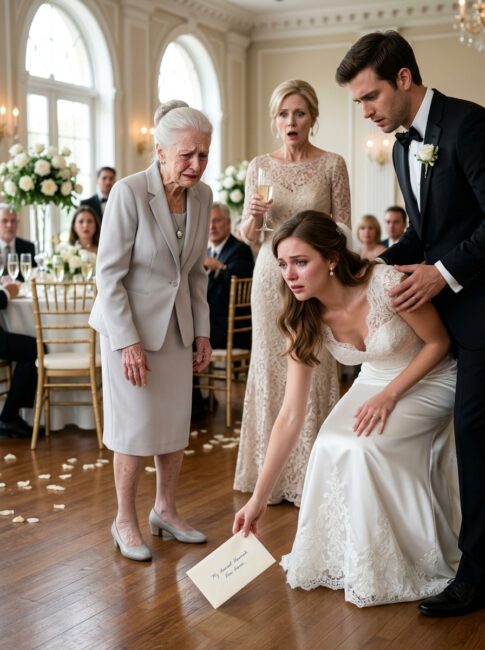
For several seconds, nobody touched the envelope.
It lay on the dance floor between the bride’s satin shoes and the groom’s polished black ones, looking too small to hold the weight suddenly pressing down on the room.
Hannah Miller stared at it.
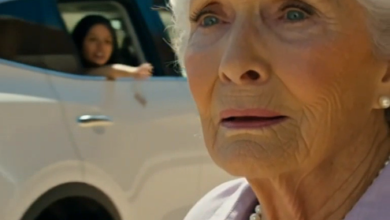
Her grandmother had always been quiet at family events. Evelyn Parker was the woman who brought hand-sewn napkins, remembered every birthday, and slipped twenty-dollar bills into children’s coat pockets at Christmas. She was not the kind of woman who made a scene.
That was the first thing that did not fit.
Michael Bennett, Hannah’s new husband, bent to pick up the envelope. His dark suit jacket pulled at the shoulders as he reached for it, but Caroline’s voice stopped him.
“Leave it.”
Hannah turned slowly toward her mother.
Caroline Miller was fifty-two, elegant, controlled, and known for never letting emotion wrinkle her makeup. She had planned the wedding with the precision of a museum curator. Every flower, speech, and seating card had passed through her hands.
Now those hands were shaking around a champagne flute.
“Mom,” Hannah said softly. “What is this?”
Caroline looked at Evelyn.
The anger in her eyes was real, but beneath it sat something older.
Fear.
That was the second thing that did not fit.
Evelyn did not look proud of what she had done. She looked as if throwing the envelope had taken the last of her strength. One hand clutched the back of a chair. Her other hand pressed against her ribs, where a small silver locket trembled on a chain.
Hannah had seen that locket before.
Inside it was a tiny photograph of a baby wrapped in a yellow blanket.
Evelyn never said who the baby was.
When Hannah was little, she once asked if it was her mother.
Evelyn had only kissed the top of her head and said, “It is someone I should have held longer.”
The memory returned so sharply that Hannah’s chest tightened.
She bent down and picked up the envelope herself.
Caroline stepped forward.
“Hannah, please. Not here.”
“Then where?” Hannah asked.
Her voice was not loud, but it moved through the ballroom clearly enough for both families to hear.
Evelyn closed her eyes.
Michael placed a hand lightly at Hannah’s back, not guiding her, just letting her know he was there.
Hannah turned the envelope over.
Her name was written across the front in faded blue ink.
For Hannah, on the day she becomes someone’s wife.
The handwriting was not Evelyn’s.
It was softer. Younger. Slightly slanted to the left.
Hannah looked up.
“Who wrote this?”
Caroline’s lips parted, but no words came.
At the front table, Hannah’s father, David, lowered his gaze to the tablecloth. He had been smiling minutes earlier, ready to toast his daughter’s new life. Now he looked like a man hearing footsteps from a locked room.
Michael noticed.
So did his mother, Grace Bennett, a warm-faced woman in a navy dress, who had stopped judging Evelyn and begun watching Caroline instead.
Hannah opened the envelope carefully.
Inside were three things.
A folded letter.
A hospital bracelet so old the ink had nearly faded.
And a small black-and-white photograph of a young woman standing outside a bus station, holding a newborn wrapped in a yellow blanket.
The ballroom disappeared around Hannah.
The woman in the photo was not Caroline.
She had dark curls, tired eyes, and a smile that looked brave rather than happy.
On the back of the photograph, someone had written:
Rose and Hannah. July 14, 1998.
Hannah stopped breathing for one second.
“My middle name is Rose,” she whispered.
Evelyn’s face crumpled.
“Yes.”
Caroline set the champagne glass down before it fell.
Hannah looked at her mother.
“Who is Rose?”
David stood then, but he did not come closer.
“Hannah,” he said, his voice broken, “there are things we should have told you.”
Evelyn stepped forward.
“No,” she said. “There are things I should have told her.”
The old woman looked around the room, at the perfect flowers and the stunned faces and the expensive wedding cake waiting untouched near the windows.
Then she looked at the bride.
“Your mother was not the first woman who held you,” Evelyn said.
Caroline covered her mouth.
And Hannah, still wearing white, unfolded the letter with hands that would not stop shaking.
The letter began with an apology.
My sweet Hannah,
If you are reading this in a wedding dress, then your grandmother finally found the courage I begged her to have.
Hannah sank into the nearest chair.
Michael knelt beside her without saying a word. His hand rested on the edge of her gown, careful not to touch the letter, as if he understood this was not his grief to enter first.
Evelyn remained standing.
Every guest in Briarwood Estate listened to the silence between Hannah’s breaths.
The letter was from Rose Whitaker.
She had been nineteen when Hannah was born.
Not a stranger. Not a distant relative. Not a mistake someone wanted to erase.
She was Caroline’s younger sister.
For most of Hannah’s life, Rose had been described only as “Aunt Rose,” a girl who died before Hannah could remember her. There was one photograph of her in Evelyn’s hallway, half hidden near the staircase, always passed without explanation.
Hannah had grown up believing Rose was part of the family’s sadness.
She had never known Rose was part of her beginning.
Rose had become pregnant during her first year away from home. The father was gone before the second trimester, leaving no address and no promises worth keeping. Caroline was already married to David and had suffered two miscarriages by then. The family did not speak openly about either sorrow.
When Rose came home, Evelyn found her sitting on the porch steps with a suitcase, a swollen belly, and a face that looked much older than nineteen.
Caroline wanted to protect her.
David wanted to help.
Evelyn wanted to make everything disappear into order.
That was the mistake she carried for twenty-six years.
The town was small. The church was smaller. People talked. Evelyn had spent her life building respectability after a childhood of hunger, gossip, and relatives who treated poverty like a stain.
She loved Rose, but fear made her love clumsy.
She pushed for quiet arrangements. A private birth. A family adoption. No public questions. No shame attached to the baby.
Rose agreed to let Caroline and David raise Hannah because she believed they could give her daughter stability she could not yet give. But she made one request.
Not money.
Not recognition.
Truth.
“When she is old enough to understand love without feeling abandoned,” Rose had told Evelyn, “tell her I chose her life, not my convenience.”
Evelyn promised.
Then Rose got sick.
Not dramatically. Not in a way that gave everyone time for speeches. A postpartum infection became a fever. The fever became emergency surgery. Rose died before Hannah’s first birthday.
After the funeral, the family folded into survival.
Caroline became Hannah’s mother in every real, daily, exhausted way. She fed her at midnight, rocked her through ear infections, taught her to tie shoes, sat through parent-teacher nights, and saved every drawing.
She did not steal motherhood.
She lived it.
But every year, when Hannah’s birthday came, Evelyn saw Rose’s face in the yellow candlelight and told herself she would explain soon.
Soon became kindergarten.
Then middle school.
Then prom.
Then college.
Then engagement.
Each delay made the truth feel more dangerous.
Caroline feared Hannah would think she was a replacement. David feared she would feel lied to by every adult she trusted. Evelyn feared the worst thing of all.
That Hannah would ask why her own grandmother had hidden her birth mother’s love like an embarrassing debt.
So Evelyn kept the envelope.
Rose had written the letter during a short recovery period, believing she would have many years to speak the words herself. She gave it to Evelyn with the hospital bracelet and the bus station photograph.
“For her wedding day,” Rose had said. “Not because marriage matters more than anything, but because that is the day everyone tells stories about where love comes from.”
Evelyn read the letter every year.
She never delivered it.
That afternoon, during the wedding, Caroline had raised her glass for the family toast. Evelyn had looked across the room and seen Hannah smiling beside Michael, ready to thank the parents who raised her.
Then she saw the empty space where Rose’s name should have been.
And something inside the old woman refused to let another public moment pass over a private grave.
She did not know how to do it gently.
So she threw the envelope.
Not because she wanted to hurt Caroline.
Because she had already hurt Rose by being careful for too long.
Hannah read the last paragraph aloud, though her voice broke twice.
If Caroline is the woman who teaches you how to live, let her be your mother with your whole heart. If David is the man who carries you when you are tired, let him be your father without question. But please know this, my little girl. Before I gave you to them, I held you against my chest and loved you for every minute I was given.
The ballroom had no sound left.
Caroline finally moved.
She came around the table slowly, as if approaching a wounded animal. When she reached Hannah, she did not reach for the letter. She knelt in front of her daughter, careless of her dress.
“I was afraid,” Caroline whispered. “Not that you would stop loving me. I was afraid you would feel unwanted for even one second.”
Hannah’s tears slipped down her cheeks.
“So you let me feel lied to instead?”
Caroline closed her eyes.
“Yes.”
The answer was plain.
It hurt because it did not defend itself.
David covered his face with one hand. Evelyn’s shoulders shook.
Hannah looked at all three of them, then down at Rose’s photograph.
The young woman in the picture looked exhausted, frightened, and proud. She looked like someone who had given away everything and still tried to smile.
Hannah touched the baby in the yellow blanket.
“Did she name me?”
Evelyn nodded.
“She chose Hannah because it meant grace. Rose because she said every girl should carry something that blooms after winter.”
That sentence broke Caroline.
She bowed her head into Hannah’s lap and cried like a daughter, not a mother. Hannah’s hand hovered above her for one painful second.
Then she placed it on Caroline’s hair.
Not forgiveness yet.
Not fully.
But touch.
The kind that keeps a room from collapsing.
Michael stood and took the microphone from the table.
He did not make an announcement.
He only said, “We are going to take a few minutes.”
Nobody objected.
No one moved toward the cake.
No one asked for music.
The wedding had stopped being a performance.
It had become a family telling the truth in front of witnesses.
When the reception resumed, it did not return to the plan.
The first dance had been scheduled before dinner. The cake cutting after the toast. Photographs under the rose arch at sunset. Caroline had printed the timeline on cream cards and placed one at every table.
By evening, no one was looking at the cards.
Hannah had spent twenty minutes in a private room with Caroline, David, Evelyn, and Michael. When she came back, her eyes were red, but her spine was steady. She carried Rose’s letter in one hand and her bouquet in the other.
The guests stood when she entered.
Not because anyone told them to.
Because something about her face made sitting feel wrong.
Hannah walked to the memory table near the entrance. It held framed photographs of grandparents, old family weddings, and loved ones who had passed. Rose’s small hallway photo was not there.
Caroline noticed the empty space first.
She removed one silver frame from the table, opened it with trembling fingers, and placed the bus station photograph inside.
Rose and Hannah.
July 14, 1998.
Then Caroline set it at the center of the memory table.
Evelyn stood behind her, one hand over her mouth.
“I should have done that years ago,” she whispered.
Caroline looked at her mother for a long moment.
“Yes,” she said softly. “But we are doing it now.”
That was all.
No grand absolution.
No perfect speech.
Just a woman making room where fear had once stood.
Later, when the DJ asked whether they still wanted the family dance, Hannah nodded.
The song began quietly.
Hannah danced first with David, who cried openly and apologized into her hair. Then she danced with Caroline, both women holding each other too tightly to move in rhythm.
When the song changed, Hannah looked toward Evelyn.
The old woman shook her head immediately.
“My legs are not good.”
Hannah walked across the floor and held out both hands.
“Then we’ll stand.”
Evelyn let herself be led to the center of the room.
They did not dance much. They swayed, barely moving, while the gold lights blurred above them.
“I was a coward,” Evelyn whispered.
Hannah’s face tightened.
“Yes.”
The old woman accepted it.
Then Hannah added, “But you brought her to me.”
Evelyn bowed her head until it rested against her granddaughter’s shoulder.
Around them, both families watched quietly. Grace Bennett wiped tears from Michael’s father’s face. Cousins who had whispered earlier now stared at the memory table. Even the servers moved more slowly, as if the room had become a chapel.
Near the end of the night, Hannah placed her bouquet beside Rose’s photograph.
White roses.
Baby’s breath.
One yellow ribbon from the waist of her gown.
Caroline stood beside her.
“She would have loved you,” Caroline said.
Hannah looked at the photo.
“She did.”
The answer was simple enough to hold everything.
The envelope, once thrown across the floor like an accusation, was later placed in Hannah’s small bridal purse. Its corners were bent. The ink was faded. But it had done what silence never could.
It had made room.
Months later, Hannah framed Rose’s letter in the hallway of her new home. Not hidden. Not explained away. Just there, beside a wedding photograph where Caroline, David, Evelyn, and Michael stood close around her.
Below it, she placed the hospital bracelet.
And beside that, the photograph of a nineteen-year-old girl holding a newborn in a yellow blanket, smiling like love had already cost her everything.
Some guests would ask who she was.
Hannah would answer without lowering her voice.
“That is Rose,” she would say. “She was my first mother.”
Then she would point to Caroline in the wedding photo.
“And that is my mother who stayed.”
On quiet mornings, when sunlight crossed the hallway, both pictures seemed to share the same warmth.
Follow this page for more emotional stories about the hidden truths that change how we see the people we love.