Part 2: A Boy Asked to Miss School for “Family Business” — Then One Photo on the Screen Made the Whole School Cry
Before that photo, Mason Cole was known mostly for what he did not say.
He did not talk much about home.
He did not invite friends over.
He did not explain why his sneakers were patched with silver tape near the toes, or why he sometimes smelled faintly of dish soap and laundry detergent before first bell.
Teachers called him polite.
Students called him weird.
Adults in town called his mother “that poor Claire Cole,” though never when Mason could hear them. At least, they thought he could not hear them.
Claire worked at Mercy Oaks Assisted Living, three nights a week as a nursing aide, and at Denny’s on weekends when tips were good. She was thirty-four, with red hair she kept in a tired bun, and hands that were always cracked from washing.
Mason’s father, Drew, had left when Mason was five.
That was the version people knew.
The version Mason knew was quieter.
His father did not leave all at once. He left in missed birthdays, unopened school envelopes, unanswered calls, and promises that arrived bright and then disappeared like weather.
By eleven, Mason had stopped waiting by windows.
He waited for other things instead.
He waited for the dryer to finish so his little sister Ava would have clean pajamas. He waited for Claire’s car headlights after midnight. He waited for the microwave to beep when he heated soup for his grandfather, Walter, who had moved in after his stroke.
Walter Cole had once been a school janitor. Not at Westbridge, but across town at the old middle school that closed after the roof failed. He had broad hands, a slow smile, and a wooden cane Mason polished every Sunday with furniture oil because Walter said it made him look “distinguished.”
The stroke stole half his speech.
It did not steal his eyes.
Walter saw more than he could say.
Every morning, Mason woke before his alarm. He packed Ava’s lunch first, because she forgot things when she was excited. He set his grandfather’s pills beside a glass of water. He fed the orange cat that technically belonged to nobody. Then he walked to school with his homework in one pocket and worry in the other.
Mrs. Patterson noticed pieces of it.
She noticed Mason’s eyelids drooping after math.
She noticed how he folded leftover cafeteria rolls into napkins and slipped them into his backpack.
She noticed that whenever the class discussed careers, Mason never picked astronaut, athlete, or firefighter.
He wrote: someone who fixes things.
Still, even Mrs. Patterson misunderstood him sometimes.
In March, she caught him taking a stack of construction paper from the art cabinet without asking.
“Mason,” she said, sharper than she meant to.
His face went white.
“I was going to bring it back.”
“That is not the point.”
He nodded, eyes on the floor, taking the reprimand without excuse.
Later that week, Mrs. Patterson found hand-cut paper flowers taped around the doorway of the assisted living center when she visited her own aunt. Each flower had a resident’s name printed in careful block letters.
At the bottom of one blue flower, almost hidden, was Mason’s handwriting.
For Miss Alma, because yellow makes her remember summer.
Mrs. Patterson stood there a long time.
After that, she tried to ask more gently.
But Mason was hard to reach. Not because he was rude. Because he had learned that every question about home could become one more thing his mother had to explain.
Then came the awards assembly.
Westbridge Elementary made a large event of it. Perfect attendance. Kindness certificates. Reading medals. Most improved. Parents were invited. Photos were taken beneath paper banners taped to the auditorium walls.
Mason had known for weeks he would receive the perfect attendance award.
He acted like it did not matter.
But Mrs. Patterson saw him straighten the printed program when it was handed out. She saw him trace his name once with his thumb.
“Mason Cole — Perfect Attendance.”
“You should be proud,” she told him.
He shrugged.
“My grandpa says showing up counts.”
“That sounds like a wise man.”
Mason’s mouth almost smiled.
Then, the day before the assembly, he gave her the note.
Family business.
No signature.
No details.
Mrs. Patterson called Claire twice. No answer. She left a message, then another.
By dismissal, Mason was quiet in a different way. He kept checking the classroom clock. His hands moved around the straps of his backpack like he was trying to keep himself from running.
“Mason,” Mrs. Patterson said, “I need a parent to confirm this absence.”
He looked at her with tired gray eyes.
“My mom’s at work.”
“I understand, but school policy requires—”
“It’s only one day.”
His voice was not defiant.
That bothered her more.
“What kind of family business?”
He swallowed.
“The kind I have to do.”
Behind him, two students exchanged looks.
Mrs. Patterson felt the classroom listening.
“Mason, that isn’t an answer.”
His cheeks colored.
“No, ma’am.”
Something in his face asked her not to press him there, in front of everyone.
She signed the absence form herself that afternoon, though she knew the office would question it.
The next morning, Mason’s desk was empty.
On top of it sat a library book he had forgotten to return.
Inside the front cover was a folded piece of paper.
Mrs. Patterson opened it, expecting homework.
Instead, she found a list.
Blanket. Comb. Blue tie. Grandpa’s shoes. Mom’s coffee. Ava’s picture. Don’t forget the flag.
She read the list twice.
Then she looked at Mason’s empty chair and felt, for the first time, afraid.
The call came during the third-grade choir song.
Mrs. Patterson was standing near the auditorium wall, supervising her class while children sang off-key into the microphone. Principal Greene sat near the stage, smiling with practiced patience.
A front office aide slipped in through the side door and motioned urgently.
At first, Mrs. Patterson thought a student was sick.
Then the aide whispered, “It’s about Mason Cole.”
Mrs. Patterson followed her into the hallway.
Claire’s voice was on the office phone, thin and shaking.
“I’m sorry,” Claire said before Mrs. Patterson could speak. “I know he missed the assembly. I know he was supposed to get an award.”
“Claire, is Mason safe?”
There was a pause.
“Yes.”
Mrs. Patterson closed her eyes.
“Where is he?”
Claire began to cry.
“He’s with his grandfather.”
Only then did the pieces shift.
Walter Cole had died the night before.
Not suddenly, exactly. He had been fading for months, though Mason had told no one at school. His speech had grown softer. His left hand had stopped holding things. Some mornings, he stared toward the kitchen window as if listening to someone calling from far away.
Claire had planned to arrange everything after her shift.
But Walter had left one wish written months earlier in shaky letters on the back of an old church bulletin.
I want Mason to help me wear my blue tie. He knows how I like it.
Claire found the note after midnight.
She tried to wake Mason gently. He was already awake.
“I know,” he said.
The funeral home offered a morning viewing because the afternoon was booked. Claire had no family nearby. No money for extra services. No one to pick up the suit from the cleaners, which had been paid for in coins Walter saved in a jar.
So Mason called it family business.
Because saying “my grandfather died and I need to dress him” felt too large for a school form.
He ironed the white shirt on a towel over the kitchen table because their ironing board had a broken leg. He polished Walter’s shoes until the cracks looked softer. He combed the silver hair the way Walter liked, parted on the left. He tied the blue tie three times before it sat straight.
Claire said she tried to help.
Mason shook his head.
“Grandpa asked me.”
At the funeral home, a director named Mr. Bellamy noticed Mason standing on a chair to fix the tie one final time. He said the boy’s hands were careful, not frightened. He said Mason whispered something, then placed a small school program inside Walter’s jacket pocket.
“What program?” Mrs. Patterson asked.
Claire’s voice broke.
“The awards assembly.”
Mrs. Patterson pressed one hand to her mouth.
“He wanted his grandpa to see his name.”
There was more.
Because Walter had once worked as a janitor at a school, Mason believed he should not leave without being thanked by one. So after the viewing, he asked Claire to stop by Westbridge Elementary before the small graveside service.
Claire did not understand.
“I thought you didn’t want to go.”
“I don’t want to go inside,” Mason said. “I just need the flag.”
Every morning, Westbridge’s flag was raised by a rotating student helper. Mason had raised it in September and took the responsibility seriously enough that the custodian still remembered.
That morning, the flag rope had twisted around the pole during a strong wind. The custodian, Mr. Ellis, was out with a knee injury. No one had fixed it.
Mason saw it from the parking lot.
He asked his mother to wait.
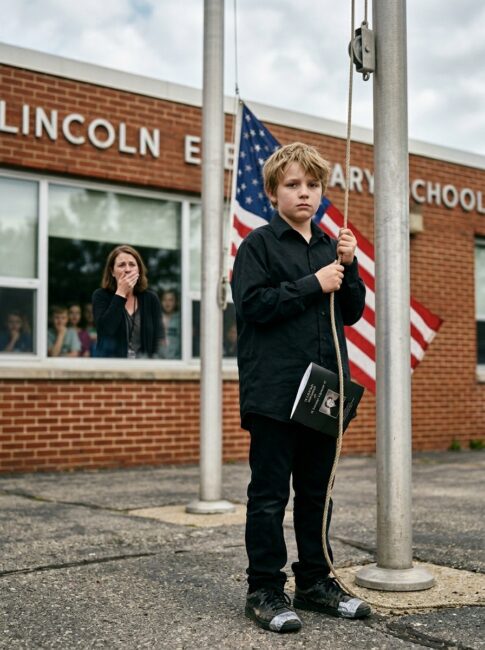
Wearing the same white shirt he had ironed for the funeral, he walked across the grass, untangled the rope, lowered the flag halfway for his grandfather, and stood there alone with one hand over his heart.
A neighbor across the street took a photo.
Not to post.
Not to gossip.
Because the sight of a boy in dress shoes, standing under a half-raised flag with a funeral program tucked beneath his arm, felt like something that needed a witness.
That neighbor was Mrs. Alvarez, a retired teacher who still called the school every Christmas to ask if anyone needed coats.
She sent the photo to Principal Greene with one sentence.
I believe your missing student is honoring someone today.
Inside the auditorium, the choir had finished.
Principal Greene returned to the stage slowly, holding her phone as if it weighed more than it should.
Mrs. Patterson stood near the wall, unable to speak.
The perfect attendance awards were next.
Everyone expected Mason’s name to be skipped.
Instead, Principal Greene touched the microphone.
“Before we continue,” she said, “there is a student we have misunderstood today.”
A murmur moved through the auditorium.
The projector screen lowered behind her.
The photo appeared.
Mason stood in front of the school flag, wearing a white dress shirt slightly too big for his shoulders, dark pants, and polished shoes. His hair had been combed carefully, probably with the same comb he used for his grandfather. In one hand, he held a folded funeral program. In the other, he held the flag rope.
The flag hung at half-staff.
His face was turned upward.
He looked small beneath all that sky.
No one spoke.
A few students who had laughed at him looked down at their laps.
Mrs. Patterson saw the list again in her mind.
Blanket. Comb. Blue tie. Grandpa’s shoes. Mom’s coffee. Ava’s picture. Don’t forget the flag.
Principal Greene’s voice shook.
“Mason Cole is absent today for family business. His grandfather, Walter Cole, passed away last night. Walter spent twenty-seven years caring for school buildings, hallways, classrooms, and children whose names he often remembered long after they forgot his.”
She paused.
“Mason came here this morning, not to attend the assembly, but to lower our flag for him.”
A soft sound moved through the room, not quite a gasp, not quite a sob.
Then Principal Greene held up Mason’s certificate.
“This certificate says perfect attendance. But today reminds us that showing up does not always mean sitting in a chair where we expect someone to be.”
Mrs. Patterson began crying then.
Quietly at first.
Then not quietly enough to hide.
The students turned toward Mason’s empty seat in the front row of their class section.
For the first time all year, that empty seat did not look like absence.
It looked like duty.
The main twist was not that Mason had lied.
It was that he had told the truth in the only words he could carry.
Family business.
A boy honoring the man who taught him that showing up counted.
Mason returned to school two days later.
He came in before the bell, as usual, with his backpack hanging low and his hair still damp from a hurried morning shower. Nothing about him announced grief except the way he paused at the classroom door before entering.
The room went quiet.
Not the cruel kind.
The careful kind.
Mrs. Patterson stood from her desk.
“Good morning, Mason.”
He nodded.
“Morning.”
His classmates watched him walk to his seat. Nobody joked. Nobody asked where he had been. Nobody said sorry right away, because children often know when grown-up words are too small.
On his desk sat his perfect attendance certificate in a blue folder.
Beside it was a small paper flower, yellow construction paper, cut unevenly.
Mason touched it.
Mrs. Patterson said softly, “The class made those for your grandfather.”
He opened the folder.
Inside was the certificate, but there was something else too.
A printed copy of the photograph.
Mason stared at it for a long time.
His face did not change much. Mason was good at holding himself still.
Then he noticed the bottom corner of the photo.
Someone had written in black marker:
Walter Cole showed up for twenty-seven years. Mason Cole showed up for him.
Mason blinked hard.
Mrs. Patterson came closer.
“I should have asked you privately,” she said. “I’m sorry I made you feel like you had to defend something that was already heavy.”
Mason looked down at the flower.
“It’s okay.”
“No,” she said gently. “It can be okay later. It does not have to be okay today.”
That was when his mouth trembled.
Only a little.
Enough.
At recess, three boys who had laughed about the note came to his desk. They stood there awkwardly, shifting from one sneaker to the other.
One of them, Tyler, held out a pack of chocolate milk.
“I saved it,” he said. “From breakfast.”
Mason looked at it.
“I don’t really drink chocolate milk.”
Tyler’s face fell.
Mason took it anyway.
“My sister does.”
Tyler nodded quickly, relieved to have been useful.
At lunch, Mason sat in his usual place near the end of the table. But one seat beside him stayed open only for a minute before another student sat there.
Then another across from him.
No speeches were made.
No one turned kindness into a performance.
They simply sat close enough that Mason did not have to be alone unless he wanted to be.
That afternoon, Principal Greene called Mason to the office.
He walked in stiffly, expecting paperwork.
Instead, his mother was there, still wearing her Denny’s uniform, and Ava stood beside her clutching a drawing of a man with a cane and wings that looked more like bird feathers than angel wings.
On Principal Greene’s desk sat a small brass nameplate.
It read:
Walter Cole Memorial Kindness Award
Mason read it silently.
Principal Greene folded her hands.
“We would like to give this once a year to a student who shows quiet responsibility when nobody is clapping.”
Mason’s eyes moved to his mother.
Claire was crying, but she was smiling too.
“Can it be for kids who help at home?” Mason asked.
Principal Greene swallowed.
“Yes,” she said. “Especially them.”
Mason nodded as if that settled the matter.
Then Ava tugged his sleeve.
“Grandpa would say your tie was crooked.”
For the first time all week, Mason laughed.
It came out small and surprised, like a window opening in a room that had been closed too long.
Later, when school ended, Mrs. Patterson watched Mason walk down the sidewalk with Ava. He carried her backpack on one shoulder and his own on the other. The yellow paper flower stuck out of the front pocket, bending in the breeze.
At the flagpole, he stopped.
Ava stopped too.
Mason looked up at the flag, now raised fully again against the late afternoon sky.
He did not salute.
He did not cry.
He only reached into his backpack, pulled out the copy of the photo, and folded it carefully along the edges so it would fit inside his library book.
Then he took Ava’s hand and kept walking home.
From the classroom window, Mrs. Patterson watched until they turned the corner.
The next morning, Mason’s seat was filled before the bell.
His pencil was sharpened.
His homework was done.
And when Mrs. Patterson began attendance, she paused at his name.
“Mason Cole?”
He looked up.
“Here.”
His voice was quiet, but everyone heard it.
For more heartfelt stories about family, kindness, and the unseen courage children carry, follow this page and keep reading with us.