Part 2: The Girl Bullied All Year Was Named Homecoming Queen — and the Ones Who Mocked Her Couldn’t Look Up
Lily did not walk forward at first.
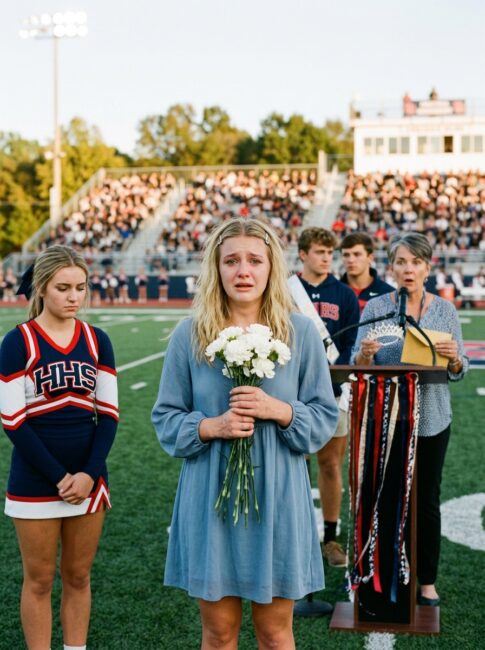
She stood beneath the white glare of the stadium lights, holding half a bouquet, with the football field stretching between her and the small platform where the crown waited.
Everyone was watching her now.
That was the one thing Lily had spent the entire year trying to avoid.
Her mother, Grace Whitaker, stood near the fence in a beige cardigan with both hands pressed to her mouth. She worked nights at a nursing home and had come straight from her shift, still wearing white sneakers that squeaked against the track.
Beside her stood Mr. Rivera, Lily’s history teacher, his tie loosened, his eyes already wet.
He knew something most of the students did not.
He knew Lily had asked three times to withdraw her name from the homecoming ballot.
He knew she had never wanted this.
Principal Morgan leaned toward the microphone again. “Lily, honey, come on up.”
That honey made a few people shift in their seats. It sounded too soft for a girl the school had not been soft with.
Lily began walking.
Her blue dress brushed against the grass. It had belonged to Mr. Rivera’s daughter eight years earlier. He had brought it in a garment bag after overhearing two girls say Lily would probably show up in “a church basement curtain.”
Lily had tried to give it back.
“It’s too pretty,” she had said.
Mr. Rivera had answered, “Then it has been waiting for you.”
Now the dress moved under the lights as if it carried more than fabric.
Brianna Hale watched from the cheer line.
She was seventeen too, white, blond, polished, and beautiful in the practiced way of girls who had never needed to wonder whether they belonged in pictures. She had been expected to win.
Everyone had expected it.
Brianna had campaign posters in the hallways. Pink letters. Perfect smile. Glitter around the edges. Her boyfriend, Mason Carter, had handed out candy with “Vote Bri” stickers taped to each wrapper.
Lily had no posters.
At least, not official ones.
Someone had printed one photo of her from freshman year, circled her face in red marker, and taped copies inside bathroom stalls with the words Ridgeview Royalty? written beneath it.
The janitor removed them before lunch.
More appeared by sixth period.
That was the first week Lily’s name showed up on the ballot.
Most people assumed she had been nominated as a joke.
Some laughed openly.
Some felt sorry for her privately.
Only a few noticed that Lily kept showing up to class anyway, sitting in the second row with her hands folded tightly over her notebook.
As she climbed onto the platform, Principal Morgan reached for the crown.
It was silver plastic and rhinestones, reflecting the lights in tiny cold flashes. Beside it sat a sash with gold lettering.
Lily turned her head, and her eyes found the senior section.
Brianna looked away.
That was the first crack in the story.
If this had been a joke, the popular girls should have been laughing.
But they were not.
Mason Carter stared at the ground. Another cheerleader, Hannah Doyle, had tears in her eyes. A football player named Caleb Price removed his cap and held it against his chest.
The crowd began noticing faces.
Confusion moved through the bleachers like wind.
Principal Morgan placed the crown on Lily’s head. It slipped slightly because her hair was too smooth, pinned back with two drugstore clips.
The stadium applauded.
At first, it was polite.
Then louder.
Then uneven, because some people clapped with guilt instead of joy.
Lily did not smile.
She looked over the crowd the way someone looks at a room full of locked doors.
Principal Morgan tried to hand her the microphone.
Lily shook her head.
The principal leaned close. “You don’t have to say anything.”
Lily stared at the microphone.
Then, slowly, she took it.
A hush fell so quickly it felt arranged.
Lily held the mic with both hands.
“I didn’t vote for myself,” she said.
The sentence was so plain that nobody knew how to react.
A few students froze.
Brianna closed her eyes.
Lily looked down at the broken carnation in her bouquet.
“I know some of you thought this was funny,” she continued. “At first, I did too. Not funny in the laughing way. Funny in the way something hurts so much your brain tries to make it smaller.”
Grace Whitaker began crying at the fence.
Mr. Rivera lowered his head.
Lily’s voice trembled, but she did not stop.
“When my name first appeared on the ballot, I thought it was another thing I would have to survive quietly.”
She looked toward the cheer line.
“I was wrong about part of it.”
Brianna’s hand flew to her mouth.
Lily had not raised her voice. She had not accused anyone by name. That somehow made the silence worse.
“I did not know, until yesterday, that people had been voting for me for a different reason.”
A murmur moved through the crowd.
Lily turned toward Mr. Rivera.
“He told me the truth this morning.”
Every eye shifted to the history teacher by the fence.
He stood very still.
Lily swallowed.
“He told me who started the write-in campaign after the joke.”
Brianna was crying now.
And suddenly, everyone wanted to know why the girl who had tormented Lily looked like someone waiting to be forgiven.
The first cruel thing happened in September.
Lily dropped her lunch tray in the cafeteria, and spaghetti slid across the floor like a red stain. Someone laughed. Then someone else. Then Brianna Hale said, “Careful, Lily. The floor didn’t ask for your leftovers.”
It was not the worst thing anyone had ever said.
That was how it began.
Cruelty often started small enough for good people to pretend they had not heard it.
Lily knelt to pick up the tray. Mr. Rivera had been near the doorway and saw her hands shaking. He also saw Brianna’s face after the joke landed.
It was not triumph exactly.
It was relief.
As if making Lily smaller had kept something inside Brianna from collapsing.
By October, Lily’s locker had been filled with paper crowns cut from notebook paper. By November, someone created an anonymous page posting blurry photos of her shoes, her sweaters, and the way she ate alone under the stairwell.
Lily never reported it.
Not because it did not hurt.
Because she had learned that reporting pain sometimes meant having adults ask for proof while everyone else learned you were someone who complained.
Her mother offered to call the school.
Lily begged her not to.
“Please,” she said. “It will get worse.”
So Grace washed Lily’s sweaters at midnight, packed her lunches in brown bags, and pretended not to see the tissues hidden in the bathroom trash.
But the story did not stay simple.
In January, Hannah Doyle came into Mr. Rivera’s classroom after school. She was crying so hard he could barely understand her.
“She made us do it,” Hannah whispered.
“Who?”
Hannah looked toward the hallway.
“Brianna.”
Mr. Rivera did not react. Teachers learn that startled faces can scare the truth away.
“Do what?” he asked.
Hannah pulled out her phone.
The anonymous page had posted a photo of Lily standing at the bus stop in the rain, her sweater dark with water, her face turned away. The caption read: Future Homecoming Queen of the Storm Drain.
Mr. Rivera felt something cold move through him.
Then Hannah said, “But Lily brought me an umbrella.”
He looked up.
“What?”
“That day,” Hannah said. “After school. My mom forgot to pick me up, and Lily saw me crying by the side entrance. She gave me her umbrella and walked to the bus stop without one.”
Hannah wiped her face with her sleeve.
“I took the picture before that. I posted it after.”
The shame in the room was heavier than any punishment.
That was the first twist Mr. Rivera kept in his heart.
The next came from Caleb Price, a football player who had once laughed when someone stuck a paper crown to Lily’s backpack.
In February, Caleb’s father was arrested. The news spread by morning. By lunch, three boys were whispering about it near the vending machines.
Lily heard them.
Caleb heard them too.
He stood there with a carton of chocolate milk in his hand, trying not to become the kind of boy who broke something.
Lily stepped between them, not dramatically, just quietly.
“Mr. Rivera said you left your essay in his room,” she told Caleb.
He stared at her.
He had no essay.
She gave him a look so small most people missed it.
He followed her out.
Later, when he asked why she had done that, Lily shrugged.
“You looked like you needed a door.”
Caleb had not known what to say.
He voted for her three times using every school-sponsored poll link sent to his email.
Then came Mason Carter.
Mason was Brianna’s boyfriend, handsome, white, and careless in the way boys are when the world keeps forgiving their edges.
He had never been the loudest bully.
He was worse sometimes.
He laughed just enough to give others permission.
In March, his younger sister, Emily, started having panic attacks in the girls’ bathroom. She was a freshman, small, nervous, and terrified of being noticed.
Lily found her sitting on the floor between the sinks, breathing too fast.
Emily expected Lily to leave.
Instead, Lily sat on the cold tile beside her.
“My mom has panic attacks,” Lily said. “You don’t have to be embarrassed.”
She stayed until the nurse came.
She never told Mason.
Emily did.
Mason stopped laughing after that.
By April, students had begun noticing things they should have seen before.
Lily picked up dropped pencils without making people feel clumsy. She shared notes with absent classmates, even the ones who had ignored her. She remembered who hated public speaking and who needed extra time to answer.
She was not loud kindness.
She was the kind people missed unless they needed it.
When the homecoming ballot opened, someone nominated Lily as a joke.
Hannah saw it first.
She came to Mr. Rivera’s room with tears in her eyes and said, “Can we change what it means?”
That question became the beginning.
Hannah told Caleb. Caleb told the football team. Emily told freshmen. Mason quietly removed two cruel posters from the cafeteria. Students who had watched without helping began voting with a guilt they did not yet know how to name.
But Brianna did not join.
Not at first.
She doubled down.
She said Lily would be humiliated if she won. She said pity was not popularity. She said people were only voting for Lily to make themselves feel better.
Mr. Rivera watched her say it in the hallway.
Then he saw her turn away and wipe her eyes.
Two days before homecoming, Brianna came to his classroom after practice.
She stood in the doorway in her cheer uniform, mascara smudged beneath one eye.
“My mom is leaving,” she said.
Mr. Rivera waited.
“She’s moving to Arizona. She told my dad in July. They told me I had to keep smiling because senior year was supposed to be special.”
Her voice cracked.
“I hated Lily because she looked like what I felt. Like everyone could tell something was wrong.”
Mr. Rivera said nothing for a long moment.
Then he asked, “Did hurting her make it easier?”
Brianna shook her head.
“No.”
“Then what are you here to do?”
Brianna opened her hand.
Inside was a stack of pink “Vote Bri” stickers.
“I want to take these down.”
They spent forty minutes removing her posters.
The next morning, Brianna posted one message on her campaign page.
Don’t vote for me because I’m easy to crown. Vote for Lily because she kept showing up when we gave her every reason not to.
By lunch, everyone had seen it.
By sunset, Lily’s name had moved to the top.
And now Lily stood on the platform with a crown on her head, looking at the very people who had broken her year into pieces.
She held the microphone close.
“I found out people voted for me because they felt bad,” she said.
Several faces dropped.
“I do not want to be queen because people feel bad.”
Her voice steadied.
“I want to be queen for the girl who cried in the bathroom and still came back to class. For the boy whose family became gossip before he had time to breathe. For every person who has sat in a cafeteria pretending to text because eating alone feels too loud.”
Brianna covered her face.
Lily looked at her.
“And for the people who were cruel because they were carrying something ugly and did not know where else to put it.”
The stadium was utterly silent.
“I am not saying that makes it okay.”
Her eyes filled.
“I am saying I know what it feels like to want pain to leave your body, even if you send it toward someone else.”
That was when Brianna stepped forward.
No one expected it.
She walked from the cheer line to the edge of the platform, still in uniform, her face bare of every practiced expression.
“Lily,” she said, voice shaking, “I’m sorry.”
The microphone caught it.
Every student heard.
“I made you a target because I was scared everyone would see me falling apart,” Brianna said. “That is not an excuse. It is just the truth I should have told before I hurt you.”
Lily looked at her for a long time.
Then she reached up and took off the crown.
The crowd gasped softly.
Lily held it in both hands and looked at the rhinestones.
“This crown is plastic,” she said.
A few people gave a broken laugh through tears.
“But tonight, it feels heavy.”
She looked at Principal Morgan, then at the crowd.
“I will wear it. Not because I won. Because maybe if I stand here long enough, someone else will know they can survive being seen.”
Then she placed it back on her head.
The applause did not explode.
It rose slowly.
Like people standing up inside themselves.
After the ceremony, the football game continued, but hardly anyone watched the first quarter.
Students gathered in strange little groups along the fence, talking quietly. Some apologized to Lily with words too small for what they had done. Some only cried. Some could not come near her at all.
Lily did not make anyone perform shame for her.
That surprised people.
They expected bitterness, maybe a speech sharp enough to return every wound. Instead, she stood near the concession stand with her mother’s cardigan around her shoulders, holding her broken carnation like it still mattered.
Brianna approached after halftime.
She had changed out of her cheer jacket but still wore the uniform. Without glitter and performance, she looked younger.
“I took down the page,” she said.
Lily nodded.
“I know.”
“I’m going to tell the principal everything Monday.”
Lily looked at her.
“That part is not for me to carry.”
Brianna cried then, not loudly. Lily did not hug her. She did not have to. But she reached into her bouquet and gave Brianna one white carnation, the smallest one, with petals bent at the edges.
Brianna held it like a consequence and a gift at the same time.
Across the field, Caleb waved awkwardly. Hannah stood beside Emily, both of them wrapped in blankets, both watching Lily with something like gratitude.
Mr. Rivera came over with two cups of hot chocolate.
“I brought the queen a drink,” he said.
Lily smiled for the first time that night.
“My crown is plastic.”
“Most crowns are,” he said. “People just forget.”
Grace Whitaker laughed through tears and touched Lily’s hair, careful not to disturb the crown.
“You ready to go home?”
Lily looked back at the stadium.
For months, this place had felt like a stage where everyone else had lines and she had only silence. Now the lights seemed less cruel. The bleachers were still metal. The field still smelled of grass and popcorn and cold air.
Nothing magic had happened.
The year was not erased.
Screenshots still existed somewhere. Words did not float backward into mouths. A crown did not turn cruelty into kindness, and applause did not make pain pretty.
But something had shifted.
As Lily walked toward the parking lot, a freshman girl she did not know stepped out from behind the ticket booth.
She had dark curls, brown skin, and sleeves pulled over her hands.
“I voted for you,” the girl said.
Lily stopped.
“Thank you.”
The girl looked down. “Not because I felt bad.”
Lily waited.
“Because you sit in the second row even when people laugh,” the girl whispered. “I sit in the back. I thought maybe next week I could sit closer.”
Lily’s throat tightened.
She took the broken carnation from her bouquet, the one with the snapped stem, and handed it to the girl.
“It still counts,” Lily said.
The girl looked at the flower, then nodded.
In the parking lot, Grace unlocked their old silver car. Lily climbed into the passenger seat carefully, lifting the dress so it would not catch on the door.
The crown slid sideways.
Her mother reached over and straightened it.
For a moment, they looked at each other under the dashboard light.
Grace did not say, “I’m proud of you.”
She had said it so many times that year in laundry rooms and school offices and quiet kitchens. Tonight, she only took Lily’s hand and held it between both of hers.
That was enough.
As they drove away, the stadium lights glowed behind them, bright but farther now.
Lily looked out the window at the crown’s reflection in the glass. It sat crooked on her head, glittering faintly against the dark.
She did not look like a girl who had forgotten what happened.
She looked like a girl who had carried it through the lights and kept walking.
And back at Ridgeview High, in the last row of the bleachers, the people who once laughed at her stayed quiet long after her name had stopped echoing.
Follow the page for more heartfelt stories about the quiet strength people often overlook.