Part 2: The Student Suspended for Fighting Took the Microphone to Apologize — and Left His Teacher in Tears
The auditorium had the uneasy silence of a room waiting for a bad kid to prove everyone right.
Marcus could feel it.
He could feel the eyes on his hands, not his face. He had tried to scrub the scabs from his knuckles that morning, but his mother stopped him at the sink.
“Don’t make yourself bleed to look clean for people,” she had said.
Now those hands held the apology paper so tightly the edges wrinkled.
Principal Vaughn stood three steps behind him, close enough to interrupt if Marcus drifted into excuses. The assistant principal stood near the side wall. Two security guards watched from the back doors.
That hurt more than Marcus expected.
He looked at the first row.
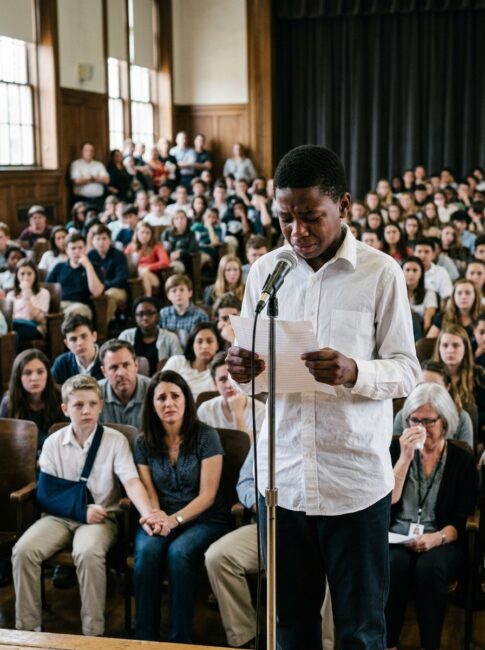
Tyler Grant sat between his parents, pale and stiff, with one arm strapped against his chest. Tyler’s father stared at Marcus with the flat, hard face of a man who had already finished judging him.
Marcus swallowed.
“I know most of you saw the video,” he said. “I know what it looked like.”
A few students shifted.
“It looked like I lost control. It looked like I wanted to hurt Tyler. It looked like Mrs. Parker was wrong when she told people I was not a bad kid.”
Mrs. Parker’s jaw tightened.
She was fifty-eight, white, with silver hair cut to her chin and reading glasses hanging from a chain. For most of the year, she had kept granola bars in her desk for Marcus because he came to first period hungry.
After the fight, she stopped offering them.
Marcus had noticed.
Everyone noticed what teachers took away, even when teachers thought they were being quiet.
“I am not here to tell you the video lied,” Marcus continued. “My hands did what you saw.”
That sentence seemed to satisfy some people. A mother near the front nodded as if the story had been settled.
Then Marcus looked down at his paper.
“But videos start where phones start recording,” he said. “They don’t always start where the story starts.”
Mrs. Parker’s eyes lifted.
Marcus rubbed his thumb over a crease in the paper. In his pocket was a small blue guitar pick, worn smooth from being touched too many times. No one could see it, but he felt it there like a second pulse.
He had not planned to mention it.
He had promised himself he would not.
“I owe Tyler an apology,” he said. “Not because he did nothing wrong, but because I hurt him in a way I cannot take back.”
Tyler glanced at his shoes.
That was the first strange thing.
The boy who had been treated like the clear victim did not look angry. He looked afraid of being seen.
Marcus noticed. So did Mrs. Parker.
“I also owe Mrs. Parker an apology,” Marcus said.
The room shifted again.
Mrs. Parker straightened, surprised.
Marcus looked at her, and for the first time, his face showed something other than shame.
“You asked me what happened before the fight,” he said. “I said nothing.”
Mrs. Parker blinked.
“You asked me again in your classroom. I still said nothing.”
Her expression softened around the edges, as if she remembered the scene exactly.
Marcus had sat across from her with a split lip, refusing to speak. She had asked gently first. Then firmly. Then with a disappointment that hurt worse than shouting.
Finally, she had said, “Marcus, I cannot help you if you keep choosing silence.”
He had stared at the floor and let her believe the worst.
“I thought being quiet would protect somebody,” Marcus said into the microphone.
A murmur moved through the students.
Principal Vaughn leaned forward slightly, but he did not stop him.
Marcus unfolded the paper again, though he was no longer reading from it.
“My little brother, Eli, is in sixth grade.”
At the back of the auditorium, Marcus’s mother closed her eyes.
“He is eleven. He wears blue hearing aids. He hates when people call them machines. He says they are just his ears.”
Several teachers turned toward the sixth-grade section.
Eli Reed was not there.
That absence made Mrs. Parker’s hand move to her mouth.
Marcus kept going.
“Three weeks ago, before the fight, I found Eli’s hearing aid case in the boys’ bathroom trash.”
A quiet, uncomfortable sound passed through the room.
“I knew it was his because he put a sticker of a red rocket on it. He said it made the case faster.”
Some students looked down.
Marcus reached into his pocket and touched the guitar pick, not because it belonged to Eli, but because it belonged to someone else he had also failed to protect.
“I went looking for him,” Marcus said. “I found him behind the gym, sitting by the dumpsters with his hood pulled over his head.”
His voice wavered.
“He told me he had dropped the case. He said nobody took it. He said he was fine.”
Mrs. Parker’s eyes were wet now, but she did not wipe them yet.
Marcus looked at Tyler.
“Then I saw Tyler and two other boys walking away laughing.”
Tyler’s father turned sharply toward his son.
Tyler’s mother whispered, “Tyler?”
Tyler did not answer.
Marcus shook his head once, as if fighting the part of him that still wanted to protect the silence.
“I thought if I told, Eli would become the boy teachers watched. The boy everyone felt sorry for. The boy with a brother who needed adults to save him.”
He paused.
“I knew what that felt like.”
No one breathed loudly.
“That was my first mistake,” Marcus said. “I thought silence was strength.”
Then he looked at Mrs. Parker again.
“My second mistake was thinking you had stopped seeing me before I gave you a reason to.”
Mrs. Parker’s tears finally fell.
But the biggest truth had not arrived yet.
And Marcus knew it.
He could feel it waiting in his chest like a locked door.
Marcus had not always been the boy adults watched carefully in hallways.
In fifth grade, he had been the boy who helped stack chairs after assemblies. In sixth grade, he had won second place in the city spelling bee and cried in the bathroom because first place got a bicycle.
In seventh grade, everything changed.
His father, Daniel Reed, died on a Tuesday morning while fixing a neighbor’s roof for extra money. The ladder slipped. The neighbor called 911. Marcus’s mother arrived at the hospital still wearing her grocery store name tag.
By Wednesday afternoon, casseroles appeared.
By Friday, people stopped knowing what to say.
By Monday, Marcus returned to school wearing his father’s old denim jacket, though the sleeves swallowed his hands.
Mrs. Parker had seen him that day.
She had not asked him to read aloud. She had placed a granola bar on his desk without looking at him, as if hunger could be treated quietly.
For a while, that was enough.
Then the comments started.
Not from everyone. Never from everyone. Cruelty usually needed only a few voices and a lot of silence.
Kids joked about Marcus’s jacket. They asked whether he slept in it. They called him “roof boy” once, then twice, then often enough that the name floated through the hallway like a smell no adult could quite locate.
Marcus learned to walk without reacting.
He learned to keep his mouth shut.
He learned that teachers often saw the shove, not the thousand little hands pushing first.
But he was not speaking about himself yet.
He looked toward the sixth-grade section again, where Eli’s empty seat seemed louder than any voice.
“My brother was born with hearing loss,” Marcus said. “When he got his first hearing aids, my dad told him they were superhero gear.”
A few people smiled sadly.
“He said Eli could hear things regular people missed. Like when Mom was pretending not to cry in the kitchen. Like when I was sneaking cookies. Like when Dad said he was proud of us under his breath.”
Marcus’s lips trembled, but he kept control.
“After Dad died, Eli stopped wearing them for two months. He said the world was too loud without Dad in it.”
Mrs. Parker pressed a tissue beneath her eyes.
“My mom worked double shifts. I walked Eli home. I made sure he ate. I checked his backpack. I thought that made me grown.”
He glanced at his mother. Her face looked broken by love and exhaustion.
“But grown people ask for help,” Marcus said. “I did not.”
Principal Vaughn lowered his head slightly.
Marcus turned toward Tyler’s row.
“When I found Eli behind the gym, I asked him who did it. He would not say. Then Tyler came around the corner.”
Tyler’s face had gone white.
“I asked Tyler where the other hearing aid was. He laughed.”
Tyler’s father whispered something sharp, but Tyler’s mother put a hand on his arm.
Marcus continued.
“I pushed him once. He said Eli was lucky he could turn the sound off because nobody wanted to hear him anyway.”
A long, painful silence followed.
Even the students who liked drama did not move.
Marcus closed his eyes for one second.
“That is when I hit him.”
Tyler started crying.
It was not loud. It was the humiliated crying of a boy who had been caught somewhere deeper than trouble.
Marcus opened his eyes and looked at him.
“I am not saying that to make you hate Tyler.”
Some parents looked startled by that.
“I know what it feels like when one moment becomes your whole name. I do not want that for him.”
That was the first time Tyler looked directly at Marcus.
“I hurt him,” Marcus said. “I put him in a sling. I scared people who did not know what happened. I scared Mrs. Alvarez, who tried to pull me back. I scared kids younger than me.”
He drew a shaky breath.
“And I scared myself.”
Mrs. Parker’s shoulders sank.
“I kept thinking about my dad,” Marcus said. “How his hands were rough, but he never made us afraid of them. I kept looking at my own hands and wondering when they had become something people stepped away from.”
The room had lost its hunger for punishment.
Something quieter had replaced it.
Marcus reached into his pocket and pulled out the blue guitar pick.
“My dad carried this in his wallet,” he said. “He could only play three songs, and he played them badly. But every Sunday, he played in the living room while Eli danced.”
He held the pick between two fingers.
“When Tyler said what he said, I did not just hear an insult. I heard every joke I ignored. Every time someone shoved Eli’s backpack. Every time I pretended not to care so my mom would not have one more thing to worry about.”
His voice cracked.
“I heard my dad not being there to stop it.”
At the back, his mother covered her mouth.
“But that still does not make what I did right,” Marcus said. “Pain can explain a fist. It cannot excuse where it lands.”
Mrs. Parker began crying harder at that line, because it sounded like something a child should not have had to teach himself.
Marcus looked at her.
“When you came to the office after the fight, I saw your face. You looked like I had become what everyone warned you I was.”
Mrs. Parker shook her head, but the motion was small and guilty.
“I was angry at you for that,” he said. “Then I realized I had made it easy for you to believe them.”
Mrs. Parker stood suddenly.
The whole room turned.
“I was wrong,” she said, her voice unsteady.
Principal Vaughn looked startled, but he did not stop her.
Mrs. Parker faced Marcus from the aisle.
“I should have kept asking. I should have asked your mother. I should have asked Eli. I should have known silence from you was never emptiness.”
Marcus’s face folded.
For three weeks, he had expected discipline. He had expected blame. He had expected the speech to be a public surrender.
He had not expected his teacher to apologize back.
Tyler moved then.
Slowly, awkwardly, with his sling pressed to his chest, he stood beside his parents.
“I took the case,” he said.
His mother began to cry.
Tyler’s voice shook as he spoke to the auditorium, not just Marcus.
“I threw it in the trash. I didn’t take the hearing aid, but I laughed when Ryan did. I said that thing about Eli.”
He wiped his face with his good hand.
“I was mad because Marcus made the basketball team and I didn’t. That’s not a reason. It’s just the ugly truth.”
No one said anything.
Tyler looked at Marcus.
“I’m sorry. To you. To Eli. To your mom.”
Marcus nodded once, but he did not smile. Forgiveness was not a button anyone could press in front of an audience.
Then a small voice came from the auditorium doors.
“He’s here.”
Everyone turned.
Eli Reed stood near the back beside the school counselor, wearing a blue hoodie and both hearing aids. One had a red rocket sticker on it.
Marcus stared at him.
“Eli,” he whispered.
Eli walked down the aisle slowly, watched by hundreds of students who had once seen him only as somebody’s little brother.
When he reached the stage, he did not hug Marcus right away.
He looked at Tyler first.
“Don’t call them machines,” Eli said.
Tyler nodded quickly. “I won’t.”
“They’re my ears.”
“I know.”
Eli turned to Marcus.
“You scared me too.”
That sentence hurt Marcus more than suspension.
“I know,” Marcus said.
“You didn’t ask me what I wanted.”
“I know.”
Eli’s chin trembled.
“I wanted Dad.”
Marcus covered his face with one hand.
That was the truth beneath every other truth, and no school assembly could fix it.
Eli stepped forward and hugged his brother anyway.
Marcus bent over him, holding the guitar pick in one hand and his brother with the other. The auditorium stayed silent, not because it was empty of feeling, but because nobody wanted to ruin the small sound of two boys breathing through grief.
Mrs. Parker stood in the aisle crying openly now.
She had once taught Marcus that a good apology did not erase the damage. It simply stopped pretending the damage belonged to someone else.
Today, he had returned the lesson to her.
The assembly did not end with applause.
Principal Vaughn tried to speak, but his voice caught on the first sentence. He cleared his throat and simply said, “We are going to do better.”
It was not a grand promise.
Maybe that was why it sounded real.
Students filed out more quietly than they had entered. Some looked at Marcus and looked away, embarrassed by what they had assumed. Some glanced at Eli’s hearing aids and then caught themselves before staring too long.
Tyler stayed behind with his parents.
His father did not look hard anymore. He looked smaller, like a man discovering that anger had covered up something he should have asked about at home.
Tyler approached Marcus near the stage steps.
“I don’t know how to fix it,” Tyler said.
Marcus looked at his sling.
“Start with Eli.”
Tyler nodded.
Eli stood beside Mrs. Parker, who had knelt to speak with him at eye level. She was holding a granola bar from her purse, the same kind she used to keep in her desk.
“Chocolate chip?” she asked.
Eli glanced at Marcus.
Marcus smiled faintly. “She thinks granola bars solve everything.”
Mrs. Parker laughed through tears. “Not everything.”
Eli took it.
That small exchange seemed to loosen something in the room.
Marcus’s mother came forward then. She had remained in the back through the whole speech, her hands clenched around her purse strap. Now she climbed the stage steps and touched Marcus’s cheek with the back of her fingers.
“You sounded like your father,” she said.
Marcus tried to answer, but nothing came out.
She pulled him into her arms, and for once he did not worry who was watching. He was thirteen. He was tired. He let himself be held.
Mrs. Parker waited until his mother stepped back.
Then she handed Marcus a folded note.
“I wrote this before the assembly,” she said.
Marcus looked suspicious. “Is it another assignment?”
“No,” she said. “It is something I should have said sooner.”
He unfolded it.
The handwriting was neat, blue, and familiar from the margins of his essays.
Marcus, I was disappointed in what you did. I was also wrong to let one bad day become the whole story I carried about you. I am sorry. My door is still open.
Marcus read it twice.
Then he folded it carefully and slipped it into the same pocket as his father’s guitar pick.
Mrs. Parker noticed.
She did not ask.
Outside the auditorium, the hallway looked exactly the same as it had on the day of the fight. The same lockers. The same trophy case. The same shiny floor where everyone’s footsteps echoed too loudly.
But Marcus walked differently through it.
Not proudly. Not free from consequences. He still had restorative meetings ahead, community service, and a long conversation with Eli that no apology could replace.
Still, he walked with his head raised.
Near the bent lockers, he stopped.
The dent had not been repaired yet.
Tyler stopped beside him, silent.
Eli stood between them, looking at the metal doors.
“That was loud,” Eli said.
Marcus almost laughed, then wiped his eyes instead.
“Yeah,” he said. “It was.”
Tyler shifted his weight.
“My dad said he’ll pay to fix it.”
Marcus looked at him.
“Maybe we both should.”
Tyler nodded.
Mrs. Parker watched from a few feet away, holding a stack of programs against her chest. She did not interrupt. Some moments did not need a teacher’s voice.
Marcus reached into his pocket and touched the guitar pick again.
For weeks, he had thought the assembly would be the place where everyone watched him become smaller. Instead, it had become the first place where the whole truth stood up with shaking knees.
At the end of the hallway, Eli slipped his hand into Marcus’s.
Marcus looked down, surprised.
“You’re still annoying,” Eli said.
Marcus smiled.
“You too.”
They walked toward the front doors together, past the dented lockers, past the whispers that had finally gone quiet, past the place where a boy’s anger had once been easier to see than his grief.
Behind them, Mrs. Parker picked up one forgotten program from the floor.
She folded it gently and tucked it under her arm, as if some ordinary paper could hold the weight of what had happened there.
Then she turned off the auditorium lights.
And Marcus Reed stepped into the afternoon with his brother beside him, his father’s guitar pick in his pocket, and one teacher’s open door waiting behind him.
Follow the page for more heartfelt stories about the quiet truths people often miss.