Part 2: The Foster Mother Sat Alone at the Back of the Scholarship Ceremony — Until the Girl Called Her “The Woman Who Chose Me”
The principal, Mr. Harlan, cleared his throat as if he could smooth the air with sound.
“Clara,” he said gently, “take your time.”
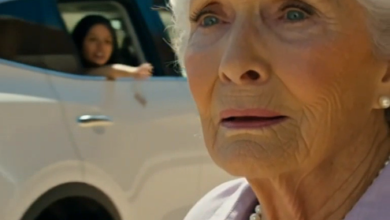
Clara nodded, but she did not look at him. Her eyes remained fixed on the last row, where Evelyn Carter sat with her coat buttoned wrong and her grocery bag resting on her lap.
The room knew pieces of the story.
In small towns, pieces were often enough to build a whole person wrong.
Everyone knew Clara had not been born a Whitman. They knew she had arrived in town at eight years old with a trash bag of clothes, a school file thick with red marks, and a silence that made adults uncomfortable. They knew Evelyn had taken her in as a foster child after three homes had failed.
They also knew Clara had left Evelyn’s house the week after her sixteenth birthday.
No one knew why, but that had not stopped them from deciding.
Some said Evelyn had been too strict. Some said she had taken in foster children for the checks. Some said the old woman had a coldness in her that no child could survive. The crueler people said Clara had escaped.
And when Clara became the shining girl of Willow Creek, the girl with perfect grades and quiet manners, the town rewrote the story even faster.
They called her resilient.
They called Evelyn the thing she had survived.
Now Evelyn sat at the back, small under all that judgment.
Clara unfolded a sheet of paper. It trembled once, then steadied.
“I was asked to speak today about gratitude,” she began. “That is a difficult word when you are young and angry.”
A few people smiled politely, waiting for the usual speech about teachers and hard work.
Clara glanced down.
“When I was eight, I believed adults were people who left. Some left loudly. Some left with papers. Some left while standing right in front of you.”
The auditorium quieted.
In the back row, Evelyn lowered her chin.
Clara continued, “I used to count exits in every room. In school, in church, in grocery stores. I wanted to know how fast I could get out before someone changed their mind about keeping me.”
A woman near the front pressed her hand over her mouth.
Clara did not soften her voice. She did not dramatize it either. That made it heavier.
“The fourth house I lived in was yellow. It had a porch light that buzzed, a kitchen clock that ran five minutes slow, and a woman who made oatmeal every morning even after I told her I hated oatmeal.”
A small ripple moved through the room. Some people turned, just slightly, toward Evelyn.
Evelyn sat very still.
“She had rules,” Clara said. “So many rules. No locked bedroom doors. No leaving dishes in the sink. Homework before television. Lights out by ten. Thank-you notes after birthdays, even if the gift was socks.”
A few soft laughs came, uncertain and brief.
Clara’s mouth curved, but it was not quite a smile.
“At eight years old, I thought rules were proof that love had conditions. I thought every boundary was a warning sign. I thought every raised eyebrow meant someone was getting ready to send me back.”
Her fingers tightened around the paper.
“I was not an easy child.”
A counselor in the second row looked down at her lap.
“I hid food under my mattress. I stole quarters from a jar on the washing machine. I broke a blue lamp and blamed the dog, even though there was no dog.”
This time the laughter came warmer, but Clara waited until it faded.
“Once, I cut every picture of myself out of every family photograph in the house. I thought if I disappeared first, nobody else could make me disappear.”
At the back of the auditorium, Evelyn’s grocery bag crinkled.
The sound was small. But Clara heard it.
She looked up.
“I used to think Mrs. Carter hated me because she never let me win.”
The sentence landed strangely.
Mr. Harlan shifted beside the curtain.
“She made me apologize when I lied. She made me return what I stole. She made me sit at the kitchen table and say what I was feeling, even when all I could say was, ‘I hate you.’”
Clara took a breath.
“And every time I said it, she said the same thing.”
The room waited.
Evelyn’s lips moved faintly in the back row, as if remembering the words before Clara spoke them.
“She said, ‘You can hate me and still eat dinner.’”
No one laughed then.
Clara blinked hard.
“I did not understand that sentence for years.”
A flash of movement came from the right side of the auditorium. Clara’s former caseworker, Miss Lila Grant, sat near the aisle. She was retired now, her hair white at the temples, her hands folded around a program. Her face had gone pale.
Clara noticed her, and something in her expression shifted.
Not fear.
Recognition.
“There are parts of my story I promised myself I would never say in public,” Clara said. “Not because I am ashamed of them. Because I was trying to protect someone who spent her life protecting me.”
The whispers stopped completely.
Even the air conditioners seemed quieter.
Evelyn shook her head once, almost invisible.
Clara saw it.
For a second, the girl onstage looked like the frightened eight-year-old again. Then she straightened.
“I am sorry,” she said, not to the room, but to the woman in the back. “I cannot let them keep thinking what they think.”
Evelyn closed her eyes.
That was the first crack in the story everyone thought they knew.
The second came when Clara reached into the pocket of her dress and pulled out a folded index card, yellowed at the edges.
“I found this last month,” she said. “It was in a box labeled ‘school papers.’ I was looking for my birth certificate for college forms.”
Miss Grant covered her mouth.
Clara unfolded the card with careful fingers.
“It is not mine,” she said. “It is Mrs. Carter’s handwriting.”
She looked at the back row again.
“And it is the first time I understood why she never sat in the front.”
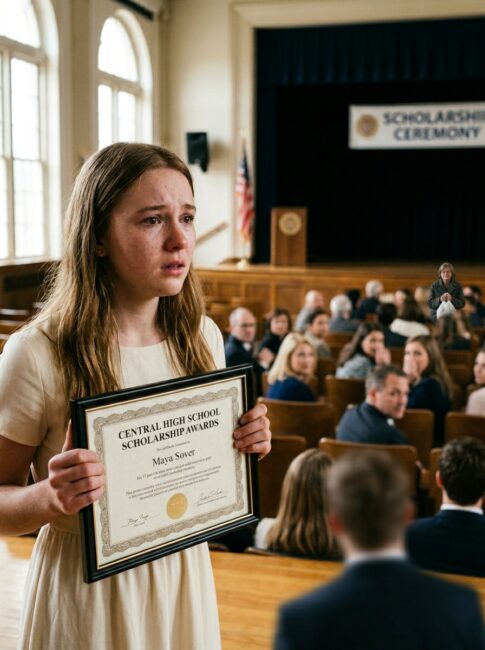
The auditorium had changed shape without moving.
The proud families, the balloons, the plaques, the flower arrangements near the stage all remained where they were. But the room no longer felt like a celebration. It felt like a confession that had been waiting ten years for permission to breathe.
Clara held the index card in both hands.
“I will not read all of it,” she said. “Some things belong to the person who wrote them.”
That one sentence made Evelyn’s face crumple for half a second. She turned toward the wall as if the beige paint had suddenly become interesting.
Clara read only one line.
“‘If Clara runs again, do not call the police first. Call me. She is not bad. She is scared.’”
A sound moved through the room. Not a gasp exactly. More like people losing the version of the story that had made them comfortable.
Clara folded the card.
“I ran away six times from Mrs. Carter’s house.”
No one moved.
“The first time, I was eight. I made it to the gas station behind Route 9 with a backpack full of crackers and one sock. She found me sitting behind the ice machine.”
A few people looked toward Evelyn, but she kept staring at the floor.
“I screamed at her in the parking lot. I told her she was not my mother. I told her nobody wanted her either, or she would have a real family.”
Clara swallowed.
“She did not yell back. She bought me a hot chocolate and drove home with the radio off.”
Her voice thinned, but it did not break.
“The next morning, there was oatmeal on the table.”
A woman in the front row began crying quietly.
“The second time I ran, I took money from her purse. Not a little. Enough that she had to choose between paying the electric bill and buying groceries. I waited for her to send me away.”
Clara looked at the grocery bag in Evelyn’s lap.
“She did not.”
Evelyn’s hands shook around the plastic handles.
“She sold her wedding ring instead.”
A low murmur moved through the auditorium. Everyone in town knew Evelyn Carter had been widowed young. Everyone knew she still wore a plain band for years after her husband died. Few had noticed when it disappeared.
Clara had not known then either.
“I found that out from Miss Grant,” Clara said, glancing toward the retired caseworker. “Mrs. Carter never told me. She told the agency she had misplaced it.”
Miss Grant nodded once, tears shining behind her glasses.
Clara’s voice grew steadier now, as if each truth gave her spine another bone.
“The third time I ran, the county wanted to move me. They said Mrs. Carter’s home might not be the right placement. They said maybe I needed a different environment.”
She paused.
“I overheard her on the phone that night.”
The room leaned in.
“She said, ‘You can move her if you have to. But do not tell her she failed another home. Tell her I failed her. Let her be angry at me. She has carried enough blame.’”
Evelyn whispered, “Clara.”
But the microphone did not catch it. Only the closest people heard.
Clara did not stop.
“That was the first time she chose to look like the villain so I could remain a child.”
The sentence landed with the force of a door opening in a burning house.
People began to understand, but understanding arrived too late to be comfortable.
Clara turned the folded paper in her hand.
“When I was eleven, I won my first school essay contest. Mrs. Carter came to the assembly wearing the same gray coat she has on today. I pretended not to see her.”
Her eyes shone.
“She stood in the back then too.”
Evelyn’s face was wet now. She wiped it with the side of her finger, quick and embarrassed.
“I told my teacher she was just my foster parent. I said it like a warning. Like a wall. Like she should not expect anything from me.”
Clara looked out at the crowd, and her gaze was kind but unsparing.
“Some of you were there.”
Several faces dropped.
“She brought cupcakes that day. Store-brand vanilla cupcakes with blue frosting. I told everyone I did not like blue frosting.”
A soft, aching laugh came through Clara’s tears.
“I ate two in the car on the way home.”
Mr. Harlan removed his glasses.
Clara continued.
“At thirteen, I started calling her Evelyn instead of Mrs. Carter because I knew it hurt her. At fourteen, I told her I wished the county had placed me with someone younger. Someone pretty. Someone who did not smell like dish soap and Vicks.”
Evelyn pressed her lips together.
“I remember every cruel thing I said,” Clara whispered. “She never repeated any of them.”
The auditorium had become a room of witnesses now, not spectators.
“At fifteen, I found letters in the trash. College brochures. Scholarship forms. Summer programs. All with my name on them.”
Clara lifted her eyes.
“I had thrown them away because I thought girls like me did not get futures like that.”
She turned toward Evelyn.
“She took them out, smoothed the pages, and filled out every deadline on a calendar.”
A small twist came then, one no one expected.
“The calendar was not even hers,” Clara said. “It was from the diner where she worked nights.”
That fact moved through the room differently. Willow Creek knew Evelyn had worked at the laundromat. They knew she cleaned offices. But the diner?
Clara answered the unspoken question.
“She worked nights for eleven months so I could take the advanced placement exam fees, buy a used laptop, and have a quiet bedroom because the kitchen table was too cold in winter.”
Evelyn shook her head again, but it no longer had power.
“She told me the extra shifts were because she liked keeping busy. I believed her because teenagers believe sacrifice is just an adult habit.”
The scholarship board sat in the front row. The Langford Foundation director, a tall woman with silver hair, stared at Clara with both hands folded against her chest.
“But the biggest lie Mrs. Carter ever told was the one that made me leave.”
The room tightened.
Here it was.
The story everyone had guessed at for two years.
Clara drew a breath that seemed to hurt.
“When I was sixteen, my biological mother came back.”
A few people gasped. Clara nodded slightly, as though she had expected that.
“She had been gone for eight years. I had dreamed about that day so many times that I did not recognize it when it finally happened. She came to the house wearing perfume and a red coat. She brought a necklace with a tiny heart on it.”
Clara touched her throat. There was no necklace there.
“She told me she had made mistakes. She told me she wanted to start over. She told me I belonged with blood.”
At the back of the room, Evelyn’s eyes lifted. They looked older than the rest of her.
“I wanted to believe her so badly that I became cruel to the one person who had never asked me to earn my place.”
Clara’s paper lowered to her side.
“My mother asked Mrs. Carter to sign a statement saying she supported the reunification. Mrs. Carter said yes.”
A murmur broke out. This was the detail that had hardened the town against Evelyn.
Clara nodded, accepting their shock.
“That is what people heard. That she let me go.”
Her voice deepened.
“What nobody heard was what my mother told her in the kitchen when she thought I was upstairs.”
Miss Grant bowed her head.
“She said, ‘If you fight me, Clara will hate you forever. If you let her come, at least she will learn the truth without thinking you kept her from me.’”
Clara’s lips trembled.
“Mrs. Carter did not sign because she did not love me. She signed because I was standing on the stairs listening, and she knew I would choose the woman who had left over the woman who had stayed.”
The auditorium went utterly silent.
“I looked at Mrs. Carter that night and said, ‘Thank you for finally not pretending I’m yours.’”
Evelyn made a small sound, not quite a sob.
Clara wiped one tear with the heel of her hand.
“She packed my clothes. She folded every shirt. She put my school records in a folder. She tucked twenty dollars in my coat pocket, though I did not find it for three days.”
Her voice broke now, but she carried it.
“And at the door, she said, ‘You can come home angry. You can come home ashamed. You can come home without calling first.’”
Clara looked down at the stage floor.
“I did not come home for nine months.”
No one coughed. No one shifted. Even the children present seemed to know they were inside something sacred.
“My mother did not become the mother I had imagined. She was not evil. She was broken in ways a child should not have to fix. We moved twice. I missed school. I stopped answering Mrs. Carter’s calls because I wanted my choice to be right.”
Clara lifted the index card again.
“Then one night, I called from a bus station two counties over. I had no money. No coat. No pride left.”
She smiled through tears.
“Mrs. Carter answered on the first ring.”
Evelyn covered her face.
“She did not say, ‘I told you so.’ She did not ask what happened. She said, ‘Stay under the light. I am coming.’”
By then, half the auditorium was crying.
“She drove through a thunderstorm to get me. When I got in the car, I expected questions.”
Clara laughed softly, almost disbelieving after all these years.
“She handed me a towel and a paper bag with a peanut butter sandwich inside.”
The grocery bag in Evelyn’s lap crinkled again.
Clara looked at it.
“That is what is in that bag today, isn’t it?”
Evelyn froze.
Clara smiled.
“A peanut butter sandwich. Apple slices. And probably a napkin folded around two oatmeal cookies because she still thinks ceremonies run too long.”
A ripple of laughter moved through tears.
For the first time since entering the auditorium, Evelyn looked up fully. Her eyes met Clara’s across all those rows, across every wrong assumption, across every year they had lost and kept at the same time.
Clara turned back to the audience.
“This scholarship is supposed to honor achievement. I am grateful for it. I am grateful for my teachers, my counselor, the Langford Foundation, and every person who helped me reach this stage.”
She paused.
“But I need to tell the truth about how I got here.”
She set the certificate on the podium.
“I did not get here because I was strong enough alone. I got here because one woman let me misunderstand her rather than let me lose the hope that someone would still come for me.”
Evelyn shook her head, tears slipping freely now.
“She kept showing up after I embarrassed her. She kept calling after I ignored her. She kept a bed made in a yellow room for a girl who kept insisting she did not need one.”
Clara’s voice softened.
“She sat at the back because I kept pushing her there.”
That was the fourth twist, and perhaps the hardest one. The town had blamed Evelyn for the distance. Clara had built it with fear, and Evelyn had honored it with patience.
Clara took one step away from the podium.
“So today, before I thank anyone else, I need to thank the woman I would not let sit in the front.”
Mr. Harlan moved as if to help, but Clara had already descended the stage steps.
The auditorium watched her walk down the aisle with the scholarship certificate in one hand and the folded index card in the other. Her cream dress brushed against the rows of chairs. People stood slightly to let her pass, though no one had asked them to.
Evelyn tried to rise.
Clara shook her head.
“No,” she said gently. “Please stay.”
She reached the last row and knelt in front of the old woman who had entered with a grocery bag and shame that did not belong to her.
Then Clara took the plastic bag from Evelyn’s lap and held her hand instead.
The microphone still picked up Clara’s voice because the auditorium was quiet enough for even a whisper to travel.
“You were not the woman who had to take me,” Clara said. “You were the woman who chose me.”
Evelyn broke then.
Not loudly. Never loudly.
She bent forward, and Clara folded into her arms as if the distance between the stage and the last row had always been the longest road home.
No one applauded at first.
Applause would have been too sharp, too ordinary, too easy for what had just happened.
The room simply sat with it.
The scholarship board director was the first to stand. Not with dramatic force, but slowly, as if rising in church. Then Mr. Harlan stood. Then Miss Grant. Then row by row, the auditorium rose for the woman in the gray coat.
Evelyn did not seem to understand it.
She kept one hand on Clara’s back and the other over her own mouth, shaking her head as though the standing crowd had made some clerical error.
Clara laughed through tears and helped her stand.
The grocery bag slipped from the chair.
An apple rolled out first, then a napkin bundle, then a peanut butter sandwich wrapped in wax paper with Clara’s name written on it in blue pen.
That small thing undid people more than the speech.
Because love, when it is real, often looks embarrassingly plain from a distance. It looks like oatmeal. It looks like rules. It looks like a sandwich packed for a girl who is old enough to win a scholarship but still someone’s child.
Clara picked up the sandwich and pressed it to her chest.
“I knew it,” she whispered.
Evelyn wiped her cheeks quickly. “You forget to eat when you’re nervous.”
“I’m seventeen.”
“And still nervous.”
The front rows laughed softly, grateful for air.
Mr. Harlan walked to the back with the second microphone. He did not make a speech. He only looked at Evelyn and asked, “Mrs. Carter, would you like to sit with Clara for the rest of the ceremony?”
Evelyn looked around, startled by all those faces that had judged her ten minutes earlier and now waited for her answer.
She leaned toward Clara.
“I don’t want to take anyone’s seat.”
Clara took her hand.
“You already saved mine.”
That was all she said, but it was enough.
A father in the front row stepped into the aisle and offered his chair. Then another parent moved. Then another. The room rearranged itself around the truth, awkwardly but sincerely, the way people do when they cannot undo harm but can at least stop adding to it.
Evelyn walked beside Clara to the front.
Not proudly.
Not triumphantly.
Just carefully, with the grocery bag in one hand and Clara’s fingers in the other.
When the ceremony resumed, Clara’s name was called again for photographs. This time, when the camera flashed, Evelyn stood beside her. She tried to step out of the frame at the last second, but Clara pulled her back by the sleeve.
“Stay,” Clara said.
Evelyn looked at her.
The word had once belonged to Evelyn. Now Clara gave it back.
So Evelyn stayed.
Afterward, people came to apologize. Some did it with words. Some with wet eyes and clumsy handshakes. Some only touched Evelyn’s arm and said her name differently than they had before.
She accepted each apology with the same quiet nod, never making anyone crawl for forgiveness.
That might have been the most painful kindness of all.
Outside, late afternoon sunlight spread over the school parking lot. Families posed near flower beds. Balloons tugged at strings. The sky had the soft blue look of a day that did not know it had witnessed anything important.
Clara and Evelyn walked slowly toward an old brown sedan parked under a maple tree.
The car was clean but tired. A graduation tassel from no one knew when hung from the rearview mirror. Clara opened the passenger door for Evelyn, but Evelyn frowned.
“You are the scholarship girl,” she said. “You should be treated special today.”
Clara leaned against the door and smiled.
“I am.”
Evelyn looked down at the grocery bag.
“I made the cookies too dry.”
“You always do.”
“I can buy some from the bakery.”
Clara shook her head. “No. I like yours.”
Evelyn studied her face, searching for the old sarcasm that used to hide in kind words. She did not find it.
So she nodded once and got into the car.
Before Clara closed the door, Evelyn touched her wrist.
“I did choose you,” she said, barely above a whisper. “Every day.”
Clara’s eyes filled again, but she did not cry this time.
“I know,” she said.
Then she walked around to the driver’s side, holding the scholarship certificate under one arm and the peanut butter sandwich in her hand.
Across the parking lot, people were still watching.
But this time, their watching felt different.
Not clean enough to erase the years. Not holy enough to excuse the whispers. Just quieter. More careful. Maybe that was where some kinds of change began.
Clara started the engine. Evelyn reached over and brushed a crumb from Clara’s dress, the same way she must have done when Clara was small and furious and pretending not to need anyone.
The car pulled away from Willow Creek High, past the auditorium doors, past the rows of proud families, past the place where an old woman had walked in carrying lunch and blame that was never hers.
At the first stop sign, Clara unwrapped the sandwich and took a bite.
Evelyn looked out the window, smiling at nothing.
And in that small, ordinary silence, the girl who had once counted every exit finally drove home with the woman who had always left the light on.
Follow the page for more heartfelt stories that stay with you long after the last line.