Part 2: The Principal Quietly Stopped the Ceremony — Then a Student Walked In Wearing a Dust-Covered Military Uniform
Noah Whitaker had not been expected to graduate.
That was the first thing Cedar Falls remembered about him, because small towns are careful archivists of other people’s failures.
They remembered the cafeteria fight in October, when he shoved a boy into a table hard enough to crack a lunch tray. They remembered the police cruiser outside the school two weeks later. They remembered his mother, Dana Whitaker, walking into the front office with red eyes and an unpaid electric bill folded in her purse.
They remembered that Noah stopped showing up before Christmas.
What most people did not remember was the way he used to arrive early every morning with his little sister’s pink backpack hooked over one shoulder.
Her name was Emma.
She was nine, small for her age, with hearing aids she decorated with tiny stickers. Their elementary school started an hour later than the high school, so Noah walked her across town before first bell, rain or shine. He tied her shoes, zipped her coat, and held one hand out at crosswalks like he had been born worried.
Teachers noticed for a while.
Then people noticed other things.
Noah sleeping in first period. Noah smelling faintly of motor oil because he worked nights at a repair shop. Noah missing homework. Noah eating only when the cafeteria served something he could wrap in napkins and take home.
Principal Harris noticed too.
But Harris had spent thirty-eight years believing structure saved children. Rules, consequences, attendance sheets, closed doors, signed forms. She thought compassion without boundaries became chaos.
So when Noah snapped in the cafeteria, she gave him three days of suspension.
She did not ask what Marcus Dell had whispered before the shove.
She did not know Marcus had said, “Your dad died overseas and still couldn’t get away from your family.”
Noah never repeated it.
He simply took the suspension slip and walked home.
His father, Staff Sergeant Aaron Whitaker, had been killed during a convoy accident in Afghanistan when Noah was seven. The folded flag came home before Noah understood why grown men kept touching his shoulder.
After Aaron died, Dana worked two jobs and smiled like a woman patching a roof in the rain. She cleaned medical offices at night and stocked shelves before dawn. Noah became the man of the house before anyone had explained to him how heavy that sentence was.
By senior year, the weight had started showing.
He lost friends.
He lost patience.
Then he lost the one thing everyone thought he had thrown away.
His place at Cedar Falls High.
The official story was that Noah withdrew.
The truth was messier.
After the cafeteria fight, Noah missed several meetings with the school counselor. He missed makeup exams. He missed a court diversion appointment after a minor trespassing charge near the closed mill. Principal Harris signed a disciplinary recommendation that placed him in an alternative completion program two counties away.
She told herself it was help.
Noah heard it as exile.
On his last day at Cedar Falls, he came to the principal’s office with his father’s old service watch in his hand.
“I need one more chance,” he said.
Harris looked at the file in front of her. Absences. Fighting. Failed assignments. Police notes. She saw risk written in ink.
“Noah,” she said, not unkindly, “chances only work when someone is ready to take them.”
His jaw tightened.
“I am ready.”
“You have said that before.”
He nodded once.
Then he placed a folded paper on her desk.
It was an essay.
The title was simple.
What My Father Left Behind
Harris did not read it then.
She had a board meeting in fifteen minutes. A parent waiting outside. A gym floor repair estimate on her desk.
She slid the essay beneath his file and said, “I’ll review this.”
Noah left without another word.
She forgot about it for six weeks.
That became the detail she would carry like a stone.
In February, a winter storm shut down school for two days. Harris stayed late sorting old files because retirement paperwork sat on her desk, and she hated the word retirement almost as much as she hated unfinished business.
Noah’s essay fell from his folder.
She read it alone under fluorescent lights.
It was not polished. Some sentences ran too long. Some words were spelled wrong. But the essay had something that no transcript could hold.
Noah wrote about his father teaching him to salute by placing two fingers against a cereal box at breakfast. He wrote about Emma asking why Daddy lived in a flag. He wrote about Dana crying in the laundry room while the dryer spun without heat.
Then he wrote one sentence Harris read three times.
I am not angry because my father left us. I am angry because everyone thinks I should know how to be him.
Harris sat very still.
At the bottom of the page, Noah had written a final note by hand.
If I don’t graduate from here, please don’t let Emma think I quit.
That was when the first crack opened.
The second came from Mrs. Lin, the school nurse, who mentioned that Noah had been picking up leftover breakfast bars from her office all semester.
“For Emma?” Harris asked.
Mrs. Lin hesitated.
“For his mother too, I think.”
The third came from Coach Bell, who admitted that Noah had asked to use the locker room showers before first period because the hot water at home had been shut off.
“I thought you knew,” Coach Bell said.
Harris did not answer.
After that, she began looking differently at the file she had once treated as proof.
Absences became questions.
Anger became smoke.
And somewhere beneath the smoke was a boy no one had stood close enough to see.
Still, when Harris called Dana, Noah was already gone.
“He enlisted,” Dana said.
Harris closed her eyes.
“He is eighteen?”
“Turned eighteen last month.”
There was pride in Dana’s voice, but fear sat beneath it like a shadow.
“He said he wanted to finish what his father started.”
“Did he finish school?”
Dana went quiet.
“He’s trying. Online packets. Military education office. I don’t understand all of it.”
Harris looked at Noah’s essay on her desk.
“Mrs. Whitaker,” she said carefully, “I think your son still deserves to walk.”
Dana inhaled sharply.
“He won’t come.”
“I can invite him.”
“He won’t come for himself.”
Harris looked down at the last line of the essay.
Then she said, “Maybe he’ll come for Emma.”
Principal Harris sent three letters.
The first went to Noah at basic training.
It came back two weeks later, forwarded and creased, with no reply.
The second went through a veterans liaison Dana knew from church.
No reply.
The third letter was different.
Harris wrote it by hand on school stationery, though her fingers cramped halfway through.
She did not mention rules.
She did not mention policy.
She did not mention redemption, because she had learned too late that adults often use beautiful words after failing to do simple things.
Instead, she wrote:
Noah, I read your essay. I should have read it when you handed it to me. Emma has been invited to sit in the family section at graduation. If you choose to come, your chair will be waiting. If you choose not to, I will understand. But I want you to know this school made a mistake when it saw your anger before it saw your burden.
She mailed it and told no one.
For three weeks, nothing happened.
Then, on the Monday before graduation, Harris received a call from a number she did not recognize.
The voice on the line was older than she remembered.
“Principal Harris?”
“Yes.”
“It’s Noah Whitaker.”
She stood so quickly her chair rolled into the wall.
“Noah.”
“I got your letter.”
A silence followed.
Harris waited.
He said, “I don’t need a ceremony.”
“I know.”
“I’m not a student there anymore.”
“You completed your credits through the state program. Cedar Falls accepted the transfer. Your diploma is here.”
Another silence.
His voice lowered.
“Does my mom know?”
“Not yet.”
“Don’t tell her.”
Harris frowned.
“Noah, if you plan to come, your mother deserves—”
“I said don’t tell her.”
The old Harris would have corrected his tone.
This Harris heard something else.
A tremor.
“Are you all right?” she asked.
He gave a small laugh with no humor in it.
“No, ma’am.”
That was the first time he had ever called her ma’am.
Then he told her part of the truth.
His training unit had granted him a short emergency travel window after paperwork confusion delayed his leave approval. He had borrowed money from another recruit, taken two buses, and caught a ride with a trucker outside St. Louis. He would reach Cedar Falls close to ceremony time if nothing went wrong.
“Why didn’t you tell your mother?” Harris asked.
“Because if I don’t make it, I can’t watch her lose me twice.”
The words entered Harris and stayed there.
She gripped the phone.
“I’ll hold the chair.”
“Don’t stop anything for me.”
But Harris did not promise that.
On graduation day, Cedar Falls High looked more beautiful than it had any right to look.
Families filled the gym. Babies fussed. Grandfathers leaned on canes. Mothers dabbed at their eyes before anything had happened yet.
Dana Whitaker arrived wearing a navy dress she had borrowed from her sister. Emma walked beside her, hearing aids decorated with tiny gold stars. She carried a small framed photograph of Aaron Whitaker in uniform, because Noah had once promised that Dad would see them both graduate one day.
Dana looked at the reserved front-row chair with Noah’s name on it.
Her face changed.
“Principal Harris,” she said quietly, “why is that there?”
Harris folded both hands in front of her.
“Because it belongs there.”
Dana looked away.
“He isn’t coming.”
Harris almost told her.
Then she remembered Noah’s voice.
If I don’t make it, I can’t watch her lose me twice.
So she said only, “Then it will wait.”
The ceremony began.
Names were read. Scholarships were announced. The choir sang a song about rivers and roads. Harris watched the back doors between every sentence.
Noah did not appear.
At 10:12, the valedictorian rose from her seat.
Harris checked her phone hidden beneath the podium.
One message.
Truck broke down outside Mill Creek. Trying to get another ride. Start without me.
The valedictorian reached the microphone.
Harris looked at the empty chair in the front row.
Emma had placed her father’s photo on it.
That small act did what no policy manual could.
Harris raised her hand.
The room quieted.
The valedictorian paused, confused.
Parents shifted. Board members frowned. A teacher leaned forward as if to rescue the schedule.
Then the back doors opened.
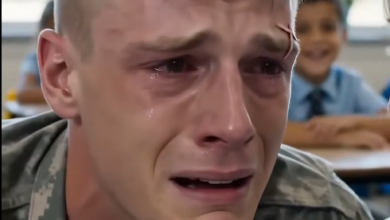
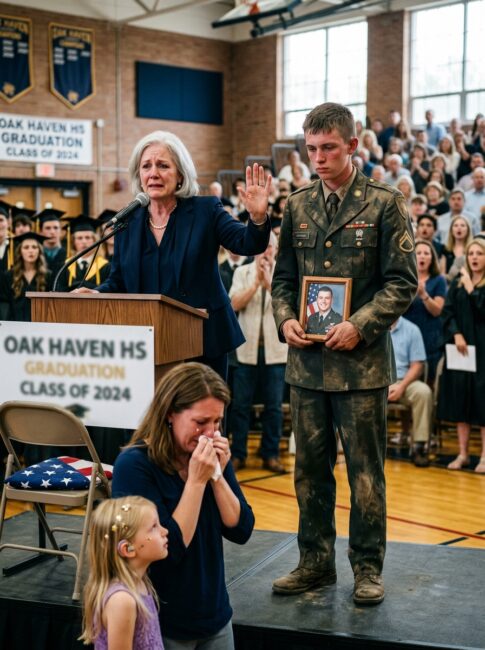
Noah walked in wearing his military dress uniform.
Dust clung to the fabric. His shoes were scuffed. His eyes looked hollow from travel and sleeplessness. One pant leg had mud dried near the cuff where he had clearly walked part of the road.
For a moment, people saw only the boy they thought they knew.
The troublemaker.
The dropout.
The angry brother. The fatherless kid who had finally chosen a uniform over a classroom.
A few whispers rose immediately.
But then Emma turned.
Her mouth opened.
The framed photo slid from the empty chair and landed flat against the seat.
“Noah,” she whispered.
Dana stood so fast her purse fell.
Noah looked at her, and all the military stillness left his face.
He was eighteen again.
He was tired.
He was sorry.
He was home.
But he did not walk to them yet.
He walked to Principal Harris.
The room watched every step.
Harris came down from the stage, which she had never done during a ceremony in all her years at Cedar Falls.
She met him at the center aisle.
Noah tried to salute.
His hand rose halfway, then trembled.
Harris gently lowered it.
“No,” she said softly, though the microphone still carried her voice. “Today, we stand for you.”
Then she turned to the audience.
“There is something this school owes Noah Whitaker.”
A school board member stood, furious. “Elaine, this is not appropriate.”
Harris looked at him with thirty-eight years of authority and one morning of courage.
“It is overdue.”
She reached into her folder and pulled out Noah’s essay.
Noah’s face tightened.
“You said you wouldn’t make it about me.”
“I am not,” Harris said. “I am making it right.”
She faced the gym.
“This young man was disciplined in this building. Some of that discipline was justified. Some of it was incomplete. We saw his absences, his anger, and his mistakes. We did not ask enough about the little sister he walked to school, the mother he helped feed, or the grief he carried while trying to become a man before he finished being a boy.”
The gym grew painfully quiet.
Dana covered her mouth.
Emma stared at her brother as if seeing all his hidden years at once.
Harris looked down at the essay.
“I will not read his private words without permission.”
She turned to Noah.
He stared at the floor.
For a second, everyone thought he would refuse.
Then he nodded once.
Harris read only two lines.
“I am not angry because my father left us. I am angry because everyone thinks I should know how to be him.”
The sentence landed across the room like rain on dry ground.
Noah closed his eyes.
Harris lowered the page.
“This diploma is not being handed to a perfect student,” she said. “It is being handed to a young man who kept walking when many adults, including me, misunderstood the weight he was carrying.”
Then she picked up a diploma folder from the podium.
“Noah Aaron Whitaker.”
No one moved.
Then Emma stood on her chair and began to clap with both small hands.
Dana clapped next, sobbing.
The sound spread slowly, row by row, until the gym was no longer whispering.
It was standing.
Noah did not look proud.
He looked almost broken by kindness arriving late.
When Harris handed him the diploma, he held it like it might disappear.
Then, instead of shaking her hand, he leaned forward and whispered something only she could hear.
But Harris stepped back and repeated it into the microphone because she knew the room needed to hear the kind of grace it had not earned.
“He said, ‘Please give Emma hers someday faster than you gave me mine.’”
And that was when even the board member sat down.
The ceremony continued, but nothing felt quite the same after Noah walked across the gym.
Names were still called. Cameras still flashed. Tassels still turned from one side to the other. Yet the room had softened in a way nobody could announce.
People looked more carefully at the students passing before them.
At the boy with sleeves too short for his arms.
At the girl scanning the crowd for someone who had not come.
At the quiet ones, the restless ones, the ones whose files had always seemed easier to read than their faces.
Noah sat between Dana and Emma for the rest of the ceremony.
He kept his shoulders straight at first, as if training had taught his body to hold itself even when his heart could not.
Then Emma slipped her hand into his.
That finished him.
His chin dropped. His eyes filled. He pressed her hand between both of his and stared at their joined fingers like he was trying to memorize home before losing sight of it again.
Dana touched the dust on his sleeve.
“You walked?”
“Some.”
“How far?”
He gave a tired half smile.
“Enough.”
She brushed at the mud on his pant leg, then stopped when she realized she was crying on his uniform.
“I would’ve come for you.”
“I know.”
“Then why didn’t you call?”
He looked toward Emma.
“Because she already had one empty chair.”
Dana’s face folded.
She reached for him, and for a moment, the mother who had tried to hold a family together with coupons, night shifts, and porch-light prayers held both her children against her.
Across the gym, Principal Harris watched from the side of the stage.
The applause had ended. The program had moved on. But her hands still trembled.
Mrs. Bell, the guidance counselor, came to stand beside her.
“You did the right thing,” she whispered.
Harris looked at Noah and his family.
“I did it late.”
Mrs. Bell said nothing.
Late was not nothing.
But late was not the same as soon enough.
After the final cap flew and families spilled into the warm afternoon, Noah remained near the front row. People came to him awkwardly. Teachers. Former classmates. A bus driver who remembered Emma’s pink backpack.
Some apologized.
Some only shook his hand.
One father, whose son had once mocked Noah in the cafeteria, stood before him and could not find words. Noah saved him from the search.
“Have a good summer, sir,” he said.
That was all.
Noah was not there to collect guilt.
Outside, sunlight spread across the school lawn. Seniors posed under the maple trees. Mothers fixed crooked collars. Balloons pulled against strings.
Emma tugged Noah toward the flagpole.
“Dad’s picture,” she said.
Dana had almost forgotten the frame.
Noah took it from her carefully.
In the photo, Aaron Whitaker stood younger than Noah was now in some ways, older in others. His smile had the same crooked bend.
Noah set the framed picture at the base of the flagpole and placed his diploma beside it.
For a while, the three Whitakers stood there without speaking.
Then Emma signed something with small, quick hands.
Noah smiled sadly.
Dana translated out of habit, though Noah understood.
“She says Dad came too.”
Noah crouched beside his sister.
“Yeah,” he said. “I think he did.”
Emma touched the dusty sleeve of his uniform.
“Are you leaving again?”
His smile faded.
“Tomorrow morning.”
Her lower lip trembled.
He reached into his pocket and pulled out the diploma’s blue ribbon. He tied it gently around the handle of her pink backpack, the same one she still refused to replace.
“You keep this until I come back.”
“What if it gets dirty?”
Noah looked down at his uniform, at the mud and road dust and creases from miles he had traveled because one chair mattered.
“Then it means it went somewhere.”
Emma seemed to accept that.
Near the school doors, Principal Harris stood alone with Noah’s essay folder pressed to her chest.
Noah saw her and walked over.
For a second, neither knew what to say.
Harris finally held out the essay.
“I believe this belongs to you.”
Noah looked at it, then shook his head.
“Keep it.”
Her eyes lifted.
“Are you sure?”
He nodded toward the school.
“Somebody else might need you to read theirs on time.”
Harris could not answer.
She only held the paper closer.
Noah returned to his mother and sister. Together, they crossed the lawn slowly, his uniform still dusty, his diploma ribbon bright on Emma’s backpack.
Behind them, the empty chair from the front row was being folded and carried away.
But for everyone who had seen it, the chair remained.
A quiet space.
A question.
A reminder that some children arrive late not because they do not care, but because they have been carrying more than anyone thought to ask about.
Noah paused at the edge of the parking lot and looked back once at the school.
Then Emma reached for his hand again.
This time, he took it without hesitation.
For more heartfelt stories about family, sacrifice, and the quiet truths people carry unseen, follow this page and keep reading with us.