Part 2: Twenty-Five Bikers Stood Outside Her House — Then One Knelt Down
My name is Sarah Whitaker, and I taught third grade at Coosa Bend Elementary, a low brick school outside Gadsden where the cafeteria smelled like floor wax, chicken patties, and old milk.
I had been teaching twelve years by then.
Long enough to know the difference between a shy child and a scared one.
Emily Carter was scared.
She was the kind of little girl who apologized when someone stepped on her foot. She kept her crayons lined up by color. She read above grade level but never raised her hand. If a door slammed, her shoulders jumped to her ears.
Her grandmother, Mrs. Ruth Carter, was raising her in a small white house off Highway 431, near a gas station where truckers bought biscuits before daylight. Ruth had arthritis in both hands and a voice soft as worn cotton. She loved that child fiercely, but love does not make courtrooms less terrifying.
Emily’s stepfather had been arrested after a neighbor called the sheriff one night.
I will not write the details.
They are not needed.
Pain does not need decoration.
By March, the district counselor told me Emily might have to testify. The prosecutor said they would try to make it gentle. The victim advocate said Emily could bring a stuffed animal. Everyone meant well.
But every time someone said “court,” Emily stopped breathing right.
One afternoon, she sat in my classroom after the other kids had left, staring at a spelling worksheet she had already finished.
“Miss Whitaker,” she said, “what happens if I can’t talk?”
I sat beside her.
“Then we wait.”
“What if he looks at me?”
I had no good teacher answer for that.
So I told the truth.
“I don’t know, sweetheart.”
That night, I went home and searched for help. Not therapy. Not law. She already had those. I searched for people who understood children who were afraid of adults.
That was how I found the Alabama chapter of Bikers Against Child Abuse.
I had heard of them in passing. Big men on motorcycles showing up for abused kids. It sounded almost too simple. Almost too strange.
But desperate people do not get picky about hope.
I wrote the letter at my kitchen table with a cup of cold coffee beside me.
A man called me the next morning.
“This is Anchor,” he said.
His voice came through the phone low and rough, but he spoke carefully, like every word had been sanded down first.
He asked Emily’s age. He asked what made her feel unsafe. He asked whether law enforcement knew. He asked whether her guardian approved.
He did not ask for details he did not need.
That mattered.
When he came to meet Ruth and me two days later, he did not come alone. Two other members came with him: a Black American biker in his fifties named Deacon, tall and narrow with silver in his beard, and a white American woman in her forties named Mercy, with red hair, tattooed arms, and eyes sharp enough to cut through excuses.
They parked their Harleys across the street, not in the driveway.
Anchor said, “We don’t crowd kids.”
That was the first thing that surprised me.
The second was the purple glove.
Hanging from his left handlebar was one small child’s winter glove, faded lavender, tied with a strip of leather.
It looked ridiculous against all that chrome and black steel.
I noticed it.
He noticed me noticing it.
His face closed.
Mercy changed the subject.
Inside Ruth’s living room, Anchor sat on the edge of the couch with his elbows on his knees. He looked too large for the house. The floor creaked under his boots. His leather cut made a small stiff sound every time he moved.
Emily stayed behind Ruth’s chair.
Anchor did not try to charm her.
He did not ask for a hug.
He did not say, “Don’t be scared.”
He just placed his gloves on the coffee table and said, “My job is to show up. Your job is to breathe.”
Emily peeked around the chair.
Anchor nodded once.
“That’s it,” he said. “Just breathe.”
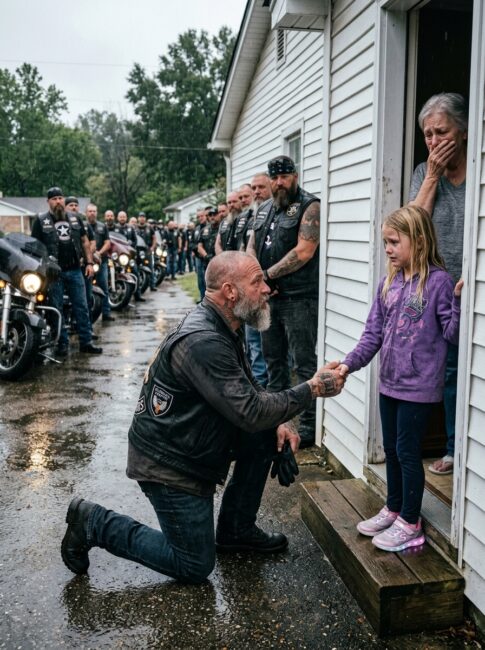
The morning of court arrived gray and wet.
A thin Alabama rain tapped the windows before sunrise. Not a storm. Worse. The kind of rain that makes everything feel tired.
I drove to Ruth’s house at 6:45 with a folder of school papers Emily had asked to bring, because children think familiar things can hold them together. Maybe they can.
Ruth opened the door in her robe.
Her eyes were red.
“She won’t put on her shoes,” she whispered.
Emily sat on the hallway floor in her purple hoodie, knees pulled to her chest, sneakers beside her untouched. Her face had gone pale in that quiet way kids get when fear has moved from their stomach into their bones.
“I can’t,” she said.
Not loud.
Not dramatic.
Just finished.
Ruth knelt beside her and winced because her knees were bad. I sat on the floor too.
For fifteen minutes, we tried every gentle thing.
The stuffed rabbit.
The breathing exercise.
The promise that I would be there.
The promise that Ruth would be there.
Nothing reached her.
Then we heard it.
One engine first.
Deep and slow.
Then another.
Then another.
The sound rolled down the street like thunder learning to count.
V-twins filled the morning. Not racing. Not showing off. Just arriving. One by one, twenty-five motorcycles turned onto that narrow road off Highway 431 and parked in a clean line along the curb.
The rain softened on their helmets and leather.
Engines cut off.
Silence dropped hard.
Emily’s head lifted.
Ruth went to the window and put one hand over her mouth.
I stepped onto the porch.
Twenty-five bikers stood in the road.
Men and women. Black, white, Latino. Ages maybe thirty to seventy. Heavy leather. Denim. Boots. Tattoos. Gray beards. Braids. Scars. Some looked like retired soldiers. Some looked like mechanics. Some looked like people a nervous cashier would watch closely in a gas station.
Every one of them wore the same purpose.
No cameras.
No speeches.
No drama.
Just a line of bodies saying what the court system could not say in a language a child could understand.
You are not alone.
Anchor stood in front.
He wore a black helmet under one arm, his cut dark from rain, his beard wet at the edges. His tattooed hands were gloved. On one finger, I saw the word HOLD inked across the knuckles.
He looked terrifying.
Then Emily appeared behind Ruth.
She saw them and began to shake.
I thought we had made a mistake.
Maybe twenty-five bikers were too much. Maybe we had brought thunder to a child already afraid of storms.
Anchor must have seen it too.
He lifted one hand slightly, and every biker behind him stayed still.
No one moved closer.
No one spoke.
Anchor walked only halfway up the driveway. Then he stopped. He lowered himself slowly until one knee touched wet concrete.
The leather of his vest creaked.
The rain clicked off his shoulders.
He removed his right glove and set it on the ground beside him.
His bare hand was scarred and huge.
But he held it open.
Empty.
“No one touches you today,” he said. “You’re safe.”
Emily stood frozen.
Then, step by step, she walked down the porch stairs.
She reached him.
Her tiny hand disappeared inside his.
Anchor’s jaw tightened.
His eyes shone, but nothing fell.
“Good,” he said.
Just one word.
The bikers escorted us to the courthouse in downtown Gadsden. Two rode in front of Ruth’s old Buick. Two rode behind. The others followed in a staggered line, headlights glowing through rain.
People on Broad Street stopped and stared.
At the courthouse, a deputy met us at the entrance. He had been warned. Still, his eyebrows went up when the bikes pulled in.
Anchor helped Emily out of the car.
Her hand stayed locked in his.
Inside, the hallway smelled like wet wool, floor polish, and vending machine coffee. Emily’s stepfather sat at the far end with his attorney.
He looked over.
Emily stopped walking.
Anchor felt it through her hand.
He did not look at the man. Not once.
He looked down at Emily.
“Breathe,” he said.
She did.
And everyone thought that was the victory.
The child walked into court.
The bikers waited outside the courtroom.
The prosecutor smiled.
Ruth cried silently into a tissue.
Emily testified.
Small voice. Clear words. Truth told once more, where it mattered.
That should have been the climax.
But the real break came after.
When court recessed, Emily stepped into the hallway and ran straight to Anchor.
He caught her carefully.
Then she looked up and asked, “Did someone do this for you?”
The hallway went still.
Anchor’s hand opened and closed once.
His voice came out rough.
“No,” he said. “Nobody came.”
I learned the truth three weeks later.
By then, Emily’s stepfather had been convicted. The sentence came down on a Friday morning. Ruth called me from the courthouse steps, crying so hard I could barely understand her.
Emily was safe.
At least legally.
People like to think that is the end.
It is not.
Safety has to be taught back into the body.
That is where the bikers stayed.
They did not vanish after the verdict. Deacon came to Emily’s school play and stood in the back by the exit. Mercy helped Ruth fix a broken porch rail. A young prospect named Caleb brought groceries and pretended he had “extra,” though no one believed him.
Anchor came every Thursday.
Same time.
Four o’clock.
He sat on Ruth’s porch while Emily read books out loud from the swing. He never corrected her unless she asked. Never pushed. Never made himself the hero of the story.
One Thursday, I stopped by with homework packets.
Anchor was in the driveway adjusting something on his Harley. The purple glove still hung from the handlebar.
This time I asked.
“Who did that belong to?”
He kept working for a few seconds.
Metal clicked.
A wrench turned.
Then he said, “Me.”
I thought I had misheard.
“That was yours?”
He stood slowly. His back popped. He wiped his hands on a rag.
“My sister’s,” he said. “Then mine. Then nobody’s.”
The air changed.
He looked toward the porch, where Emily was laughing at something Mercy had said.
Anchor leaned against the bike.
“I was eight,” he said. “My mother’s boyfriend liked quiet houses.”
That was all he said at first.
No details.
No performance.
Just six words that carried a whole childhood behind them.
He told me he used to hide in a laundry room with his little sister, Annie. She had a purple glove she wore even when it wasn’t cold. Said it made her brave. One night, after things got bad, he promised her he would tell someone at school.
He didn’t.
He was afraid.
The next week, Annie was sent to live with an aunt in Mississippi. Anchor stayed. He never saw her again after he turned twelve. Letters stopped. Adults gave half answers. The world moved on like children were boxes that could be misplaced.
He grew up angry.
Fought everyone.
Trusted no one.
Joined the Army at eighteen because uniforms made more sense than families. Came home with more ghosts than he left with. Drank too much. Slept too little. Got arrested once for putting a man through a bar table after hearing him call his kid stupid.
“I wasn’t noble,” he said. “I was loaded.”
Years later, a BACA member visited a veterans support meeting and talked about standing with abused children.
Anchor almost walked out.
Instead, he joined.
Not because he had healed.
Because he had not.
That was the twist I did not see coming.
Anchor did not kneel in front of Emily because he was fearless.
He knelt because he remembered being small.
He knew what a hallway felt like when the wrong man was home.
He knew the sound of boots that meant hide.
He knew what it cost a child to speak.
And he had spent forty years wishing one grown man, just one, had taken off a glove, held out a hand, and said, “You’re safe.”
After that, everything I had seen made sense.
The way Anchor always removed his glove before offering his hand.
A glove can look like armor.
A bare hand says, I will not hurt you.
The way he never walked directly toward Emily. He stopped halfway and let her choose the distance.
The way his club stood in silence instead of roaring and cheering. Loud men had scared him as a boy. He would not become one for a child.
Even his road name changed in my mind.
Anchor.
Not because he was heavy.
Because he stayed.
I asked Mercy about it once while we watched Emily draw chalk flowers on Ruth’s driveway.
Mercy smiled a little.
“He doesn’t like people telling that story.”
“I won’t.”
“He thinks pain should be useful or buried.”
“That sounds healthy.”
Mercy snorted. “Brother, none of us joined because we were well-adjusted.”
She told me the club had been tested before Emily’s case.
Not by outsiders.
By themselves.
The week before court, three members had argued against sending all twenty-five. Too much attention. Too risky. Too likely to be misunderstood. One man said the prosecutor might hate the optics. Another said the press could twist it.
Anchor listened.
Then he placed the teacher’s letter on the clubhouse table.
A small sheet of paper. My handwriting. One sentence circled in black pen.
“She needs someone who can make her feel safe.”
He tapped it once.
“Not famous,” he said. “Safe.”
That settled it.
Brotherhood is easy over coffee. Easy at charity rides. Easy when the sun is out and everybody likes the same music.
It gets real when showing up might cost something.
Reputation.
Comfort.
The chance to stay misunderstood.
They came anyway.
The morning after the conviction, Anchor returned to the courthouse alone. I know because I saw him there.
I had gone to pick up paperwork for Emily’s school file. His Harley was parked under a pecan tree across from the courthouse, rainwater dried in pale spots on the black tank.
He stood on the sidewalk facing the courthouse steps.
No helmet.
No gloves.
Purple glove tied to his belt loop that day.
He did not know I was behind him.
For a long time, he did not move.
Then he took the purple glove in his big scarred hand and pressed it once against his chest.
Not dramatic.
Not for anyone.
A ritual.
Later, Ruth told me Emily had asked him if he ever got scared.
Anchor said, “Every day.”
Emily asked, “Then why do you still come?”
He answered, “Because scared ain’t the boss.”
Five words.
That became her sentence.
Before spelling tests.
Before counseling appointments.
Before the first time she slept through the night without Ruth leaving the hallway light on.
Scared ain’t the boss.
By summer, Emily had changed in small ways that looked ordinary to people who did not know what they were seeing.
She asked for ketchup at a diner.
She corrected a cashier who gave Ruth the wrong change.
She sang in the back seat.
At school, when a boy knocked over her pencil box by accident, she did not flinch. She looked at him and said, “Pick them up, please.”
He did.
Children noticed power when it gets quiet.
Anchor noticed too.
One Thursday, Emily ran out with a construction-paper badge she had made. It said GUARDIAN in purple marker. She tried to tape it to his leather cut.
He stopped her gently.
“Not outside,” he said.
Her face fell.
Then he opened the inside of his vest.
“Here,” he said.
Inside, near the heart, were small hidden things.
A strip of old lavender fabric.
A faded school photo of a little girl I knew must have been Annie.
And now, Emily’s crooked paper badge.
He let her tape it there.
Hidden from the world.
Close enough to carry.
Every year after that, on the anniversary of Emily’s court date, the bikers came back to Ruth’s house.
Not all twenty-five every time.
Some moved away. Some got sick. One passed from cancer. A few new ones joined and learned the route.
But Anchor always came.
Four o’clock.
Same driveway.
Same Harley.
Same purple glove.
Emily got taller. Her hair grew out even. Her purple hoodie disappeared, replaced by softball jerseys, then marching band shirts, then a black graduation gown that Ruth cried over for three straight days.
Anchor never tried to be her father.
He became something harder to name.
A post at the edge of deep water.
A porch light.
A man who answered when called.
On the fifth anniversary, Emily was fourteen and pretending she did not care about anything. She came outside with earbuds in and attitude on her face.
Anchor looked at her.
“You too cool for old bikers now?”
She rolled her eyes.
Then she hugged him so hard his sunglasses fell off.
Deacon laughed until he coughed.
Mercy picked up the glasses and said, “Still got him wrapped, kid.”
Emily smiled.
That day, she read a letter out loud to the club. Her voice shook at first, then steadied.
She said she used to think motorcycles were monsters because monsters were loud.
Then she learned some loud things come when you call for help.
Anchor stood at the back of the group, arms crossed, face unreadable. But his thumb kept rubbing the place inside his vest where her paper badge had been taped years earlier.
The paper was gone by then.
Worn away.
The tape had dried.
But he still touched the spot.
After everyone left, I saw him sit alone on Ruth’s porch steps. The sun dropped behind the gas station sign near Highway 431. Trucks hissed by on wet pavement. Somewhere down the road, a dog barked and a motorcycle answered.
Emily sat beside him.
Neither spoke for a while.
Then she slipped something into his hand.
A new glove.
Purple.
Adult size.
Anchor stared at it.
Emily said, “In case you need brave too.”
His jaw worked once.
He put the glove in his vest.
Inside.
Near Annie.
Near the badge.
Near all the things he carried without showing anyone.
The last time I saw Anchor with Emily, she was eighteen.
We were outside the same courthouse in downtown Gadsden, but this time nobody was on trial.
Emily had been invited to speak at a victims’ advocacy event. She wore a navy dress, low heels, and a silver necklace Ruth had saved for three months to buy. Her hands shook before she went in.
Anchor stood beside his Harley at the curb.
Older now.
Beard whiter.
Shoulders still wide.
Hands still scarred.
The purple glove still hung from the bike.
Emily walked over to him before the speech.
“I’m scared,” she said.
Anchor nodded.
“Good.”
She laughed. “Good?”
“Means it matters.”
She looked up at the courthouse doors.
Then back at him.
“Scared ain’t the boss,” she said.
Anchor smiled.
Not big.
Just enough.
“No, ma’am.”
Inside, she told a room full of strangers what it meant when twenty-five bikers stood outside her house and said nothing. She told them how silence can protect. How a hand can be offered without being forced. How safety sometimes arrives smelling like rain, gasoline, and leather.
When it was over, the bikers started their engines one by one.
The V-twins rolled low through the courthouse square.
Emily stood on the steps, shoulders straight, no longer hiding inside herself.
Anchor pulled on one glove.
Then the other.
He looked back once.
She raised her hand.
He tapped two fingers to his heart and rode toward Highway 431, the purple glove moving softly against the black leather.
This time, somebody came.
Follow the page for more biker stories that prove the loudest engines can carry the quietest kindness.