Part 2: A Biker Found A Boy Alone At 10 PM — Then He Saw Himself
My name is Elaine Porter, and I was working the night desk at Paducah General when the call came in.
Before that, Marcus Reed was just a name I knew from the hospital parking lot.
He came in every Thursday night around 9:30, bought black coffee from the vending machine, and sat with recovering addicts in the outpatient room downstairs. He didn’t lead the meetings. Didn’t wear a counselor badge. Didn’t talk much unless someone looked ready to bolt.
People noticed him anyway.
You could not miss Marcus.
He had the build of a man who had spent half his life carrying things heavier than boxes. Tattoos ran from his wrists up under his sleeves. A faded skull covered the back of his right hand. His knuckles were scarred. His beard was rough. His eyes were pale and watchful, like he had learned early that doors could open wrong.
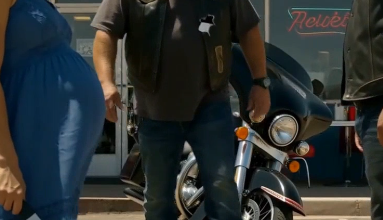
His Harley always sat near the far light pole in the lot, never in the front. Black touring bike, dent on one saddlebag, a red shop rag tied around the left mirror.
That rag was the first strange thing I noticed.
Everything else about him was dark leather, steel, and road grime. But that rag was bright red, folded carefully, always clean.
Once, I asked if it was for repairs.
He looked at it a second too long.
“Kind of,” he said.
That was Marcus. Two words where other people used twenty.
His club brothers came by sometimes. Not a loud outlaw crew. More like old road dogs who had survived themselves and didn’t know how to say affection without insulting each other.
There was Tiny, a Black American biker in his sixties who was not tiny at all, with a gray beard and a laugh that shook the floor.
There was Rooster, a white American biker with a limp, red suspenders under his cut, and a habit of bringing donuts no one admitted they wanted.
And there was Maria, a Mexican American woman in her forties with tattooed forearms, silver rings, and the calmest voice in any room she entered.
They called Marcus “Preacher,” even though he never preached.
I later learned why.
Ten years sober.
Fifteen years lost before that.
Heroin, mostly.
He never dressed it up. Never blamed it on the world, though the world had given him plenty to blame. He told people in recovery, “I dug the hole. Other folks handed me shovels. Both things can be true.”
Men listened when he said that.
Women too.
Not because he sounded wise.
Because he sounded like he had paid full price.
The night he found the boy, he had left a meeting early. One of the younger guys had relapsed the week before, and Marcus took it harder than he showed. I saw him outside the hospital afterward, both tattooed hands gripping the handlebar of his Harley, head bowed under the buzzing light.
Tiny walked up beside him.
“You good, brother?”
Marcus didn’t answer.
Tiny knew better than to push.
A minute later, Marcus started the bike and headed west toward Highway 60.
He said later he meant to ride until the noise in his chest got tired.
Instead, he found Ethan Miller sitting alone in Noble Park.
That was the boy’s name.
Ethan.
Five years old. Too quiet. Too still. Wearing pajamas in a public park at ten at night.
Marcus could have kept riding.
Plenty of people would have.
A child alone at night is a problem. A tattooed biker alone with that child can become a different kind of problem fast, even when he is trying to help. Marcus knew that. He had lived long enough to know how people read the cover before the page.
So he sat far away on the bench.
Hands visible.
Helmet on the ground.
Phone out.
He called police after the first fifteen minutes, but asked them not to rush in with lights unless they had to.
“He ain’t scared yet,” Marcus told dispatch. “Don’t teach him.”
Then he waited.
And while he waited, Ethan leaned back against the bench, dinosaur pajamas glowing faintly under the park light, and asked, “Is your motorcycle loud?”
Marcus looked at him.
“Yeah.”
“My mom doesn’t like loud.”
“Mine didn’t either.”
Then the boy asked, “Are you bad?”
Marcus rubbed his thumb over the scar on his knuckle.
“Used to be worse,” he said.
Ethan nodded like that made sense.
Kids know more than adults want them to.
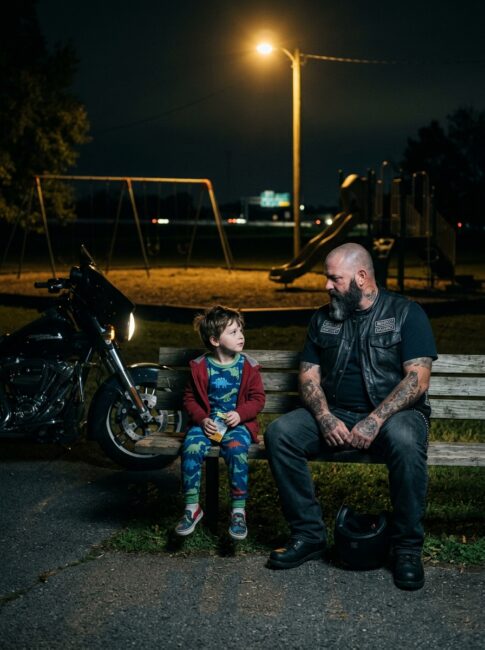
The police arrived at 12:19.
Two cruisers, no sirens.
Officer Bennett came first, a white American woman in her thirties with tired eyes and a careful walk. She knew Marcus from recovery calls. Most cops in town did. Some trusted him. Some didn’t. Bennett did.
She crouched ten feet from the bench.
“Hey, Ethan,” she said. “I’m Dana. This your friend?”
Ethan looked at Marcus.
Marcus shook his head once.
“Just sitting,” he said.
That answer mattered.
He did not claim the boy.
Did not make himself important.
Just sitting.
The officers searched the area. A playground. Bathrooms. Picnic shelters. The little parking strip by the pond. Nothing.
Ethan kept saying the same thing.
“Mom said wait here.”
“What’s Mom’s name?”
“Kayla.”
“Last name?”
He didn’t know.
“Where do you live?”
“With Mom.”
“Where’s that?”
He pointed toward the dark like dark was an address.
Marcus stayed on the bench the whole time, one boot planted, one hand resting near the empty juice box. When Ethan started to shake from cold, Marcus took off his leather jacket and placed it between them.
Not around the boy.
Beside him.
“Your call,” he said.
Ethan pulled it over his knees.
That was the first time Officer Bennett looked at Marcus differently.
Not soft.
Just less guarded.
At 12:46, another officer radioed from three blocks away. They had found a blue sedan behind a closed laundromat near a strip mall on Park Avenue. A woman was inside. Alive. Unresponsive. Possible overdose. Emergency medical already on the way.
Ethan heard only one word.
“Mom?”
He stood up so fast the jacket fell.
Marcus caught it before it hit the mud.
Officer Bennett stepped in. “We’re going to help her.”
“Mom?” Ethan said again.
His voice cracked that time.
Not loud.
Worse.
Small.
Marcus closed his eyes for half a second.
When he opened them, his face had changed. Harder. Older. Like somebody had opened a door inside him he kept nailed shut.
The ambulance took Kayla Miller to Paducah General, where I was waiting at the desk. I didn’t know yet that the little boy in the blanket was hers. I only knew Marcus walked in behind him at 1:23 a.m., still in a sleeveless denim shirt because his leather jacket was wrapped around the child.
Hospital security stiffened when they saw him.
They always did.
Marcus ignored them.
Ethan sat in the family room with a carton of milk and stared at the vending machine. Officer Bennett made calls. Social services came in from McCracken County. Kayla was stabilized, then moved under observation.
No miracle.
No speech.
No instant redemption.
Just breath returning where it had almost stopped.
Ethan asked if his mother was dead.
A social worker started to answer with too many words.
Marcus cut in gently.
“She’s breathing,” he said.
Ethan looked at him.
“That means alive?”
“Yeah.”
“Can I see her?”
“Not yet.”
“Why?”
Marcus swallowed.
“Doctors are working.”
The boy accepted that because Marcus said it plain.
Around 3 a.m., the social worker told us Ethan would need emergency placement.
A foster home.
Temporary.
That word slid through the room like a blade.
Ethan did not cry.
He went still again.
The same bench stillness.
Marcus saw it before anyone else.
His hands, those huge tattooed hands, started shaking. Not much. Just enough that he shoved them under his arms.
Officer Bennett noticed.
So did I.
The social worker said, “Mr. Reed, we appreciate your help, but we’ll take it from here.”
Marcus nodded.
He knew how systems worked. Knew when men like him were supposed to leave.
He stood.
Ethan looked up.
“Are you going too?”
Nobody moved.
Marcus’s jaw tightened.
He looked toward the hallway where Kayla lay unconscious. Then toward the boy in his jacket. Then at the floor.
“Not yet,” he said.
That was the false ending.
A biker found a lost child. Police found the mother alive. The system stepped in. Everybody did their job.
But Marcus Reed did something nobody expected.
The next morning, he walked into the county office and asked what it took to become an emergency foster parent.
The clerk looked at his tattoos, his leather cut, the scar across his jaw, and the skull ink on his hand.
Then she looked back at the form.
“You?” she asked before she could stop herself.
Marcus nodded.
“Me.”
It took two weeks before I learned why.
I was coming off a late shift when I found Marcus sitting outside the hospital near the ambulance bay. The sun was coming up pink over the roofline, and the air smelled like diesel, rain, and old cigarettes.
His Harley was parked beside the curb.
The red rag on the mirror moved in the morning wind.
Kayla had survived. She had agreed to treatment. Ethan was in temporary care with a certified foster family, but Marcus had started the process to qualify as a respite placement. Background checks. Home inspection. Classes. References.
He did everything asked.
Quietly.
Fast.
Like a man repairing something before the weather turned.
I brought him coffee.
He took it without looking up.
“You don’t have to do all this,” I said.
He laughed once. No humor.
“Yeah. People keep telling me that.”
“Why are you?”
He rubbed both hands over his face.
For a long while, he watched the ambulance doors.
Then he said, “I was five.”
I sat beside him.
“My mom used to tell me to wait places. Bus stations. Laundromats. Park benches. Outside bars when the bouncer wouldn’t let me in. She always said she was coming right back.”
His voice stayed flat, which somehow made it worse.
“One night in Louisville, she left me outside a diner off Dixie Highway. Red booth inside the window. Rain coming sideways. I had a red scarf she tied around my wrist so I wouldn’t lose it.”
He pointed at the rag on his Harley.
“That’s not a shop rag?” I asked.
“No.”
I felt my chest tighten.
“She never came?”
He shook his head.
“Not that night. Not really ever.”
The state took him two days later. His mother disappeared into treatment, then jail, then stories nobody could confirm. Marcus bounced through relatives, group homes, couches, and streets. By fifteen, he was using. By twenty, he was stealing. By thirty, he had lost teeth, friends, years, and any idea of who he might have been if someone had sat beside him on that bench.
“I saw Ethan,” he said, “and I knew the posture.”
“The posture?”
“Kid trying not to need anybody.”
He pulled a small object from his vest pocket.
The empty juice box.
Flattened now. Cleaned. Folded at the corners.
“I kept this like an idiot,” he said.
“Why?”
He looked at it in his palm.
“Because somebody should remember what he was holding when he got left.”
That was the twist.
Marcus was not drawn to Ethan because he was simply a good man who happened to pass by.
He stopped because he had been the boy.
The waiting.
The dark.
The mother gone too long.
The grown-ups arriving after the damage.
The difference was this time, Marcus had a motorcycle, ten years sober, and enough scar tissue to stay.
He did not want to replace Kayla.
That mattered to him.
“I ain’t trying to take that boy from his mama,” he said. “I’m trying to keep him standing until she can walk back right.”
Then his club got tested.
Tiny thought Marcus was taking too much on.
Rooster said, “Brother, saving yourself once was hard enough.”
Maria said nothing for a while. Then she asked, “You doing this for him or for you?”
Marcus looked at the red rag on his mirror.
“Both,” he said.
Nobody liked that answer.
But it was honest.
Brotherhood does not mean clapping for every bad idea a man calls destiny. Sometimes it means standing in his garage at midnight and asking whether he is about to turn a child into a bandage.
They asked.
He stayed.
Not because he was certain.
Because Ethan needed someone who did not leave when things got complicated.
Marcus’s house sat on a narrow road outside Paducah, past a closed bait shop and a diner where truckers ate breakfast before sunrise.
It was small.
Clean.
Almost painfully clean.
The social worker expected motorcycle parts on the kitchen table, beer in the fridge, ashtrays, maybe a mattress on the floor. Instead, she found labeled cabinets, folded towels, a guest room with dinosaur sheets, and a night-light already plugged into the wall.
Marcus had bought the sheets before approval.
That almost hurt to know.
In the garage, he had moved tools to high shelves, locked chemicals in a cabinet, and taped a paper sign above the workbench.
ASK BEFORE TOUCHING.
NO MEANS NO.
HELMETS EVERY TIME.
“House rules?” I asked.
Marcus nodded.
“For both of us.”
The first weekend Ethan stayed with him, the boy did not sleep.
He sat in the guest room doorway with a blanket around his shoulders, watching the hall.
Marcus did not tell him to go back to bed.
He sat on the hallway floor with his back against the wall, a cup of coffee cooling in his hand.
At 2:14 a.m., Ethan asked, “Is Mom bad?”
Marcus looked at the ceiling.
“No.”
“Then why’d she leave me?”
“Because sick people make bad choices.”
“Are you sick?”
Marcus answered slow.
“I was.”
“From what?”
“Drugs.”
Ethan hugged the blanket tighter.
“You got better?”
“Trying.”
That was another thing about Marcus. He never spoke about recovery like it was a trophy. He spoke of it like roadwork. Every day, another stretch repaired. Some days, cones everywhere.
Kayla entered treatment in Bowling Green. The first month, she called twice. The second, four times. The third, Ethan drew her a picture of a park bench with three people on it.
A little boy.
A woman.
A giant biker.
When Marcus saw it, he said, “Your mom’s gonna like that.”
Ethan asked, “You think she’ll come back?”
Marcus was washing dishes. His hands stopped under the water.
“I think she’s trying.”
“That’s not yes.”
“No,” Marcus said. “It ain’t.”
The boy nodded.
Plain truth had become their language.
Marcus’s club brothers came around, carefully at first. Tiny fixed the porch step. Rooster brought groceries and claimed he “accidentally bought too much,” which nobody believed. Maria taught Ethan how to make scrambled eggs without burning them and told Marcus his smoke alarm battery was dead.
“You checking my house now?” Marcus grumbled.
“Yes,” she said.
He replaced the battery.
The red rag on the Harley mirror stayed.
So did the juice box in the top drawer of Marcus’s dresser.
One day Ethan found it.
“What’s this?”
Marcus did not snatch it away.
“Yours.”
“Why do you have it?”
Marcus sat on the edge of the bed, leather vest creaking.
“Because that night mattered.”
Ethan studied the flattened carton.
“I don’t like that night.”
“Me neither.”
“Then why keep it?”
“So we don’t pretend it didn’t happen.”
The boy thought about that.
Then he placed the juice box back in the drawer carefully, like it was not trash anymore.
A year passed in pieces.
Kayla got sober. Then stayed sober. Then got a job at a grocery store. Then moved into a supervised apartment. Then earned unsupervised visits. None of it was smooth. There were late calls. Missed forms. One hard week when she almost left treatment and Marcus rode two hours just to sit outside the building, not going in, not forcing anything.
Kayla saw him through the window.
Later she said that was the moment she stayed.
Not because he shamed her.
Because he didn’t.
Reunification day came in October.
The park trees had gone gold. The air smelled like leaves and cold pavement. Ethan wore a blue jacket. Kayla stood in the doorway of her apartment with both hands pressed over her mouth.
She was thin. Nervous. Alive.
Ethan stepped inside slowly.
Then ran.
The sound Kayla made when she held him was not pretty. It was broken and grateful and too big for the little apartment.
Marcus stood outside the door.
Not in the living room.
Not even on the welcome mat.
Just outside.
Hands in his vest pockets. Boots planted in the hallway. Black leather cut on his shoulders. Skull tattoo visible on one hand.
A man built like a wall, trying very hard not to become one.
I stood near the stairs with the social worker.
“Marcus,” Kayla said through tears, “you can come in.”
He shook his head.
“This is yours.”
That was his way.
Step back when the mother returned.
Do not make the child choose.
Do not let your wound become a claim.
Then Ethan turned.
He pulled away from Kayla, ran to the door, and wrapped both arms around Marcus’s leg.
“Uncle Marcus,” he said, “you come in too.”
Marcus froze.
The hallway went quiet.
His face changed the way men’s faces change when life gives them something they stopped asking for.
Kayla wiped her eyes and nodded.
“Please,” she said. “Come in.”
Marcus looked down at Ethan.
Then across the threshold.
For the first time in his life, he was not sneaking into a house, being kicked out of one, or waiting outside for someone who forgot him.
He was invited.
So he stepped in.
After reunification, Marcus kept his distance on purpose.
Not gone.
Distance.
There is a difference.
Every Thursday, he met Kayla and Ethan at the diner off Highway 60. Same booth if it was open. Red vinyl seat by the window. The kind of booth Marcus had once watched from outside in the rain when he was five.
Kayla drank coffee.
Marcus drank coffee.
Ethan ordered pancakes no matter the hour.
At first, Kayla apologized too much.
Marcus stopped her once.
“Don’t spend his childhood paying me back,” he said. “Just be there.”
So she was.
She showed up tired. Showed up scared. Showed up when she had cravings and admitted them before they got teeth. Marcus drove her to meetings when her car broke down. Maria watched Ethan during one emergency shift. Tiny replaced Kayla’s dead battery in a grocery store parking lot and pretended not to hear her crying.
The club never made speeches about it.
They just came with jumper cables, casseroles, and bad jokes.
Every month, Marcus rode past Noble Park at 10:07 p.m.
Not to suffer.
Not exactly.
He said it was maintenance.
“Old ghosts get loud if you never check on them,” he told me.
He would park near the bench, kill the Harley, and sit for five minutes. Sometimes Ethan came. Sometimes Kayla did. Sometimes Marcus sat alone with the red rag on the mirror and the empty bench under the yellow light.
A year later, Ethan brought him something.
A new red bandana.
“For your motorcycle,” the boy said.
Marcus held it in both hands.
“What’s wrong with the old one?”
“It looks tired.”
“So do I.”
Ethan grinned. “You’re old.”
“Watch it.”
They tied the new bandana over the old rag. Not replacing it. Covering it. Letting the past stay, but not alone.
That is how healing looked with Marcus.
Not clean.
Not pretty.
Layers.
Old cloth under new.
The bench still there.
The child no longer waiting.
Three years after that night, Noble Park held a summer movie on the lawn.
Families came with blankets, folding chairs, coolers, bug spray. Kids ran under the same lights that once made the park look empty and dangerous.
Marcus arrived late.
You heard him before you saw him.
The Harley rolled in low, then stopped near the curb. No showing off. No thunder for thunder’s sake. Just an engine cooling in the dark, metal ticking softly while fireflies blinked over the grass.
He stepped off in black leather, tattoos, boots, and that rough old face.
A few parents looked over.
Then looked away.
People had learned.
Ethan saw him and ran.
He was eight now. Taller. Louder. Still wearing sneakers on the wrong feet sometimes because some things don’t need fixing fast.
Kayla sat on a blanket with popcorn between her knees.
She waved Marcus over.
Not to the edge.
Not near the sidewalk.
To the blanket.
Marcus hesitated like doorways still confused him.
Ethan grabbed his hand.
“Come on,” he said. “You’re with us.”
Marcus sat down carefully, big knees up, leather vest creaking, red bandana tied around his wrist now instead of the bike.
On the screen, the movie started.
On the grass, Ethan leaned against his mother.
Then against Marcus.
Nobody made a speech.
Nobody called it a miracle.
The old biker just sat there under the park light, one hand resting on the ground, close enough for a child to find if the dark got too big.
The bench across the path stayed empty.
This time, nobody waited alone.
Follow the page for more biker stories about rough-looking men who carry quiet kindness farther than anyone expects.