Part 2: A Bandidos Biker Picked Her Up From School — Then She Drew Him As Her Father
His name was Marcus “Graveyard” Cole.
I didn’t ask how he got the nickname. In my world, nicknames came from uncles, coworkers, or bad haircuts in high school. In his world, I figured they came from things people didn’t talk about after midnight.
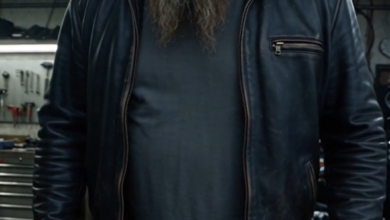
He lived in the other half of our duplex, the side with the cracked driveway and the dead pecan tree. He didn’t have much. A motorcycle. A toolbox. Two duffel bags. A coffee maker he ran too early. And that black leather vest he never wore like fashion. He wore it like weight.
Every morning before sunrise, I heard him in the garage.
Metal clinked. Chains shifted. A lighter clicked once. Then the smell of coffee, motor oil, and cigarette smoke drifted through the thin wall between us.
He never had parties. Never played loud music. Never brought trouble home.
Still, people watched him like trouble had simply learned to park politely.
Lily watched him too.
Not the way adults did. Adults looked for danger. Kids look for truth.
She noticed he fed the stray orange cat that limped behind the dumpsters. She noticed he carried groceries for Mrs. Ortega without making eye contact. She noticed when one of the neighborhood boys crashed his bicycle, Marcus came out with a first-aid kit before the boy’s own dad opened the door.
He cleaned the scrape, taped the bandage, and said only, “Helmet next time.”
That was Marcus.
Few words. Clean hands. Rough voice.
The first strange thing I noticed was his fingernails. They were cut short and scrubbed clean, though his knuckles were scarred and tattooed. The second was inside his vest. Not the outside, with the patch that made parents clutch their children closer. The inside.
One afternoon Lily came home holding a tiny yellow button.
“Mr. Marcus dropped this,” she said.
It was shaped like a cartoon sun.
I turned it over and saw the words printed in chipped letters: LITTLE LIONS READING CLUB.
I almost laughed because nothing in the world fit Marcus Cole less than a children’s reading club button.
That evening, I knocked on his door.
He opened it holding a wrench, grease on his forearm, a white T-shirt stretched tight across his chest. Behind him, his garage smelled like gasoline and old leather.
“This yours?” I asked.
He looked at the button in my palm.
For half a second, his face changed.
Not much.
Just enough.
“Yeah,” he said.
“You work with kids?”
“No.”
He took the button carefully, like it could break.
Then he closed his fist around it and added, “Used to read to one.”
That was all.
After the school incident, I thought his help would be one day. A kind gesture from a man who happened to be nearby.
But Monday came.
At 3:05, the Harley rolled up.
Tuesday, same thing.
Wednesday, I watched from my beat-up Honda across the street as Marcus parked beside the curb, killed the engine, and waited with both hands folded over the handlebars. He didn’t wave at anyone. Didn’t talk to parents. Didn’t act like a hero.
He just waited.
When Lily came out, she walked faster than I had seen in weeks.
The boys who used to crowd the gate backed up.
One whispered something.
Marcus turned his head.
That was enough.
No violence. No scene. No threat anyone could report.
Just presence.
A mountain at the gate.
By the end of the second week, Lily stopped asking if I would be late. She knew somebody would be there.
By the end of the first month, Marcus kept a little purple helmet hanging from his left handlebar. Not for riding far. Just the two blocks home, slow enough that old ladies could pass them walking.
His club brothers saw it before I did.
Four of them came by one Saturday morning, Harleys lined along our curb like thunder waiting for permission. Men with beards, patches, chains, sunburned faces, and pasts written in the way they stood.
One of them, a thin man called Preacher, pointed at the purple helmet.
“Graveyard,” he said, “you running daycare now?”
The others laughed.
Marcus didn’t.
He wiped his hands on a rag and said, “She needed a ride.”
Preacher’s smile faded.
A heavier man with a white beard looked toward my window and said, quieter, “That all?”
Marcus stared at the floor.
“No,” he said. “Not all.”
The garage went silent.
That was the first time I understood his brothers knew something I didn’t.
And whatever it was, it had been riding beside him long before he ever moved next door to us.
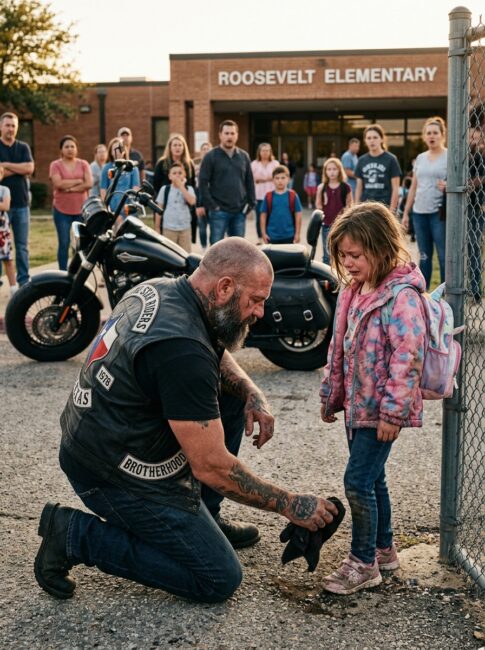
The trouble came in January, when the air turned sharp and the sky over Wichita Falls looked like dirty tin.
I was working the lunch rush at the Route 287 Diner when the school called.
Not the nurse.
The principal.
That difference hits a mother in the ribs before a word is spoken.
“Ms. Parker,” Principal Hensley said, “there’s been an incident.”
My hands went cold around the coffee pot.
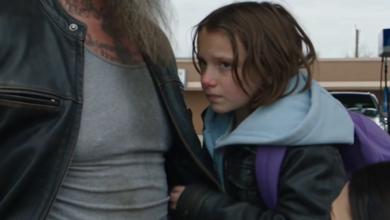
Lily had been cornered behind the gym after recess. Three kids. Same boys. One girl this time too, because cruelty likes company. They’d taken her backpack, dumped her spelling papers into a puddle, and told her she should ask her “fake motorcycle daddy” to buy her a real family.
A teacher found Lily hiding behind the dumpster.
I left the diner so fast my manager yelled my name twice.
When I pulled into the school lot, Marcus was already there.
His Harley stood crooked at the curb, engine still ticking hot. He must have heard the call on his scanner, or maybe the principal called him too. I never asked.
He was inside the office when I came through the glass doors.
The whole room felt too small for him.
His boots were planted on the tile. His leather vest creaked when he turned. The secretary stared at her keyboard like it might save her.
Lily sat in a chair against the wall with her knees pulled up, holding the torn strap of her backpack.
Marcus stood three feet away from the boy’s father.
The father was red-faced, thick-necked, wearing a company polo and the kind of confidence some men mistake for height.
“My son said your biker buddy scared him,” the man snapped at me before I even spoke. “Maybe if you didn’t have criminals picking up your kid—”
Marcus’s jaw tightened.
That was it.
Just a small movement.
But every adult in that office felt it.
The boy’s father turned toward him. “You got something to say?”
Marcus looked at Lily.
Her eyes were wide, wet, terrified.
Then he looked down at his hands.
I saw them tremble.
Not from fear.
From restraint.
He closed his fingers slowly, one at a time, until both fists were locked at his sides. His knuckles went pale under the ink.
“No,” Marcus said.
The man laughed. “That’s what I thought.”
For a second, I thought Marcus would break him.
I’m ashamed to admit part of me wanted him to.
Not because it would solve anything. Because pain makes civilized people wish for ugly answers.
But Marcus didn’t move.
He lowered himself beside Lily, the same way he had the first day.
“You hurt?” he asked.
She shook her head.
“Liar,” he said softly.
A tiny sound escaped her. Almost a laugh. Almost a sob.
He took the torn backpack strap between two fingers and examined it like evidence.
Then he stood and faced Principal Hensley.
“I want names written down,” he said.
The principal blinked. “Mr. Cole—”
“Names. Dates. Every report. Every time her mama called. Every time a teacher saw and didn’t see.”
His voice stayed low. That made it worse.
The boy’s father said, “You threatening the school?”
Marcus turned to him.
“No,” he said. “I’m documenting it.”
That word surprised everyone.
Documenting.
Not punching. Not shouting. Not scaring.
Documenting.
Then Marcus reached inside his vest and pulled out a folded paper.
Principal Hensley went still.
Preacher walked in behind us wearing a black suit jacket over his club shirt, rain on his shoulders, a leather folder under one arm.
I had seen him smoke on Marcus’s porch. I had heard him joke about daycare.
I had not known he was an attorney.
He looked at the principal and smiled without warmth.
“Afternoon,” Preacher said. “Let’s talk about the district’s bullying policy.”
That should have been the climax.
The big bad biker bringing a lawyer into the school office. The bullies exposed. The parents embarrassed. The principal suddenly remembering forms and procedures and responsibilities.
For most stories, that would be enough.
It wasn’t.
Because while the adults argued, Lily reached up and grabbed the bottom of Marcus’s vest.
Not hard.
Just two fingers in the leather.
He looked down.
She whispered something so low I almost missed it.
“Don’t leave.”
And Marcus’s face did something I still don’t know how to describe.
It looked like a locked door hearing a key turn for the first time in forty years.
After that meeting, things changed fast.
The school moved the boys to different recess groups. The district sent a counselor. Principal Hensley started greeting Lily by name in the mornings like kindness had suddenly become policy.
Parents who once avoided Marcus began nodding at him in the pickup line.
Nobody apologized. Not really.
People don’t like admitting they were cowards in daylight.
But the bullying stopped.
Every afternoon, Marcus still came.
Rain. Cold. Wind that cut across the flat Texas roads. He parked the Harley, took off his gloves, and waited.
Sometimes Lily ran to him with a drawing. Sometimes she walked slowly because the day had been too much. Sometimes she just leaned against his leg while he talked to no one.
I thought he was saving her.
That was the simple version.
The comfortable version.
Then one night in March, I heard something through the wall.
Not shouting. Not television. Not tools.
A man’s voice.
Low. Broken. Repeating the same sentence.
“I’m sorry I didn’t come.”
I stood in my kitchen with a dish towel in my hands, listening through cheap drywall like a thief.
“I’m sorry I didn’t come,” Marcus said again.
The next morning, I found him sitting on the back steps before sunrise. His Harley was half-covered in dew. He held the yellow reading club button in one hand.
I should have gone back inside.
Instead, I stepped out with two cups of coffee.
He accepted one.
For a while, we watched the alley turn blue.
“Who didn’t you come for?” I asked.
He didn’t answer fast.
Bikers don’t confess like people on TV. They circle pain. They spit near it. They look away from it. They make you wait.
Finally, he said, “My little brother.”
I sat down beside him.
“His name was Tommy,” Marcus said. “Seven years old. Same age as Lily when it started.”
The cup shook once in his hand.
He steadied it.
“We had no dad. Mom worked nights. I was twelve. Supposed to pick him up from school. Some boys messed with him every day because his shoes were taped and his lunch came in a bread bag. I got tired of walking there. Thought he should learn to handle it.”
He swallowed.
The alley was quiet except for a dog barking somewhere behind the laundromat.
“One day I didn’t go.”
I didn’t move.
Marcus rubbed his thumb over the little sun button.
“He ran home alone. Crossed Kemp Boulevard without looking. Truck never saw him.”
That was the twist.
Not that Marcus had a soft heart.
Not that he was better than people thought.
It was worse than that.
He wasn’t picking up Lily because she needed a father.
He was picking up Lily because once, a little boy needed a brother.
And Marcus Cole had not come.
The yellow button had been Tommy’s.
The clean fingernails. The careful bandages. The way Marcus always arrived at 3:05, never 3:06. The way he stood between children and the world without touching anybody.
It all came from one missed afternoon.
One empty curb.
One road crossed alone.
After Marcus told me about Tommy, I understood why his club brothers never teased him too hard.
They knew.
Preacher knew. The white-bearded man, whose road name was Mule, knew. Even the young prospect who washed bikes in the driveway knew enough to lower his voice when Lily came outside wearing that purple helmet.
Marcus had joined the club years after Tommy died.
Before that, he had done everything wrong.
He drank. Fought. Slept in county jail twice. Lost jobs. Broke his mother’s heart in ways he never said out loud. He rode because sitting still made the past louder. He stayed gone because home had a seven-year-old ghost at the kitchen table.
Then one winter, somewhere outside Amarillo, his bike broke down behind a gas station. A group of Bandidos stopped.
Not to recruit him.
To help.
Mule gave him a wrench. Preacher gave him coffee. Another brother told him to shut up when he started acting tough.
“You ain’t scary,” Mule said. “You’re just tired.”
For some reason, that sentence saved him more than any sermon could.
The club didn’t fix Marcus. People don’t get fixed like engines. But they gave him men who noticed when he disappeared. Men who rode out to find him. Men who stood in his garage when January got bad and Tommy’s birthday came around.
Brotherhood, I learned, wasn’t all road names and patches.
Sometimes it was four men pretending to check spark plugs because one of them shouldn’t be alone.
The little sun button stayed sewn inside Marcus’s vest, under the left panel, close to his ribs. He had stitched it there himself with ugly black thread. That was the detail Lily had touched the first day he knelt in front of her. Her small hand had brushed the inside of his cut, and Marcus had looked startled, almost scared.
I thought she had grabbed leather.
She had found Tommy.
The week after his confession, Marcus did something I didn’t expect.
He asked permission.
Not in a dramatic way. Not with flowers or speeches.
He stood on my porch at 7:10 in the evening, holding his helmet under one arm.
“I ain’t her dad,” he said.
“I know.”
“I ain’t trying to be.”
“I know.”
He looked toward the window, where Lily was doing math homework at the kitchen table.
“But if it’s all right with you,” he said, “I’ll keep showing up.”
I could have said many things.
Thank you.
Please.
You already have.
Instead, I said the only thing that came out clean.
“Don’t be late.”
He nodded once.
“Never again.”
That became the rule.
Never again.
Not just for Lily. For him.
At the end of May, Roosevelt Elementary held its art night in the cafeteria. Paper flowers hung from the ceiling. Parents walked between folding tables, smiling at paintings that looked mostly like colorful weather accidents.
Lily wore a yellow dress from the thrift store and held Marcus’s hand in the parking lot.
He tried to let go before we reached the doors.
She held tighter.
Inside, people stared.
Not like before. Different now. Still curious. Still uneasy. But no longer cruel.
Her class wall was covered with drawings titled MY FAMILY.
There were stick figures. Dogs. Houses. One kid drew what looked like a spaceship.
Then I saw Lily’s.
A small brown-haired girl. A woman in a blue diner uniform. A giant man with a black vest. A motorcycle drawn too large for the page. Above them, a yellow sun.
Her teacher, Mrs. Bell, crouched beside her and asked, “Lily, who is this man?”
Lily looked at Marcus.
He stopped breathing. I saw it.
His shoulders locked. His scarred hands opened and closed once, like he was searching for handlebars that weren’t there.
Lily said, “That’s my dad.”
The cafeteria noise dropped away for me.
Mrs. Bell smiled gently. “Your dad?”
Lily nodded.
“He picks me up.”
That was all the proof she needed.
Marcus turned his face away.
He did not cry. Not there. Not in front of everyone.
But Mule, standing near the punch table with the other brothers, cleared his throat hard and looked at the ceiling like the tiles had personally offended him.
Preacher took off his glasses.
I looked at Marcus’s vest and saw, just inside the leather, the edge of that tiny yellow sun.
Tommy had come to art night too.
In the only way he could.
Summer came hot and mean.
The school gates locked. The playground sat empty. Heat shimmered off the blacktop where kids used to line up with backpacks and secrets.
Marcus still rode every afternoon.
At 3:05.
Not to the school anymore. Just around the block, past Roosevelt Elementary, down the service road toward Highway 287, then back home.
At first I thought it was habit.
Then one day Lily asked him why.
We were sitting on the porch eating popsicles that melted faster than we could save them. His Harley clicked in the driveway, cooling in the sun. The air smelled like asphalt, cut grass, and gasoline.
“Mr. Marcus,” Lily said, “why do you still go there?”
He looked at the school in the distance.
The answer took a while.
“To remind the road it doesn’t get everybody,” he said.
Lily accepted this like children accept strange adult truths. She nodded and handed him the orange popsicle because she had decided he liked that flavor.
He took it.
A man with skulls on his rings and a dead brother in his vest sat on our porch eating a melting orange popsicle with a seven-year-old girl who no longer looked at the sidewalk when she walked.
That was the whole story, if you ask me.
Not the school meeting.
Not the lawyer.
Not the bullies getting quiet.
This.
A brutal-looking man learning how to stay.
Every now and then, his brothers came by. They still filled the curb with chrome and thunder. They still smelled like leather, fuel, sweat, and gas station coffee. But now they brought sidewalk chalk. Cheap kites. A used bicycle that Mule claimed “fell off a truck,” though I saw the receipt in his pocket.
They never called Lily a mascot.
Never made her a joke.
They called her Little Sun because of the drawing.
Marcus pretended not to like it.
But one evening, I saw him sewing a new patch inside his vest. Small. Hidden. Yellow thread.
Not outside for the world.
Inside, where the heart keeps its dead and its living.
On the last day of second grade, I got off work early.
I wanted to pick Lily up myself for once.
But when I turned onto the school street, the Harley was already there.
Of course it was.
Marcus stood beside it, arms crossed, purple helmet hanging from the handlebar. Parents moved around him like water around a stone. Nobody looked afraid now. Not exactly.
Lily came out carrying a folder, her backpack, and a paper crown that said PROMOTED.
She ran straight past me.
Straight to him.
He bent down, and she slammed into his chest with both arms. He caught her carefully, like she was something breakable and holy.
Then she put the paper crown on his shaved head.
The big biker froze.
The whole pickup line watched.
Mule started laughing first. Preacher followed. Then Lily. Then me.
Marcus stood there wearing a crooked construction-paper crown, tattoos up his neck, Bandidos patch on his back, one hand resting lightly on my daughter’s shoulder.
He looked ridiculous.
He looked saved.
A few minutes later, he started the Harley. The V-twin rolled low and steady, not loud enough to scare anybody. Lily climbed behind him with her purple helmet and tiny denim jacket.
He looked back at me.
I nodded.
They pulled away slow, toward our street, toward home, past the school gate where she used to cry.
The sun hit the yellow patch inside his vest.
Then the bike turned the corner.
And this time, nobody was left waiting.
Follow the page for more biker stories that change what people see when they hear a Harley coming.