Part 2: He Only Got Four Hours Every Sunday — Twenty-Two Years Later, His Wedding Gift Broke Me
I did not understand divorce when I was five.
I understood doors.
Mom’s door stayed closed when Dad came. Dad never stepped past the welcome mat unless she said he could. Their voices stayed tight, careful, too polite in that way adults speak when love has already burned down but the ashes are still hot.
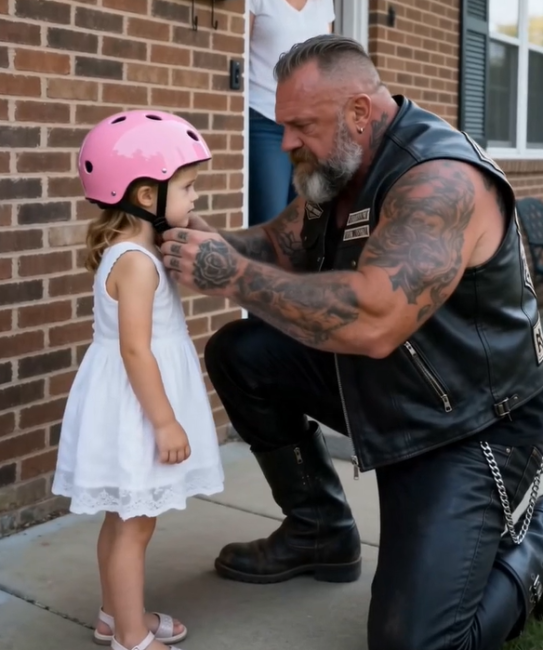
I would run past Mom with my pink helmet under one arm and my sneakers untied.
Dad always crouched.
He never scooped me up without asking.
That is something I remember now.
At five, I only thought he was slow.
At twenty-seven, I understood he was a man who had learned the court could turn any wrong move into a weapon.
“You got her back by four,” Mom would say.
“Four,” Dad answered.
Always just that.
He never said, “I know.”
He never said, “I’m not stupid.”
He never said the things his face looked like it wanted to say.
He took my small hand in his scarred one, walked me to the Harley, and buckled my helmet.
The bike was not really the point.
I know biker stories make everything sound like chrome and thunder, but for Dad, the Harley was a bridge. It carried him across a divorce decree, across my mother’s anger, across a town that thought a man with skull patches and a custody schedule must have done something to deserve so little time.
Maybe he had.
That was the thing.
My father was not innocent in the clean, easy way people prefer.
Before I was born, he drank too much. He rode too angry. He missed dinners. He got into one bar fight outside a pool hall in Franklin and spent a night in jail. Mom never let him forget it. Dad never defended it.
When I was older, I asked him if he had been a bad husband.
He was quiet so long I thought he would not answer.
Then he said, “I was a loud man when your mama needed peace.”
That was all.
No excuses.
The Iron Pike Riders were his club, though Mom called them “that pack of trouble” and Grandma called them “those leather men.” They looked exactly like the town feared they would. Big white American and Black American men in heavy boots, tattooed arms, gray beards, shaved heads, sunburned necks, and black leather cuts covered in patches that meant nothing to me back then.
But every Sunday, they knew the rule.
No club business before four.
No calls unless someone was bleeding.
No rides that took Dad past the clock.
Once, when I was seven, his brother named Dutch rolled into Dairy Dip with three other bikers and sat two tables away. Dad looked at him once.
Dutch raised both hands.
“Just eating, brother.”
Dad nodded.
But Dutch still left before us.
That was their respect.
Quiet. Rough. Understood.
The first seed was the pink helmet.
It had white scuffs on one side from when I dropped it in Mom’s driveway and blamed a squirrel. Dad knew I lied. He just rubbed the scratch with his thumb and said, “Squirrel must’ve had attitude.”
Inside the helmet, near the left cheek pad, he put a tiny silver sticker shaped like a star.
“One star for every safe ride,” he told me.
I thought he meant the bike ride.
He meant Sunday.
Every Sunday I came back safe.
Every Sunday he got all four hours.
Every Sunday he returned me on time, even when I begged for five more minutes.
That was how he loved me then.
By not stealing what the court had not given him.
The hardest Sunday was not the first one.
It was not even the rainy one when I cried because water ran down the back of my jacket and Dad pulled under the awning of a closed gas station off Nashville Road, wrapped me in his leather vest, and sat in a T-shirt while wind cut through him.
The hardest Sunday was my thirteenth birthday week.
Middle school had made me aware of things I had never noticed before.
The way people stared when Dad pulled up.
The way the Harley announced us before we arrived.
The way his boots sounded against pavement.
The way his beard, tattoos, skull ring, and black cut made other parents go still.
At five, I thought he was a giant.
At thirteen, I thought he was embarrassing.
That Sunday, he arrived at noon like always.
The V-twin rolled down our street, low and familiar. The curtains in three houses moved. Mom stood behind me with her arms crossed.
I had already decided.
I came outside wearing jeans, a hoodie, and no jacket.
Dad held the pink helmet.
I looked at it like it belonged to a stranger.
“I don’t want to ride today,” I said.
He blinked once.
“Roads are clear.”
“I know.”
He looked at Mom, then back at me.
“You sick?”
“No.”
“You scared?”
“No.”
My throat tightened because I wanted him to understand without making me say it.
Teenagers are cruel that way. We want parents to read the words we are too ashamed to speak.
I finally said, “Can we just take your truck?”
His face did not change much.
But his hand tightened around the helmet.
The leather of his glove creaked.
“Sure,” he said.
That was all.
He put the pink helmet back in the saddlebag like he was placing something small in a coffin.
We rode to Dairy Dip in his old Chevy pickup.
No rumble. No helmet tap. No warm leather smell. No engine vibration under my sneakers. Just the dashboard clicking, Dad’s hands on the wheel, and country radio turned low.
I thought I had made the afternoon easier.
I had made it quiet.
At Dairy Dip, I ordered chocolate instead of strawberry because I had decided strawberry was for little kids. Dad ordered black coffee because he never really liked ice cream. That was something I did not realize until much later.
Eight years of Sundays, and the man barely ate the thing.
He watched me eat mine.
That day, a boy from school came by with his family. His name was Tyler Briggs. He looked at Dad’s tattoos, then at me, then smiled the way boys smile when they find a soft place to press.
“Your dad’s one of those biker guys?” he asked.
I shrugged.
Dad heard him.
Of course he heard him.
Tyler said, “My mom says those clubs are all criminals.”
Dad took a slow sip of coffee.
I waited for him to scare Tyler.
A look. A sentence. Something.
He did nothing.
That made me angrier than if he had.
On the ride back, I stared out the passenger window.
“You could’ve said something,” I muttered.
Dad kept his eyes on the road.
“What did you need me to say?”
“That you’re not.”
“Not what?”
“A criminal.”
He nodded once.
“I know what I am.”
I hated that answer.
I wanted him to clean himself up for me. Make himself easier to explain. Become the kind of father who wore golf shirts and arrived in silence.
At 3:56, he pulled into Mom’s driveway.
Four minutes early.
He always gave her those four minutes like a tax he paid for his past.
I reached for the door handle.
Dad said, “Bug.”
I froze.
He had not called me that in front of anyone for a year.
“You don’t have to ride,” he said. “You don’t have to explain me either.”
I looked at him.
His eyes were wet, but he did not cry.
Not Dad.
Not Maddog.
Not in a truck parked under my mother’s window.
“You just have to show up if you want to,” he said.
That should have fixed everything.
It didn’t.
Because growing up is sometimes just learning how to break your parents’ hearts with cleaner grammar.
At sixteen, I got my license.
Dad said, “Good.”
He said it like he was proud and wounded at the same time.
From then on, I drove myself to Dairy Dip.
He still arrived first.
Always.
Same table if the weather allowed it. Same black coffee. Same leather cut over the back of the chair. Same heavy boots under the metal table, crossed at the ankles. Same way he looked up when my car turned in, like a man watching a boat return through fog.
By then, I knew more about the divorce.
Not everything. Just enough to be unfair.
Mom told me Dad had chosen the club too many times. Dad told me Mom had deserved better than the man he used to be. Neither lied, exactly. But truth in a divorce is like broken glass. Everybody holds one piece and bleeds from the others.
When I was seventeen, Dad missed one Sunday.
The only one.
I waited in the Dairy Dip parking lot for twenty-three minutes, angry before I was afraid. Then Dutch pulled in on his Harley with two other Iron Pike Riders behind him.
Dutch was a large Black American man in his late fifties with silver in his beard, dark sunglasses, and hands scarred from decades of welding. He looked like he had been built out of railroad ties.
He took off his helmet.
“Your dad’s at the hospital.”
My stomach dropped.
“What happened?”
“Shop accident. He’s alive.”
“Why didn’t he call?”
Dutch looked away.
“Didn’t want you hearing him scared.”
I drove to the hospital in Bowling Green and found Dad in a room with his right arm wrapped from wrist to elbow. A transmission had slipped at the shop. Crushed two fingers. Tore skin. The kind of injury that makes nurses speak gently.
Dad saw me and tried to sit up.
“You get ice cream?”
I stared at him.
“What?”
“It’s Sunday.”
That was when I saw the second seed and missed it.
On the rolling table beside his bed was a Dairy Dip receipt.
Two orders.
One strawberry.
One black coffee.
Time stamped 12:18.
Dutch had gone for him.
I did not understand then that the club had kept the Sunday for Dad when Dad could not keep it himself.
I just snapped, “You’re in the hospital and you care about ice cream?”
He looked embarrassed.
“Habit.”
The false climax came the summer I turned eighteen.
College was coming. I was leaving for Louisville. I had plans, opinions, and the unbearable confidence of a girl who thinks distance proves adulthood.
That Sunday, I met Dad at Dairy Dip.
He had healed mostly, though his right hand never closed the same again. The ring finger curved strangely. When he held his coffee, it trembled if he was tired.
I noticed.
I pretended not to.
We sat under the red umbrella. The road hissed with traffic. A group of teenagers laughed near the ordering window. Dad’s Harley sat near the curb, black and patient, the pink helmet no longer in sight.
I ordered vanilla.
Dad ordered coffee.
We talked about my dorm.
My classes.
My car.
The weather.
Safe things.
Then he said, “You want to keep doing Sundays when you move?”
I looked at him like he had asked if I wanted to keep wearing training wheels.
“Dad,” I said, laughing a little because I was uncomfortable, “I’m grown now. I don’t need ice cream anymore.”
He nodded.
Just once.
“Yeah,” he said. “I figured.”
I waited for him to argue.
He didn’t.
I waited for him to look hurt.
He didn’t give me that either.
He reached into his vest pocket, pulled out cash, and paid for both of us.
At 3:42, he stood.
Not four.
3:42.
The earliest he had ever ended a Sunday.
“Drive safe, Bug.”
I wanted to say something.
I didn’t.
His Harley started with that low sound I had spent years trying to outgrow.
He pulled onto Nashville Road and disappeared behind a line of traffic.
I thought he had let me go.
The twist was, he never stopped showing up.
I learned that at my wedding.
Nine years later.
I was twenty-seven, wearing a white dress in a converted tobacco barn outside Franklin, Kentucky, with mason jar lights, long wooden tables, and too many flowers because my mother and mother-in-law had joined forces like a polite army.
Dad came in through the side door.
He hated formal clothes.
He wore a black shirt, dark jeans, polished boots, and his leather cut because I had told him he could.
Actually, I had told him, “Please don’t feel like you have to wear a suit.”
He heard, “Come as my father.”
The Iron Pike Riders sat at the last table.
Not because I put them there.
Because they chose it.
Dutch. Sweeney. Rooster. Little Mike, who was only little compared to furniture. A few of their wives. A few gray ponytails. A few hands folded carefully around beer bottles like they did not belong in a place with linen napkins.
Dad sat with them.
End of the room.
Back to the wall.
Old habit.
During the speeches, I thanked my mother first.
She deserved it.
She had done the daily work. Homework. Doctors. Laundry. Curfews. All the things courts measure because they can be written down.
Then I looked at Dad.
He lifted his beer slightly, like he was telling me not to make a thing of him.
So of course I did.
I told the room about Sundays.
Four hours.
No more.
No less.
I told them about the pink helmet. The strawberry ice cream. The way he tapped the top twice and called me Bug. The way he never once brought me back late, even when I begged. The way I stopped riding with him because I was too young to know the difference between shame and other people’s opinions.
Dad looked down at the table.
His beard hid most of his face.
I kept going because some apologies need witnesses.
“When I was eighteen,” I said, “I told him I didn’t need ice cream anymore.”
My throat closed.
Across the room, Dad’s hand tightened around his beer.
“I thought I was saying I had grown up. But I think what he heard was that I didn’t need him.”
The room went very still.
“I’m sorry, Dad.”
He did not move.
But Dutch did.
He put one big hand on Dad’s shoulder.
Then came the gift table.
We opened things later, after dinner, when people were dancing and the photographer was trying to catch fake candid moments. Dad’s gift was not wrapped fancy. Brown paper. Black tape. My name written in block letters.
Inside was the pink helmet.
The room tilted.
It was smaller than I remembered.
Scuffed white on one side.
Squirrel attitude.
The silver star sticker still inside.
So were dozens more.
Tiny stars lining the inner shell, some faded, some crooked, some layered over older ones.
My husband touched my back.
“You okay?”
I couldn’t answer.
Inside the helmet, written in black marker, were the words:
“416 Sundays. 416 cones. I counted every one. Worth it.”
That was the main twist.
The number hit harder than any speech.
Four hundred sixteen Sundays.
Eight years of custody.
Eight years of him building fatherhood out of four-hour scraps.
Then I saw there was an envelope tucked beneath the helmet padding.
My hands shook opening it.
The note was short.
Dad’s handwriting looked like fence wire.
“Bug, you were wrong. You did need ice cream. So did I. After you turned eighteen, I still went every Sunday at noon for a while. Not to make you feel bad. Just didn’t know where else to put the love. When it stopped hurting so sharp, I put the helmet away. Figured one day you might want to know none of it was wasted. Every mile. Every cone. Every minute. Worth it. Love, Dad.”
That was the third seed returning.
The hospital receipt.
Dutch bringing the ice cream.
The club sitting at the back.
They had known.
Not because Dad made a performance of heartbreak.
Because brothers notice when a man keeps riding to the same ice cream stand after his daughter stops coming.
I looked across the hall.
Dad was still at the last table.
Beer in front of him.
Eyes on me.
Not crying.
But his hand was shaking so hard the bottle tapped against the wood.
Tap.
Tap.
Tap.
Like a small engine trying not to stall.
I crossed that room in my wedding dress.
People moved aside.
I reached him.
For a second, he looked scared, which I had never seen before.
Then I put the helmet in his lap and wrapped my arms around his neck.
He smelled like leather, beer, aftershave, and the faint ghost of gasoline.
“I’m sorry,” I whispered.
His rough hand came up slow against my back.
“Don’t be,” he said.
Two words.
That was Dad.
I pulled away and looked at him.
“Will you take me for ice cream tomorrow?”
His mouth moved.
No sound came out at first.
Then he nodded once.
“Yeah, Bug.”
Dutch wiped his eyes with a napkin and pretended it was barbecue sauce.
There was no barbecue sauce.
The next day, at noon, Dad pulled into the gravel drive outside the barn.
Not in a truck.
On the Harley.
My wedding dress was packed away. My hair was still full of pins. My husband stood on the porch smiling like a man smart enough not to interfere with a ritual older than him.
Dad held out a helmet.
Not the pink one.
That one was too small now.
This was black, new, with a tiny silver star sticker inside.
My throat tightened.
“Still doing the stars?” I asked.
He shrugged.
“Safe ride’s a safe ride.”
I climbed on behind him for the first time in fourteen years.
I had forgotten the weight of the moment before the engine starts. That little pause. The world holding its breath. Then the V-twin caught, low and familiar, rolling through my ribs like an old language I thought I had forgotten.
We rode down Nashville Road to Dairy Dip.
The same place.
Same red umbrellas.
Same cracked ordering window.
Same smell of fryer grease, sugar, hot pavement, and summer dust.
Dad ordered strawberry for me.
Black coffee for himself.
I looked at him.
“You don’t even like ice cream, do you?”
He took a sip of coffee.
“Nope.”
I laughed so hard I cried.
After that, we did not go every Sunday.
Life was different.
I was married. He was older. Mom had softened in ways none of us expected. The court order was long dead.
But once a month, sometimes twice, Dad and I met at Dairy Dip.
If it rained, we sat inside.
If it was cold, we got coffee.
If he was tired, I drove.
The Iron Pike Riders would sometimes pass by, engines low, pretending not to check on us.
Dutch always raised two fingers.
Dad always raised one.
Every year on Father’s Day, I put a silver star sticker inside the pink helmet.
Not because we rode that day.
Because we had made it back to each other.
That helmet sits now on a shelf in Dad’s garage, beside oil cans, worn gloves, old registration papers, and a photo of me at five years old with melted strawberry ice cream running down my wrist.
Dad still acts like he doesn’t look at it.
The dust pattern says otherwise.
Dad is slower now.
His beard is more white than black. His tattoos have blurred at the edges. His right hand still trembles when he grips a beer too long or buttons his cut on cold mornings.
The Harley starts rough sometimes.
So does he.
But on the Sundays we ride, he still arrives at noon.
Not 12:03.
Not 11:58.
Noon.
Some habits are really vows wearing work boots.
Last month, I brought my daughter to Dairy Dip.
She is four.
Too young for long rides, old enough to know Grandpa sounds like thunder when he pulls up.
Dad parked near the curb and shut off the engine. The sudden quiet made her hide behind my leg.
He got off slow, knees stiff, leather creaking.
To strangers, he still looked like trouble.
Huge frame. Black cut. Scarred hands. Boots heavy on the concrete. Old patches. Gray beard. A face weathered by too much road and not enough sleep.
Then he reached into his saddlebag.
Out came the pink helmet.
My pink helmet.
He held it like glass.
My daughter stared at it.
Dad crouched carefully, one knee popping.
“You like strawberry?” he asked.
She nodded.
He looked up at me.
His eyes were wet.
Not crying.
Never that.
Just full.
I put one more silver star inside the helmet before we went in.
Dad saw me do it.
He didn’t say anything.
He tapped the top twice.
Worth it.
Follow the page for more biker stories about rough-looking men, quiet love, and the rides that bring people home.