Part 2: They Called Him Unfit — Until His Daughter Fought for His Name
I knew Mason before the neighborhood decided what he was.
Not well. Nobody knew him well.
But I ran the register at Millie’s Diner on Route 64, where truckers came in smelling like diesel and farmers sat in the same booths they’d used since Reagan was president. Mason started showing up there three months after he moved into the little blue rental house across from mine.
First time he walked in, the bell above the door gave a weak little jingle, and everybody looked up.
You could feel a room change around a man like him.
His boots hit the old tile slow. Leather creaked when he reached for his wallet. His beard was black then, with a little gray at the chin, and his eyes had that long-road look, like sleep had been chasing him for years and never quite caught up.
Millie whispered, “Keep an eye on that one.”
But he didn’t ask for whiskey. Didn’t start trouble. Didn’t flirt. Didn’t even sit at the counter.
He ordered three milks, one black coffee, two scrambled eggs, one biscuit with extra jelly, and a bowl of oatmeal with brown sugar on the side.
Then he turned toward the booth by the window and said, “Girls. Hands.”
Three tiny hands went up.
He wiped them one at a time with napkins he’d dampened in the restroom.
That was Mason.
He scared people from ten feet away. Up close, he was checking syrup temperature so it wouldn’t burn a four-year-old’s mouth.
I watched him for months.
He worked at Earl’s Transmission, the garage with the faded sign and the chain-link fence full of hubcaps. He left before daylight, came home smelling like oil, brake dust, and sweat, and still somehow got dinner on the table by six.
Sometimes it was boxed mac and cheese.
Sometimes frozen pizza.
Sometimes burnt chicken he pretended was “smoky.”
The girls ate like it was Thanksgiving.
Every Thursday night, his club came by.
They called themselves the Iron Apostles, though half the town called them worse. Seven men, mostly older. Tattooed. Heavy. Hard voices. Bikes lined along the curb like black horses. The sound shook window glass.
But they didn’t come to drink.
They came with groceries.
One brother, Tank, had a beard down to his chest and brought diapers when June was still small.
Another, Rooster, wore a patch over one eye and knew how to fold fitted sheets because his mother ran a motel.
A prospect named Danny mowed Mason’s yard every other Saturday and claimed it was “club work,” though everyone knew he just liked Lucy yelling, “Go faster!” from the porch.
That brotherhood got tested in small ways before it ever got tested big.
Mason didn’t ride much anymore.
That bothered them at first.
I heard Tank say once outside the diner, “Brother, the road still needs you.”
Mason was buckling June into a booster seat at the time. He didn’t look up.
“My girls need me more.”
No speech. No drama.
Just that.
After that, the Iron Apostles adjusted.
They stopped planning weekend rides without asking who could babysit. They learned school schedules. They kept spare hair ties in saddlebags. Rooster once showed up with a pack of glitter barrettes and looked like he’d rather confess to murder than admit he bought them himself.
And still the town talked.
Because people will ignore a thousand quiet acts of love if one thing about you makes them uncomfortable.
They saw the Harley.
They saw the tattoos.
They saw three girls climbing onto a porch beside a man with a prison-style scar over his eyebrow, and they built a story out of fear.
I made my own assumptions too.
I wondered where their mother was. Everybody did.
The girls never mentioned her. Mason never mentioned her. In that house, “Mom” was a word that seemed to live behind a locked door.
Only once did I almost ask.
It was after Emma’s school concert, when Mason came into Millie’s with the girls still wearing their Christmas dresses. Emma had a red bow in her braid. Lucy was asleep against his side. June was drawing circles in spilled sugar.
Mason pulled off his vest and hung it on the booth hook.
That was when I saw the pink ribbons inside again.
Emma. Lucy. June.
The stitching was uneven. Not a woman’s neat hand. His hand.
A big man’s clumsy work.
He saw me looking and pulled the vest back like I’d walked in on him praying.
“Just patches,” he said.
But patches mean something in biker life.
They are earned, not decorated.
And those three ribbons looked like the only patches he was afraid to show.
The call came on a Tuesday.
Cold morning. Gray sky. That kind of Tennessee winter that doesn’t give you snow, just wet wind and bones that ache.
Mason had dropped the girls at school at 7:42. I knew because I was taking out trash when his Road King rolled past, softer than usual, like he was trying not to wake the street even though everyone was already up pretending not to watch him.
Emma sat behind him that morning, wearing a purple coat and two tight braids.
Lucy and June were in Rooster’s old pickup because Mason’s truck was in the shop. Brotherhood, again. Not loud. Not heroic. Just a man handing over keys and saying, “Bring it back full.”
At 10:16, the office at Cascade Elementary called Earl’s Transmission.
I know the time because Earl told me later.
He said Mason was under a Chevy with both hands inside a dead transmission when the shop phone rang. Earl answered, listened, then went quiet.
“Mase,” he called. “School.”
Mason hit his head on the frame getting out.
He didn’t curse. That’s what Earl remembered. A man like that, bleeding a thin red line near his temple, and he didn’t curse.
He just wiped his hands on a rag and said, “Which one?”
“Emma.”
Mason stood still.
The shop noise kept going around him. Air compressor. Wrench clatter. A radio playing old Waylon Jennings through static.
“What happened?”
Earl covered the receiver. “They said she hit a boy.”
Mason’s face changed.
Not angry.
That would have been easy to understand.
It went blank.
That frightened Earl more.
He grabbed his cut from the hook, the leather stiff and dark with years, and walked out before Earl finished saying, “You want me to drive?”
The Harley fired outside with a sound that made every mechanic look up.
Not because it was loud.
Because it was sharp.
A man can say things with an engine he won’t say with his mouth.
At the school, the office smelled like floor wax, copier ink, and children’s hand sanitizer. I wasn’t there yet. I came later because Millie had sent a tray of muffins for the teachers and I happened to arrive right as Mason walked in.
That is how I saw the whole thing.
The receptionist stiffened first.
Then the assistant principal stepped out.
Then two teachers stopped pretending to sort papers.
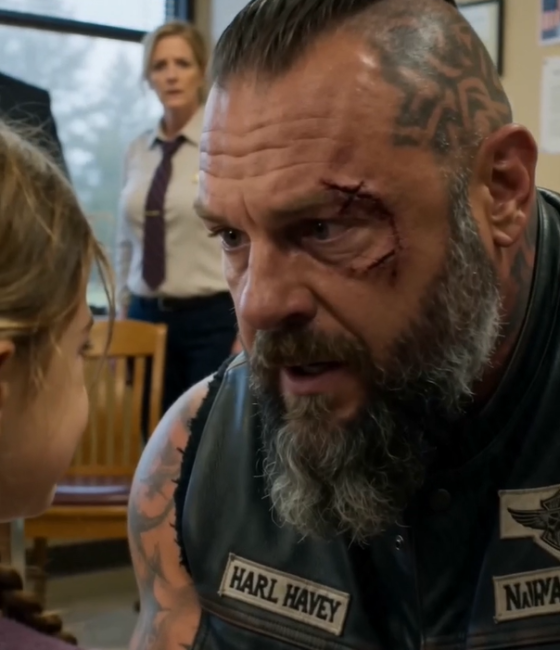
Mason filled that doorway. Leather cut. Grease on his sleeves. Dried blood at his hairline. Boots heavy on the linoleum.
His hands were washed but not clean. Mechanic hands never are. The black stays in the lines.
“Where’s my daughter?” he asked.
Not loud.
That made it worse.
The principal, Mr. Harlan, came out with his tie pulled too tight and his face already arranged into judgment.
“Mr. Cole, thank you for coming. We have a serious situation.”
Mason looked past him.
Emma sat in a chair by the nurse’s door, feet not touching the floor. Her lower lip was split. Her purple coat was bunched in her lap. One braid had come loose, strands of hair stuck to her wet cheek.
Across the room sat a boy named Carson Webb with a red mark near his eye, his mother rubbing his shoulder like he had survived war.
Mrs. Webb saw Mason and pulled Carson closer.
That small motion hit the room like a slap.
Mason saw it.
Emma saw him see it.
Her chin started shaking.
“What happened?” Mason asked.
Mr. Harlan stepped between them. “Emma struck another student during recess. We do not tolerate violence here.”
Mason kept his eyes on his daughter.
“Emma.”
She looked down.
“Why?”
No answer.
“Baby. Look at me.”
That word changed the air.
Baby.
From a man with skulls on his vest and dried blood near his temple.
Emma raised her eyes.
“He said…” She swallowed. “He said you were bad.”
Mrs. Webb sighed. “They’re children. They say things.”
Emma’s small hands curled around the coat.
“He said bikers are criminals. He said you probably hurt my mom and made her leave.”
The office went quiet.
The kind of quiet that hums.
Mason’s face didn’t move, but I saw his right hand twitch. Once. Like it wanted to become a fist and he had to remind it not to.
Emma kept going, because children don’t know when the knife is already deep enough.
“He said girls need moms because men like you don’t know how to raise anybody.”
Mason closed his eyes.
Only for a second.
When he opened them, they were wet.
But he did not cry.
Men like Mason learn early that tears make some people crueler.
He crossed the office and lowered himself to one knee in front of Emma. His leather creaked. His boots squeaked on the waxed floor. The chain on his wallet clicked against the chair leg.
Every adult watched him like he might explode.
Instead, he took his daughter’s small hand in both of his.
Those hands could pull an engine apart.
They held her like glass.
“Did you hit him?” he asked.
Emma nodded.
“Then you were wrong.”
Her face collapsed.
“But Dad—”
“No.” His voice stayed steady. “We don’t hit because words hurt. We use words. We walk away. We get a teacher. You know better.”
She nodded again, crying now.
Then Mason squeezed her hand.
“But I am proud you wanted to protect me.”
Mr. Harlan blinked.
Mason turned his head just enough to include the room.
“I ride a Harley,” he said. “I also make breakfast every morning. I wash socks. I pack lunches. I read dinosaur books to June even when I’m so tired the words move on the page.”
Nobody spoke.
“I braid hair with hands that don’t bend right because I broke two fingers years ago being stupid. I learned from YouTube at four in the morning because picture day was coming and my girls deserved better than ponytails that fell out before lunch.”
He looked at Mrs. Webb then.
“My bike doesn’t decide what kind of father I am.”
That should have been the climax.
That should have been the moment everybody understood.
But life doesn’t clean itself up that easy.
Because Mr. Harlan cleared his throat and said, “Mr. Cole, there are still concerns about the home environment.”
And that is when Mason’s club walked through the school doors.
They came in one by one.
Tank first.
Then Rooster.
Then Danny the prospect, carrying June’s forgotten lunch box because apparently that had been the reason he was near the school in the first place.
Three bikers in an elementary office will make people reconsider every choice they made that morning.
The receptionist stood up so fast her chair rolled into the wall.
Mason slowly rose.
His shoulders went tight.
“Why are you here?” he asked Tank.
Tank looked at Emma, then at the principal.
“Earl called. Said family needed backup.”
Mason’s jaw hardened. “This ain’t club business.”
Tank’s eyes softened. “Brother, your girls are club business.”
It could have gone wrong.
A room full of fear. A father already cut open by a child’s words. Men who had spent half their lives being mistaken for threats and sometimes acting like the mistake saved time.
But the twist wasn’t that the bikers came to scare people.
They came with paperwork.
Rooster reached into his vest and pulled out a folded folder.
Not a knife.
Not a threat.
A folder.
He handed it to Mr. Harlan.
“Sir,” Rooster said, and I had never heard that man say sir before, “you got questions about the home environment, you might want the full picture.”
Mr. Harlan opened the folder.
Inside were copies of emergency contact forms, pediatric appointment records, school volunteer sign-ins, daycare pickup authorizations, and three certificates from a parenting class in Murfreesboro.
Mason stared at the folder like he had never seen it.
Tank shrugged. “We keep copies.”
“You what?” Mason said.
“Brother,” Tank said, “you forget forms. We don’t.”
Danny lifted the lunch box weakly. “Also June only eats the star crackers if they’re in the blue cup.”
That was the first time Emma almost smiled.
Mr. Harlan looked uncomfortable now. Authority does not like being handed evidence by a man with a throat tattoo.
Mrs. Webb wasn’t done.
“Well,” she said, “it still doesn’t explain the mother.”
The room froze again.
Mason turned toward her.
For one second, the old version of him appeared.
Not violent. Not loud.
Just dangerous in the way a storm cloud is dangerous before it breaks.
Tank stepped half an inch closer.
Mason noticed and lifted one finger.
Stay.
That was brotherhood too.
Not charging in.
Holding back because your brother asks you to.
Mason looked down at Emma. Her eyes were huge.
This was the locked door.
The word nobody used.
Mom.
Mr. Harlan cleared his throat. “Perhaps we should continue privately.”
“No,” Mason said.
His voice was rough now.
He reached for Emma’s coat and helped her stand.
“We’re done here.”
“But consequences—”
“She’ll write an apology,” Mason said. “She’ll lose TV for a week. She’ll come back tomorrow and face what she did.”
Then he looked at Carson.
“And son, I’m sorry you got hit.”
Carson stared at his shoes.
Mason turned to Mrs. Webb.
“But don’t you ever use my missing wife as proof I failed my children.”
Nobody breathed.
Missing wife.
That was the phrase that followed us out into the parking lot.
The school doors shut behind us with a soft hydraulic sigh.
Outside, the air smelled like wet asphalt and exhaust. The Harleys sat along the curb, black and chrome under a dull sky. For once, none of them looked like machines of rebellion.
They looked like waiting horses.
Emma stood beside Mason, small against all that leather.
She didn’t ask the question there.
She waited until they got home.
But I saw it on her face.
The school had cracked something open.
And Mason knew he couldn’t patch it with pancakes this time.
That night, our whole street seemed to listen.
Not on purpose.
That’s what we told ourselves.
But sound travels in old neighborhoods. Especially in winter. Especially when a man who never talks is about to tell the truth.
Mason’s kitchen window glowed yellow across from my porch. I was sitting outside with a cup of coffee gone cold, watching nothing, hearing everything.
The Harley was in the garage.
No engine noise.
No club.
No boots on pavement.
Just that little blue house, three girls inside, and the past waiting at the table.
Later, Mason told me what happened.
Not all at once. Men like him hand you truth the way they hand you tools. One piece at a time, heavy and practical.
He said he made grilled cheese for dinner because it was Emma’s favorite and because his hands were shaking too bad for anything complicated.
Lucy asked why nobody was talking.
June asked if hitting was always bad or only at school.
Emma didn’t eat.
After dinner, Mason washed the plates. He wiped the counters. He packed lunches for the next day. Peanut butter for Lucy, turkey for Emma, cream cheese and cucumber for June because June was strange in a rich-person way nobody understood.
Then he sat down.
The girls knew.
Children always know when adults are standing at the edge of a sentence.
Emma asked it with both hands in her lap.
“Dad, where did Mom go?”
Mason said the room got so quiet he could hear the refrigerator click.
He wanted to lie.
Not because he was a coward.
Because lies can feel like blankets when children are cold.
He had used soft versions before.
“She had to leave.”
“She wasn’t ready.”
“It wasn’t your fault.”
All true in pieces.
Not enough anymore.
So Mason reached for his vest hanging on the chair.
He turned it inside out.
That was the first seed coming back.
The pink ribbons.
Emma. Lucy. June.
He laid the leather across the table like a map.
“When your mom left,” he said, “June was three months old.”
Lucy’s mouth opened.
June looked confused, too young to place herself inside a story.
Emma didn’t move.
“She didn’t die?” Emma whispered.
“No.”
“She didn’t get taken?”
“No.”
“She left us?”
Mason swallowed.
“She left me,” he said. “I decided she wasn’t taking that from you girls.”
That was Mason’s way.
Even in truth, he tried to absorb the worst part.
He told them their mother had been young, tired, and drowning in a life she didn’t want. He did not call her selfish. He did not call her cruel. He did not say the words other people would have used.
He said, “Some people run because staying feels like dying. I don’t hate her for running.”
Emma’s eyes filled.
“Do you miss her?”
Mason rubbed his thumb over the ribbon with her name.
“I miss who she was before she got lost.”
That was twist one, I guess.
The town thought he scared the mother away.
The truth was, he had spent years making sure his daughters did not grow up hating the woman who left them.
Then came the second seed.
The YouTube braids at 4:17.
Emma asked, “Is that why you wake up so early?”
Mason nodded.
“At first, I woke up because June cried. Then because Lucy had nightmares. Then because you needed picture day hair and I didn’t know how. After a while, early morning was the only time I could learn things before you girls needed me to already know them.”
That one broke Emma.
Not loud.
She just folded over the table and cried into the leather vest.
Mason didn’t rush her.
He put one hand on her back.
Those rough fingers. Those mechanic hands. The same hands that people saw and judged before they ever saw what they carried.
Then Lucy asked the question only Lucy would ask.
“Did the motorcycle make Mom leave?”
Mason almost laughed. Almost.
“No, baby.”
“Then why do people hate it?”
He thought about that.
“Because sometimes people pick one thing they understand and blame it for everything they don’t.”
June touched the skull patch outside the vest.
“It’s scary.”
“Yeah,” Mason said.
“Are you scary?”
He looked at all three girls.
“Sometimes.”
That was the most honest thing a father could say.
Then he added, “But not to you.”
He didn’t promise he was perfect. He didn’t dress himself up for them. He did not turn into some clean movie version of a dad.
He told them he had been arrested once at twenty-two for fighting outside a bar.
He told them he had drunk too much after his own father died.
He told them the club saved him, not by making him good, but by refusing to let him disappear.
Tank had taken his keys one night.
Rooster had dragged him to work the next morning.
Earl had hired him when no decent shop would.
Then Emma was born, and Mason said the first time she wrapped her hand around his finger, he understood that a man could spend his whole life being hard and still be undone by something weighing seven pounds.
He pointed to the ribbons.
“I sewed these inside because people already stare at you girls enough. I didn’t want to make you part of my world before you chose it.”
Emma touched her name.
“But we are your world.”
Mason’s voice broke then.
Just once.
“Yeah,” he said. “You are.”
That was the night Emma understood why her father woke before the sun.
Not because he was tough.
Because love had given him homework.
And he refused to fail.
Things changed after that.
Not all at once.
Towns don’t repent overnight. They just get quieter.
Mrs. Dawson stopped making comments over her roses. Mr. Harlan became painfully polite at pickup. Mrs. Webb sent Carson to school with an apology note written in pencil and folded twice.
Emma wrote hers too.
She gave it to Carson at recess.
Then she told him, “You can think motorcycles are scary. But don’t talk about my dad like you know him.”
Carson nodded.
Ten-year-old boys are not built for deep accountability, but he managed, “Okay.”
Mason kept waking at 4:17.
That became the ritual.
Coffee first. Black, in the chipped mug that said WORLD’S OKAYEST DAD because Rooster bought it as a joke and Mason used it every day.
Then breakfast.
Then laundry from the dryer.
Then the braids.
By spring, he could do fishtails.
By summer, he could do buns for dance class.
By fall, other fathers were asking him at school pickup, quietly, like they were buying contraband, “Hey, man, how do you keep the part straight?”
Mason would grunt, pull a comb from his back pocket, and show them.
The Iron Apostles changed too.
Their Thursday night grocery runs became Thursday night dinner.
Tank learned to make spaghetti.
Danny learned that glitter never leaves denim.
Rooster built a small wooden shelf by the front door with four hooks.
Three for backpacks.
One for Mason’s vest.
Inside that vest, the ribbons stayed hidden unless you knew where to look.
Once a year, on the anniversary of the day their mother left, Mason took the girls for breakfast at Millie’s before school.
No speeches.
No sad music.
Just pancakes, eggs, milk, and his black coffee.
Afterward, he rode alone down Route 64 until the houses thinned out and the fields opened. He never told me where he went, but I knew he came back lighter and sadder at the same time.
Some grief is like a dog that follows your bike.
You don’t feed it.
You don’t kick it.
You just learn its pace.
One October morning, I saw Emma on the porch before sunrise.
She was thirteen then, taller, still sharp-eyed.
Mason sat on the step below her while she braided his beard with a pink ribbon.
He acted annoyed.
He was not annoyed.
The Harley waited in the driveway, chrome catching the first dull blue of morning. Somewhere down the street, a dog barked. A school bus hissed two blocks over.
Emma tied the ribbon off and said, “There. Now people will know.”
Mason touched it like it might burn him.
“Know what?”
“That you’re ours.”
He looked away toward the road.
For a long second, he said nothing.
Then he stood, kissed the top of her head, and went inside to wake her sisters.
I still see Mason most mornings.
Older now.
More gray in the beard. More ache in the knees. Same boots, though the soles have been replaced twice. Same Road King, though it coughs longer before it catches.
The girls are growing fast.
Emma is almost as tall as him. Lucy argues like a lawyer. June still eats cucumber sandwiches and asks questions that make grown men reconsider their lives.
The neighborhood doesn’t whisper like it used to.
Now they wave.
Some even wait for that engine in the morning, because the sound no longer means trouble to them.
It means three girls are getting to school.
It means lunches are packed.
It means a father kept his promise again before most of us opened our eyes.
Last week, I watched Mason step out onto the porch with his vest over one shoulder and a hairbrush sticking from his back pocket.
June ran after him, yelling, “Dad, my braid’s crooked.”
He stopped beside the Harley.
The engine was already warming, low and steady.
He shut it off.
No hesitation.
Just silence, then boots on the porch steps.
He sat down, took the brush, and fixed the braid with hands that still looked too rough for something so gentle.
When he finished, June kissed his cheek and ran inside for her backpack.
Mason stayed there a moment.
Big man. Skull patch. Pink ribbon hidden near his heart.
Then the Harley started again.
And he came home.
Follow the page for more biker stories that look rough on the outside and hit hard where it matters.