Part 2: He Let His Son Fall Twelve Times — Ten Years Later, That Boy Led His Father’s Final Ride
I need to tell you something before I make my father sound wise.
He wasn’t always.
Ray Mercer was not some clean old man from a church bulletin. He was complicated. He had a temper when he was young. He drank hard after my mother died. He punched a wall once and broke two fingers because the hospital gave him her wedding ring in a plastic bag and he didn’t know where to put the grief.
He never hit me.
Not once.
But he could make a room shrink just by stepping into it.
My mother died when I was nine. A drunk driver crossed the center line outside Lebanon, Tennessee, on a wet March night. Dad got there before the ambulance left. The cops told him not to look. He looked anyway.
After that, he stopped sleeping like normal people.
Some nights I’d wake at two in the morning and hear the garage door roll up. Then the Harley would cough, shake, and settle into that low V-twin rhythm that rattled the kitchen glasses. He’d sit there on the bike without going anywhere. Just idle. Just breathe.
I thought he was trying to escape us.
Years later, I understood he was trying not to disappear.
The Iron Valley Riders kept him alive in the ways men like that allow themselves to be kept alive.
Tank brought groceries and pretended he had bought too much.
Preacher, who wasn’t a preacher and had not seen a church in years, drove me to baseball practice when Dad couldn’t stop shaking long enough to hold the wheel.
Smitty, the club mechanic, taught Dad how to cook eggs without burning the house down.
They never said, “We love you.”
They said, “Your oil’s low.”
They said, “Kid needs cleats.”
They said, “Brother, shower. You smell dead.”
That was their language.
Dad listened because they were the only men rough enough to tell him the truth and stay.
He worked at a machine shop near Hendersonville. He came home smelling like coolant, steel dust, leather, and gas station coffee. His hands were always cracked. His fingernails always had black in them. His knees popped when he stood up. His voice sounded like gravel being pushed under a shovel.
But every Friday night, he took me to Duke’s Diner on Route 109.
Same booth. Same two burgers. Same rule.
Phones face down.
At sixteen, I hated that rule.
Now I’d give anything for one more burger across from him, watching him drown fries in hot sauce and pretend not to check whether I had enough ketchup.
The tiny red thread inside his collar showed up after Mom died.
I noticed it once when he bent to tighten my skate laces at a frozen birthday party I didn’t even want to attend. A single crooked stitch, red against black leather.
“What’s that?” I asked.
“Nothing,” he said.
Dad’s “nothing” usually meant pain.
So I stopped asking.
He started talking about teaching me to ride when I turned fifteen. Not because I begged. I didn’t. I liked bikes, but I feared his Harley. It was too big, too loud, too connected to him.
That machine felt like a living thing that only obeyed my father.
He told me riding wasn’t about looking tough.
“It’s balance,” he said. “Throttle. Brake. Eyes. Respect.”
That word came up a lot.
Respect the weight.
Respect the road.
Respect the machine.
Respect the part of yourself that panics.
At the time, I thought he was talking about motorcycles.
He wasn’t.
The lesson happened in July.
Hot enough for the asphalt to sweat. Hot enough that cicadas screamed from the trees like they were being punished for something.
Dad picked the abandoned church lot because nobody would be there to watch me fail. That was the one kindness I didn’t recognize.
His Harley-Davidson Road King sat in the empty parking lot like a black animal, heavy and patient. Chrome warm to the touch. Leather seat cracked at the edges. The tank had a faint scratch from where Mom had once dropped her keys against it and said, “Ray, this thing is louder than your ego.”
He never buffed that scratch out.
I wore jeans, boots, gloves, and a helmet that smelled like dust and old sweat. Dad checked the chin strap twice. Pulled my gloves tight. Tapped my knee guards.
“You fall,” he said, “you don’t throw your hands under the bike. You get clear.”
“You think I’m gonna fall?”
He stared at me.
“Everybody falls.”
The first fall was stupid.
Too much clutch. Too little throttle. The bike lurched. My feet scrambled. The weight leaned past the point where sixteen-year-old confidence becomes physics. I bailed sideways, and the Harley went down with a metal-heavy crash that made my stomach drop.
Dad didn’t yell about the bike.
That should’ve told me something.
He stood ten feet away with his arms crossed.
“Pick it up.”
I laughed because I thought he was joking.
He wasn’t.
“Dad, help me.”
“No.”
The word was flat.
I tried. The Harley didn’t move. My shoulder burned. Sweat ran down my neck into my shirt. My helmet made every breath loud.
Dad came closer but still didn’t touch it.
“Back to the seat. Grab the bar. Legs, not arms.”
“I can’t.”
“Then it stays down.”
That made me angry enough to lift it.
Barely.
When the bike came upright, Dad reached over and steadied the front brake for one second. One second only. Then he stepped back.
“Again.”
I fell the second time near the old basketball hoop.
The third time, I stalled and tipped.
The fourth, I grabbed too much front brake and hit the pavement hard enough to see white.
Dad’s jaw moved, but he didn’t come running.
I saw his hands though.
That was the thing I remember most.
He kept opening and closing them.
Like every instinct in him wanted to reach for me, and every promise he made to himself forced those hands shut.
By the fifth fall, I hated him.
By the seventh, Tank and Smitty had rolled up and parked near the edge of the lot. They didn’t laugh. They didn’t cheer. They watched like men attending a hard service.
“Merc,” Tank said once, low.
Dad didn’t look away from me.
“He’s got it.”
“I don’t got it!” I shouted.
My voice cracked. That made it worse.
The eighth fall tore my jeans.
The ninth bruised my hip.
The tenth knocked the air out of me.
The eleventh made me scared.
The twelfth made me mean.
I lay on the hot pavement with grit stuck to my palm and blood running down my shin. The Harley rested on its side beside me, engine off, metal ticking as it cooled.
Dad stood there.
Still.
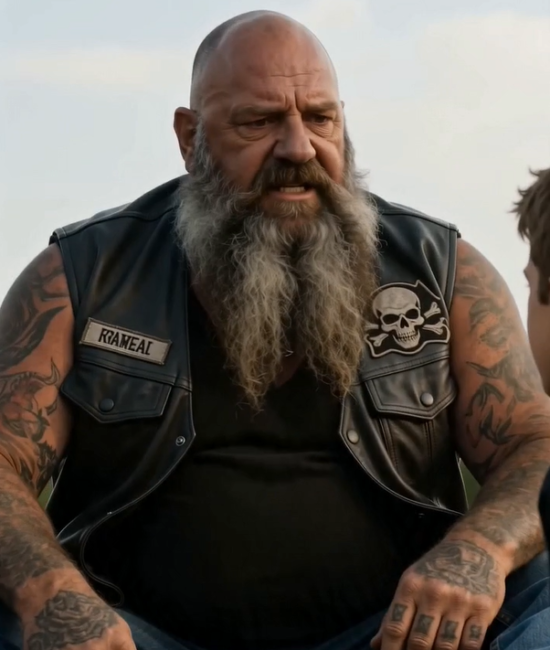
Huge. Tattooed. Silent. Cruel, I thought.
I ripped off my helmet and threw it. It bounced once and rolled toward the weeds.
“You don’t love me, do you?”
Tank looked down.
Smitty turned away.
Dad flinched like I had hit him.
That was the false ending right there. The moment a weaker story would make him soften, rush over, apologize, help me stand, and prove love by removing pain.
My father didn’t do that.
He walked over slow.
His boots scraped gravel. His vest creaked. The chain on his wallet clicked against his leg.
Then he sat on the asphalt beside me.
Not above me.
Beside me.
The heat had to be burning through his jeans, but he didn’t move.
He looked at my bleeding knee, then at the fallen bike, then at the road beyond the church lot.
“If I pick you up,” he said, “you’ll learn to stand with my hands.”
His voice was rough.
“If I don’t, you’ll learn to stand with your own legs.”
I stared at him, crying now, though I would have denied it until death.
He swallowed.
“I’m choosing the second one because I won’t live forever.”
I hated that sentence most of all.
Because he said it like a fact.
Not a threat.
Not drama.
A fact.
Then he got up, walked to my helmet, picked it up, brushed the dirt off with his sleeve, and set it beside me.
“Again,” he said.
I did get the bike moving that day.
Not far.
Maybe thirty yards.
But thirty yards can feel like a country when you’ve been eating pavement all afternoon.
I wobbled across the church lot, boot hovering, arms stiff, jaw clenched. The Harley shook under me like it wanted Dad back. I almost dropped it near the faded handicapped sign, corrected too hard, panicked, then somehow found balance.
The engine steadied.
My breathing steadied.
The lot opened up.
Dad stood at the far end with his arms crossed, but I saw his eyes.
Wet.
Not crying.
Dad didn’t cry where men could see.
But wet.
When I stopped without falling, Tank let out one sharp whistle.
Smitty muttered, “About damn time.”
Dad walked over.
I expected praise.
A hug maybe.
At least one of those rare father-son movie moments.
He just took the key, shut the bike off, and said, “Good.”
That was it.
Good.
I wanted more.
For years, I thought he had cheated me out of tenderness.
The twist is, he had been giving me the only kind he trusted.
The second twist came later, after his funeral, when I found the notebook.
But before that, there were ten years.
Ten years of me becoming a man the way boys do when they are lucky enough to argue with their fathers and unlucky enough to think there will always be time to fix it.
I moved to Nashville at nineteen.
I worked warehouse nights and community college mornings.
Dad called every Sunday at 7 p.m.
Never missed.
The calls were short.
“You eating?”
“Yes.”
“Bike running?”
“Yes.”
“Change the oil?”
“Yes.”
“You lying?”
“Maybe.”
“Don’t be stupid.”
“Love you too.”
Click.
That was us.
At twenty-three, I bought my own Harley. Used, beat-up, black paint fading on the tank. Dad came to look at it in the seller’s driveway. He walked around it twice, pointed out three problems, negotiated the price down eight hundred dollars, and never once said he was proud.
On the ride home, he stayed behind me.
Always behind me.
I thought it was because he didn’t trust me to keep up.
Now I know he was watching traffic for me.
At twenty-five, he got sick.
He didn’t tell me at first.
Men like Ray Mercer can admit a carburetor is failing before they admit a body is.
Lung cancer.
Not from cigarettes, though he smoked when he was young. The doctor said machine-shop years, dust, bad luck, maybe all of it. Dad heard “treatment,” “spread,” and “time,” then drove himself home because he didn’t want anyone seeing him in a hospital gown.
The club knew before I did.
That hurt.
I said so.
Dad sat on the porch, thinner already, vest hanging looser on his shoulders.
“I needed brothers before I needed a son scared.”
“I’m not a kid.”
“No,” he said. “That’s why I’m telling you now.”
He fought it for eleven months.
Quietly. Angrily. With black coffee, chemo, and cursing under his breath when his hands shook too much to button his cut.
Three weeks before he died, he called me to the garage.
His Road King sat under a canvas cover.
The place smelled like fuel stabilizer, dust, leather, and the peppermint candies he kept in an old coffee can for no reason he ever explained.
He handed me the keys.
I didn’t take them.
“Dad.”
“Don’t make it soft,” he said.
So I took them.
His fingers stayed on mine for one second too long.
Then he let go.
He died on a Thursday morning.
4:38 a.m.
Tank called me.
Not the hospital.
Tank.
That felt right and wrong at the same time.
I drove to Dad’s house in silence, no radio, both hands locked on the wheel. The sun hadn’t come up yet. Gallatin was still dark except for gas stations, porch lights, and the cold blue glow of vending machines outside closed storefronts.
The Iron Valley Riders were already there.
Bikes lined the curb.
No engines running.
That silence was heavier than noise.
Inside, Dad’s vest hung on the back of the kitchen chair. His boots were by the door, toes facing out like he might still step into them. A coffee cup sat in the sink. Half full. Black.
Tank handed me an envelope.
“Merc said after.”
That was all.
Inside was a key to a metal box under his workbench.
Inside the box was the notebook.
That was the second twist.
My father, the man who spoke in five-word sentences and considered greeting cards suspicious, had kept notes for ten years.
Not diary stuff.
Training notes.
Dates.
Falls.
Repairs.
Things I said.
Things he wished he had said back.
The first page was from that July day in the church parking lot.
“Boy fell twelve times. Wanted to help every time. Didn’t. Might have done it wrong. Hope not.”
I had to sit down.
The page blurred.
Tank stood near the garage door and pretended to inspect a wrench.
I turned the page.
“Kid thinks I don’t love him. That one got under my ribs.”
Another page.
“He rode thirty yards. Best sound I ever heard.”
Another.
“Followed him to Nashville. Stayed back. He checks mirrors better when he thinks I’m not watching.”
Another.
“Doctor says time is shorter. Need him ready. Hate this.”
Then the red thread came back.
Tucked into the back of the notebook was a small folded piece of cloth.
Red.
A strip from my mother’s scarf.
The one she wore in the last photograph of the three of us together.
Dad had stitched a piece of it inside his collar after she died.
Not for decoration.
For weight.
So every ride carried her.
Every lesson carried her.
Every time he bent down and I saw that crooked red thread, I was looking at the one soft thing he had kept closest to his throat.
There was a note wrapped around the cloth.
“Give this to him when he can ride without looking back.”
That sentence broke me in a way his death had not yet managed.
Because suddenly every hard thing rearranged itself.
The falls.
The silence.
The way he refused to pick me up.
The way he rode behind me.
The way he corrected my hands instead of hugging my fear.
The way he said, “Again,” when what I wanted was “It’s okay to quit.”
It had never been cruelty.
It had been preparation from a man terrified of leaving.
The day of the funeral, 200 motorcycles showed up.
I don’t know how word traveled that fast, but biker grief has its own highway.
They came from Tennessee, Kentucky, Alabama, Georgia. Old men with white beards. Women with black gloves and red eyes. Prospects who had never met my father but knew his name because someone had once said, “Merc helped me when nobody else would.”
The funeral director looked panicked.
Tank handled it.
“We ride him out,” he said.
Dad’s casket went in the hearse.
I sat on his Road King.
For one second, my hands forgot how to work.
The grips felt too familiar. The seat held his shape. The keys shook between my fingers. Behind me, 200 engines waited.
Not roaring.
Waiting.
Tank pulled up beside me.
“You don’t have to lead.”
I looked at the road ahead.
Highway 31E stretched out past the church, past the parking lot where I had fallen twelve times, past the place where Dad had sat beside me and refused to save me from myself.
I put on my helmet.
“Yes,” I said. “I do.”
The engine turned over.
Low. Heavy. Alive.
My boot came up.
The bike moved.
And I did not fall.
Every year now, on the Thursday closest to the day he died, I ride to that abandoned church lot outside Gallatin.
It isn’t abandoned anymore.
Somebody bought the building and turned it into a storage place for landscaping equipment. The basketball hoop is gone. The weeds are trimmed. The pavement still has cracks, though. Time doesn’t fix everything. It just grows around it.
I park near the far end.
Same spot.
I shut off the engine and listen to the metal tick as it cools.
That sound takes me back faster than any photograph.
Hot pavement.
Bleeding knee.
My father’s boots.
“Again.”
Sometimes Tank comes with me.
Sometimes he doesn’t.
He’s older now. Hip bothers him. Still rides. Still lies about pain.
When he does come, he brings two gas station coffees and sets one on the ground where Dad sat.
Black.
No sugar.
No lid.
“Brother hated lids,” he says every time.
Then we stand there and say almost nothing.
That is how biker men build a chapel.
No stained glass.
No choir.
Just cracked asphalt, cooling engines, and coffee going cold.
I keep Dad’s notebook in my garage.
Not on display.
In the top drawer of his old tool chest, under a shop rag and beside the red strip from Mom’s scarf. I stitched that strip inside my own vest collar last year.
Badly.
Crooked.
He would’ve laughed and called it ugly.
He would’ve touched it when nobody was looking.
I teach younger riders now.
Not many. Only the ones who can handle hearing the truth.
I don’t let them pretend the bike is a costume.
I don’t let them treat fear like shame.
And when they fall, I check their eyes first.
If they’re hurt, I help.
If they’re scared, I wait.
There’s a difference.
That was the part Dad knew.
The part I didn’t.
I’ve got a son now.
His name is Caleb Ray.
He is five, too small for a bike, too big for me to carry as often as I want to. He runs to the garage when he hears me come home and puts both hands over his ears while smiling like the noise is a secret.
Sometimes he climbs onto the seat of Dad’s Road King, grabs the bars, and says, “I’m Grandpa.”
The first time he said it, I had to turn away.
Not crying.
Just wet-eyed.
Like Dad.
Last month, Caleb fell off his bicycle in our driveway.
Training wheels had just come off.
He scraped both palms and hit the concrete hard enough to scare himself silent.
Every part of me wanted to scoop him up.
I almost did.
My hands moved before my head could stop them.
Then I heard Dad.
Not as a ghost. Not like some movie. Just memory, rough and clear.
If I pick you up, you’ll learn my hands.
So I crouched beside Caleb on the driveway.
Not above him.
Beside him.
I checked his palms. No broken bones. Just blood, fear, and a boy deciding what pain meant.
He looked at me with tears hanging on his lashes.
“Daddy, help me.”
I swallowed hard.
“I’m right here,” I said. “Stand up.”
He cried harder.
I stayed.
He pushed one hand against the concrete, then one knee, then both feet.
When he stood, he shook like a leaf.
I wiped his palms. Put the helmet back on his head. Turned the little bike toward the street.
He stared at me like I had betrayed him.
I knew that look.
I had worn it.
“Again?” he whispered.
I looked toward the garage.
Dad’s Harley sat in the shade, red thread hidden inside my vest, chrome holding a thin line of afternoon light.
“Again,” I said.
Caleb rode three crooked feet.
Then five.
Then ten.
Behind him, I walked with empty hands.
Follow the page for more biker stories where the roughest men leave the softest lessons behind.