Part 2: The Little Girl Brought Worn-Out Dance Shoes to the Audition — When the Music Started, the Entire Hall Held Its Breath
The pianist waited for the signal.
So did everyone else.
Ella stood in fifth position, or something close to it. Her heels did not press together perfectly, and one ribbon had already begun slipping down her ankle. Her chin was lifted, but her shoulders were tight, as if she expected someone to change their mind and ask her to leave.
Madame Renard folded her hands on the table.
“Begin when ready.”
Ella did not move.
That made the room restless.
A girl in a lavender leotard whispered, “She doesn’t even know how to start.”
Her mother touched her arm, but not quickly enough to hide the smile.
Ella heard that too.
Her eyes lowered to the scuffed floor.
For a moment, she looked exactly like what the room had decided she was. A child out of place. A girl with no training, no money, and no business standing between the mirrors of a school that hung framed photographs of famous alumni along its walls.
Then the pianist played the first note.
Ella’s head turned sharply.
Not toward the judges.
Toward the piano.
Her expression changed so suddenly that even Madame Renard noticed. It was not surprise. It was recognition.
The music was simple at first, a soft arrangement of “Clair de Lune,” slow enough for a beginner audition. Most girls used it to show pretty arms, clean turns, and control.
Ella did not move on the first phrase.
Or the second.
Madame Renard lifted her pen.
Beside her, Mr. Calloway, the younger judge who taught contemporary dance, leaned back in his chair. “Is she frozen?”
Ella’s lips parted slightly.
The pianist missed a note.
Only one.
Tiny.
Most people did not hear it.
Ella did.
Her left foot slid back half an inch, not like a planned step, but like a memory finding its place. Her fingers opened at her sides. Her shoulders loosened.
Then she began.
It was not polished.
That was the first thing Madame Renard told herself.
The turnout was imperfect. The arms were soft but not academically correct. Her balance wavered during the first rise, and the old shoes made a faint whisper against the floor.
But the room changed anyway.
Ella did not dance like a girl trying to impress judges.
She danced like someone answering a voice no one else could hear.
Her first turn was small, almost hidden. Then she reached one hand toward the empty piano chair and pulled it back to her chest, as if gathering something invisible. The gesture was so private that a few adults looked down, suddenly ashamed to be watching.
The mothers stopped whispering.
The girls stopped stretching.
Madame Renard’s pen hovered over the score sheet.
Ella moved through the first minute with strange hesitations, pausing in places where the music did not ask for pauses. Each one seemed wrong for half a second. Then the next phrase arrived, and the pause made sense.
Like she knew a version of the song underneath the one being played.
The pianist, Mrs. Bell, stared at her hands.
She knew that arrangement.
She had played it hundreds of times for auditions.
But Ella was not following the sheet music.
Ella was following breaths.
Madame Renard noticed the shoes again.
The frayed ribbon on the right ankle had come loose. It dragged against the floor as Ella turned, leaving a faint gray line behind her. The left shoe had a seam repaired with white thread that did not match.
Those were not neglected shoes.
They were kept shoes.
Saved shoes.
The difference was small, but it stayed in Madame Renard’s mind.
Near the back wall, Ella’s grandmother sat alone, holding a worn brown purse in both hands. She was a white woman in her late sixties with tired eyes, a navy coat, and a folded tissue clenched between her fingers.
She was not smiling.
She was watching Ella as if afraid the child might break.
Madame Renard glanced at the application form.
Ella Whitman. Age twelve. Guardian: Ruth Whitman.
No listed dance school.
No private coach.
No competition history.
Only one handwritten note beneath “special circumstances.”
Please allow her to use her own shoes.
Madame Renard had nearly rejected the request.
Now she looked back at the floor.
Ella rose onto her toes, not fully en pointe, just high enough to test the shoe’s ruined front. Her face tightened with pain, but she did not stop. She turned once, then stepped into a slow arabesque that trembled through her whole body.
A girl near the mirror whispered, “Why does it feel like she’s saying goodbye?”
No one answered.
At the piano, Mrs. Bell’s hands slowed.
Ella looked at her.
Not angrily.
Pleading.
The pianist found the rhythm again.
And that was when Madame Renard saw the writing inside the shoe.
As Ella turned, the loose ribbon opened just enough to reveal small faded letters on the lining.
For my little star.
Madame Renard’s breath caught.
She had seen that handwriting before.
But she did not yet know from where.
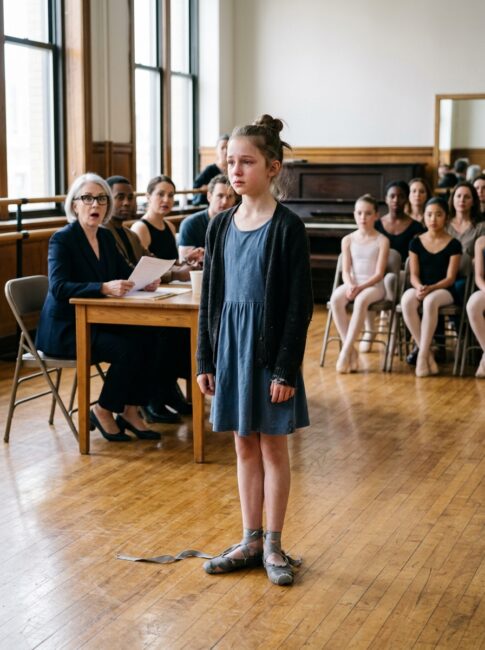
The audition was supposed to last ninety seconds.
Ella danced for almost three minutes.
No one stopped her.
Not because rules had been forgotten, but because every adult in the room seemed to understand that interrupting her would be like slamming a door in the middle of a prayer.
When the music softened into its final phrase, Ella stepped backward, one hand still reaching toward the piano chair. Her breathing shook. Her old ribbon had fully unraveled now, trailing behind her like something she refused to let go.
She ended not with a dramatic pose, but with both feet flat on the floor.
Her head bowed.
Her hand resting over her heart.
Silence filled the hall.
Then someone clapped once.
It was not a judge.
It was Ella’s grandmother, Ruth.
She had stood without realizing it, one hand pressed to her mouth, the other trembling against her purse. The single clap sounded lonely in the large room, and somehow more powerful because of it.
Then Ruth stopped herself, embarrassed.
Ella turned toward her.
For the first time all morning, the child’s face cracked.
Madame Renard removed her glasses.
“Miss Whitman,” she said slowly, “where did you learn that variation?”
Ella looked at the floor.
“I didn’t.”
Mr. Calloway frowned. “You improvised?”
Ella nodded once.
“That was not the assigned ending,” Madame Renard said.
“I know.”
“Then why did you dance it that way?”
Ella’s grandmother took one step forward. “Ella, sweetheart.”
Ella shook her head slightly.
A child’s way of saying, let me.
She bent down and untied the right shoe. The hall watched every movement. No one laughed now. No one whispered.
When she lifted the shoe, Madame Renard saw the inside clearly.
For my little star. Dance where I can see you.
Ella held it in both hands.
“They were my mom’s,” she said.
The sentence landed softly, but it changed the air completely.
Madame Renard sat straighter.
“Your mother danced?”
Ella nodded. “Not here.”
Ruth closed her eyes.
“She wanted to,” Ella added. “She came once when she was sixteen. She said the building looked like a palace.”
Madame Renard looked toward the wall of old framed photographs.
“Her name?”
Ella swallowed.
“Marianne Whitman.”
Mrs. Bell’s hands fell from the piano keys.
The sound was small, but everyone heard it.
Madame Renard turned sharply toward her.
Mrs. Bell’s face had gone pale.
“Marianne,” the pianist whispered.
Ella looked at her. “You knew her?”
Mrs. Bell covered her mouth.
Madame Renard’s memory finally opened.
Marianne Whitman.
A scholarship finalist from almost twenty years earlier. A girl with borrowed tights, wild musicality, and a laugh that filled the hallway. She had arrived late to the final audition because her mother’s car broke down. The panel had marked her unprepared before she even danced.
Madame Renard had been a young instructor then.
Not the director. Not powerful enough to change the vote. But old enough to remember the girl crying behind the costume rack afterward, holding her shoes against her chest.
Marianne had not been admitted.
Madame Renard had told herself the academy had standards.
For years, that sentence had been convenient.
Now Marianne’s daughter stood in the same hall, wearing the same shoes.
Ruth spoke from the back, her voice careful.
“Marianne kept them in a box.”
Ella looked down at the shoe. “She said they were the first thing she bought with her own money.”
Ruth wiped her eyes. “She wore them everywhere, even after they were too small.”
A girl in the lavender leotard lowered her head.
Her mother reached for her hand.
Madame Renard’s voice softened. “Is your mother here today?”
Ella’s fingers tightened around the shoe.
“No.”
The one word seemed to take everything from her.
Ruth stepped closer. “She passed last winter.”
Mrs. Bell made a quiet sound.
Ella kept talking because if she stopped, she might not start again.
“She was a night nurse,” she said. “She worked at County Memorial. She taught me in the kitchen when she got home. Sometimes she was too tired to stand, so she counted from a chair.”
Ruth nodded through tears.
“She used the refrigerator handle as a barre,” Ella said, almost smiling. “And she always said music starts before you hear it.”
Madame Renard looked down at her score sheet.
Under “Training,” she had written: insufficient.
The word felt suddenly small and ugly.
Ella continued.
“When she got sick, she made me promise I would audition here. I told her I couldn’t because we didn’t have the money for classes.”
Her voice began to tremble.
“She said, ‘Then dance what you have.’”
No one in the hall moved.
Not the girls by the mirror.
Not the mothers who had judged the shoes.
Not the judges who had prepared polite rejection phrases before the first note.
Ella slipped the old shoe back onto her foot, though the ribbon would not stay tied.
“I know they look bad,” she said. “But when I wear them, I can remember how her hands tied them. She was always careful, even when her fingers hurt.”
Ruth turned away, unable to hold her face together.
Madame Renard stood.
The room seemed to prepare for a decision.
But she did not announce one.
She walked around the table and came to the center of the floor. Up close, Ella looked even younger. Her knees were scraped. Her bun was loosening. Her eyes were too tired for twelve.
Madame Renard knelt.
That stunned the room more than applause would have.
She reached for the loose ribbon, then paused.
“May I?”
Ella nodded.
Madame Renard tied the ribbon slowly, with practiced hands that had tied thousands of shoes over decades. When she finished, she did not let go right away.
“I remember your mother,” she said.
Ella stopped breathing.
“She danced with a kind of honesty that made people uncomfortable when they were too focused on rules.”
Mrs. Bell began crying silently at the piano.
Madame Renard looked toward the judges’ table, then toward Ruth.
“I was not kind enough to her then.”
Ruth’s face changed.
Not because the apology fixed anything.
Because it named something she had carried for almost twenty years.
Madame Renard turned back to Ella.
“Your mother should have been given a chance.”
Ella’s lips parted, but no sound came.
“And today,” Madame Renard said, “I will not make the same mistake twice.”
The room exhaled.
But the real twist came from the piano.
Mrs. Bell stood, wiping her cheeks.
“She left something,” she said.
Madame Renard turned. “Who?”
“Marianne.”
Ruth’s eyes widened. “What do you mean?”
Mrs. Bell walked to the bench and opened the compartment beneath the seat. Inside were old sheet music books, pencils, and a small yellow envelope tucked into the side, faded with age.
“I found it years ago after auditions,” Mrs. Bell said. “No last address. Only her first name. I kept it because I thought one day she might come back.”
She carried it to Ella.
On the envelope, in younger handwriting, was written:
For the girl who dances after me.
Ella’s hands shook as she opened it.
Inside was a folded page of music.
Not a full composition.
Just a melody line, handwritten, unfinished.
At the bottom, Marianne had written:
If I ever have a daughter, this is hers.
Ruth covered her face.
Ella stared at the page.
Mrs. Bell whispered, “That was the phrase I accidentally played wrong today. You followed the old melody instead.”
Madame Renard looked at Ella.
The girl had not simply improvised.
She had recognized a song her mother had hummed in kitchens, hospital rooms, and quiet mornings when pain sat near the table.
The entire hall seemed to understand it at once.
Ella had danced to music that had waited twenty years to find her.
No decision was announced that morning.
At least, not the way auditions usually end.
There was no cold list taped to a hallway wall. No numbers circled in red. No girls pretending not to look while their mothers read faster than they did.
Madame Renard dismissed the room quietly and asked Ella and Ruth to stay.
The other dancers gathered their bags more slowly than usual. The girl in the lavender leotard walked past Ella, stopped, and looked down at the worn shoes.
“My shoes hurt too,” she said, then seemed embarrassed by how small that sounded.
Ella gave her a gentle smile. “Maybe they need to learn you.”
The girl nodded as if she understood more than she could say.
When the hall emptied, sunlight poured across the floor in long pale rectangles. Dust floated in the quiet. The piano sat open, the yellow envelope resting on its lid.
Madame Renard brought Ella a new pair of practice shoes from the academy supply closet.
They were soft, clean, and the right size.
Ella held them carefully.
“Do I have to throw the old ones away?”
“No,” Madame Renard said. “Some shoes are for dancing. Some are for remembering.”
Ruth sat in the front row, holding Marianne’s unfinished melody like a fragile bird.
Mrs. Bell returned to the piano and played the handwritten notes. They were simple. A little uneven. Beautiful in the way unfinished things can be beautiful when someone loved them enough to begin.
Ella listened with her mother’s shoes in her lap and the new shoes beside her.
For the first time since winter, she did not look like she was trying to keep a promise alone.
Madame Renard sat beside Ruth.
“We have a scholarship place,” she said. “Full tuition. Supplies included.”
Ruth’s hand flew to her chest.
Ella did not speak.
She looked at the floor where she had danced, then at the old shoes.
“What if I’m not good enough?”
Madame Renard took a long breath.
Years ago, she might have answered with discipline, technique, and standards.
Today she said, “Then we will teach you.”
Ella looked up.
That was the sentence she had needed.
Not that she was perfect.
Not that grief made her special.
Only that someone was willing to begin from where she stood.
A week later, Ella returned for her first class.
Her bun was still uneven. Her leotard was borrowed. The new shoes pinched at the heel, and she stumbled twice during warm-up.
Nobody laughed.
Madame Renard watched from the doorway, one hand resting against the frame. Mrs. Bell played the counts softer than usual, leaving space between the notes, as if listening for another melody underneath.
After class, Ella stayed behind.
She placed her mother’s old shoes in a small shadow box Madame Renard had arranged near the academy entrance. Beneath them was a simple card.
Marianne Whitman
A dancer who began here, even when no one knew it.
Ella read the card twice.
Then she reached into her dance bag and pulled out the yellow envelope. She tucked a copy of the unfinished melody beneath the shoes.
Before leaving, she touched the glass with two fingers.
“Dance where I can see you,” she whispered.
Outside, Ruth waited by the curb in an old blue sedan. Ella climbed in, tired and quiet, with her new shoes hanging from her bag.
Ruth glanced at her. “How did it feel?”
Ella looked down at her feet.
“They don’t remember yet,” she said.
Ruth smiled through tears. “They will.”
The car pulled away from Briarwood Arts Academy, past the tall windows and the bright audition hall where people had once judged a child by the shoes she carried.
Inside, the old shoes rested under glass, ribbons frayed, toes patched, still holding the shape of two lives.
And if this story made you think of someone who kept dancing with what life left behind, follow this page for more stories that stay with you.