Part 2: The Boy Always Marked “Disruptive” in the Class Log — Until His Year-End Speech Made Every Teacher Look Back
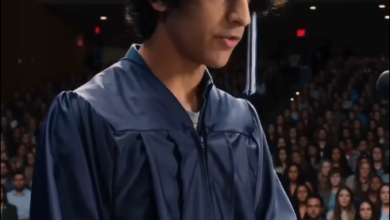
At first, everyone thought Noah was about to make things worse.
That was what people expected from him. A joke. A loud excuse. One more awkward moment for teachers to manage while parents exchanged knowing looks.
Principal Hayes placed a hand gently over the microphone.
“Noah,” she said, keeping her smile tight for the audience. “We’ll hear student speeches in a few minutes.”
Noah looked at her hand, then at the folded paper he carried.
“I know,” he said. “Mrs. Whitaker picked Lily Mason to speak.”
A small ripple moved through the fifth-grade rows.
Lily Mason sat two seats away, wearing a white dress and a ribbon in her hair. She was everything a school loved on stage. Polite, neat, gifted, and reliable. Her speech had been printed on index cards with purple ink.
But Lily was not looking at Noah with annoyance.
She was staring at the floor.
That was the first strange thing.
The second was Mrs. Whitaker’s face.
She did not look angry anymore. She looked uncertain.
Noah unfolded his paper carefully. His hands shook, but he kept his chin lifted.
“I wrote one too,” he said. “I didn’t turn it in because I figured nobody wanted to hear from the kid in the logbook.”
The parents grew still.
At the side of the gym, Mr. Coleman, the custodian, shifted his mop handle from one hand to the other. His eyes were fixed on Noah.
Principal Hayes glanced toward Mrs. Whitaker.
Mrs. Whitaker stepped forward. “Noah, sweetheart, this isn’t the time.”
He looked at her then, and the whole gym saw something pass between them.
Not defiance.
Hurt.
“Every time wasn’t what you thought,” he said.
The sentence was quiet, but it carried.
Some teachers looked away.
Noah turned toward the fifth-grade section. “Can I read it?”
No one answered at first.
Then Lily Mason stood.
Her ribbon slipped loose from her hair.
“He should,” she said.
Her mother, sitting in the second row, frowned. “Lily, sit down.”
Lily did not sit.
Another student stood next, a Black boy named Marcus Reed, who had spent most of the year being moved away from Noah because teachers said Noah distracted him.
“He should read it,” Marcus said.
Then Sophie Chen stood.
Then Eli Thompson.
Then three more students.
The gym began to feel less like an assembly and more like something carefully hidden had started finding air.
Mrs. Whitaker pressed her fingers to her lips.
Noah looked at the microphone, waiting.
Principal Hayes slowly removed her hand.
“Two minutes,” she said.
Noah nodded.
But before he began, he reached into his pocket and pulled out a small red object.
A plastic whistle.
Several teachers recognized it.
Mrs. Whitaker’s shoulders dropped.
The whistle had caused one of the worst notes in the logbook.
Noah made loud whistle sound during silent reading.
That day, Mrs. Whitaker had sent him to the office. She remembered the heat in her face, the way the whole class had jumped, the way Noah refused to apologize.
She had not remembered the look on Lily’s face afterward.
Noah held the whistle up.
“This is not mine,” he said.
Lily closed her eyes.
The room waited.
Noah placed it on the podium like a piece of evidence.
“It was Lily’s brother’s safety whistle,” he said. “She brought it after her dad forgot to pick her up twice. She was scared after school.”
Lily’s mother went pale.
Noah did not look at her.
“She blew it by accident during reading, and everyone turned around. She started crying. I knew she’d be embarrassed if people knew.”
He swallowed.
“So I said it was me.”
A tiny sound came from Mrs. Whitaker.
Noah looked down at his paper.
“That was the first note.”
He turned toward the teachers lining the wall.
“The crawling under desks one came after Marcus dropped his inhaler.”
Marcus looked at the floor, jaw tight.
“He didn’t want anyone to know he still needed it. He kicked it under Sophie’s desk, and then he couldn’t breathe right. I crawled under to get it.”
The gym had no whispers now.
Only breathing.
Noah’s voice stayed small, but it no longer shook.
“The humming during the spelling test was because Sophie panics when it gets too quiet. Her mom told the counselor music helps, but the counselor wasn’t there that day.”
Sophie covered her mouth.
Noah glanced at her and gave a quick, embarrassed shrug.
“I only knew one tune.”
A few people laughed softly, but the sound broke in the middle.
Mrs. Whitaker remembered that day too.
Noah had hummed through the entire test. She had taken his paper, written another note, and called his mother before lunch.
His mother had not answered.
She almost never did.
Back then, Mrs. Whitaker had assumed that explained everything.
Now she was not sure it explained anything at all.
Noah unfolded the second page.
“And the day I yelled during science,” he said, “was because Eli’s lunchbox had a note from his dad inside. Eli wasn’t supposed to see it.”
Eli’s father sat near the aisle, wearing a work shirt with his name stitched over the pocket. His face hardened with confusion.
Eli stood straighter.
Noah looked at him, silently asking permission.
Eli gave one small nod.
Noah continued.
“It was from before his dad got out of the hospital. Eli thought it meant his dad was going away again.”
Eli’s father lowered his head.
“I yelled because everybody was about to hear him cry.”
The folded chairs creaked as adults shifted in them.
Not because they were bored.
Because shame does not always arrive loudly. Sometimes it moves through a room chair by chair.
Noah looked at the logbook still resting on the table beside Principal Hayes.
“All year, I thought teachers wrote down what happened,” he said. “But sometimes they only wrote down what they saw.”
Mrs. Whitaker closed her eyes.
That sentence stayed in the gym longer than applause ever could.
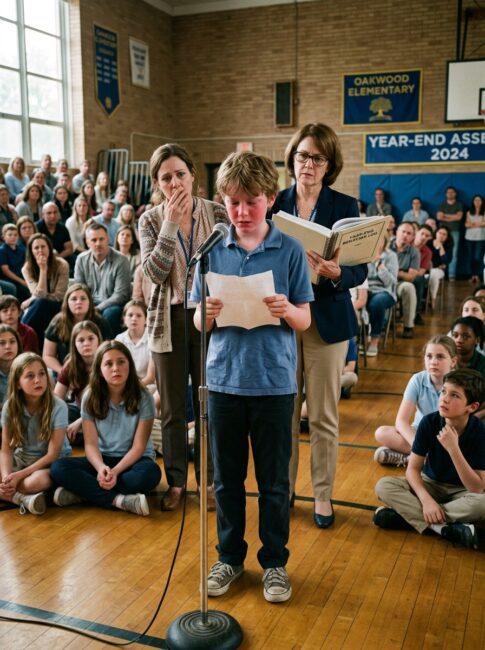
Noah had not planned to keep speaking.
His paper only had two pages. Most of the sentences were crossed out and rewritten in pencil. Some words were spelled wrong. Some lines leaned downward, as if his hand had grown tired before his courage did.
But once the room stopped laughing at him, he found the strength to continue.
“I’m not saying I never made trouble,” he said.
That made Mrs. Whitaker open her eyes.
He looked straight at her, and his expression was painfully honest.
“I did.”
A few students smiled through tears.
“I talked too much. I tapped pencils. I made jokes when I was nervous. I got mad when people called me bad before I did anything.”
His voice caught on the word bad.
Mrs. Whitaker heard it.
For nine months, she had used softer words. Disruptive. Challenging. Off task. Needs redirection.
But children are very good at translating adults.
Noah had heard bad.
He looked at the parents next.
“My mom works nights at St. Andrew’s. She cleans the emergency room. Sometimes she gets home when I’m getting up.”
His mother was not in the audience.
Several people noticed then. Some had noticed earlier and judged him for that too.
“She wanted to come,” Noah said quickly, as if protecting her from thoughts nobody had spoken aloud. “She left her uniform on the chair last night. She even wrote the time on her hand.”
He glanced down at his own palm.
A blue ink mark had been smudged there.
“But a lady at her job had a baby early, and my mom stayed because the lady was alone.”
The fifth-grade teachers stood very still.
Noah folded and unfolded the corner of his speech.
“My mom says sometimes you do the right thing and nobody claps because nobody knows.”
The sentence landed differently after what he had already revealed.
Mrs. Whitaker looked at the logbook.
She saw her handwriting across dozens of pages. Clean, quick, professional.
Noah disrupted.
Noah refused.
Noah laughed.
Noah crawled.
Noah made noise.
The words had been true in the smallest possible way.
That was what hurt.
Noah continued.
“I guess I learned that from her. But I also learned it can make people think you’re something you’re not.”
Principal Hayes’s face had changed completely.
She was no longer managing the assembly. She was listening as if the child at the microphone had become the only teacher in the gym.
Noah looked toward Mrs. Whitaker again.
“I didn’t tell you because Marcus asked me not to. Lily asked me not to. Sophie didn’t ask, but I could tell. And Eli looked like he might disappear if anybody knew.”
Eli wiped his face with both hands.
“So I took the notes,” Noah said. “I figured I already had a lot.”
That was when Mrs. Whitaker stepped forward.
“Noah,” she whispered.
The microphone caught it.
He looked down quickly, as if he expected correction even now.
Instead, Mrs. Whitaker walked to the table and picked up the class logbook.
For a moment, everyone thought she might close it and end the assembly.
But she carried it to the podium and placed it beside Noah’s paper.
Then she turned it toward herself and opened to the first page.
Her voice trembled.
“September 14. Noah interrupted morning work by asking the same question four times.”
Noah shifted.
She looked at him. “What did I not see?”
He hesitated.
Then Marcus answered from the student section.
“He was asking because I couldn’t read the instructions from the back row. My glasses were broken.”
Mrs. Whitaker nodded slowly.
She turned another page.
“October 3. Noah refused to line up for recess.”
Sophie spoke from the second row. “He saw a kid from fourth grade crying by the lockers. He didn’t want to leave him there.”
Mrs. Whitaker’s hand tightened around the book.
“November 18. Noah knocked over art supplies.”
A small girl named Grace, who had barely spoken all year, stood with her hands clasped in front of her dress.
“I spilled paint first,” she said. “He knocked over the cup so people would look at him instead of my picture.”
Noah looked surprised.
He had not known Grace remembered.
The gym was no longer watching a boy defend himself.
They were watching a year rearrange itself.
Page by page.
Moment by moment.
A child everyone had reduced to a pattern was becoming a person in front of them.
Mrs. Whitaker stopped at a page in March.
Her mouth trembled before she read.
“March 22. Noah laughed during fire drill instructions.”
Noah looked away.
That one, he had not planned to explain.
Principal Hayes looked confused. “I remember that. We had to restart the drill.”
Noah’s ears turned red.
“It was the day after my mom got hurt at work,” he said.
The teachers looked at one another.
“She slipped near the ambulance entrance,” he continued. “She hit her head. I heard the sirens that morning, and I thought they were for her again.”
His voice thinned.
“When you said alarm, I laughed because I didn’t want to cry.”
Mrs. Whitaker covered her mouth.
There are moments when an adult realizes they were not cruel on purpose, but they were careless with power anyway.
This was one of those moments.
She closed the logbook.
Then she did something none of the students expected.
She sat down on the edge of the stage so her eyes were level with Noah’s.
“I am sorry,” she said.
Noah stared at her.
Teachers apologize sometimes, but often in careful adult ways. Sorry if you felt hurt. Sorry this became confusing. Sorry, but.
Mrs. Whitaker did not use a but.
“I wrote what I saw,” she said. “I did not always ask what happened. You deserved better than that from me.”
Noah’s face crumpled for one second before he fixed it.
He was eleven, but he had practiced not needing things.
The apology almost ruined him.
Mrs. Whitaker reached for the logbook again.
“May I?” she asked.
Noah nodded.
She opened to the final blank page, took the pen from her lanyard, and began writing.
This time, slowly.
Noah Bennett noticed when classmates were afraid.
Noah Bennett protected other children’s dignity.
Noah Bennett carried blame that did not belong to him.
Noah Bennett deserved to be seen more carefully.
She turned the book toward him.
“Is that true enough?” she asked.
Noah read it.
His lips pressed together.
Then he nodded once.
Lily began clapping.
Not loudly at first.
Just two hands meeting through tears.
Then Marcus joined.
Then Sophie.
Then Eli.
Soon the gym filled with applause, but Noah did not smile the way children usually smile when praised.
He looked overwhelmed.
As if kindness felt heavier than punishment because he was not used to holding it.
From the side doors, a woman in blue hospital scrubs stepped into the gym.
Her hair was pulled back badly. Her shoes were wet from the rain outside. There was a red mark on her cheek where she had probably slept against a bus window.
Noah saw her.
“Mom?”
His voice broke on the single word.
The applause softened.
His mother stood at the door with one hand over her mouth.
“I’m sorry,” she said, though nobody asked her to be.
Noah stepped away from the microphone and ran.
This time, no teacher wrote down that he left the stage without permission.
Noah’s mother met him halfway across the gym.
He hit her like a wave, wrapping both arms around her waist, and she held him so tightly the folded paper in his hand crumpled against her uniform.
“I tried,” she whispered into his hair. “The bus was late.”
“I know,” he said.
And he did.
That was the thing about Noah Bennett.
He knew too much about why people were late, why people were tired, why people snapped when they were afraid, and why some children needed someone else to take the blame for a minute.
For a long time, adults had called that disruption.
Now the gym did not seem so sure.
After the assembly, the fifth graders spilled into the hallway for cookies and lemonade. Parents spoke more softly than usual. Teachers gathered in small groups, not gossiping, just standing with the discomfort of having learned something too late.
Mrs. Whitaker sat alone in Room 12 after dismissal.
The behavior logbook lay open on her desk.
She did not tear out the old pages. She did not pretend she had never written them. Instead, she placed sticky notes beside several entries, adding what she now understood.
Beside Crawled under desks, she wrote: Marcus’s inhaler.
Beside Hummed during test, she wrote: Sophie’s anxiety.
Beside Laughed during fire drill, she wrote: Fear sounds different in children.
Then she stopped at a blank space and wrote one more note, not for Noah, but for herself.
Ask first.
The door creaked open.
Noah stood there with his backpack hanging from one shoulder. His mother waited behind him in the hall, speaking quietly with Principal Hayes.
“I forgot my speech,” he said.
Mrs. Whitaker picked up the wrinkled paper from the podium where someone had left it. She held it carefully, as if it were not a school assignment but a fragile record of a boy who had spent the year being misunderstood in public.
“You wrote a strong speech,” she said.
Noah shrugged. “It was kind of messy.”
“Most true things are.”
He looked at the logbook on her desk.
His eyes moved over the sticky notes.
“Are you changing it?”
“I’m adding what I missed.”
Noah came closer, uncertain.
He read the last note.
Ask first.
For a while, neither of them spoke.
Outside, the hallway buzzed with the end of the year. Lockers slammed. Parents called names. Children laughed because summer was waiting just beyond the doors.
Inside Room 12, a teacher and a boy stood beside a book that had once made him smaller.
Mrs. Whitaker opened the back cover and slipped his speech inside.
“I’d like to keep this with the log,” she said. “Only if that’s okay.”
Noah thought about it.
Then he nodded.
“But don’t put it under disruptive.”
Mrs. Whitaker smiled through tears. “Where should I put it?”
He glanced at the board, where tomorrow’s homework had already been erased for summer. Then he looked back at the teacher who finally seemed to see him.
“Put it under things you didn’t know yet,” he said.
She wrote that on a fresh page.
Things we didn’t know yet.
Noah left with his mother a few minutes later. In the hallway, he reached for her hand, then pretended he had only bumped it by accident. She took it anyway.
Mrs. Whitaker watched them walk toward the sunlight pouring through the front doors.
The logbook stayed open on her desk, its final page still wet with ink.
And if this story made you think twice about a child people labeled too quickly, follow this page for more stories that stay with you.