Part 2: The Mother Who Knitted Through the Entire Ceremony — And Froze the Room When Her Gift Was Finally Given
The ceremony continued, but something had shifted.
Mason returned to his seat with the yarn in his hand, walking like someone had placed a heavy stone between his ribs. He gave it back to his mother without looking at her face.
Evelyn took it gently.
“Thank you,” she whispered.
He did not answer.
From the row behind them, a woman muttered, “Poor boy. Works that hard and she can’t even give him ten minutes.”
Evelyn heard it.
Her fingers paused for half a second, just long enough for the blue yarn to slacken between the needles. Then she lowered her eyes and continued.
Click. Loop. Pull.
Mason looked forward, shoulders rigid, as if he could hold the entire room away from her by sitting perfectly still.
He was eighteen, though he had carried himself like a grown man since he was twelve. People in Westbridge knew pieces of him, never the whole boy. They knew he worked early mornings at Becca’s Diner before school. They knew he tutored freshmen after class. They knew he had never missed honor roll, never gotten detention, never once asked for pity.
They also knew his mother cleaned rooms at the Riverside Lodge.
That was the version people trusted because it gave them something simple to say.
Poor kid. Good boy. Shame about the mother.
Evelyn had never corrected anyone.
Not when she came to parent conferences in her work uniform, smelling faintly of bleach and coffee. Not when she sat alone at basketball games, knitting under the bleachers because the gym lights hurt her eyes. Not when other mothers brought cupcakes and she brought nothing but a paper bag lunch for Mason, wrapped tight so no one could see it was mostly leftovers.
She had a way of shrinking in public.
That morning, she had shrunk so small that people mistook her quiet for coldness.
The ceremony moved into scholarship announcements. Each student’s story was read aloud. Parents clapped, cried, lifted phones.
Mason’s name came near the middle.
“Next, we recognize Mason Carter, recipient of the Westbridge Community Merit Award, the Langford Science Grant, and the North County Full Tuition Scholarship.”
The applause rose sharply.
Mason stood.
Evelyn did not.
Her needles kept moving, but the stitches had changed. The rhythm was uneven now. Her left thumb pressed hard against the yarn, and a small red mark had appeared where the fiber cut into her skin.
Principal Harris smiled down from the podium. “Mason, your teachers describe you as disciplined, thoughtful, and unusually compassionate. Your essay on home health inequity was described by the committee as deeply personal and beautifully argued.”
Mason’s eyes flicked toward his mother.
She did not look up.
The woman in pearls shook her head again. “Unbelievable.”
Beside Evelyn, an older man named Mr. Alvarez sat with a folded program in his lap. He had been the night janitor at Westbridge High for twenty-seven years, and he noticed things other people missed.
He noticed the yarn was not ordinary blue. It was the exact faded blue of the hospital blankets from St. Agnes Medical Center.
He noticed Evelyn’s hands trembled only when Mason’s achievements were read aloud.
He noticed the canvas tote beside her feet, patched at the corner with a square of denim. A paper tag stuck out from inside it. On the tag were three words written in black marker.
For Room 214.
Mr. Alvarez looked from the bag to Evelyn’s face.
Then he looked at Mason.
Something about the boy’s expression made the old janitor stop judging and start wondering.
When Mason returned from the stage with his scholarship folder, he passed close enough for Evelyn to touch his sleeve. She lifted one hand, hesitated, and placed two fingers lightly against his cuff.
It was not a proud mother’s dramatic embrace.
It was smaller than that.
Almost a question.
Mason froze. His throat moved as if he had swallowed something sharp. Then he sat down without turning toward her.
Evelyn lowered her hand.
The needles resumed.
By then, the video of her knitting had already begun circulating among parents in the auditorium. A girl in the back row showed her friend a clip with the caption: Mason’s mom really said “not my problem.”
A few seats away, Mason’s younger sister Lily saw it on someone’s screen.
She was nine, with a crooked ponytail and a blue dress Evelyn had hemmed by hand the night before. Lily’s face flushed bright red.
“That’s not fair,” she said.
The girl holding the phone glanced down. “What?”
“My mom is not mean.”
Evelyn leaned across Mason’s empty seat and touched Lily’s knee.
“Sweetheart,” she said softly. “Let it be.”
“But they’re lying.”
“Let it be.”
There was something tired in Evelyn’s voice, but not defeated. More like a woman holding a door shut with both hands while a storm pressed from the other side.
Lily sat back, eyes wet.
On stage, Principal Harris adjusted the microphone. “Before our final award, we have a special recognition. This year, our senior class voted to honor one family member whose support shaped a student’s journey.”
A ripple of warmth moved through the room.
Parents straightened.
Mothers dabbed at their eyes before hearing the name.
Mason looked down at his folder.
Evelyn’s needles stopped.
For the first time all morning, she lifted her face fully toward the stage.
Principal Harris smiled. “This nomination was submitted anonymously by one of our graduating seniors.”
Mason closed his eyes.
Evelyn stared at him.
The principal continued, “The recipient asked that the recognition remain simple, but the student insisted this story deserved to be heard.”
A small frown crossed Evelyn’s face.
Not fear exactly.
Recognition.
As if a promise had just been broken.
Then Principal Harris said, “Would Mrs. Evelyn Carter please come to the stage?”
The auditorium turned toward her.
Evelyn did not move.
The unfinished blue fabric lay across her lap, caught between the needles like a secret halfway told.
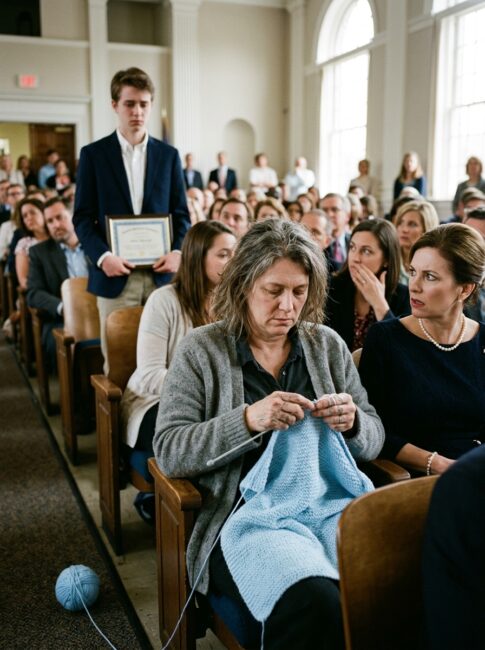
For several seconds, nobody breathed loudly enough to be noticed.
Evelyn looked at Mason, and the hurt on her face was so brief most people missed it. Mason saw it. Lily saw it. Mr. Alvarez saw it.
Then Evelyn shook her head once.
Not in refusal of honor.
In refusal of exposure.
Principal Harris waited, still smiling, unaware that the room had tightened around her like a fist.
Mason rose slowly from his seat.
He walked to his mother and crouched beside her chair, though the whole auditorium was watching.
“Mom,” he said, low enough that only the nearest rows heard. “I’m sorry.”
Evelyn’s eyes softened. “Mason, no.”
“They need to know.”
“No, they don’t.”
His voice cracked. “I do.”
The simple sentence did what no scholarship announcement had done. It broke something open in him.
Evelyn looked around at the faces turned toward her, some curious, some embarrassed, some still judgmental because they did not yet know how wrong they were. Then she gathered the knitted fabric carefully, tucked the needles through it, and stood.
She did not walk like a woman proud to be called onstage.
She walked like a woman carrying something fragile through a crowd that might drop it.
When she reached the podium, Principal Harris stepped back. Mason stood beside his mother, one hand hovering near her elbow without touching it.
Evelyn looked smaller under the stage lights.
Her hair, pinned at the back of her neck, had silver strands Mason had never noticed from the front row of his life. Her hands were rough, red at the knuckles, with tiny cuts near the nails.
The audience saw them now.
The hands they had mocked for working.
Principal Harris began, “Mrs. Carter, Mason wrote—”
“Please,” Evelyn said.
The microphone caught the word and carried it through the auditorium.
Please.
It was not dramatic. It was barely a sound.
But it stopped the principal.
Mason took the paper from her hand. “I’ll read it.”
Evelyn turned sharply. “Mason.”
He looked at her then, really looked, and for a moment he was no longer the perfect scholarship boy. He was a son who had spent years letting his mother disappear so he could survive the shame other people handed him.
“I’m tired of letting them think you didn’t show up for me,” he said.
A murmur moved through the room.
He unfolded the paper.
“My mother asked me not to submit this,” Mason read, his voice unsteady at first. “She said people don’t need to know what families go through behind closed doors. She said a good deed stops being good when you hold it up like a trophy.”
Evelyn stared at the floor.
Mason continued.
“She has worked at Riverside Lodge for eleven years. Before that, she worked nights at St. Agnes laundry. Before that, she worked anywhere that would take a woman with two children and no husband willing to stay.”
Several heads lowered.
The father who had whispered earlier shifted in his seat.
“When I was twelve, my little sister was born early. Very early. She spent one hundred and sixteen days in Room 214 at St. Agnes. My mother sat beside her incubator every night after work.”
Lily pressed both hands over her mouth.
“She could not afford flowers. She could not afford soft toys from the gift shop. So she asked a nurse if she could have the damaged blankets that were going to be thrown away. The nurse gave her one.”
Evelyn closed her eyes.
“She unraveled that blanket thread by thread and made my sister a cap small enough to fit in the palm of her hand.”
The room had become painfully still.
Somewhere near the front, a woman sniffed.
Mason’s voice grew steadier, not because the words hurt less, but because he had carried them too long.
“After Lily came home, Mom kept knitting. Not scarves for craft fairs. Not things to sell. She made tiny hats for babies in Room 214. Then blankets. Then sleeves for children with IV lines. Then soft wraps for elderly patients whose families lived too far away to visit.”
Evelyn’s fingers tightened around the blue fabric.
“She did it on buses. In waiting rooms. During my games. During school meetings. During every ceremony I ever had. I hated it sometimes.”
The confession landed gently, but it landed.
Mason swallowed.
“I thought she was choosing strangers over me.”
Evelyn looked up then.
Her eyes filled, but she did not interrupt.
“I thought she missed parts of my life because she was tired, or distracted, or ashamed to sit with the other parents. I didn’t know she was finishing blankets for people who had nobody.”
A quiet sound broke from the back row.
Not a sob exactly.
More like a person realizing too late that judgment can be loud even when it is whispered.
Mason turned one page.
“Three years ago, I found a box under her bed with names on paper tags. Room 214. Oncology. Recovery. Hospice. NICU. There were letters inside too. Thank-you notes. Some from parents. Some from nurses. Some from people who never got to bring their child home.”
Evelyn wiped one tear quickly, almost angrily, as if even that was too much attention.
“She told me not to read them. I did anyway.”
A few people gave a soft laugh through tears.
“One letter was from a man named Daniel Whitaker. He wrote that his wife died holding a blue blanket my mother made. He said it was the last thing that made her smile.”
At that name, the woman in pearls went rigid.
Her face drained of color.
Mason saw her from the stage, though he did not understand why.
The woman lifted one trembling hand to her mouth.
Beside her, her husband stared forward, stunned.
Mr. Alvarez noticed.
So did half the row.
Mason continued.
“This morning, my mother was not knitting because she didn’t care about me. She was finishing a gift for a boy named Noah in Room 214. He is six months old. His parents were told he may not survive the week.”
Evelyn turned toward him, whispering, “Mason, please.”
But Mason’s voice softened.
“And she was trying to finish it before visiting hours ended.”
The room finally understood the tote bag.
For Room 214.
The same bag everyone had ignored.
Principal Harris covered her mouth.
Mason folded the paper but did not put it down.
“The part I didn’t know until last night,” he said, “is that my mother asked the hospital to never tell anyone her name. For thirteen years, the nurses called her gifts ‘the blue blessings.’ Nobody knew it was her.”
He looked out at the auditorium.
“They knew the blankets. They did not know the hands.”
Evelyn’s shoulders shook once.
Mason stepped closer to her.
“I wanted her to receive this award because she taught me what service looks like when nobody claps.”
The applause began in a small pocket near the aisle.
Then it spread.
Slowly at first.
Not the bright applause of a school ceremony, not the easy applause people give when a name is printed in a program. This sounded different. Uneven. Ashamed. Human.
But Evelyn lifted her hand.
The applause faded.
She leaned toward the microphone, and when she spoke, her voice was plain.
“I appreciate the kindness,” she said. “But I need to say something.”
Mason looked at her, surprised.
She glanced toward the woman in pearls.
“I do not knit because I am good,” Evelyn said. “I knit because once, when my daughter was behind glass and I could not hold her, a stranger gave me something soft to touch. That was all I had that night.”
The woman in pearls began crying silently.
Evelyn went on.
“I never found out who made that first little cap. I only knew it kept me from falling apart.”
She held up the unfinished blue blanket.
“So I kept passing it on.”
The auditorium did not move.
Then the woman in pearls stood.
Her husband tried to steady her, but she stepped into the aisle alone.
“My sister,” she said, voice breaking. “Daniel Whitaker was my brother-in-law. My sister’s name was Margaret.”
Evelyn’s face changed.
Not with pride.
With memory.
The woman pressed a hand to her chest. “She died at St. Agnes two years ago. We thought the hospital gave her that blanket.”
Evelyn lowered her eyes.
The woman began walking toward the stage, slow and shaking.
“I judged you this morning,” she said, loud enough now for everyone to hear. “I called you cold.”
No one spoke.
“I held my sister’s hand under the blanket you made,” the woman said. “And I sat here today judging the woman who comforted her.”
Evelyn did not move toward her.
She only stood there, holding the blue yarn between both hands.
When the woman reached the stage steps, she looked as if she wanted to climb them and kneel. Instead, she stopped at the bottom.
“I am sorry,” she said.
Evelyn looked down at her.
Then, with the smallest nod, she said, “Your sister had kind eyes.”
The woman broke.
Not loudly.
Just enough that her husband had to come stand beside her.
That was the moment the auditorium truly changed. Not because a secret had been revealed, but because the people inside it realized the woman they had reduced to an embarrassment had been present in their lives in ways they never saw.
A nurse in the back row stood next.
“My son had one of those blankets,” she said.
Then a teacher near the aisle whispered, “My father too.”
Another voice: “My niece.”
Another: “My mother.”
Each confession rose like a light turning on in a dark house.
Mason stared at his mother, stunned by the size of a life she had hidden from him.
Evelyn looked overwhelmed, almost frightened by all the gratitude coming toward her at once.
She had known how to survive judgment.
She did not know what to do with love.
After the ceremony, people did not rush the exits the way they usually did.
They stayed in the aisles, quiet and careful, as if speaking too loudly might damage what had happened.
Mason’s scholarship folder sat forgotten on a chair.
Lily carried the canvas tote with both hands, guarding it like treasure. Every few steps, someone stopped Evelyn to thank her. Some had stories. Some only had tears.
Evelyn listened to each one.
She never said much.
Just “I’m glad it helped,” or “I hope they’re doing well,” or, when there was no happy ending to ask about, “I’m sorry.”
Mason watched from a few feet away.
For years, he had believed his mother’s silence meant distance. Now he saw it differently. Her silence had been a room where she stored other people’s pain, carefully folded, carefully carried, never displayed.
Near the auditorium doors, Principal Harris offered to have the school create an official volunteer award in Evelyn’s name.
Evelyn shook her head.
“No,” she said gently. “Name it for Room 214.”
The principal nodded, eyes wet.
Outside, afternoon sunlight spread across the school steps. Families posed for pictures under the banner that said Congratulations, Seniors. A breeze lifted the edges of programs scattered on the lawn.
Mason stood beside his mother without knowing what to say.
He had given speeches in front of hundreds. He had written essays that won scholarships. But now, beside this woman who had been braver than his pride could understand, words felt too small.
Evelyn adjusted the tote on Lily’s shoulder. “We should go.”
“Where?” Mason asked.
She looked at him as if the answer were obvious. “St. Agnes. Visiting hours.”
He glanced at the unfinished blanket. “You still want to bring it today?”
Evelyn’s smile was tired, but warm. “Noah doesn’t know there was a ceremony.”
Mason laughed once, then wiped his face before anyone could comment.
They walked to the old station wagon parked under a maple tree at the edge of the lot. Its paint was dull, one taillight taped, the back seat filled with folded grocery bags and a spare pair of work shoes.
Before getting in, Mason touched the blue blanket.
“Can I finish a row?” he asked.
Evelyn looked at him.
For a moment, she seemed to see the twelve-year-old boy who had resented the clicking needles, the fifteen-year-old who sat apart from her at games, the eighteen-year-old who finally understood that love does not always look up when your name is called.
She handed him the needles.
His fingers were clumsy. The yarn slipped twice. Lily giggled from the back seat, then covered her mouth like she had done something wrong.
Evelyn smiled at her. “It’s all right.”
Mason tried again.
Click. Loop. Pull.
The stitch was uneven, wider than the others, unmistakably his. Evelyn did not fix it.
She simply placed her hand over his for one quiet second, guiding the yarn through.
At St. Agnes, Room 214 was softly lit. Noah’s parents sat beside the crib, pale with exhaustion. They looked up when Evelyn entered, not knowing her name, not knowing the auditorium, not knowing the whispers, the apology, the applause.
Evelyn laid the blanket gently near the baby’s feet.
“It’s not much,” she said.
Noah’s mother touched the blue yarn and closed her eyes.
Mason stood in the doorway with Lily beside him, watching his mother become small again.
Not because people made her small.
Because some kindnesses fit best in quiet rooms.
When they left, Evelyn slipped the knitting needles back into her bag. Mason held the door for her, and this time, he did not walk ahead.
He walked beside her.
And if this story made you look a little longer at someone you once misunderstood, follow this page for more stories that stay with you.