The Part 2: Old Man Sat Crying Outside the Courthouse After Losing Everything, but Nobody Knew a Tattooed Biker Was Waiting at the Steps With a Promise From Forty Years Ago
Arthur Bell was not a man built for asking.
That was one of the first things people should have understood about him, though most people only understand old pride after it has already caused damage. He had worked thirty-eight years as a high school janitor, the kind who knew which lockers jammed, which teachers cried after hours, which students hid in stairwells, and which boys needed a sandwich more than detention.
He was not rich.
Not even close.
But his life had once been orderly.
Paycheck on Friday.
Mortgage on the first.
Church on Sunday.
Tomatoes in June.
Christmas lights after Thanksgiving, never before, because his wife Margaret said early decorations made December feel cheap.
Margaret was the one who handled envelopes.
She had a kitchen drawer for bills, receipts, stamps, warranties, coupons, and birthday cards bought months ahead of time. Arthur fixed things. Margaret remembered things. Together, they made one functioning household out of two imperfect people.
When she died, the drawer became a place Arthur avoided.
After their daughter Elaine got sick, she took over the paperwork from her own kitchen table. She set up automatic payments, called offices, argued with insurance, and made her father promise not to worry.
Then she died too.
Cancer has a way of making promises collapse quietly.
For two years, Arthur kept living as if someone somewhere still had the drawer under control. He paid what came in red envelopes. Ignored what looked confusing. Answered phone calls only when the number looked familiar. He did not understand online accounts, late penalties, tax liens, or how quickly a missed notice becomes a hearing date when a man is grieving inside a house too full of ghosts.
The first seed was the blue porch.
Every spring, Arthur painted the porch rail the same shade of blue Margaret had chosen in 1979. Sky Harbor Blue. Not navy. Not baby blue. Sky Harbor. She had been very serious about that.
By the time Hawk Mercer came back into his life, the rail was peeling.
The second seed was the brass key.
Arthur had given that key away forty years earlier to a boy who had nowhere else to go.
That boy was Hawk.
Back then, he was not Hawk Mercer, biker, road captain, former welder, and the man most people crossed the street to avoid. He was Sammy Mercer, sixteen years old, angry, hungry, father in prison, mother lost to pills, sleeping in school locker rooms when he could and abandoned cars when he could not.
Arthur found him one January evening in the basement hallway of Eastmoor High, curled beside the boiler room with a backpack under his head.
Most adults would have called the police.
Arthur brought him soup.
Not right away.
First he stood there with a mop in one hand and said, “Boy, you planning to freeze to death on my floor?”
Sammy sat up fast, ready to run.
Arthur pointed down the hall.
“Kitchen got leftover soup. You can run after.”
That became the beginning.
For three months, Arthur let Sammy stay after school in the maintenance room until the building closed. He washed the boy’s clothes in the athletic laundry. Sent him home with food. Helped him apply for a work program. Never once called him charity.
Then one night, after Sammy came in with a split lip and no place safe to sleep, Arthur brought him to the little blue-porched house on Linden Avenue.
Margaret looked at the boy.
Then at Arthur.
Then set an extra plate.
No speech.
No drama.
Just meatloaf, mashed potatoes, and a folded towel on the bathroom sink.
Before Sammy left six months later to join a mechanic apprenticeship, Arthur gave him a brass key.
“Not because you live here forever,” he said. “Because every boy needs one door in the world he knows will open.”
Sammy wore that key on a chain until he bought his first Harley.
Then he tied it to the handlebar.
Decades passed.
People changed.
Names changed.
Sammy became Hawk.
Arthur became Mr. Bell.
But Hawk never untied the key.
Hawk did not know about the court hearing until the night before.
A woman from the old neighborhood called him because she still had his number from when he had fixed her son’s truck years earlier. Her name was June Ellis, Black American woman, seventy-six, sharp voice, sharper memory, and no patience for men who pretended they did not care.
“You remember Arthur Bell?” she asked.
Hawk was in his garage, replacing brake pads on a club brother’s bike.
His hands stopped.
“Yes, ma’am.”
“He’s in trouble.”
That was all she needed to say.
By 8:00 the next morning, Hawk was in Columbus.
He rode alone.
No club.
No thunderous line of bikes.
No show.
Arthur would have hated a show.
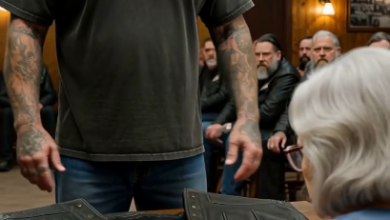
Hawk parked two blocks from the courthouse and went inside long enough to learn that the hearing had already started. He saw Arthur at the front table, shoulders hunched, folder open, trying to follow words that had been designed for people with lawyers, not men who fixed squeaky doors with butter knives and kept tax notices in shoeboxes.
The judge was not cruel.
That made it worse somehow.
Cruelty gives grief a target.
Procedure gives it a wall.
The city had rules. The lien had been processed. Notices had been sent. Deadlines had passed. A property investor had purchased the tax debt and filed for possession. There were options once, perhaps, but those options had expired while Arthur was caring for his dying daughter and then learning how to sit alone in rooms she used to call from.
Hawk stood in the back and listened.
His jaw tightened.
His hands opened and closed.
But he did not interrupt.
That was important.
A younger Hawk might have believed anger could force fairness into a room.
This Hawk knew better.
He waited.
The ruling came before lunch.
Arthur had thirty days.
Thirty days to leave a house he had lived in longer than most people in that courthouse had been alive.
The attorney shook his hand afterward, as if manners could soften eviction.
Arthur nodded because old men trained in dignity often nod when they are bleeding internally.
Then he walked outside.
Hawk followed at a distance.
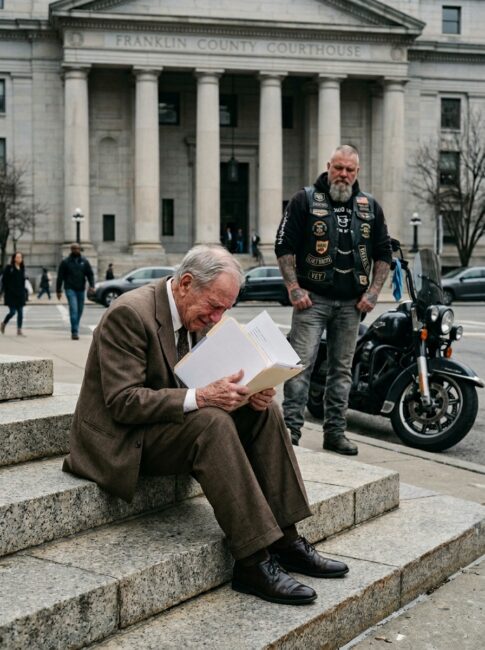
Arthur made it halfway down the courthouse steps before sitting down.
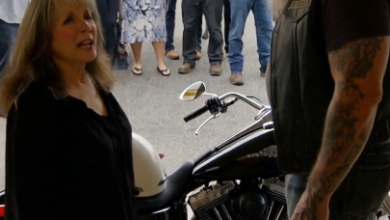
The false climax was the moment Hawk sat beside him and offered the key.
People watching thought that was the story.
Rough biker comforts old man.
Old debt repaid.
A touching moment on courthouse steps.
But the real crisis came when Arthur refused to stand.
“I can’t go back there,” he whispered.
Hawk looked at him.
“Why not?”
Arthur stared at the folder in his lap.
“Because if I walk in that house knowing I have to leave it, I’ll hear Margaret in every room.”
Hawk said nothing.
Arthur’s voice got smaller.
“And Elaine.”
The courthouse doors opened behind them. People moved around them, careful not to stare too openly.
Arthur looked down at his hands.
“I buried them both from that house. I don’t know how to pack them in boxes.”
That sentence stopped Hawk completely.
Because he had come ready to fight paperwork, haul furniture, call favors, gather the club, maybe intimidate a few bureaucrats by existing near them.
He had not come ready for that.
No man is ever fully ready to hear how grief lives in architecture.
Hawk did not take Arthur home right away.
He took him to a diner.
Not a fancy one.
Arthur would have distrusted cloth napkins that day.
They went to Miller’s, a narrow place near the courthouse with cracked vinyl booths, strong coffee, and waitresses who called every man “hon” without surrendering authority. Arthur sat by the window, folder still in front of him, looking like a man who had been removed from his own life and set somewhere temporary.
Hawk ordered coffee for both of them.
Arthur did not drink his.
After a long silence, Hawk said, “You remember giving me that key?”
Arthur looked at him, confused for a moment.
Then his eyes moved to the handlebar outside the window, where the brass key hung from blue cloth.
“I remember.”
“You said every boy needs one door.”
Arthur swallowed.
“That was Margaret’s line.”
“I know.”
“She made me say it like it was mine.”
“She did that a lot.”
For the first time that day, Arthur almost smiled.
Then it disappeared.
“I should have called you,” Arthur said.
Hawk leaned back.
“When?”
“When things got bad.”
“You didn’t.”
“No.”
“Why?”
Arthur’s pride flared faintly.
“You were a boy I helped. Not a bill I could send out.”
Hawk’s face hardened, but not with anger.
With hurt.
“That what you think you were to me?”
Arthur looked away.
Hawk took the key from his pocket. He had untied it from the bike before entering the diner. The brass was worn smooth from forty years of weather.
He placed it on the table.
“You gave me this when nobody else wanted me in their house.”
Arthur stared at it.
“I was sixteen,” Hawk said. “I had two shirts, a record, and an attitude so bad it should’ve been taxed. You let me eat at your table. Mrs. Bell washed my clothes. Elaine was little then. She used to draw snakes on my boots with chalk.”
Arthur’s face folded at his daughter’s name.
Hawk continued, voice low.
“I slept in your basement three nights. You pretended not to know.”
Arthur’s eyes filled.
“I knew.”
“I know you knew.”
The waitress came by, saw their faces, and left without asking about refills.
Hawk tapped the key once.
“I didn’t keep this because it opens your door. I kept it because it opened me.”
That was the twist.
Hawk was not waiting at the courthouse because he had heard about an old man in trouble.
He was waiting because Arthur Bell had once been the only adult who taught him that a door could mean safety instead of permission.
Arthur covered his mouth.
“I’m sorry,” he whispered.
“For what?”
“For needing it back.”
Hawk’s answer came immediately.
“You ain’t getting it back.”
Arthur looked up.
Hawk picked up the key and tied it back through the blue cloth.
“This one’s mine. We’ll make you another.”
The second twist came from June Ellis.
While Hawk sat with Arthur at the diner, June was making phone calls with the fury of a church secretary who had discovered bureaucracy had underestimated her. By 2:00 p.m., she had tracked down Elaine’s old friend, a legal aid attorney, and a retired county clerk who owed her a favor from 1998 involving a parking ticket and a casserole.
By 4:00, Hawk’s club was involved.
The club was called the Blacktop Covenant.
Not an outlaw club.
Not saints either.
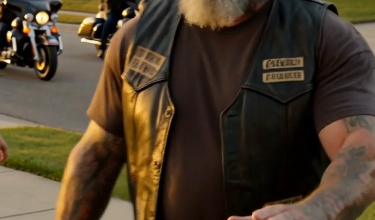
Working men and women mostly. Veterans, welders, nurses, truck drivers, one accountant, and a former city housing inspector named Rosa Martinez who rode a white Harley and had the terrifying ability to read municipal code for fun.
Rosa looked over Arthur’s paperwork at his kitchen table that evening.
The house was quiet around them.
Too quiet.
The blue porch rail peeled outside the window. Margaret’s photograph sat on the mantel. Elaine’s scarf still hung on the coat rack because Arthur had never been able to move it.
Rosa read for forty minutes.
Then she said, “This was legal.”
Arthur closed his eyes.
Hawk’s jaw tightened.
Rosa lifted one finger.
“I didn’t say it was finished.”
The investor had followed the process, but there were hardship provisions, senior protection delays, and a narrow appeal window connected to improper notice after Elaine’s death because she had been listed as the communication contact. It would not be easy. It might not save the house. But it was not hopeless.
Arthur heard “not hopeless” and started crying again.
Quietly this time.
Like a man afraid hope might hear itself and run.
Over the next three weeks, the Blacktop Covenant did what bikers in these stories always do best when nobody is filming.
They showed up.
Not all at once.
Arthur would have hated that.
Two at a time.
One fixed the porch step.
One cleaned gutters.
One organized paperwork.
One drove Arthur to legal aid.
One sat with him while he opened the drawer Margaret used to manage.
Hawk came every morning.
He never asked permission after the first day. He brought coffee, checked the mail, sat on the porch, and sometimes said nothing for an hour because silence with someone beside you is different from silence alone.
The real revelation came when they started cleaning Elaine’s room.
Arthur had avoided it for eighteen months.
Hawk did not rush him.
They opened one box at a time.
Old textbooks.
A photo album.
A cracked mug that said Best Daughter, bought at a pharmacy, clearly last-minute, deeply loved.
Then Arthur found a sealed envelope with Hawk’s name on it.
His hands shook when he gave it over.
Hawk opened it carefully.
Inside was a note from Elaine, written during chemo.
Sammy,
Dad won’t ask you for help. He still thinks helping you years ago was something small. It wasn’t. You were my first big brother before I knew what that meant. If this letter ever finds you, please check on him. He forgets bills when he’s scared, and he calls it “being tired.”
Also, he kept the basement blanket you used. Don’t let him pretend he didn’t.
— Elaine
Hawk sat down on the edge of the bed.
Arthur stood in the doorway, weeping without sound.
There are moments when the dead do not return, but they reach across a room anyway.
That was one of them.
The legal fight lasted four months.
It was ugly in the boring way legal fights often are. Forms, deadlines, signatures, waiting rooms, copy fees, certified mail, phone calls where nobody had answers until someone used the right case number.
The investor did not become a villain in a dramatic speech.
He was just a man who had bought debt and expected profit, which may be worse because ordinary cruelty often comes dressed as paperwork.
Rosa negotiated.
Legal aid filed.
June prayed and threatened in equal measure.
The club held a fundraiser without Arthur’s face on a flyer because Hawk said, “He ain’t a mascot.” They called it a senior housing support ride and raised enough money to cover the overdue taxes, legal fees, repairs, and a year of insurance.
Arthur hated accepting it.
Hawk told him, “Call it maintenance.”
Arthur said, “That’s not what it is.”
Hawk said, “Then call it interest.”
Arthur frowned.
“Interest?”
“On a key you gave me forty years ago.”
Arthur had no answer for that.
The appeal worked.
Not perfectly.
The court did not apologize.
Courts rarely do.
But the sale was delayed, then reversed under hardship and notice review, and Arthur entered a senior tax assistance program with Rosa watching every signature like a hawk with reading glasses.
The house stayed his.
When they told him, he sat on the blue porch and looked at the tomato beds for a long time.
Then he said, “Margaret’s going to be insufferable about this.”
Hawk smiled.
“Probably.”
“She always said I should label folders better.”
“She was right.”
“She usually was.”
That spring, the club repainted the porch Sky Harbor Blue.
Not close.
Exact.
Rosa found the paint code online.
Arthur supervised from a chair, criticizing brush strokes with the authority of a man who had regained the right to be annoying on his own property.
By summer, tomatoes grew again behind the house.
Arthur started keeping a notebook by the phone. Bills. Dates. Appointments. Names. Not because he had become young again, but because asking for help no longer felt like losing his dignity.
Once a week, Hawk came for dinner.
Sometimes other riders came too.
Arthur complained they ate too much.
Then cooked more.
One year after the courthouse day, Arthur Bell walked up those same steps again.
Not for a hearing.
For a senior legal clinic the Blacktop Covenant helped fund, where older people could bring confusing letters before confusion became disaster. Arthur wore his brown suit, now properly tailored by June’s niece, and polished shoes. Hawk rode beside him, not because Arthur needed escort, but because some roads are better taken with witnesses.
Outside the courthouse, a bench had been installed near the steps.
A small brass plaque on it read:
EVERYONE DESERVES ONE DOOR THAT OPENS
Arthur pretended the plaque made him uncomfortable.
It did not.
A young man leaving the courthouse stopped near them that morning. White American, maybe nineteen, hoodie too thin for the weather, court papers in one hand, fear hidden badly behind anger.
He looked at Hawk’s vest, then at Arthur, then at the bench.
Arthur noticed.
Old janitors notice lost boys.
He patted the bench beside him.
“You waiting on someone?”
The boy shrugged.
“No.”
Arthur nodded.
“Sit anyway.”
Hawk looked at him.
Arthur looked back.
“What?”
“Nothing.”
The boy sat.
For a while, nobody spoke.
Then Arthur reached into his pocket and pulled out a small new brass key on a blue cloth loop.
Not his house key.
Not Hawk’s.
Just a key bought at a hardware store, cut to nothing, meant to open no lock and somehow every one.
He handed it to the boy.
The boy frowned.
“What’s this for?”
Arthur looked toward Hawk’s Harley, where the old key still swung from the handlebar, worn smooth by forty years of weather and road.
“It means,” Arthur said, “you’re not the first person to need a door.”
The boy stared at the key.
Hawk stood nearby, arms folded, leather vest dark in the morning sun, looking as hard as a man could look while trying not to cry.
The courthouse doors opened and closed behind them.
People came out carrying papers.
Some lost.
Some relieved.
Some too stunned to know yet.
And at the curb, the biker waited, like someone had once waited for him.
Follow the page for more stories about the people you almost judged before you knew which door they were still holding open.