Part 2: The Poor Woman Was Asked to Leave the Funeral Because Her Dress Was Too Old, Until a Line of Bikers Arrived and Revealed Who the Dead Man Had Loved Most
Clara Mae Dawson had never been good at taking up space.
Some people are not born quiet. They are trained into it.
She grew up in a small Tennessee town where money did not simply buy nicer things; it bought the right to be loud, to be believed, to be forgiven for rudeness if your shoes were polished enough. Clara’s father worked at a tire plant until his lungs gave out. Her mother cleaned houses where the women called her “sweetheart” and left lists on marble counters.
Clara learned early how to stand near walls.
How to smile when spoken down to.
How to make one dress work for church, interviews, and funerals by changing the scarf.
She married young to a good man named Earl Dawson, who drove delivery trucks, laughed too loudly, and brought home wildflowers from ditches because he said store flowers died arrogant. They had no children, though not for lack of hoping. Earl died at fifty-eight from a heart attack in the kitchen, leaving Clara with a mortgage she could not keep and a silence in the house so complete she sometimes left the radio on just to hear another human voice mispronounce the weather.
That was when Henry Whitaker first knocked on her door.
He had once owned half the rental properties on that side of Franklin, and people assumed that made him hard. He was hard, in some ways. Proud. Stubborn. Too slow to apologize. Too used to giving instructions. But grief had softened him after his younger brother died, and old age had started to teach him that money could fill rooms without making them warm.
He came because Clara’s porch step had split.
She told him she could not afford repairs.
He looked at the board, then at her.
“Did I ask for a bid?”
She frowned.
“No.”
“Then don’t start negotiating with a man holding a hammer.”
He fixed it.
Then came back the next week with soup.
Then the next with a bag of tomatoes from a roadside stand.
Then, after a few months, Clara began seeing him every Tuesday at the laundromat on Maple Street, where he sat beside her, reading the paper upside down because he had forgotten his glasses but refused to admit it.
Their friendship became the kind that people misunderstand because it does not perform itself.
No public affection.
No grand announcements.
No matching rings.
Just two old people sitting together in cheap plastic chairs, folding towels, sharing coffee from a thermos, and slowly becoming necessary to each other.
The first seed was Henry’s old motorcycle.
He had ridden in his thirties, before business suits and family expectations made him sell the bike. Clara found this out when a line of bikers stopped at the diner one afternoon and Henry watched them through the window with a sadness he tried to hide.
“You used to ride?” she asked.
“Long time ago.”
“You miss it?”
He folded his napkin.
“Every day I pretend I don’t.”
The second seed was Isaiah Boone.
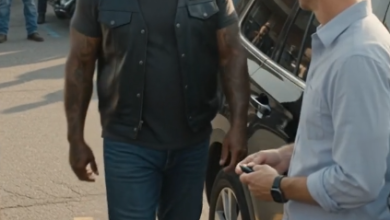
Everybody called him Graveyard because he ran funeral escorts for veterans, forgotten riders, and families who had no one else to walk beside the hearse. He was not a funeral director. He was a retired EMT, a widower, and president of the Iron Lantern Riders. His club did memorial rides without cameras, without speeches, and without turning grief into a stage.
Henry met Graveyard at a gas station after watching the bikers escort a homeless veteran to the cemetery with more respect than some rich men got from their own children.
Henry asked him why they did it.
Graveyard answered, “Because somebody should.”
That sentence lodged inside Henry.
The third seed was the envelope.
Two weeks before Henry died, he gave Graveyard a sealed envelope and said, “If Clara gets pushed aside when I’m gone, don’t let them make her small.”
Graveyard did not ask who Clara was.
He knew a man’s voice when love had finally outrun pride.
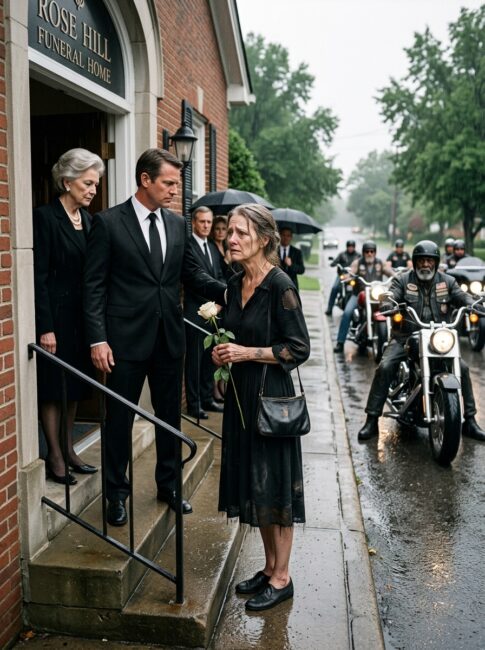
Henry’s funeral was exactly the kind of funeral his family wanted.
Elegant.
Controlled.
Expensive enough to look like grief had been handled properly.
White lilies arranged near the casket. A framed photograph from twenty years earlier, when Henry still had thick hair and the expression of a man who believed he could negotiate with time. Soft piano music. Guest book on a polished table. Programs printed on heavy cream paper with his name embossed in dark blue.
Clara arrived fifteen minutes early because she did not want anyone to see her deciding where to sit.
She had ironed the black dress twice.
It still looked old.
That was not her fault.
Old fabric remembers old lives.
She brought one white rose from her yard, the last bloom on a bush Earl had planted years earlier. She had almost bought flowers from the grocery store, then counted the money in her purse and decided Henry would understand.
He would have.
The chapel lobby smelled like lilies, cologne, raincoats, and money.
Clara signed the guest book with careful handwriting.
Clara M. Dawson
Then she stood near the back, rose held in both hands, waiting for enough people to move so she could slip into a rear pew.
Henry’s ex-wife Lillian saw her first.
Lillian was a white American woman in her seventies, elegant in navy, pearls at her throat, silver hair styled perfectly. She had not been married to Henry for twelve years, but families sometimes keep authority long after love has left the room.
Her eyes moved over Clara’s dress.
Then the rose.
Then her shoes.
Not once did they rest on Clara’s face long enough to find a person there.
Bradford came next.
His younger brother, Steven, stood behind him, uncomfortable but silent. That silence mattered. It often does.
Bradford spoke quietly, which allowed later denial.
“This gathering is for family and close friends.”
Clara held the rose tighter.
“I was his friend.”
“I don’t think this is appropriate.”
“Henry wanted—”
“My father is not here to be used by people who confused his kindness with invitation.”
That sentence took the air from her.
People nearby pretended not to hear. A woman looked down at her program. A man adjusted his tie. Someone coughed once, not from illness but from the need to do anything except intervene.
Clara’s mouth trembled.
“I only came to say goodbye.”
Bradford’s face hardened.
“Then say it from outside.”
That was the false climax.
The poor woman humiliated by the wealthy family. The cruel son defending appearance over truth. The room choosing silence because silence is easier when the target is someone already used to being overlooked.
Clara turned and walked out.
Rain had started again, thin and cold.
She stood beneath the funeral home awning for a moment, then stepped farther away because she did not want the family to see her from the windows. The white rose bent in her hand. Her dress clung at the hem. Her shoes soaked through.
Inside, the service began.
A pastor spoke about Henry’s generosity.
That word floated through the walls and reached Clara like an insult.
Then the first motorcycle entered the lot.
Graveyard arrived at 10:04.
He was not early.
He was exactly on time.
That was how he explained it later.
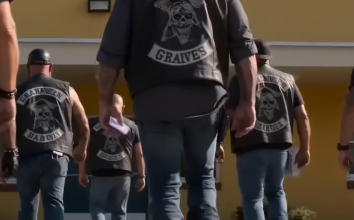
He had waited at the gas station down the road with twenty-three Iron Lantern Riders, engines off, helmets on seats, everyone holding a single white rose because Henry’s envelope had specified that detail in his uneven handwriting.
No lilies. Clara hates lilies. White roses if you can get them.
When the funeral began and Clara did not walk in with the family, Graveyard knew.
He started his Harley.
The line followed.
The funeral home windows rattled lightly when the bikes rolled into the parking lot, not loud for show, not reckless, just present. People inside turned toward the sound. The pastor paused. Bradford frowned. Lillian closed her eyes as if the noise itself were vulgar.
Outside, Clara looked up.
Graveyard saw her standing near the curb, shoulders hunched beneath the rain, white rose limp in her hand.
He parked, removed his helmet, and walked to her.
He did not ask what happened.
The answer was already on her face.
He took off his black leather vest and placed it around her shoulders with the care of a man covering a wound.
“Miss Clara,” he said, “Henry told me you might need us.”
Her eyes widened.
“You knew Henry?”
Graveyard nodded.
“Enough to know he was done being a coward at the end.”
That startled a laugh out of her, but it broke halfway into tears.
The chapel doors opened.
Bradford stepped outside, face tight with anger disguised as control.
“What is this?”
Graveyard turned.
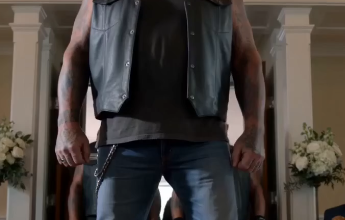
He was a big man, but he did not make himself bigger. He did not threaten. He did not raise his voice. That made the moment more powerful, not less.
“This,” he said, “is the part of your father’s funeral he arranged himself.”
Bradford looked at the line of bikers, the roses, the leather vests, the rain.
“My father would never—”
Graveyard reached into his inside pocket and unfolded a letter.
“Henry Whitaker signed this three weeks ago. Asked our club to escort his final goodbye if Miss Clara was not allowed in.”
Lillian had come to the doorway now.
So had Steven.
So had half the funeral guests, drawn by engines and discomfort.
Graveyard read only one line aloud.
If my family honors me by humiliating the woman who sat beside me when none of them had time, then take me out of that building and let Clara say goodbye first.
No one spoke.
Clara covered her mouth.
That was the twist.
The biker club had not arrived by coincidence.
Henry had planned for the one cruelty he feared his family might commit.
Because he knew them.
And because, too late but not too late entirely, he had chosen Clara in writing.
The funeral director did not know what to do.
That was fair.
Funeral directors are trained for grief, not moral earthquakes in parking lots.
Bradford argued first.
He said the letter was inappropriate.
He said his father had been confused.
He said no one was removing a casket from a prepaid service because a motorcycle club president with tattoos had dramatic timing.
Graveyard listened.
Then he handed the letter to the funeral director.
Attached to it was a notarized instruction.
Henry had paid for a second procession.
A private graveside stop before burial.
No speeches from family unless Clara was invited.
No restrictions on the Iron Lantern Riders.
And one final request written in Henry’s hand:
Let Clara place the rose.
The funeral director read it twice.
Then looked at Bradford.
“Sir, this appears valid.”
Lillian sat down on the nearest bench as if her knees had been quietly removed.
Steven finally spoke.
“For God’s sake, Brad. Let her in.”
Bradford turned on him.
“You’re okay with this?”
Steven’s face was pale.
“I’m not okay with what we just did.”
That was the first crack in the family wall.
The chapel emptied slowly into the covered drive. Some guests looked ashamed. Some looked curious. A few looked moved in the safe way people allow themselves to feel when responsibility has already passed to someone else.
Clara stood wrapped in Graveyard’s leather vest.
It was too big for her.
The shoulders hung low.
The patch on the back darkened with rain.
She looked smaller inside it, but not weaker.
Protected.
Graveyard offered his arm.
“Ready?”
She shook her head.
“No.”
He nodded.
“We can wait.”
That simple sentence nearly undid her.
Because most of Clara’s life had been people rushing her through discomfort: hurry up at the register, move along in offices, step aside in rooms where she did not look like she belonged. Now twenty-three bikers waited in the rain because her grief was allowed to take time.
Eventually, she walked inside.
The chapel was silent.
Henry’s casket waited near the front.
Clara moved slowly down the aisle, one hand holding the white rose, the other gripping Graveyard’s arm. She stopped beside the casket and looked at Henry’s face.
For a long moment, she said nothing.
Then she whispered, “You stubborn old fool.”
A few people gasped.
Graveyard smiled faintly.
Clara touched the edge of the casket.
“You should’ve told me.”
Her voice cracked.
“I would’ve worn the good dress if I’d known you were going to make trouble.”
That broke something open in the room.
Not laughter exactly.
Something close.
Humanity, maybe.
Clara placed the white rose on Henry’s chest.
Then she leaned down and said the goodbye nobody else had earned the right to hear.
The procession to the cemetery was unlike anything Franklin had seen in years.
The hearse came first.
Then Clara in the funeral car, still wearing Graveyard’s vest over her old black dress.
Then the family.
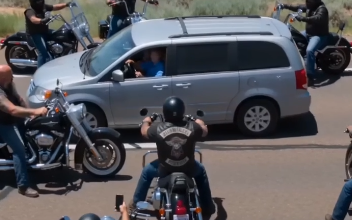
Then twenty-three motorcycles, each rider carrying a white rose tied to the handlebar, engines low, steady, respectful. Rain fell lightly over the road. Drivers pulled to the side. Some put hands over their hearts because people do that for long processions even when they do not know the story inside them.
At the graveside, Henry’s family stood on one side.
Clara stood on the other with the bikers behind her.
Not between her and the family like a wall.
Behind her like ground.
The pastor, to his credit, adjusted.
He spoke less about Henry’s business success and more about the strange mercy of being known by someone after the world has stopped being impressed.
Then Graveyard read Henry’s full letter.
Not all of it.
Some parts were Clara’s.
But enough.
Henry admitted he had been afraid of his sons’ judgment. Afraid of looking foolish. Afraid of loving someone openly after seventy because people treat old love like comedy or inconvenience. He wrote that Clara had brought him back to ordinary joy: bad diner coffee, laundromat chairs, Tuesday weather, soup eaten from chipped bowls, white roses from a yard that refused to give up.
Then came the line that made Bradford look down.
If I ever made her feel hidden, that was my shame, not hers.
Clara wept quietly.
Lillian did too, though hers was a different kind of grief, the complicated kind that arrives when you realize the person you thought you knew had rooms you never entered.
After the burial, Bradford approached Clara.
His face was stiff.
For a second, I thought he would perform an apology.
A bad one.
Instead, Steven stepped in first.
“I’m sorry,” he said.
Clara looked at him.
Steven swallowed.
“We should have asked who you were to him.”
Clara’s answer was soft.
“He knew.”
Steven nodded.
“He did.”
Bradford said nothing.
Not then.
Some people need longer to become decent, and some never make the trip.
Graveyard gave Clara a ride home in the funeral car because he said she was not riding a motorcycle in wet shoes at sixty-two unless she wanted to make Henry haunt all of them.
She laughed for the first time that day.
At her house, the bikers lined the curb.
One by one, they placed white roses along her porch rail.
No cameras.
No speeches.
Just roses.
Clara stood in the doorway, Graveyard’s vest still around her shoulders, and watched the poor little porch become a place of honor.
Three months later, Clara went back to the laundromat on a Tuesday.
Not because she needed to.
Because grief sometimes asks to sit where love once had a routine.
She brought Henry’s old thermos.
The one he always claimed kept coffee hot for twelve hours, though it barely managed two.
She sat in the same plastic chair near the window and folded towels slowly while rain tapped the glass.
At 10:15, a Harley rolled up outside.
Then another.
Then five.
Graveyard came in carrying a basket of laundry.
Clara looked at him.
“You brought laundry?”
He held up the basket.
“Club towels.”
“They look clean.”
“Then you’re welcome.”
She shook her head, but she smiled.
The Iron Lantern Riders had not disappeared after the funeral. That was the part Henry would have liked most. They checked on Clara, not in a smothering way, but in a rhythm she could trust. One fixed her porch light. One repaired the kitchen faucet. One brought groceries and claimed they had bought too many eggs, which was a lie so obvious Clara let it live.
Bradford never came.
Steven did.
Not often at first.
Then more.
One Tuesday, he sat beside Clara at the laundromat and asked about his father.
Not the businessman.
Not the difficult parent.
The man who read newspapers upside down and bought tomatoes from roadside stands.
Clara told him.
That was Henry’s final gift too.
Not just dignity for Clara.
A bridge for a son who had almost missed his father completely.
On the anniversary of Henry’s death, the bikers escorted Clara to the cemetery.
She wore a new black dress this time, bought by herself, with her own money, chosen because she liked the way the sleeves fit. Graveyard’s vest stayed on the back of her chair at home. He had told her to keep it.
She brought one white rose.
At the grave, she placed it gently near Henry’s name.
“You made a mess,” she whispered.
Then smiled.
“But you made it right.”
Behind her, the Harleys stood silent in a row, engines off, chrome catching the morning sun. Tough men and women in leather waited with their heads bowed, not because Clara looked important, not because she had money, not because anyone had approved her place in the story.
Because she belonged there.
And this time, nobody asked her to leave.
Follow the page for more stories about the people you almost judged before you knew who they had loved in silence.