Part 2: A Young Mother Was Carjacked Outside a Gas Station at Midnight, Until One Biker Heard Her Baby Cry and Tore Down the Street With an Engine the Whole Block Never Forgot
Mara Evans had been awake since 4:15 that morning.
That mattered.
People later judged her for leaving the car running, because judgment is cheap when the worst thing did not happen to you. They said she should have turned the engine off. They said she should have carried the baby inside. They said a mother should never take her eyes off a child, even for a second, as if exhaustion were a moral failure and not something working people survive on a daily basis.
Mara worked at Saint Anne’s Rehabilitation Center, where the hallways smelled like disinfectant, warm blankets, overcooked vegetables, and elderly people trying to remain dignified while needing help with things they once did without thinking. She changed sheets, lifted patients, checked vitals, answered call lights, cleaned spills, and smiled when families visited for twenty minutes and gave opinions about care they did not provide.
She was good at her job.
She was also tired enough that her hands shook when she clocked out.
Naomi had spent the day with Mara’s cousin, then fallen asleep in the car seat on the way home. The little girl had dark curls, round cheeks, a pink blanket with yellow ducks, and a habit of waking if the car stopped too long. The November night was cold, rain had started again, and the Honda’s heater worked only when the engine was running.
So Mara pulled into Riverside Fuel, used her card at the pump, filled ten dollars because ten was all she could spare until Friday, and stepped toward the receipt slot when it failed to print properly.
Two steps.
Maybe three.
That was all.
Knox noticed the Honda before the man did.
He noticed everything near his shop after midnight. A tow truck driver learns the language of streets after dark: cars parked wrong, engines left running, people standing too close to doors, arguments that are still quiet but about to become loud. Knox had owned Delaney Auto & Cycle Repair for seventeen years, and he knew Riverside Fuel the way a man knows a corner that has given him both business and trouble.
He had seen Mara before.
Not personally.
In passing.
Blue scrubs. Old Honda. Baby seat in back. Always tired. Always polite to the clerk. Always checking the back seat before she drove away.
The first seed was the pacifier on his mirror.
A tiny pink pacifier, old now, the plastic cloudy with age, clipped to a silver chain that had no business being on a black Harley. Men had joked about it over the years, usually once. Knox had a way of looking at jokes until they died in the mouth.
The second seed was the small car seat base in the corner of his office, covered with a tarp but never thrown away.
The third seed was the way Knox reacted to crying children.
He never scowled at them in stores. Never told parents to quiet them down. If anything, he got quieter, like crying was a radio frequency only his bones could hear.
At 12:38, when Mara screamed, he was already turning.
The man in the gray hoodie had come from the side of the gas station, face half-hidden, movement sharp and desperate. He saw running car, open opportunity, tired mother, cold night. He did not see the baby seat until the car was already moving.
Or maybe he did.
That question later sat in the police report like a stone.
Knox did not run straight at the Honda because running at a moving car with a baby inside is how pride turns into tragedy. He went to the Harley because the bike was already pointed toward the street, because he knew the roads, because he had a phone mount, because a chase without police is just another danger.
He kept his distance.
Close enough to see.
Far enough not to force panic.
The Honda blew through the first stop sign and fishtailed slightly on wet pavement. Knox eased off, heart slamming, every instinct in him wanting to close the gap, every hard lesson in his life telling him not to push a scared driver carrying a child.
He spoke into the emergency call like a man reading from a manual.
“Silver Honda Accord. Ohio plates. Infant in rear seat. Driver heading north. I’m following at distance on a motorcycle. No contact. Send units to Huron and Maple.”
The dispatcher told him not to pursue.
Knox answered, “I’m not pursuing. I’m keeping eyes.”
There is a difference.
A thin one.
A dangerous one.
He rode that line for four miles.
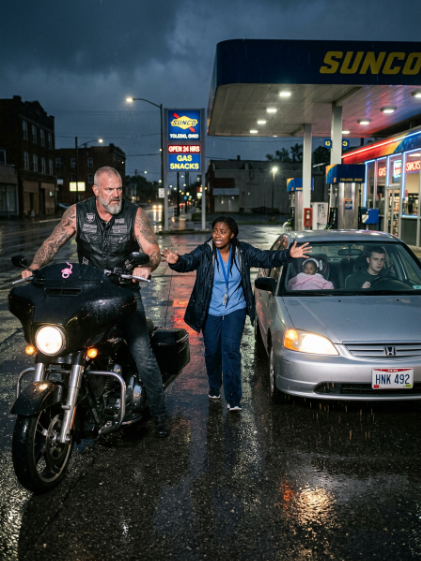
Mara did not remember standing up.
The clerk told her later that she tried to run after the Honda even after it was gone, one shoe slipping on the wet pavement, palms scraped, breath coming in broken sounds that did not form words except one.
Naomi.
Again and again.
Naomi.
The clerk, a Pakistani American man named Sameer, twenty-nine, usually calm behind bulletproof glass and lottery tickets, came outside without his jacket and helped her to the curb. He had already called 911 too, but Mara kept trying to get up as if her body believed motherhood could outrun a stolen car.
“He’s following,” Sameer told her.
“Who?”
“The biker. He’s following.”
That did not comfort her at first.
Why would it?
A stranger in a leather vest riding after her child through midnight rain sounded like another problem until the first police cruiser arrived and the officer said, “Ma’am, the rider is giving location updates. We have units moving.”
Mara clung to that sentence because there was nothing else to hold.
Across town, the Honda turned onto Maple, then cut into a residential block where old houses leaned close to the road and porch lights burned above wet steps. Knox saw the driver glance back once. Not at him, exactly. At the baby.
The Honda slowed.
Then sped up.
Then slowed again.
Knox understood before the dispatcher did.
“He’s thinking about dumping the car,” he said.
The dispatcher asked for location.
Knox gave it.
“Tell units to block Main and Fern. He’s boxed if he keeps going.”
The driver made one more reckless turn, clipped a trash can, and swerved toward a dead-end service road behind a closed furniture warehouse. Knox slowed before the turn, because dead ends make desperate people stupid.
The Honda stopped hard.
Driver’s door opened.
The man jumped out and ran toward the alley.
Knox did not chase him.
That surprised people later.
They wanted a story where the biker tackled the thief, where fists flew, where revenge wore leather and looked satisfying. Knox did not give them that story.
He killed the Harley, left it angled so the headlight washed over the Honda, and moved toward the back door with both hands visible.
Naomi was screaming.
Alive.
Terrified.
But alive.
The car door was locked.
Knox looked through the window and saw her little face red with crying, pink blanket twisted around one leg, tiny hands opening and closing in panic.
He spoke through the glass.
“Hey, baby girl. I see you.”
She cried harder.
Police sirens grew closer.
Knox wanted to break the window. Every part of him wanted to. But broken glass near a baby is not a decision a man makes because he is emotional. He checked the front door first.
Unlocked.
He reached in, hit the back lock, opened the rear door, and leaned in slowly.
Naomi stopped crying for half a second, then started again when she saw his beard.
“Fair,” he muttered, voice shaking. “I ain’t pretty.”
He did not unbuckle her.
Not yet.
He checked her breathing, the seat straps, the blanket around her leg, the car interior, the floor. The police arrived as he was still bent into the back seat, one huge tattooed hand braced on the doorframe, the other holding the pacifier Naomi had dropped near her knee.
An officer shouted.
Knox stepped back immediately, hands up.
“Baby’s okay. Driver ran east down the alley. Gray hoodie. White male. Maybe twenties.”
Two officers ran after the suspect.
One stayed with the car.
Within minutes, Naomi was in the arms of a female officer, wrapped in the pink duck blanket, crying with all the furious strength of a child who had survived something she would not remember clearly but her mother would never forget.
That should have been the false climax.
Baby found.
Thief fleeing.
Biker did the right thing.
Police taking over.
But the moment that changed Knox did not happen on that dead-end road.
It happened when Mara arrived and Naomi reached for the biker first.
Mara came in a cruiser, barefoot because one shoe had been lost at the gas station, hair loose from its tie, scrubs soaked, face drained of every color except terror.
The officer carrying Naomi stepped toward her.
“Ma’am, she’s okay.”
Mara made a sound that was not speech.
She reached for her daughter.
Naomi turned toward her mother’s voice, then caught sight of Knox standing near the Harley, rain dripping from his beard, one hand still holding the little pacifier he had picked up from the car seat.
The baby reached both arms toward him.
Only for a second.
A confused, exhausted, frightened second.
But everyone saw it.
Mara froze.
Knox froze harder.
Then Naomi turned back toward her mother and collapsed into her arms, sobbing against Mara’s neck.
The moment passed quickly, but not for Knox.
Nothing about that night passed quickly for him again.
Mara kissed her daughter’s hair, her forehead, her cheeks, her hands. She repeated apologies no baby could understand and no mother should have had to make. Police wrapped both of them in blankets, checked Naomi over, asked Mara questions gently, took statements, found her shoe, and eventually caught the suspect three blocks away hiding behind a dumpster.
Knox stayed by his bike, out of the way.
That was where Mara found him after the ambulance cleared Naomi.
She walked over slowly, baby in her arms, blanket around both of them.
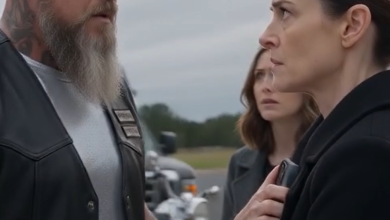
“You followed her,” she said.
Knox nodded.
“You didn’t scare him into crashing.”
“No.”
“You didn’t leave her.”
His jaw moved.
“No.”
Mara looked at the pacifier on his Harley mirror, then at the one he held in his hand.
“Do you have kids?”
Knox looked away.
The rain had softened to mist, but his face looked like it was still being hit by weather.
“I had a daughter,” he said.
That was the twist.
Her name had been Lila.
She was three years old when Knox lost her.
Eleven years earlier, long before he owned the repair shop, he had been married, younger, louder, full of pride, and convinced that working late was the same as providing. His wife, Claire, had called him one night from the side of the road with a flat tire and a crying toddler in the back seat. Knox was across town finishing a bike for a customer who “needed it by morning.”
He said he would come.
But he finished the job first.
Twenty minutes became forty.
By the time he arrived, another car had slid on black ice and struck the shoulder where Claire had been waiting. Claire survived. Lila did not.
The pacifier on his mirror was hers.
The car seat base in the office was hers.
The silence in his house was hers.
And since that night, Knox had measured himself by the distance between a call for help and the moment he moved.
That was why he turned around after hearing Mara scream.
Not because he was fearless.
Because once, he had been late.
Mara did not know what to say to a grief that old.
So she did the only thing that felt true.
She shifted Naomi in her arms and whispered, “Thank you for not being late tonight.”
Knox closed his eyes.
That sentence hit him harder than the storm, harder than the sirens, harder than the sight of the stolen Honda turning into the dark with a baby inside.
Thank you for not being late tonight.
For eleven years, Knox had believed his life had split into before and after because he had failed the one person a father is supposed to reach in time. People had told him it was not his fault. Police reports said weather conditions were poor. Claire, through her own broken grief, had once told him she did not blame him, but marriages can drown even when nobody is holding them under, and they divorced two years later because every room in the house had Lila’s absence in it.
Knox stopped going to family gatherings.
Stopped answering most calls.
Started working nights.
Started riding more.
Started helping strangers without explaining why.
If someone had a flat tire, he stopped.
If a car seat was installed wrong, he corrected it.
If a mother looked tired at the gas station, he watched the pumps until she drove away.
Not in a creepy way.
In a haunted way.
The Iron Mile Riders, his small club, knew pieces of it. Their president, a Black American man named Curtis “Anchor” Bell, knew more than most. Anchor had once told him, “You keep trying to pay a debt nobody sent you.”
Knox had answered, “Still owe it.”
That night, as Mara stood in the rain holding Naomi, the debt shifted.
Not erased.
Never erased.
But changed.
Police asked Knox to come to the station for a full statement. He did. He sat under bright lights in wet jeans and told the story without making himself sound brave. He emphasized the dispatcher, the officers, the mother, the clerk, the route, the plate number, the distance kept.
When an officer said, “You probably saved that baby’s life,” Knox shook his head.
“Her mama screamed. I heard it. Police did the work.”
The officer looked at him for a long moment.
“Some people hear and keep going.”
Knox had no answer for that.
By sunrise, local news vans were outside Riverside Fuel.
Mara refused interviews.
So did Knox.
Anchor showed up at the repair shop around 8:00 with coffee and no questions at first. He saw the empty place on Knox’s mirror where the pacifier chain had snapped during the ride. The pacifier itself sat on the workbench, next to Naomi’s dropped one, which police had returned after processing the car.
Two pacifiers.
One old.
One new.
Knox stared at them like they were talking to each other across years.
Anchor stood beside him.
“You all right?”
“No.”
“Good. Honest answer.”
Knox picked up Lila’s pacifier and clipped it back to the mirror chain.
Then he picked up Naomi’s, clean now, sealed in an evidence bag.
“Mara asked if I wanted to keep it,” he said.
Anchor nodded.
“And?”
“I told her it belongs to her kid.”
“Good.”
“But she said…” Knox swallowed. “She said I could keep the receipt from the gas station. The one she dropped. Said it’s the moment before and the moment after.”
Anchor looked at the small paper on the bench.
Ten dollars of gas.
Time stamp 12:37 a.m.
A tiny proof that ordinary life can become disaster in the space between pump and receipt.
Knox folded it once and placed it in the metal box where he kept Lila’s hospital bracelet.
That was not healing.
Not fully.
But it was the first new thing he had allowed into that box in eleven years.
The neighborhood changed after that night.
Not dramatically enough for movies, but enough for people who lived there to notice.
Riverside Fuel installed better lighting and a sign warning drivers not to leave running cars unattended, which some people called obvious and others called necessary. Sameer, the clerk, started walking tired parents to their cars after midnight when he could. Police increased patrols for a while, though patrols always move on eventually.
Knox changed too.
He still looked the same.
Same gray beard.
Same tattoos.
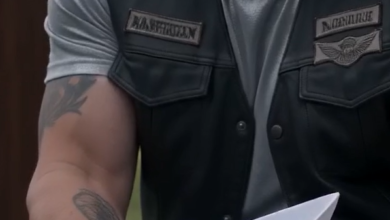
Same black vest.
Same heavy boots.
Same Harley with Lila’s pacifier on the mirror.
But something in him had stopped leaning only backward.
Mara came by the shop two weeks later with Naomi on her hip and a box of homemade banana muffins because her grandmother said gratitude should be edible. Knox looked at the box as if muffins were outside his expertise.
“You didn’t have to,” he said.
“I know.”
Naomi stared at his beard suspiciously.
Knox stared back.
“She remembers you,” Mara said.
“She’s a baby.”
“Babies remember feelings.”
Knox looked away because that sounded too close to something he could not argue with.
Mara showed him that Naomi was fine. Not untouched by fear, because children feel storms through the bodies of the adults holding them, but safe, loved, still laughing at ceiling fans and trying to eat her own socks.
Mara was not fine yet.
She admitted that too.
She had nightmares. She checked the locks too many times. She cried whenever Naomi cried in the car. She stopped for gas only in daylight for months.
Knox never told her to get over it.
He knew better.
He fixed her Honda’s heater for free and lied that it was an easy fuse. It was not. He replaced the back door lock too, and when she tried to pay, he pointed at the muffins.
“Invoice settled.”
The Iron Mile Riders quietly began offering late-night safe-stop escorts for nurses, waitresses, and shift workers who used nearby gas stations after midnight. Not a patrol. Not vigilantism. Just visible presence, coffee runs, tire help, and a rule Anchor stated clearly: “We are not cops, and we are not cowboys. We are neighbors with engines.”
Knox liked that.
Neighbors with engines.
It sounded better than heroes.
A year later, Mara invited Knox and Anchor to Naomi’s second birthday party in a small park near the river. Knox almost refused, but Anchor said, “You’re going. I want cake.”
So Knox went.
He wore a clean shirt under the vest, brought a toy truck wrapped badly in newspaper, and stood near the edge of the picnic area like a man uncertain whether he had entered a country that required softer shoes.
Naomi opened the truck and immediately tried to put a cracker in it.
Knox nodded.
“Good cargo.”
Mara laughed.
Near the end of the party, Naomi toddled over to the Harley, which was parked well away from the children, and pointed at the pacifier on the mirror.
“Baby,” she said.
Knox froze.
Mara heard.
Anchor looked at the sky.
Naomi pointed again.
“Baby.”
Knox crouched slowly.
“Yeah,” he said, voice rough. “That was my baby’s.”
Naomi considered this, then offered him a half-eaten cracker.
He took it like communion.
Three years after the carjacking, Riverside Fuel replaced its old pumps.
They invited the neighborhood to a small safety event, mostly because Sameer had bought too many hot dogs and needed an excuse. Police came. Nurses came. Tow drivers came. Parents came with children who wanted stickers. The Iron Mile Riders parked in a clean line along the side street, engines off, leather vests softened by sunlight instead of midnight rain.
Mara came with Naomi.
Naomi was four now, full of questions, braids bouncing, pink sneakers flashing, hand wrapped around her mother’s fingers. She did not remember the night the Honda disappeared with her inside, not in pictures, not in words, but she knew Knox. She knew his bike. She knew the pacifier on the mirror was not a toy to touch unless invited.
Knox stood near the shop door, arms folded, pretending he was not watching them approach.
Naomi ran the last few feet and stopped in front of him.
Not hugging.
Just looking up.
“Mr. Knox,” she said.
He raised an eyebrow.
“Miss Naomi.”
She held out something in her palm.
A tiny silver charm shaped like a heart.
“My mom says your bike keeps babies safe,” she said.
Mara’s eyes widened.
“I said he helped keep you safe.”
Naomi ignored the correction with the confidence of a child who had already improved the story.
Knox took the charm carefully.
His hand shook once.
Only once.
“You want it on the bike?”
Naomi nodded.
“With the baby thing.”
The crowd around them had gone quieter, not silent, just aware.
Knox walked to the Harley and clipped the heart charm beside Lila’s pacifier. The silver caught the afternoon light, small and bright against the black mirror stem.
For a long moment, he stood there with one hand on the handlebar.
Then Naomi slipped her small hand into his free one.
Knox looked down.
He did not move away.
Mara saw that.
Anchor saw that.
The whole street seemed to hold the moment gently.
The Harley was quiet, but the memory of its engine still lived on that block, tearing through midnight, following a stolen car without forcing it into danger, carrying one man’s old grief toward one mother’s worst fear.
Knox finally looked at Mara.
“She doing good,” he said.
Mara smiled.
“She is.”
He looked at Naomi.
Then at the pacifier and the heart charm swaying together.
“Good.”
That was all he said.
For Knox, it was a lot.
When he rode home that evening, the Harley’s engine rolled down the street low and steady, not ripping through panic this time, but moving through warm air like a promise kept again.
On the mirror, the pacifier and the silver heart swung side by side.
One for the child he could not reach in time.
One for the child he did.
Follow the page for more stories about the people you almost judged before you knew what sound made them turn back.