His Son Lost Part of an Arm at Ten Days Old—So This Father Learned to Build What He Needed
When Sol Ryan was brought to have a cast taken for a prosthetic arm, his father had a simple way to help him understand what was needed. The little boy extended his arm and stayed still. For the experienced clinician preparing the cast, that cooperation was unusual. For Ben Ryan, it reflected something already familiar at home: trying devices, getting used to them, and making room for another attempt.
The scene appears in a 2018 interview with Ben, a former psychology teacher from North Wales. It is one moment in an earlier family story that began with an emergency after Sol’s birth and developed into a sustained effort to design prosthetics for young children.
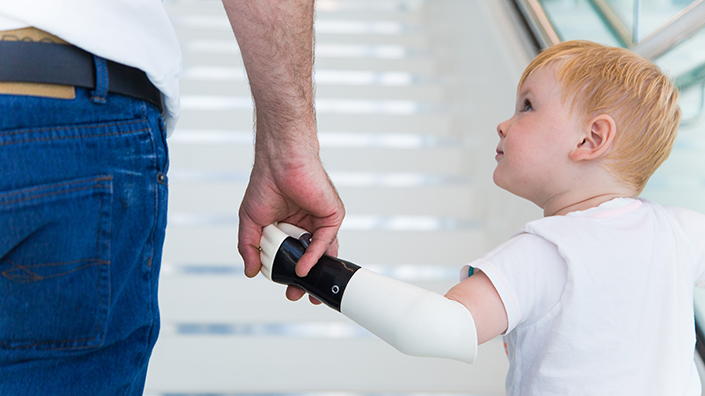
Before the photographs of the white arm
Sol was born in March 2015. Complications affected his left arm, and doctors amputated below the elbow when he was ten days old. His parents were caring for a newborn while also learning what that change would mean in practical terms.
Ben learned that different prosthetic options would become available at different ages. Contemporary reporting distinguished a cosmetic device from a powered, functional one; they were not the same product or the same waiting period. His immediate interest was in giving Sol an extension he could begin using while he was still very young.
That distinction matters when the story is reduced to a photograph and a dramatic headline. Ben’s project grew alongside medical care. It did not replace the operation that had been necessary, and a single finished-looking arm was not the beginning of the work.
The first version was much simpler.
A small response worth noticing
When Sol came home, Ben used a piece of kitchen sponge and a dressing to make a lightweight extension. His son was five weeks old. In his later account, Ben described Sol lifting it and using it with his toys soon after it was fitted.
For a parent, an ordinary moment of play can become a particularly useful form of feedback. Sol was showing what interested him through movement. Ben had something concrete to observe, rather than only a drawing of what a device might eventually do.
The sponge was a beginning, not the sophisticated hydraulic prosthesis shown in later coverage. Between those stages lay new skills, outside assistance, and repeated changes. That time is easy to lose when several years of effort are compressed into a few photographs.
Ben kept looking for a design that could help his son make a useful grasp.
Learning a different kind of work
He had not trained as an engineer. To develop the idea, he learned computer-aided design and sought help with the tools needed to turn a concept into a physical object. The ERA Foundation’s film about his work describes support from Bangor University’s engineering department.
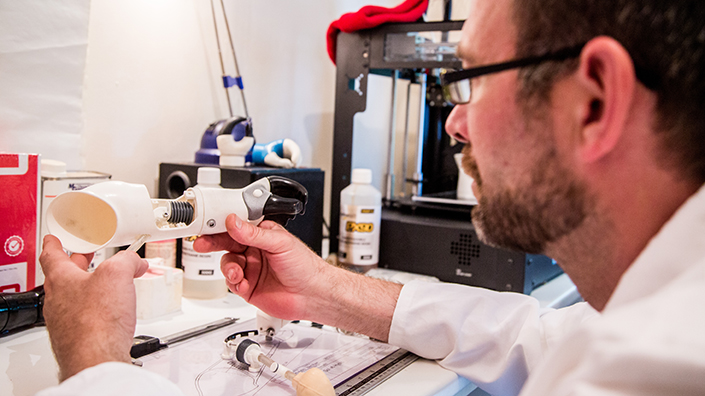
One line of experimentation involved fluid pressure. Later designs used a hydraulic mechanism that could help operate a thumb. Stratasys documented the use of its 3D-printing technology in producing prototypes, while Autodesk’s design software became part of Ben’s working process.
Those technical names describe different contributions. Ben brought the problem he wanted to address and the persistence to keep returning to it; other people and organizations supplied expertise, equipment, and opportunities to develop the design.
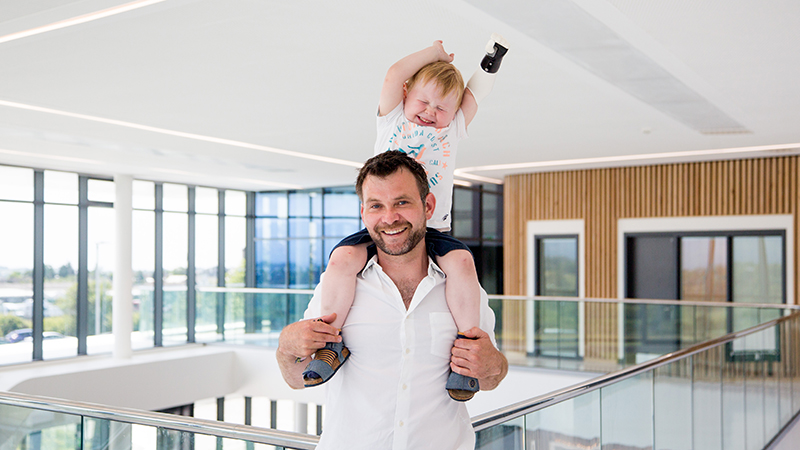
Photographs from the period show the work at close range: a prosthetic hand on a desk, drawings and measuring tools, and Ben examining parts. They belong beside the warmer picture of Sol on his shoulders. Both kinds of image are part of the same family history.
A project that reached beyond one home
Ben founded Ambionics with the hope of helping other children who might benefit from an earlier, more adaptable prosthesis. In 2017, public accounts of the project described a father developing an answer for his own son while considering how it could be made available more widely.
That larger ambition introduced further work. A device used by one child becomes a different undertaking when other families, different body sizes, production costs, testing, and fitting are involved.
The later engineering interview also recorded business and funding setbacks. Its account did not describe an effortless rise from an improvised sponge to a secure company. Ben was still trying to find a workable route forward.
The human part of the story survives those complications. A parent had noticed a need in his child’s daily life and begun learning how to respond to it. The commercial difficulties do not erase the early play, just as the appealing photographs do not erase the difficulties.
The moment in the fitting room
The hospital scene offers a quieter measure of familiarity. According to the 2018 interview, the prosthetist expected the casting process to be difficult. Ben used a brief cue that Sol understood, and his son offered his arm without the struggle the clinician was accustomed to seeing.
That was the development hinted at in the family’s story: a child who had already spent time exploring prosthetic devices could recognize another part of the process.
It was not evidence that every future device would fit perfectly. It was one specific, meaningful response from one boy. Keeping the scale of that moment makes it more moving, because it allows Sol to remain a child learning through experience.
The published photographs show him playing, reaching, looking at his father, and enjoying being carried. His life in those images contains affection and ordinary childhood alongside the visible equipment.
This account revisits reporting from 2017 and 2018; it does not present those ages, devices, or business plans as a new medical update. What remains clear across the sources is the sequence that began at home: Ben made an early attempt, watched his son respond, learned more, and kept refining what he could offer.
The little extension made from sponge was only a start. The relationship around it was already there.
Reporting sources
- Institution of Mechanical Engineers — direct interview, July 24, 2018
- Sky News — March 2, 2017
- ERA Foundation — Born to Engineer, October 6, 2017
- Stratasys — 2017 development announcement