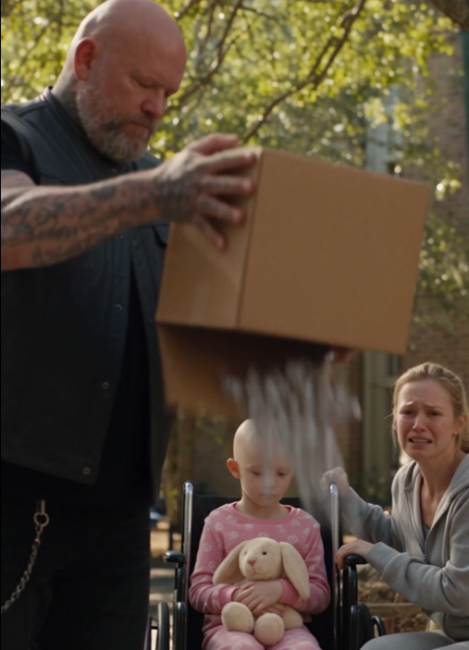
A BIKER DUMPED A 10-YEAR-OLD CANCER PATIENT’S ENTIRE BOX OF MEDICINE INTO A STORM DRAIN AS HER MOTHER SCREAMED—THEN HE HANDED THE DOCTOR ONE BOX.
Part 2
Dr. Rebecca Saunders held the little white box up to the sunlight.
“Jill,” she said quietly. “Come here. Look at this.”
Jill Thornton got up off the pavement. Her knees were scraped and her face was wet. She walked over on shaking legs.
The doctor pointed to a line of small gray print along the bottom of the box. It was the standard warning that appears on every medicine package in America.
Keep out of reach of chilren.
Jill read it twice before she saw it.
Chilren.
There was no D.
“It’s just a typo,” Jill whispered.
“No,” Calvin Garrett said behind her. The security guards still had his arms. “It’s not just a typo.”
Everyone turned to look at him.
“I spent eighteen years as a quality control chemist at a drug plant on the west side,” Calvin said. “Every word on every box gets checked by three people and a machine. A real drug company would destroy a million boxes before shipping one with a spelling mistake.” He nodded at the box. “That box wasn’t printed by a drug company. It was printed by somebody in a garage.”
The courtyard had gone very quiet.
Dr. Saunders turned the box over. She opened it, took out one of the foil blister packs, and held a pill up to the light.
“The color’s a little off,” she said slowly. “The imprint is shallow.” She looked at Jill. “Where did you get these?”
“An online pharmacy,” Jill whispered. “MedSaver Direct. They had reviews. They had a license number on the website. It was a fraction of the price.”
Dr. Saunders closed her eyes for a second.
“How long has Evie been taking these?”
“Five weeks,” Jill said. “Since the insurance denied the real ones.”
The doctor’s face changed again.
Five weeks was exactly how long Evie had been getting worse. Her blood counts had been climbing in the wrong direction. Dr. Saunders had spent three weeks ordering tests, adjusting doses, and puzzling over charts.
She’d never once thought to question the pills.
“I’m sending this to our lab,” Dr. Saunders said. “Stat. They’ll run a full analysis. It’ll take about six hours.”
She turned to the guards.
“Let him go,” she said.
“Ma’am, he destroyed property,” one guard said. “Police are on the way.”
Jill’s phone buzzed in her pocket.
She pulled it out with trembling fingers. It was an email.
MedSaver Direct: Great news! Your next shipment has been processed and will arrive in 3–5 business days. Thank you for trusting us with your family’s health!
Part 3
Evie Thornton had been diagnosed with acute lymphoblastic leukemia fourteen months earlier.
She was nine then. She’d been tired all summer, with bruises she couldn’t explain. Then came a fever that wouldn’t break. By August, she was at Riley Hope Children’s Hospital with a port in her chest and a word Jill couldn’t say out loud for weeks.
The first year of chemotherapy went better than anyone hoped. Evie lost her hair. She lost twenty pounds. She also stayed in remission.
Then in July, her doctors found a genetic marker in her cancer cells. That meant she needed a newer drug, a targeted therapy taken as a pill every day.
The pills cost fourteen thousand dollars a month.
Jill’s insurance denied it. Then denied the appeal. Then denied the second appeal.
Jill worked as a dental office manager. Her husband, Mark, drove a long-haul truck and was gone three weeks out of four. They had a mortgage, a car payment, and fourteen months of medical bills.
So Jill searched online for help.
She found a Facebook group for parents of kids with leukemia. Someone posted a link to MedSaver Direct, “a Canadian pharmacy that ships the same drugs at a fraction of the price.”
Then, three days later, a pharmacy technician at the hospital’s outpatient pharmacy mentioned it too.
“Lots of our families use MedSaver,” the tech told her, handing her a business card. “They’re legit. Tell them I sent you.”
Jill sold her car the next week. She bought a month’s supply for nineteen hundred dollars.
Evie started getting worse eleven days later.
Now, in the hospital courtyard, a police officer named Officer Derek Pham arrived and walked up to Calvin Garrett. The guards were still holding his arms.
“Sir, I’m told you destroyed a patient’s medication,” the officer said.
“I did,” Calvin said.
“About two thousand dollars’ worth?”
“About two thousand dollars’ worth of chalk,” Calvin said quietly.
The officer looked at him.
Calvin’s motorcycle club, the Crossroads Riders, had come to Riley Hope that afternoon with forty teddy bears for the oncology ward. Six bikers in leather jackets stood silently at the edge of the courtyard now, watching.
“Mr. Garrett,” Officer Pham said, “I’m going to need you to come with me until this gets sorted out.”
Part 4
They held Calvin in the hospital security office for six hours.
He didn’t complain. He sat in a plastic chair with his hands folded and his eyes closed.
Jill sat upstairs in Evie’s room on the oncology floor, staring at the wall.
She couldn’t stop thinking about it.
What if he was wrong?
What if it really was just one typo? What if the pills were real and Evie had just missed a dose of the only medicine keeping her alive, because some stranger had dumped it down a storm drain? Jill had sold her car. She had no more money. She couldn’t buy another box.
And the man had a criminal-looking beard, tattoos, and a motorcycle jacket. What did she really know about him?
Evie was lying in bed with her stuffed rabbit, watching cartoons.
“Mom,” she said suddenly. “Is the big man in trouble?”
“Maybe, baby.”
Evie was quiet for a moment.
“The new pills don’t taste the same,” she said.
Jill turned around.
“What do you mean?”
“The old ones were bitter,” Evie said. “Really bitter. I had to drink a whole cup of juice.” She shrugged. “The new ones taste like nothing. Kind of chalky. I thought maybe it was a different flavor.”
Jill felt like the floor had dropped out from under her.
“Why didn’t you tell me?”
“You said they were the same medicine,” Evie said. “You said they were cheaper.” She looked down at her rabbit. “I didn’t want you to have to pay more.”
Jill sat down on the edge of the bed and pulled her daughter into her arms.
At 4:30 that afternoon, Jill’s phone rang. It was a number with a Toronto area code.
“Mrs. Thornton? This is Alex from MedSaver Direct customer service,” a smooth male voice said. “We received your email asking about the authenticity of your last shipment. I want to assure you that all our products are fully certified. If you’ve been told otherwise, I need to warn you that spreading false information about our company is defamation, and we will take legal action.”
Jill hung up.
Her hands were shaking.
At 7:42 p.m., Dr. Saunders knocked on the door of Evie’s room. She was holding a printed lab report.
Her face was gray.
“Jill,” she said quietly. “There’s no medicine in those pills.”
Part 5
“None,” Dr. Saunders said. “Zero. Not a trace of the active drug.”
She laid the report on the bed table.
“Calcium carbonate,” she said. “Basically chalk. Corn starch. A little sugar. And a dye to make them the right color.”
Jill stared at the paper.
“Five weeks,” she whispered.
“Five weeks without her medicine,” Dr. Saunders said. “That’s why her counts went up. That’s why she’s been so tired. I’ve been chasing it for three weeks and I never thought to check the pills.” She shook her head. “I’m so sorry, Jill.”
“Is she going to be okay?” Jill asked.
“I’ve already gotten emergency approval from the hospital to give her the real drug from our own supply, starting tonight,” the doctor said. “No charge. Her counts haven’t gone too far. If we start now, we have a very good chance.”
Jill put her face in her hands.
“Where’s Mr. Garrett?” she asked when she could speak.
“Downstairs,” the doctor said. “They just released him.”
Jill found Calvin Garrett in the hospital parking lot, sitting on the curb beside his black motorcycle in the dark. Six of his club brothers stood nearby, smoking and talking quietly.
He stood up when he saw her coming.
“There was nothing in them,” Jill said. “Nothing.”
Calvin nodded slowly.
“I’m sorry about your car,” he said.
Jill started crying. Then, before she could stop herself, she hugged him. She wrapped both arms around the huge biker in his leather jacket and sobbed into his chest.
He stood very still. Then he patted her back gently, the way you’d pat a frightened animal.
“How did you know?” she finally asked. “You saw it from across the courtyard.”
Calvin didn’t answer right away.
He pushed up the short sleeve of his leather jacket.
On the inside of his forearm was a tattoo. It wasn’t a skull or a flame. It was a chemical structure, a small diagram of hexagons and letters, the kind you’d see in a textbook.
“That’s the molecule,” Calvin said. “The same drug your daughter needs.”
Jill stared at it.
“My daughter, Katie, had leukemia when she was eight,” Calvin said. “Twenty years ago. Same kind as Evie. That drug was brand new back then. It saved her life.” He looked at the tattoo. “I got this the day she rang the bell.”
He swallowed.
“I’ve stared at that box design every day for twenty years,” he said. “I’d know it in my sleep. When I walked past your bench, the box looked wrong. Then I saw the word.”
“Where’s Katie now?” Jill asked.
Calvin smiled for the first time.
“She’s twenty-eight,” he said. “She’s a pediatric oncology nurse.” He nodded up at the hospital. “Fourth floor. She works nights.”
Jill looked up at the lit windows of the oncology ward.
Behind her, Dr. Saunders came out the hospital doors and walked quickly toward them.
“Jill,” she said, “I need to ask you something important. Who told you about MedSaver?”
Part 6
Jill gave Dr. Saunders the business card the pharmacy technician had handed her.
It belonged to Kristy Lamb. She had worked at the hospital’s outpatient pharmacy for four years.
By Monday, hospital administrators had pulled Kristy Lamb’s records. She had personally referred at least forty families of children with cancer to MedSaver Direct over two years.
When the hospital’s compliance officer confronted her, Kristy broke down and confessed. MedSaver had paid her two hundred dollars for every family she sent them. She had also printed patient lists, with names, diagnoses, and the drugs they needed, and sold them to MedSaver’s owner.
“I needed the money,” she said through tears. “I thought it was just a cheaper pharmacy. I swear I didn’t know the pills were fake.”
The hospital fired her the same day and reported her to the Indiana State Board of Pharmacy and the FBI.
But MedSaver Direct fought back.
On Tuesday morning, the company posted a long statement on its website and Facebook page.
A biker with no medical credentials destroyed a child’s legitimate medication in a public place, and a hospital colluding with big pharmaceutical companies is now attacking an affordable pharmacy that helps struggling families. MedSaver Direct has filed a defamation lawsuit against Mrs. Jill Thornton and a criminal complaint against Calvin Garrett.
They attached a video. It was the clip someone had filmed in the courtyard. It showed Calvin dumping thirty pill bottles down a storm drain while a mother screamed and a bald little girl watched from her wheelchair.
It had a million views by Wednesday.
How can someone do this to a cancer kid?
Lock that biker up.
Big Pharma is scared of cheap drugs.
Jill got a letter from a lawyer in Miami. MedSaver was suing her for five hundred thousand dollars.
She sat at Evie’s bedside reading it over and over.
She was terrified. She couldn’t afford a lawyer. She couldn’t afford anything.
Calvin came to the hospital that afternoon. Jill showed him the letter.
He read it slowly.
“Don’t worry about this,” he said.
“How can I not worry?” Jill said. “They have lawyers. They have money.”
Calvin’s phone rang.
He looked at the screen and frowned. Then he stepped into the hallway to answer.
When he came back, his face was different.
“That was a special agent from the FDA,” he said. “The Office of Criminal Investigations.” He looked at Jill. “They tested the pills too. And they’re asking if I can come downtown tomorrow.”
“Why?”
“Because they think we just found something they’ve been chasing for two years,” Calvin said.
Part 7
Special Agent Monica Reyes of the FDA’s Office of Criminal Investigations met Calvin and Jill in a conference room at the federal building in downtown Indianapolis on Thursday morning.
She laid a map of the United States on the table. It was covered with red dots.
“MedSaver Direct isn’t in Canada,” she said. “It’s not a pharmacy. It’s run out of a warehouse in Fort Lauderdale, Florida, by a man named Russell Doane. He’s been selling counterfeit cancer drugs online for at least two years.”
She tapped the map.
“Every one of these dots is a patient who bought from him,” she said. “We’ve identified three hundred and twelve so far. In twenty-two states.”
Jill felt sick.
“Most of them are adults,” Agent Reyes said. “Some are children. All of them have cancer. All of them were desperate, couldn’t afford the real drugs, and found MedSaver through Facebook groups or referrals like Ms. Lamb’s.”
“What happened to them?” Jill whispered.
The agent paused.
“We’re still pulling records,” she said carefully. “But so far, we’ve confirmed at least eleven patients who were taking MedSaver pills and died in the last eighteen months.” She looked down. “Every one of their death certificates says the same thing.”
“Disease progression,” Calvin said quietly.
The agent nodded.
“Their doctors thought their cancer stopped responding to treatment,” she said. “Nobody ever questioned the pills. Nobody ever tested them.”
The room was silent.
“Until a biker in a hospital courtyard noticed a missing letter,” Agent Reyes said.
Over the next two weeks, Calvin Garrett did something nobody expected.
He set up a folding table in the garage behind his motorcycle shop on the east side of Indianapolis. He posted a message in every leukemia and cancer parent group he could find online.
If you bought medication from MedSaver Direct, don’t take another pill. Send me a photo of the box. I’ll tell you if it’s fake. Free. No questions.
Photos poured in from all over the country.
Calvin examined every box with a magnifying glass. He sat up past midnight comparing them to the real packaging he’d memorized twenty years earlier.
Two hundred and six boxes had the same misspelling.
Chilren.
Calvin sent every one to Agent Reyes.
On a Tuesday morning in October, Agent Reyes called him at 6 a.m.
“Mr. Garrett,” she said. “We’re going in.”
Part 8
At 7:15 a.m., federal agents raided a warehouse in Fort Lauderdale, Florida.
They found a pill press, a label printer, and bags of calcium carbonate and corn starch. Stacks of empty orange bottles stood on the floor. A box of printed labels sat in a corner, every one reading Keep out of reach of chilren.
Russell Doane was arrested in his condominium two miles away. He had four point two million dollars in bank accounts in three countries.
Five others were arrested the same day. They included two warehouse workers, a man who ran MedSaver’s fake website, a woman who ran the Facebook ads, and a man in Toronto who answered the phones and threatened families with lawsuits.
Kristy Lamb was charged with conspiracy and healthcare fraud.
That afternoon, the U.S. Attorney held a press conference in Miami.
Jill Thornton stood at the back of the room beside Calvin Garrett. Behind them stood twenty members of the Crossroads Riders in black leather jackets. They had ridden nineteen hours from Indianapolis.
“This defendant sold sugar and chalk to people fighting for their lives,” the U.S. Attorney said. “Eleven of them have died. He looked at the most desperate people in America and saw a business opportunity.” She paused. “This case was cracked open because one man noticed one missing letter on one box.”
She looked at the back of the room.
“Mr. Garrett,” she said, “thank you.”
Every camera in the room turned toward the biker.
Calvin looked at the floor.
MedSaver’s defamation lawsuit against Jill was dropped that week. So was the criminal complaint against Calvin.
Within ten days, every one of the three hundred and twelve patients on MedSaver’s customer list had been contacted. Their doctors were notified. Their remaining pills were collected.
Riley Hope Children’s Hospital announced that it would cover the cost of real medication for every child patient on that list until insurance appeals could be resolved.
Then the hospital’s CEO called Calvin.
“Mr. Garrett,” she said. “We’d like to do something permanent, so no family ever has to go looking for cheap medicine online again. We were hoping your club might help.”
Part 9
Here’s how the rest of it went.
Russell Doane pleaded guilty to distributing counterfeit drugs, wire fraud, and causing death through counterfeit medication. He was sentenced to twenty-five years in federal prison. All four point two million dollars was seized and distributed to the victims’ families.
The other five defendants received sentences from four to twelve years.
Kristy Lamb received three years and permanently lost her pharmacy license.
The families of the eleven patients who died received letters from the FDA explaining what had really happened. Their death certificates were amended. Several of them wrote to Calvin.
He keeps the letters in his saddlebag.
The Crossroads Riders and Riley Hope Children’s Hospital started a fund together that winter. It pays for cancer medication for children whose families can’t afford it, while insurance appeals drag on for months.
The club raises the money with a charity ride every spring. In the first year, it raised three hundred and forty thousand dollars. By the second year, it was over half a million.
The fund covers every child at Riley Hope who needs it. No family is turned away.
They named it Evie’s Fund.
Evie Thornton took the real medicine every day, bitter and awful, with a whole cup of juice.
Her blood counts came down within a month. Her energy came back. Her hair started growing in, curly and dark blond.
Sixteen months after the afternoon in the courtyard, Evie was declared in complete remission.
On her last day of treatment, the oncology nurses gathered around the brass bell on the fourth floor of Riley Hope. Every child rings it when they finish.
A young nurse with a dark ponytail stood beside Evie, holding her hand.
It was Katie Garrett.
At the back of the crowd stood her father, a huge biker in a black leather jacket, with a chemical structure tattooed on his forearm.
Evie rang the bell three times, as hard as she could.
Then she walked straight through the crowd to Calvin and handed him a small white box.
It was an empty medicine box. She had decorated it with markers and stickers.
On the side, in careful purple letters, she had written a warning label.
KEEP OUT OF REACH OF CHILDREN.
She’d underlined the D three times.
“So you know it’s real,” Evie said.
Calvin Garrett held the little box for a long time.
Then he put it in his saddlebag, right next to the letters.
People see a huge, tattooed biker pour a sick little girl’s medicine down a storm drain, and they decide he’s a monster before the last bottle disappears. Her mother screamed at him. Security tackled him. A million strangers called for his arrest. Russell Doane was the one selling chalk to dying children. Sometimes the person who takes away what you think is saving you is the only one who can see it was never saving you at all.
If this story stayed with you, follow our page. We share stories like this one every week, about the people who notice what everyone else misses. And if you ever buy medicine online, read every word on the box. Every single letter.