A DERBY CHAIRMAN LAUGHED AS 30 BIKERS SQUEEZED INTO CARDBOARD SOAPBOX CARS BUILT BY A 9-YEAR-OLD GIRL—THEN SHE CLICKED HER STOPWATCH AND READ THE TIME.
Part 2
The rest of the cars came rolling across the finish line one after another.
There were twenty-nine more cardboard soapbox cars with twenty-nine more enormous bikers folded inside. Some came fast. Some wobbled. One drifted gently into a hay bale and stopped. The biker inside, a man named Big Lou, sat there with his knees around his ears and gave a thumbs-up.
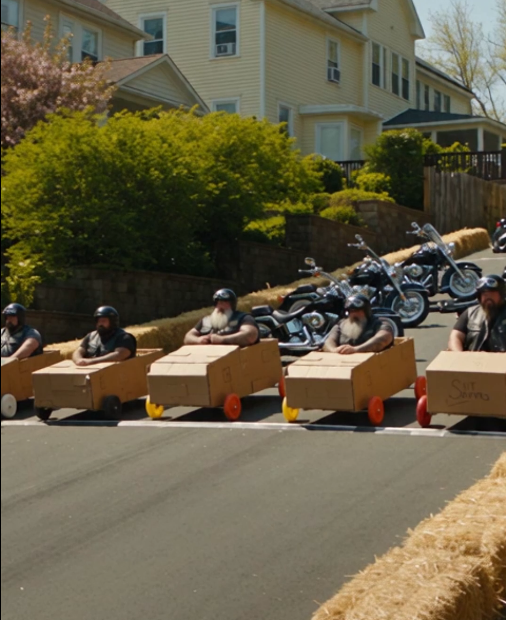
Not one car fell apart.
Birdie Callahan stood at the finish line clicking her stopwatch for every single one. She wrote each time on her clipboard in pencil, her tongue sticking out of the corner of her mouth in concentration.
Lacey stood beside her and watched the crowd.
Nobody was laughing anymore.
Up the street, Todd Brannigan had his phone out and was talking fast to someone, his face red.
Moose Tolliver unfolded himself from his cardboard car, one creaking limb at a time. It took two other bikers to pull him out by the arms. He stood up, stretched his back, and walked over to the finish line.
He looked down at Birdie.
“How’d we do, Chief?”
Birdie checked her clipboard.
“Twenty-nine point eight,” she said. “But your weight distribution was terrible on the bump. You were sitting too far back. I told you sixty-forty.”
“Yes, ma’am.”
“And Big Lou’s rear axle is crooked. I’m going to have to redo it.”
“Yes, ma’am,” Big Lou called from the hay bale.
The crowd laughed again. This time it was different laughter.
A woman with a toddler walked up to Lacey.
“Your daughter built all thirty of those?” she asked.
“She designed them,” Lacey said. “She drew the plans. She did the axles and the steering. The guys did whatever she told them.” She smiled a little. “She’s very strict.”
“But I heard she got kicked out of the school derby last week,” the woman said, frowning. “Todd said her grandfather built her car for her.”
Lacey’s smile faded.
“Her grandfather died fourteen months ago,” she said quietly.
The woman’s face fell.
Before Lacey could say anything else, Todd Brannigan came striding down the hill. Two people were behind him. One was the elementary school principal, Dr. Fran Weller. The other was a Hickory Bend police officer.
“Officer,” Todd said loudly, pointing at the bikers, “these people don’t have a permit for this event.”
Part 3
Lacey Callahan’s father had been named Jack Callahan.
Everybody in Hickory Bend called him Sparkplug.
He’d owned Callahan’s Garage on Main Street for forty-one years. He fixed tractors, pickups, lawnmowers, and motorcycles. He rode with a club called the Cumberland Iron Riders for thirty years.
And from the time Birdie could walk, she had followed him around the garage.
At four, she could name every tool on the wall. At six, she could change a lawnmower blade. At eight, she rebuilt a carburetor on an old motorcycle with her grandpa watching over her shoulder, not saying a word.
“She’s got the hands,” Jack used to tell Lacey. “Better than mine.”
Fourteen months ago, Jack Callahan had a heart attack in his garage.
He died with a socket wrench in his hand.
Birdie stopped talking for almost two months.
Then, in March, the elementary school announced its annual soapbox derby. For the first time since the funeral, Birdie smiled.
She spent every day after school in her grandfather’s garage. She drew plans on graph paper, measured, cut, and sanded. She balanced the weight with fishing sinkers and built the steering from an old bicycle part.
Her car weighed exactly the allowed limit. It was the best-built thing Lacey had ever seen.
On derby morning, Birdie’s car ran a practice heat in thirty-one point one seconds. It was the fastest time of the day.
Twenty minutes later, Todd Brannigan disqualified her.
“Girls don’t build cars like this,” he told Lacey in front of everyone. “Somebody did this for her. Rules say the child builds it.”
“Her grandfather’s dead,” Lacey said.
“Then somebody else did,” Todd said. “I’m not stupid.”
His son, Carter, won the derby that afternoon with thirty-one point four.
Birdie went home and sat in her grandfather’s garage until dark.
That night, Moose Tolliver came by the house. He had been Jack’s best friend for thirty years and the president of the Cumberland Iron Riders.
He found Birdie sitting on the garage floor beside her disqualified car.
He sat down next to her.
“Kiddo,” he said. “How many of these could you build in a week?”
Part 4
Now, at the bottom of Sycamore Hill, the police officer looked around uncertainly. He took in thirty bikers, thirty cardboard cars, hay bales, and two hundred spectators.
“Who organized this?” he asked.
“I did,” Moose said.
“Do you have a permit?”
Moose reached into his leather jacket and pulled out a folded piece of paper. “Special event permit,” he said. “City of Hickory Bend. Signed Tuesday.”
The officer read it. He handed it back.
“Looks fine to me,” he said.
Todd Brannigan’s face got redder.
“Fine,” he said. “Then I want it on the record. Dr. Weller, this is exactly why we disqualified that girl. Look at this.” He waved his arm at the line of motorcycles. “A bunch of bikers building cars and claiming a nine-year-old did it. It’s the same scam. These men built those cars, and they built hers last week too.”
Dr. Weller looked uncomfortable.
“Todd,” she said quietly, “I’m not sure that’s—”
“It’s obvious,” Todd said. “No nine-year-old girl builds thirty working soapbox cars in a week. I’m filing a complaint with the school board. And I’m posting the truth about this circus.”
He did.
That night, Todd posted on the Hickory Bend community Facebook page.
Today a motorcycle gang held an unsanctioned race on Sycamore Hill, claiming a 9-year-old built their cars. This is the same family whose child was disqualified from our school derby last week for having adults build her car. Using a child as a prop for a publicity stunt is shameful. Our derby rules exist for a reason.
Under it, he posted a photo of thirty bikers crammed into cardboard cars, laughing.
Two hundred comments came in by morning.
Poor kid, being used by a biker gang.
Todd’s right, no 9-year-old builds that.
Why is a little girl hanging around with those guys?
Lacey read every comment at her kitchen table.
Birdie came downstairs in her pajamas, holding her clipboard.
“Mom,” she said. “Are people saying I didn’t build them?”
Lacey didn’t know what to say.
Birdie looked at the floor for a long time.
Then she looked up.
“Then I’ll show them,” she said.
Part 5
On Monday morning, Moose Tolliver came to the house with a laptop and a helmet camera.
“Grandpa Jack used to film every job in the garage,” he told Lacey. “For insurance. Habit from the old days.” He set the laptop on the kitchen table. “When Birdie started building the derby car in his garage, the camera was still mounted on the shelf. Still running.”
Lacey stared at him.
“Two months of footage,” Moose said. “Every day.”
He pressed play.
It was Jack Callahan’s old garage, filmed from a high shelf. There was a little girl in braids, alone at the workbench.
She was cutting plywood with a coping saw. She was drilling axle holes, measuring twice, and checking her graph-paper plans. She was crying in frustration when a wheel came off, then wiping her nose on her sleeve and fixing it.
There was no adult anywhere in the frame.
Not for two months.
“There’s more,” Moose said.
He pulled up footage from the past week, filmed on his own helmet cameras. It showed the Cumberland Iron Riders’ clubhouse garage.
Thirty huge bikers stood in a semicircle around a nine-year-old girl standing on an upside-down bucket.
“Okay,” Birdie was saying on screen, pointing at a whiteboard full of drawings. “Axle goes here. Not there. Here. Big Lou, that’s the third time.”
“Sorry, Chief.”
“Moose, you’re too heavy for the standard frame. I made you a reinforced one.”
“Thank you, Chief.”
Lacey laughed out loud, wiping her eyes.
“I’ll send this to the school board,” Moose said.
Then Lacey’s phone rang.
It was a woman named Denise Ochoa, a volunteer car inspector at the school derby.
“Mrs. Callahan,” she said, “I have to tell you something. I should have said it last week.”
“What is it?”
“I inspected every car that morning,” Denise said. “Birdie’s car was clean. Kid-built. You could see the pencil marks on the wood. I told Todd that.” She paused. “But Carter Brannigan’s car wasn’t.”
Lacey sat down slowly.
“What do you mean?”
“It had professional welds on the axle mounts,” Denise said. “Machined bearings. Laser-cut steering plates. No nine-year-old did that.” She hesitated. “Todd owns Brannigan Fabrication on Route 9.”
Part 6
Lacey met Denise Ochoa at the diner on Main Street that afternoon.
Denise had brought photos she’d taken on derby morning with her phone. They showed close-ups of the underside of Carter Brannigan’s soapbox car.
There were perfect welds, precision bearings, and steering plates stamped with a tiny logo.
Brannigan Fab.
“I flagged it during inspection,” Denise said. “I told Todd the car wasn’t kid-built. He told me he’d handle it. Then twenty minutes later, he disqualified Birdie instead.” She shook her head. “For the exact thing his own son was doing.”
“Why didn’t you say something?” Lacey asked.
Denise looked down at her coffee.
“Todd’s company sponsors the derby,” she said. “And the PTA. And the Little League. My husband works for him.” She swallowed. “I was scared.”
“What changed?”
“I saw that little girl on Saturday,” Denise said, “standing at the finish line with her clipboard, yelling at a three-hundred-pound biker to lean left.” She smiled through tears. “I thought, if she can stand up there, I can stand up too.”
That afternoon, Lacey got another message.
It was from a ten-year-old boy, sent from his mother’s phone.
Mrs. Callahan, this is Carter Brannigan. Can Birdie meet me at the park? I need to tell her something.
Lacey drove Birdie to the park after school.
Carter Brannigan was sitting alone on a swing with his head down.
Birdie walked up and stood in front of him with her arms crossed.
“What?” she said.
Carter didn’t look up.
“I didn’t build my car,” he said quietly. “My dad’s guys at the shop did. I just painted it.” He scuffed his sneaker in the dirt. “When you got disqualified, I knew it was wrong. I didn’t say anything. My dad said winning was good for business.”
Birdie didn’t say anything.
“Your car was better than mine,” Carter said. “Everybody at the derby knew it.”
He finally looked up at her.
“Can you teach me how to build one?” he asked. “For real?”
Part 7
On Thursday night, Lacey sat in Moose Tolliver’s garage at the Cumberland Iron Riders’ clubhouse.
The bikers were putting away the cardboard cars. Birdie had insisted every one be properly stored, labeled, and stacked. She was at the far end of the garage, inspecting Big Lou’s rear axle with a flashlight, lecturing him under her breath.
Moose sat on a stool beside Lacey with a cup of coffee.
“Why did you do all this?” Lacey asked him quietly. “Thirty grown men, folded into cardboard boxes in front of the whole town. People laughed at you.”
Moose looked across the garage at Birdie.
Then he turned around on his stool. On the back of his black leather jacket was the club’s patch. There was a big iron anvil, and right in the center, where Lacey had never really looked before, was a small spark plug.
“Your dad’s,” Moose said. “We added it after the funeral. Every Cumberland Iron Rider wears it now.”
Lacey’s eyes filled.
“Six months before he died, Jack and I were sitting right here,” Moose said. “He was watching Birdie rebuild that carburetor. He said, ‘Moose, somebody’s going to tell that girl she doesn’t belong in a garage someday.'” He paused. “He said, ‘If I’m not around, you make sure she knows she does.'”
He pushed up the short sleeve of his leather jacket.
On his forearm was a new tattoo, still slightly pink. It was a little girl’s drawing of a soapbox car, copied line for line from graph paper, crooked wheels and all.
Underneath were two words in Birdie’s handwriting.
CHIEF BIRDIE.
“Got it Tuesday,” Moose said. “Didn’t tell her yet.”
Lacey laughed and cried at the same time.
At the far end of the garage, Birdie stood up from Big Lou’s axle.
“Moose!” she shouted. “Who wrote ‘good enough’ on this work order? Nothing is good enough!”
Moose sighed and set down his coffee.
“Coming, Chief.”
The next morning, the Hickory Bend school board scheduled an emergency meeting about the soapbox derby.
Todd Brannigan had requested it.
Part 8
The Hickory Bend Elementary School cafeteria was packed on Monday night.
Parents filled the folding chairs. Kids sat on the floor. Along the back wall stood thirty members of the Cumberland Iron Riders in black leather jackets, arms folded, silent.
Todd Brannigan sat at the front with the school board.
He spoke first. He talked about rules, integrity, and protecting the derby from adults who build children’s cars. He talked about a motorcycle gang using a little girl for publicity.
“This is about fairness,” he said.
Then the board chair, Martha Gaines, nodded to Lacey.
Lacey stood up and connected Moose’s laptop to the cafeteria projector.
The room watched two months of footage from Jack Callahan’s garage. A nine-year-old girl worked alone at a workbench, sawing, drilling, failing, and fixing.
Then a week of footage from the bikers’ clubhouse. Thirty huge men stood around a little girl on a bucket, and she bossed every one of them.
People started laughing. Then some of them started crying.
Then Denise Ochoa stood up. Her voice shook as she held up her inspection photos. She showed the professional welds, the machined bearings, and the tiny stamp on the steering plate.
Brannigan Fab.
“I told Mr. Brannigan on derby morning that his son’s car wasn’t kid-built,” she said. “He disqualified Birdie Callahan twenty minutes later.”
The cafeteria went silent.
Todd Brannigan stood up. “This is a setup. That woman’s husband works for me. She’s bitter.”
Then a small voice came from the third row.
“Dad.”
Carter Brannigan stood up beside his mother.
He was shaking. He didn’t look at his father.
“I didn’t build my car,” he said. “The guys at your shop did. You told me not to tell anybody.”
Nobody said anything.
Todd sat down slowly.
The school board voted that night. Todd Brannigan was removed as derby chairman. Brannigan Fabrication was removed as a sponsor. Carter’s derby win was vacated.
The board also voted to rewrite the rules, with a new line added in bold.
Every child may enter, regardless of gender. All cars will be inspected by a qualified volunteer.
Then Martha Gaines looked out at the cafeteria.
“We’ll need a new head inspector for next year’s derby,” she said. “Someone who knows soapbox cars better than anybody in this town.”
Every head in the room turned toward a nine-year-old girl in an orange pit crew shirt.
Part 9
Here’s how the rest of it went.
Todd Brannigan issued a written apology to the Callahan family. It was posted on the school website. Several parents noted that it was very short.
The school awarded the derby title to Birdie Callahan, based on her practice time of thirty-one point one seconds.
Birdie said she’d rather win it fair next year.
So the next May, she did.
Her car ran Sycamore Hill in thirty point six seconds, a new school record. She built every inch of it herself in her grandfather’s garage, with the camera running on the shelf.
The second-place car belonged to Carter Brannigan.
He built that one himself too. Birdie taught him, every Tuesday and Thursday for six months. He said she was strict. He said it was worth it.
Eleven girls entered the Hickory Bend Elementary Soapbox Derby that year. The year before, there had been none.
The derby’s new head inspector was ten years old. She carried a clipboard and a flashlight. She failed three cars for crooked axles and told one dad, very politely, that she could tell he had done the welding.
Denise Ochoa was her assistant.
The Cumberland Iron Riders turned their race into a yearly event. Every May, the Saturday after the school derby, thirty bikers fold themselves into cardboard soapbox cars and roll down Sycamore Hill.
The town calls it the Sparkplug Classic.
Last year, it raised nineteen thousand dollars for a free after-school mechanics program for kids at Callahan’s Garage on Main Street. Lacey reopened it with Moose’s help. Half the kids in the program are girls.
The program has one teacher. She’s ten.
Moose still hasn’t won the Sparkplug Classic. Big Lou won last year. Birdie redesigned his rear axle.
But every May, when Moose climbs out of his cardboard car at the bottom of Sycamore Hill, Birdie is waiting at the finish line with her stopwatch.
Last year, she finally noticed the tattoo on his forearm.
She stared at it for a long time. CHIEF BIRDIE. Her own soapbox car, crooked wheels and all.
“You got my wheels wrong,” she said. “The front ones are bigger.”
“I know,” Moose said. “I copied it exactly.”
Birdie looked at the tattoo again. Then she looked at the spark plug on the back of his jacket.
She hugged him around the middle as hard as she could.
“Grandpa would’ve liked this,” she said into his leather jacket.
“He’d have said your weight distribution was terrible,” Moose said.
“It was,” Birdie said. “Sixty-forty, Moose. Every time.”
People see thirty tattooed bikers folded into cardboard boxes on a hill, and they decide it’s a joke or a stunt before the first car rolls. A whole town laughed. A chairman said a little girl couldn’t possibly have done it. Todd Brannigan was the one who had a professional shop build his son’s car, then punished a girl for building her own. Sometimes the scariest-looking men on the street are the ones who show up to prove a child right.
If this story stayed with you, follow our page. We share stories like this one every week, about the people who stand behind kids the world underestimates. And if a little girl in your life loves wrenches, hand her one.